Dom Guéranger Refounds Solesmes
A country curate buys a ruined priory, and the recovery of the Roman liturgy in France begins.
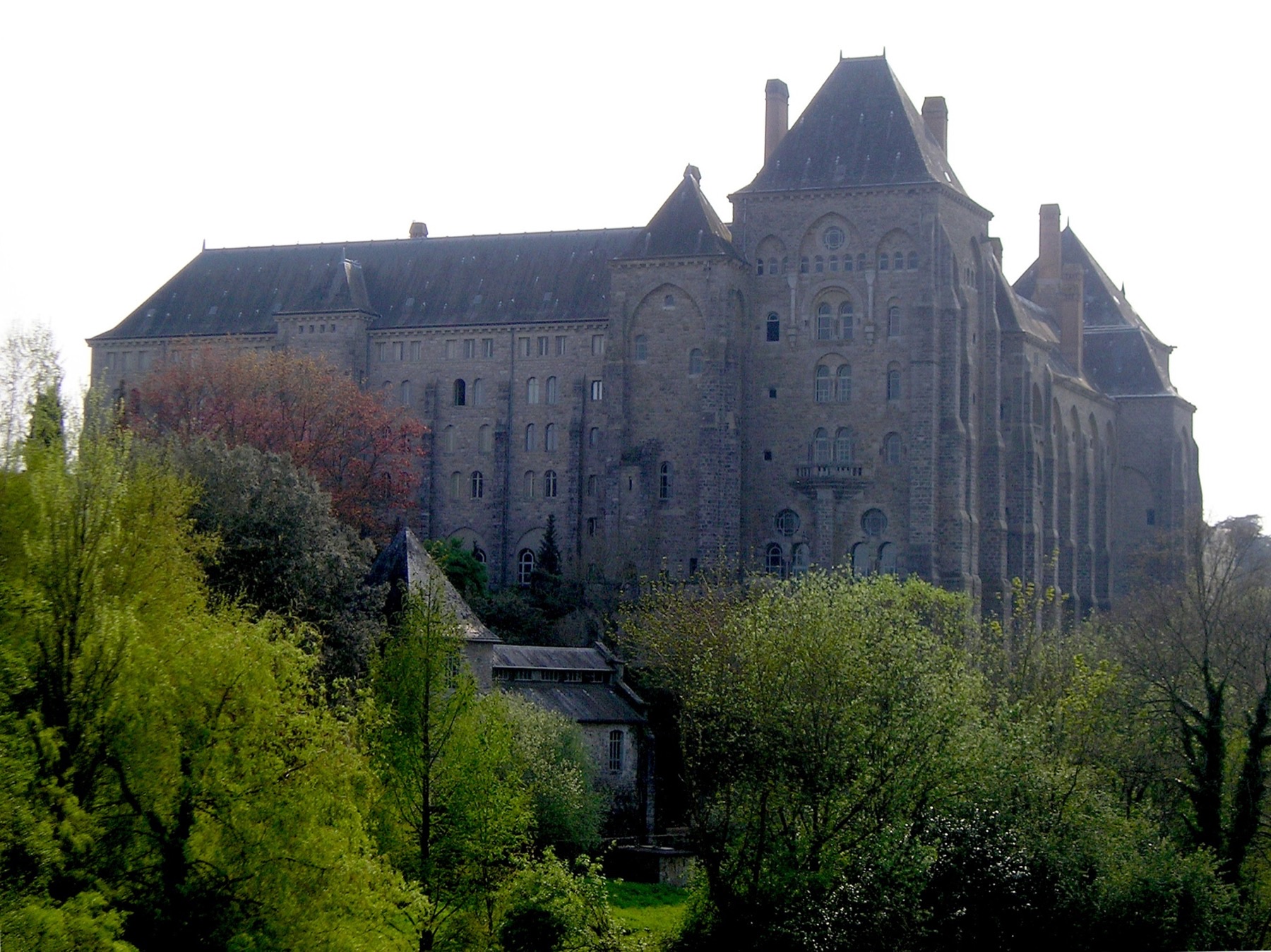
The Abbey of Saint-Pierre de Solesmes, restored to Benedictine life in 1833. Photo: Leag, CC BY-SA 3.0, via Wikimedia Commons.
Event 1 of 57
On 11 July 1833, five priests moved into a derelict priory in a village on the Sarthe. The buildings had stood empty since the Revolution; the youngest of the five, Prosper Guéranger, was twenty-seven, a diocesan priest of Le Mans with no fortune and no monastic training. He had decided in June 1831 to try to buy the place, and by December 1832, on private donations, it was his. There was not a single working Benedictine monastery left in France. On 15 August 1836 the community publicly declared its intention to restore the Order of St. Benedict; on 1 September 1837 Pope Gregory XVI, himself a Benedictine, raised Solesmes to the rank of abbey and made it head of the French Congregation. Guéranger pronounced his vows and became its first abbot.
The Liturgical Movement is usually dated from this priory. That is fair, provided one is clear about what Guéranger was actually trying to do, because almost everything that later claimed his name would have appalled him.
He was not trying to make the liturgy simpler, shorter, or more comprehensible. He was trying to make it Roman again. In the France of 1833 that was the radical position — because most French dioceses were not using the Roman rite at all.
The Problem: A Church That Had Made Up Its Own Liturgy
By the early nineteenth century the great majority of French dioceses had abandoned the Roman liturgical books for locally composed “neo-Gallican” ones. Beginning in the late seventeenth century, diocese after diocese had produced its own missal and breviary: new prayers, rewritten hymns, suppressed feasts, scripture rearranged on principles the compilers found more rational. Paris had its rite; Lyon, Rouen, Sens, Troyes had theirs. A French priest could cross a diocesan boundary and find the Church praying a different Mass.
This was not a quaint local custom. It was the liturgical face of Gallicanism, the doctrine that the Church in France enjoyed a large independence of Rome, and it had been carried out, in many places, by men touched by Jansenism and by the rationalism of the age. Guéranger’s judgment was that a Church which composes its own worship will end by composing its own faith. His life’s work was to get the Roman books back into French sanctuaries, and by the time he died in 1875 he had very largely succeeded: the neo-Gallican liturgies were gone.
The Anti-Liturgical Heresy
Guéranger set out the case in Institutions liturgiques, published across eleven years in three large volumes (1840, 1841, 1851). Its most famous section is a catalogue of what he called the “anti-liturgical heresy” the set of instincts he found running, unchanged, from the fourth-century Vigilantius through Luther and Calvin to the Jansenist Synod of Pistoia. He listed its principles one by one. Read today, the list is uncomfortable reading in more than one direction.
The first principle, he wrote, is hatred of tradition in the formulas of worship: “Every sectarian who wishes to introduce a new doctrine finds himself, unfailingly, face to face with the Liturgy, which is Tradition at its strongest and best, and he cannot rest until he has silenced this voice.” The fourth is the appeal to antiquity, the claim to be recovering the primitive Church, which in practice means that “they prune, they efface, they cut away,” and the worshipper who was promised the purity of the early Church finds himself “encumbered with new formulas dating only from the night before.” The fifth is the stripping of mystery: “No more altar, only a table, no more sacrifice as in every religion, but only a meal.”
Hatred for the Latin language is inborn in the hearts of all the enemies of Rome. They recognize it as the bond among Catholics throughout the universe, as the arsenal of orthodoxy against all the subtleties of the sectarian spirit.
— Dom Prosper Guéranger, Institutions liturgiques, “The Anti-Liturgical Heresy,” eighth principle
That sentence is about the Latin language. It is frequently paraphrased into a claim about the liturgy in general (“the liturgy is the arsenal of orthodoxy”), and then set in quotation marks. Guéranger did not write that. The distinction matters, and a movement that appeals to him should quote him as he wrote.
The Liturgical Year
The Institutions were for scholars and bishops. Guéranger’s other great work was for everyone. Beginning in 1841 he issued, volume by volume, L’Année liturgique, The Liturgical Year, walking the reader through every day of the Church’s calendar with the texts of the Mass and Office, history, and commentary. He did not live to finish it; his monks completed it after his death, and it eventually ran to fifteen volumes in English.
Its purpose was not information. It was to make the Church’s own prayer the reader’s prayer: on the conviction, stated in the General Preface, that the liturgy is not one devotion among many but the voice of the Bride herself, and therefore carries a weight no private prayer can.
❝The prayer of the Church is, therefore, the most pleasing to the ear and heart of God, and therefore the most efficacious of all prayers.
— Dom Prosper Guéranger, The Liturgical Year, General Preface
What He Handed On
Solesmes became the engine of everything that followed: the Roman books restored to France, the scientific recovery of Gregorian chant, and a way of writing about the liturgy that made it seem, to educated Catholics, the most interesting thing in the Church. Within a lifetime that inheritance had passed to men who used his vocabulary for ends he had condemned. That is the story this timeline tells.
One line of his states the criterion by which the rest of it can be judged, and it is the reason he belongs at the head of the story rather than in the middle of it.
Progress in Liturgy must be an enrichment by the acquisition of new forms rather than by the violent loss of the ancient ones.
— Dom Prosper Guéranger, quoted in Alcuin Reid, The Organic Development of the Liturgy, 2nd ed. (Ignatius, 2005), 56
- What it was From the late 17th century, French dioceses replaced the Roman missal and breviary with locally composed books — new prayers, rewritten hymns, suppressed feasts.
- How widespread The great majority of dioceses; Paris, Lyon, Rouen, Sens and Troyes all had their own use.
- Why it mattered It was Gallicanism made audible, a national Church praying its own words, several of the compilers touched by Jansenism.
- The outcome Guéranger’s campaign, waged in print and with the bishops, returned the Roman books to France within his lifetime.
- Dom Prosper Guéranger, Institutions liturgiques, 3 vols. (Le Mans/Paris, 1840–1851); “The Anti-Liturgical Heresy”; abridged English translation transcribed at Rorate Caeli (2006)
- Dom Prosper Guéranger, The Liturgical Year, General Preface, trans. Dom Laurence Shepherd
- Dom Alcuin Reid, The Organic Development of the Liturgy, 2nd ed. (San Francisco: Ignatius, 2005), 56
- “Prosper Louis Pascal Guéranger” and “Abbey of St. Solesmes,” The Catholic Encyclopedia (New York: Robert Appleton, 1913)
- Éditions de Solesmes, abbey history and chronology