The Malines Congress
A Belgian monk gives one paper on the liturgy, and the movement changes direction.
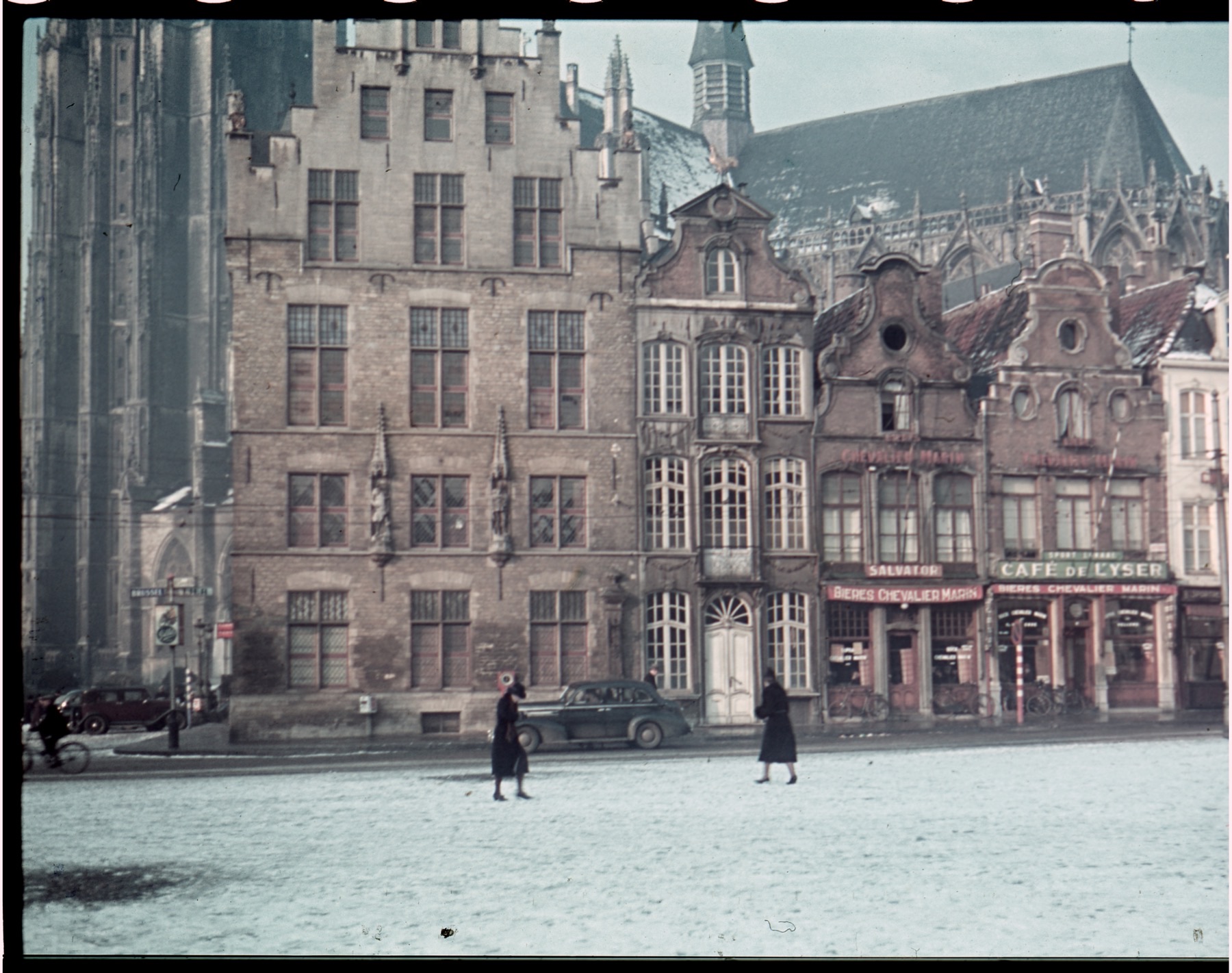
Malines (Mechelen), Belgium, where the National Congress of Catholic Works met in September 1909. Photo: Richard Boske (Stadsarchief Rotterdam), CC0, via Wikimedia Commons.
Event 5 of 57
In September 1909 the National Congress of Catholic Works met at Malines (Mechelen, in Flemish) under the patronage of Cardinal Désiré-Joseph Mercier. Among the papers read was one by a thirty-six-year-old Benedictine of Mont-César in Louvain, Dom Lambert Beauduin. It was called La vraie prière de l’Église, “the true prayer of the Church.” By the close of the congress its proposals had been turned into resolutions and passed. Historians of the liturgy generally date the modern Liturgical Movement from that week.
Born Octave Beauduin near Liège on 5 August 1873, the fifth of nine children, he had been ordained for the diocese in 1897, taught at Saint-Trond, and joined a congregation of chaplains to the industrial working class before entering Mont-César in 1906. That order of events matters: he came to the liturgy from the factory gates, not from the library.
Guéranger’s project was to form the faithful by the liturgy. Beauduin’s was to bring the liturgy to the faithful. Stated that way the two sound complementary, and in Beauduin’s own hands they largely were. But the second formulation contains a question the first does not: what if the liturgy, as it stands, is in the way?
What He Actually Proposed
The resolutions that came out of Malines are strikingly modest by later standards. Translate the Latin texts of each Sunday’s Mass and Vespers into the vernacular, and put them in hand missals so the people can follow. Restore the parochial sung Mass to the centre of Sunday. Spread Gregorian chant more widely, so as to displace the theatrical music that had turned too many churches into opera houses. Orient popular devotions toward the liturgy rather than away from it. Hold annual retreats for church choirs at centres of liturgical life such as Mont-César and Maredsous.
Not one of those asks for a change to a rite. Every one of them is a proposal to change the people — their books, their singing, their Sunday. On the terms of 1909, Beauduin was asking the Church to give the faithful the liturgy it already had.
The Warrant: Pius X
Beauduin’s authority for all of it was a single sentence of Pope St. Pius X, from the 1903 motu proprio on sacred music. His paper was in large part an exposition of what that sentence meant. It is the most consequential sentence in the modern history of the Roman liturgy, and it will reappear on almost every card in this timeline.
… the faithful assemble for no other object than that of acquiring this spirit from its foremost and indispensable font, which is the active participation in the most holy mysteries and in the public and solemn prayer of the Church.
— Pope St. Pius X, Tra le Sollecitudini, 22 November 1903
Beauduin’s Own Words
He was candid about where he had started. In a journal article of 1913 he admitted that before entering Mont-César his own piety had nothing liturgical about it at all: the liturgical acts, he wrote, “were for me a formality of worship that had no appreciable influence on the direction of my piety.” What changed him was the monastic office; what troubled him was that almost no layman had access to it.
Hence the phrase for which he is best remembered, and which contains both his charity and the whole ambiguity of the movement he founded.
❝We [monks] are aristocrats of the liturgy … everyone should be able to nourish himself from it, even the simplest people: we must democratize the liturgy.
— Dom Lambert Beauduin, quoted in Thomas Kocik, “Dom Lambert Beauduin,” Adoremus (2024)
For Beauduin the liturgy was not a department of the Church’s life but its circulatory system, “the piety of the Church, the very dynamo of ecclesial vitality.” His theology of it was ecclesial before it was anything else: because the Church is the Mystical Body, its worship must be both hierarchical and corporate. “The Christian does not walk alone on the path of his pilgrimage,” he wrote; the Catholic “is … a member of a visible organism.”
What Followed, and How Fast
The machinery went up quickly. In 1911 Mont-César launched the journal Questions liturgiques, later Questions liturgiques et paroissiales, with Beauduin as editor, aimed at forming parish clergy. In 1914 he published his only book, La Piété de l’Église, translated into English in 1926 as Liturgy, the Life of the Church, setting out his goals: popular participation in the Mass and the sacraments, sung Mass with the people singing, parish Vespers and Compline, and the restoration of the Liturgy of the Dead. Within a generation the movement had spread across Europe and the Atlantic: people’s missals, liturgical periodicals, liturgical weeks, schools of sacred music, institutes of liturgical study.
It is easy, reading backwards from 1969, to make Beauduin the villain of the first act. The record does not support it. In the inaugural issue of La Maison-Dieu in January 1945 he warned against zealous liturgists who treat the Church’s existing liturgy as an impoverishment to be corrected and so become, in Dom Alcuin Reid’s phrase, audacious reformers. When Pius XII issued Mediator Dei in 1947, endorsing the movement while condemning archaeologism, Beauduin was greatly encouraged by it.
A movement is not only what its founder intended. Beauduin handed on an argument (that the liturgy exists for the sanctification of the people and must therefore be made accessible to them) together with an institutional apparatus of journals, congresses and institutes capable of carrying it. Men who did not share his restraint inherited both. Within his own lifetime the congresses he made possible were debating whether the rites themselves should be rebuilt.
Beauduin died in 1960, having lived to see the Council announced. He remains the pivot of this timeline: the last figure whose programme can be stated entirely in terms of forming the faithful, and the first whose vocabulary would serve just as well for reforming the rite.
- Hand missals Translate each Sunday’s Mass and Vespers into the vernacular so the people can follow the Latin.
- Sung parish Mass Restore it to the centre of the Sunday obligation.
- Chant Spread Gregorian chant, displacing theatrical church music.
- Devotions Orient popular devotion toward the liturgy.
- Choir retreats Annual retreats at Mont-César and Maredsous.
- Note well Not one resolution proposes altering a rite.
Events That Led Here
- Pope St. Pius X, motu proprio Tra le Sollecitudini, 22 November 1903
- Dom Lambert Beauduin, La vraie prière de l’Église (paper, National Congress of Catholic Works, Malines, September 1909)
- Dom Lambert Beauduin, La Piété de l’Église (1914); English trans. Dom Virgil Michel, Liturgy, the Life of the Church (1926)
- Fr. Thomas Kocik, “Dom Lambert Beauduin: The Moses of the 20th-century Liturgical Movement,” Adoremus Bulletin, November 2024 — the source of the Beauduin quotations here
- Dom Alcuin Reid, The Organic Development of the Liturgy, 2nd ed. (Ignatius, 2005)
- Pope Pius XII, encyclical Mediator Dei, 20 November 1947