L’Année Liturgique and the Recovery of the Chant
Solesmes gave the Church back its own book of days — and then, from the manuscripts, its own voice.
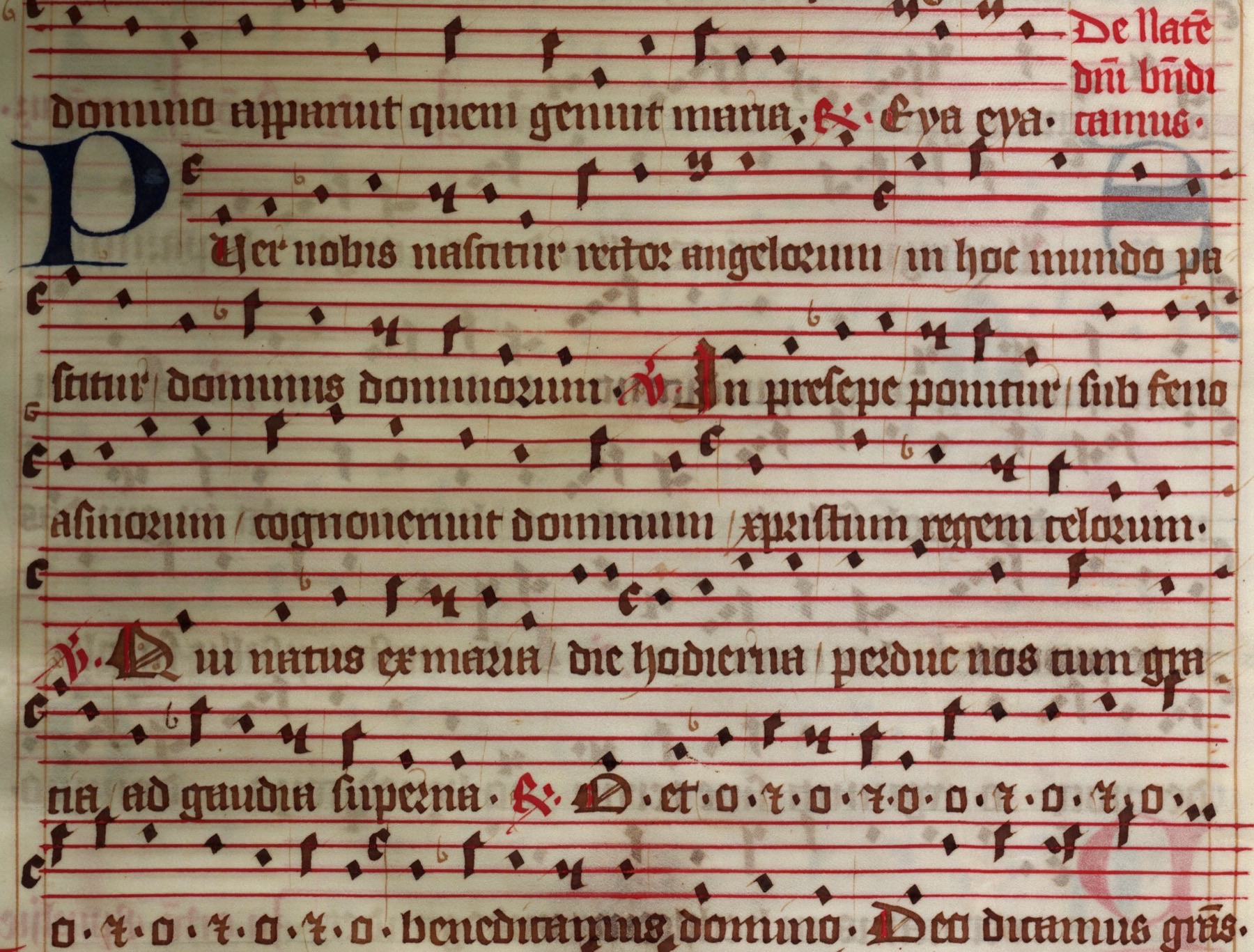
The Moosburg Gradual (ca. 1360) — the kind of manuscript the Solesmes paleographers collated. Image: public domain, via Wikimedia Commons.
Event 2 of 57
Restoring the Roman books to France solved a problem of law. It did not solve a problem of the heart: the faithful still did not know what was being prayed over them, and what was sung at them was often not the Church’s music at all. Guéranger’s answer to the first was a book. His monks’ answer to the second took two generations, a photographic press, and a quarrel that reached the Pope.
The Book of Days
From 1841 Guéranger began issuing L’Année liturgique, volume by volume: every day of the Church’s year, with the texts of the Mass and the Office, their history, and a commentary meant to be prayed rather than studied. He died in 1875 with the work unfinished; his monks completed it, and in Dom Laurence Shepherd’s English translation it eventually filled fifteen volumes.
Its premise is stated in the General Preface and it is the premise of the entire movement that followed, that the Church’s public prayer is not one devotion among others but the prayer of the Bride, and that a Catholic who prays with it prays with a weight he cannot generate on his own.
The prayer of the Church is, therefore, the most pleasing to the ear and heart of God, and therefore the most efficacious of all prayers.
— Dom Prosper Guéranger, The Liturgical Year, General Preface
Guéranger’s argument is that the faithful should be formed by the liturgy. Within seventy years the same sentence would be used to argue that the liturgy should be reformed to suit the faithful. The words are nearly identical; the direction is reversed. Watch for the reversal — it is the single most important thing on this timeline.
The Chant: From Corruption to Manuscript
The music was in worse condition than the texts. What passed for plainchant in nineteenth-century France was a heavily edited, rhythmically flattened descendant of the medieval melodies, printed in editions that had been abridged and “corrected” for centuries. Guéranger set his monks to a different method: go back to the manuscripts, all of them, and let the sources decide.
Dom Paul Jausions and Dom Joseph Pothier began the work of collation. In 1883 Pothier published the Liber Gradualis, incorporating Jausions’s earlier research and following his own Mélodies grégoriennes; it marked the beginning of a genuine reform of liturgical chant. In 1889 Pothier’s disciple Dom André Mocquereau founded the Paléographie musicale, a series of photographic facsimiles that put the medieval manuscripts themselves in front of scholars, seven volumes between 1889 and 1901.
This was scholarship of a high order, and it is worth pausing on what kind. The Solesmes monks were not arguing from taste, or from a theory of what early Christians must have done. They were photographing sources and comparing them. When a later generation invoked “the sources” to justify inventions no manuscript contained, it was borrowing the prestige Solesmes had earned by doing the opposite.
Rome Ratifies — and the Scholars Divide
In his 1903 motu proprio Tra le Sollecitudini, Pope St. Pius X declared Gregorian chant “the Chant proper to the Roman Church, the only chant she has inherited from the ancient fathers,” noting that “the most recent studies” Solesmes’s, had “so happily restored” it “to their integrity and purity.” He called for an official edition built on that work. A pontifical commission was appointed in 1904, with Pothier presiding; the Vatican Kyriale appeared in 1905 and the Graduale in 1908.
The commission also exposed a real disagreement between the two greatest men in the field. Pothier was willing to weigh received tradition and practical singability alongside the manuscripts; Mocquereau held that the manuscripts alone should decide. Mocquereau, prior of Solesmes from 1902 to 1908 and head of the editorial board of Solesmes monks in 1904–05, withdrew from the Vatican edition over the melodies. Solesmes went on issuing its own editions with its rhythmic signs, which is why a choir today may be singing from either.
Both men were serious scholars and both were loyal. Their quarrel is worth knowing because it shows what a real dispute over liturgical restoration looks like: two experts, the same manuscripts, a genuine question of method, submitted to Rome and settled by authority. It bears no resemblance to what would be done in commissions seventy years later.
The Inheritance, and the Turn
By 1910 the work begun at Solesmes had given the Latin Church a restored Roman liturgy in France, a devotional literature that made the liturgical year intelligible to ordinary Catholics, a critical edition of its own chant, and papal endorsement for all of it. This is the high-water mark of the Liturgical Movement’s first phase, and it was achieved without altering a single rite.
The next generation would take the word Pius X had used, participation, and begin to ask what the liturgy would have to become for the faithful to participate in it more fully. That question, asked at Malines in 1909, opens the second era of this timeline.
- Pothier Weighed the manuscript evidence together with living tradition and singability; presided over the Vatican Edition.
- Mocquereau Held that the manuscripts alone should decide; founded the Paléographie musicale; withdrew from the Vatican Edition over the melodies.
- Why it matters A genuine methodological dispute, argued from sources and settled by authority — the opposite of reform by committee fiat.
- Today Solesmes continued its own editions with rhythmic signs; both traditions are still sung.
Events That Led Here
- Dom Prosper Guéranger, The Liturgical Year, General Preface, trans. Dom Laurence Shepherd
- Dom Prosper Guéranger, Institutions liturgiques, 3 vols. (1840–1851)
- Pope St. Pius X, motu proprio Tra le Sollecitudini, 22 November 1903
- Dom Joseph Pothier, Liber Gradualis (Solesmes, 1883); Mélodies grégoriennes (1880)
- Dom André Mocquereau, ed., Paléographie musicale (Solesmes, from 1889)
- Dom Alcuin Reid, The Organic Development of the Liturgy, 2nd ed. (Ignatius, 2005)
- “Abbey of St. Solesmes” and “Gregorian Chant,” The Catholic Encyclopedia (1913); Éditions de Solesmes, history of the Musical Palaeography workshop