The Easter Vigil of 1951: The Night Restored, and the First Stage Begun
Pius XII gave the Vigil back its night as an optional experiment. Paul VI would later call it the first stage of the reform that produced the Missal of 1969.
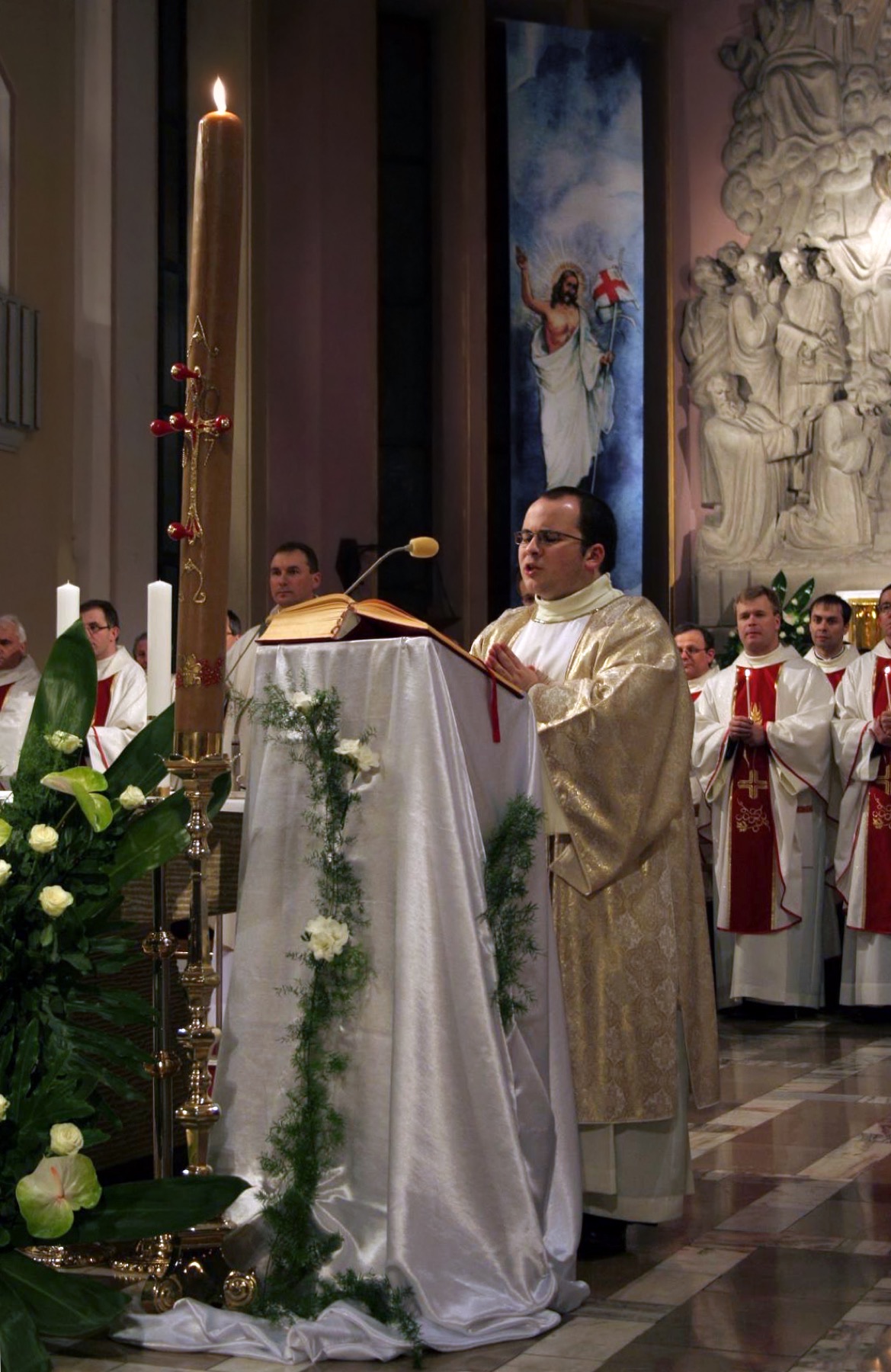
In 1951 the Easter Vigil was allowed to return to the night, at first as an optional experiment. Photo: Blazej Benisz, CC BY-SA 2.5, via Wikimedia Commons.
Event 15 of 57
Before 1951, on the morning of Holy Saturday, the Church sang of a night that had not yet fallen. The new fire was struck and the paschal candle lit in daylight; the Exsultet praised “this night” with the sun already up. The vigil that St. Augustine had called the mother of all vigils had drifted, over centuries, from the dark before Easter to the morning of the day before it, and, as the Congregation of Rites itself would admit in 1955, it was usually kept by the clergy in churches often almost deserted.
On 9 February 1951 the Sacred Congregation of Rites issued a decree that put the Vigil back in the night. It did so cautiously: for that year only, where the local bishop judged it wise, and as an experiment. Four years later the experiment became the law of the Roman Rite, and eighteen years later Paul VI named it as the place where his own reform had begun. Both halves of that story matter, and this article tells them in turn.
Almost no one, traditional critics included, wants the Easter Vigil sung on Saturday morning again. The questions are narrower: what else changed along with the hour, how the change was made, and what it began.
The Night That Was Lost
The decree of 1951 tells the history itself (the translations from its Latin here are ours). The celebration of the vigil “took place in the night hours which precede the Resurrection of the Lord”; in the course of time, and for various reasons, it was moved “first to the evening hours, then to the afternoon, and finally to the morning hours of Holy Saturday,” with changes introduced along the way, “not without harm to the original symbolism.” The Catholic Encyclopedia of 1910, forty years before the reform, told the same story: for six or seven centuries the ceremonies ran through the whole night, in the eighth century they were held on Saturday afternoon, though not yet everywhere, and later, “by a singular anachronism,” on Saturday morning.
Century
Century
The cause was practical, not theological. The Encyclopedia explains that the great night gatherings, swollen with catechumens to be baptised, “often occasioned abuses” which the clergy could only prevent by moving the ceremonies into daylight. The rite that resulted was coherent in its texts and incoherent in its hour, and by the twentieth century the incoherence was plain to anyone who stood in an empty church on Holy Saturday morning and heard the deacon sing of the night.
An Experiment, Not an Imposition
The decree Dominicae Resurrectionis vigiliam was dated 9 February 1951, forty-three days before Holy Saturday, which fell that year on 24 March. It obliged no one to use the new rite. Pius XII approved the new rubrics, it says, “for the nocturnal celebration of the paschal vigil,” to be restored optionally “for this year, at the prudent judgment of local Ordinaries, and as an experiment.” The Ordinaries who used the faculty were asked to report to the Congregation on the attendance and devotion of the faithful and on the success of the restored vigil.
The decree also says who had asked for the change, and why. As research into the ancient liturgy grew, it says, a lively desire had arisen to bring the paschal vigil back to its first splendour, and there was a pastoral reason besides: Holy Saturday was no longer kept as a holy day, and very many of the faithful could not come to a rite held in the morning. Many local Ordinaries, groups of the faithful and religious had petitioned the Holy See, and Pius XII had sent the question to a special commission of experts. The decree, then, made no secret of the commission, though it named none of its members; what stayed hidden was its way of working.
…pro nocturna vigiliae paschalis celebratione, facultative pro hoc anno de locorum Ordinariorum prudenti iudicio instauranda, et ad experimentum. (…for the nocturnal celebration of the paschal vigil, to be restored optionally for this year, at the prudent judgment of local Ordinaries, and as an experiment.)
— Sacred Congregation of Rites, decree of 9 February 1951, Acta Apostolicae Sedis 43 (1951) 129 (tr.)
So it continued. A decree of 12 January 1952 granted the optional Vigil for three more years, and on 15 January 1955 it was extended again, “for another year.” Only with Maxima redemptionis nostrae mysteria, on 16 November 1955, did the restored Vigil become obligatory, together with a restored order for the whole of Holy Week, from Palm Sunday 1956. The later decree gives its reason in so many words (again in our translation): the experiment “has, on the whole, had the best success, as very many Ordinaries have reported to the Holy See.”
The forty-three days, then, are real, but they were not a deadline. Where the bishop did not take up the faculty, the old rite simply went on. What the short notice hints at, and what Bugnini confirms below, is how the reform was prepared: out of sight, with the rite appearing complete, and the bishops asked to report only on how it was received.
The Commission Behind It
The new Vigil was the work of a commission that Pius XII had appointed on 28 May 1948, in the wake of Mediator Dei. Its president was Cardinal Clemente Micara, who headed the Congregation of Rites; its members included Archbishop Alfonso Carinci, Fr. Ferdinando Antonelli, Fr. Josef Löw, Dom Anselmo Albareda and Fr. Augustin Bea; and its secretary was a young Vincentian, Fr. Annibale Bugnini. In 1953 Micara, who had become Vicar of Rome, was replaced as president by Cardinal Gaetano Cicognani. The account we have of its working comes from Bugnini himself.
In the twelve years of its existence (June 28, 1948, to July 8, 1960) the commission held eighty-two meetings and worked in absolute secrecy.
— Annibale Bugnini, The Reform of the Liturgy 1948–1975 (Liturgical Press, 1990), p. 9
So complete was the secrecy, Bugnini goes on, that the publication of the new Holy Saturday rite at the beginning of March 1951 “caught even the officials of the Congregation of Rites by surprise.” And the Pope, he adds, “was kept abreast of its work by Monsignor Montini and even more, on a weekly basis, by Father Bea, confessor of Pius XII.” Montini was then the Substitute at the Secretariat of State; he would become Paul VI.
It does not show that the Congregation of Rites was bypassed. The Cardinal who presided over the commission headed the Congregation, and its Secretary, Archbishop Carinci, sat on the commission and countersigned the decree. The decree itself says that the Pope approved the new rubrics on the report of that Cardinal, who signed it as Pro-Prefect. What it does show is a method: a small body of experts, working unseen, with a direct channel to the Pope. The Holy Week of 1955 came from the same commission, though that time the Pope put its work to the Cardinals of the Congregation, who approved it unanimously on 19 July.
What the New Vigil Changed
The hour was the headline. The rubrics told the priest to begin at an hour “which permits the solemn Mass of the paschal vigil to begin about midnight.” Matins and Lauds of Holy Saturday were no longer to be anticipated the evening before but said in the morning, and Vespers in the afternoon, so that the day kept its character of waiting.
Midnight was itself a choice. The ancient vigil, as the decree of 1955 recalls, began on Saturday evening and ended the next morning in the joy of the Resurrection, and Msgr. Léon Gromier, a former papal master of ceremonies, would later call the insistence on midnight a “pastoral dogma” that was “not easily defended.”
The rite itself was shortened and rearranged. Of the twelve prophecies in the Roman Missal, four were read: the first, the fourth, the eighth and the eleventh. The litany was divided around the blessing of the font. At the Mass the priest omitted the psalm Judica me and the Confiteor at the foot of the altar, the short Vespers that had followed Communion gave way to a communion verse, and the Last Gospel was dropped.
And one element was new. After the blessing of the font the celebrant led the people in a Renewal of Baptismal Promises. It was given in Latin; where an approved ritual already allowed a partial use of the vernacular for baptism, the same texts could be said in the vernacular. Nothing like it had stood in the Roman vigil before. Its questions were those of the baptismal rite, put into the plural, and its closing prayer echoed the prayer at the anointing after baptism; what was new was the address that opens it and the act itself, a whole congregation of the baptised renewing its promises aloud, the priest standing before the paschal candle or in the pulpit. Its critics saw in it a door for the vernacular, and Gromier called it “a massive para-liturgy, a purely pastoral creation and un-liturgical, an occasion to insert the vernacular into the liturgy.”
Four absences often blamed on the reform are older than it. The Creed, the Offertory antiphon, the Agnus Dei and the Kiss of Peace were absent from this Mass before 1951 and remained absent after it. Pages that blame the reform for them, as this one once did, are mistaken.
Paul VI’s Word: The First Stage
Eighteen years later Paul VI promulgated the new Roman Missal with the apostolic constitution Missale Romanum. Near its opening he named where the renewal had begun.
The beginning of this renewal was the work of Our predecessor, this same Pius XII, in the restoration of the Paschal Vigil and of the Holy Week Rite, which formed the first stage of updating the Roman Missal for the present-day mentality.
— Pope Paul VI, Apostolic Constitution Missale Romanum, 3 April 1969 (vatican.va)
Two readings of that sentence are possible, and both deserve a hearing. On the first, Paul VI was placing his Missal in continuity with a reform the whole Roman Rite had received: one work, begun by a Pope no one could call a revolutionary, and legitimate for that reason. On the second, the sentence describes what 1951 had been from the start, the first act of a larger design. The first makes the continuity a claim of 1969; the second makes it a fact of 1951. Within five years the men of the commission were speaking in the second way. In 1956 Fr. Antonelli told the Assisi congress that the reform of Holy Week was more than a restoration.
❝…it represents the most decisive step toward that general reform of the liturgy for which the whole world is waiting and praying.
— Fr. Ferdinando Antonelli, O.F.M., on the reform of Holy Week, The Assisi Papers (1957), p. 155
Whichever reading one takes of Paul VI, Antonelli’s words settle a narrower point: by 1956 the men who made the Vigil saw their work as a step toward a general reform of the liturgy. The Vigil was the first rite their standing commission produced, and the commission was only beginning.
The Traditional Catholic Perspective
A traditional reading of 1951 has to begin by granting what is true. The hour was wrong, the decree said so, and the decree was right. The strongest objection comes from Pius XII’s own encyclical. Mediator Dei had warned against going back to the usage of antiquity and discarding the new patterns introduced by Providence “to meet the changes of circumstances and situation,” and the morning Vigil could claim to be such a pattern: the night gatherings had bred abuses, and St. Pius V had forbidden the evening celebration in 1566, as Gromier would point out in 1960. The decree itself supplies the answer. Circumstances had changed again: Holy Saturday was no longer kept as a holy day, and very many of the faithful could not come in the morning. Restoring the night answered a new situation, and the same encyclical says that the Church “adapts and accommodates herself to temporal needs and circumstances.” The zeal it rebukes belongs to those “bent on the restoration of all the ancient rites and ceremonies indiscriminately” without the Holy See, to which alone it reserves such changes; the night was restored in 1951 by the Pope himself, and only where the bishop chose. The restoration still cost something. The same rubrics dropped eight of the twelve prophecies, the prayers at the foot of the altar, the short Vespers after Communion and the Last Gospel.
The concerns lie elsewhere. The first is the method: a commission working in secret, and the liturgy treated as a field for experiment. Dr. Peter Kwasniewski has fastened on the phrase ad experimentum itself, which would become ever more common as the reform went on. The second is invention alongside restoration: the Renewal of Baptismal Promises took its questions and its closing prayer from the baptismal rite, but its opening address was new, and so was the sight of a whole congregation renewing its promises at the Vigil. The third is what followed. In 1955 the same commission prepared a restored order for the whole of Holy Week, which the Cardinals of the Congregation approved and the Pope made binding, and many of those changes had no restoration to plead at all.
The restored Vigil met its pastoral aim. The faithful could now keep the greatest night of the year at night, and the bishops who tried it asked for the same restoration for the rest of Holy Week: by 1955 the Congregation could say that the experiment had, on the whole, succeeded. A traditional Catholic can be grateful for the night and still ask whether the commission that restored it should have been trusted with the rest.
- The hour Begun so that the Mass starts about midnight (rubric II.1); Matins and Lauds in the morning, Vespers in the afternoon.
- The prophecies Four of twelve: the 1st, 4th, 8th and 11th.
- The font and the litany The litany divided around the blessing of the font.
- New The Renewal of Baptismal Promises, in Latin; the vernacular only where an approved ritual already allowed it for baptism.
- The Mass No Judica me or Confiteor; a communion verse in place of the short Vespers; no Last Gospel.
- Unchanged No Creed, no Offertory antiphon, no Agnus Dei, no Kiss of Peace, before and after 1951.
- Pius XII Appointed the commission (1948) and approved the new rubrics (1951).
- Card. Clemente Micara President of the commission and head of the Congregation of Rites; signed the 1951 decree as Pro-Prefect.
- Card. Gaetano Cicognani Succeeded Micara as president in 1953; signed the decrees of 1955 as Prefect.
- Fr. Annibale Bugnini Secretary of the commission; later secretary of the Consilium that prepared the 1969 Missal.
- Msgr. G. B. Montini Substitute at the Secretariat of State; with Bea, one of two informal channels to the Pope; later Paul VI.
- Fr. Augustin Bea Member of the commission and confessor of Pius XII; kept the Pope informed weekly.
- Fr. Ferdinando Antonelli Member of the commission; at Assisi in 1956 he called the Holy Week reform “the most important act in the history of the liturgy from St. Pius V to our day” (The Assisi Papers, p. 150).
The restoration of the night was right, and the decree that made it was cautious: optional, experimental, and reported on before it became law. What deserves scrutiny is the method and what it began: a commission working unseen, a new rite built from the baptismal ritual and inserted into the oldest vigil of the year, and a pattern of change by experiment that Paul VI would later name as the first stage of his own reform.
- Sacred Congregation of Rites, decree De solemni vigilia paschali instauranda (“Dominicae Resurrectionis vigiliam”), 9 February 1951, with its rubrics, Acta Apostolicae Sedis 43 (1951) 128–137
- Sacred Congregation of Rites, decree of 15 January 1955 extending the optional Vigil (citing the decree of 12 January 1952), and Maxima redemptionis nostrae mysteria, 16 November 1955, Acta Apostolicae Sedis 47 (1955) 48 and 838–847
- Pope Pius XII, encyclical Mediator Dei, 20 November 1947, §§58–63 (vatican.va)
- Pope Paul VI, apostolic constitution Missale Romanum, 3 April 1969 (vatican.va)
- Annibale Bugnini, C.M., The Reform of the Liturgy 1948–1975 (Collegeville: Liturgical Press, 1990), pp. 8–9
- The Assisi Papers: Proceedings of the First International Congress of Pastoral Liturgy (Collegeville: Liturgical Press, 1957), pp. 150, 155
- Catholic Encyclopedia (1910), “Holy Saturday” (newadvent.org)
- Gregory DiPippo, “Compendium of the 1955 Holy Week Revisions of Pius XII,” Part 6.2, New Liturgical Movement (2009)
- Léon Gromier, “Semaine Sainte Restaurée,” conference, Paris, July 1960; English translation by Fr Anthony Chadwick
- Rituale Romanum (1903 printing), Ordo Baptismi: the interrogations and the prayer at the anointing after baptism, compared with rubric 25 of 1951
- Peter Kwasniewski, “Ending Seventy Years of Liturgical Exile,” New Liturgical Movement, April 2021