Cardinal Enrico Dante:
The Keeper Who Could Not Keep
The Papal Master of Ceremonies who watched the old liturgy die from the inside
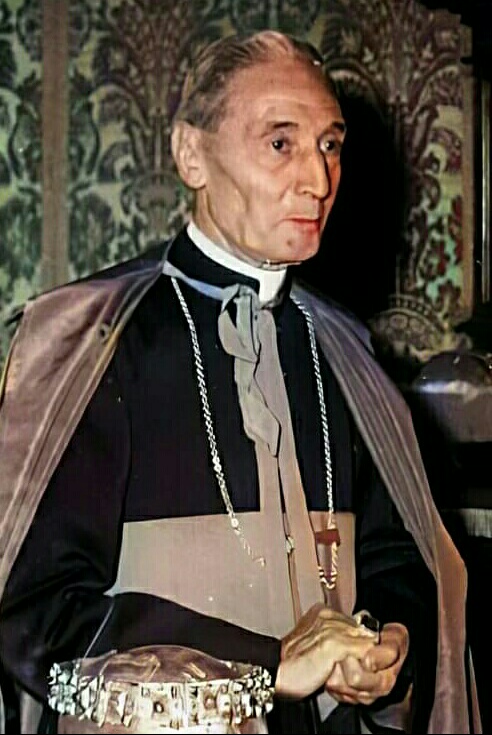
Cardinal Enrico Dante, papal Master of Ceremonies, a voice of caution amid the reform.
Photo: public domain · Event 21 of 57
There is a particular kind of tragedy reserved for men who spend their lives in faithful custody of something beautiful, only to watch it dismantled in their final years by the institution they served. Enrico Dante was such a man. For more than half a century he was the living guardian of the papal liturgy, its memory, its precision, its sacred grammar. He organized five conclaves, crowned five popes, and spent thousands of hours in the service of an ancient rite he knew with a intimacy no living person could match. When the reform came, he opposed it quietly, consistently, and without effect. He died in 1967, two years a cardinal, the rite he had kept already dying around him.
To understand Dante’s significance in the story of the Liturgical Movement, one must understand what a Papal Master of Ceremonies actually was. He was not a liturgical theorist. He was not a reformer. He was the man who made the sacred functions happen, who knew where every candle stood, who walked before whom, what words were spoken in which key, and at what angle the mitre was placed. Guardini gave the movement its theology. Herwegen gave it its experiments. Bugnini gave it its wrecking ball. Dante gave it its institutional memory, and its institutional conscience.
Fifty Years at the Altar
Born in Rome on July 5, 1884, Dante was a Roman in the fullest sense: shaped by the Eternal City, steeped in its ecclesiastical culture, and devoted to its liturgical patrimony with an almost proprietary affection. He was ordained to the priesthood in 1910, and by 1914, at the age of thirty, he had already been admitted to the College of Pontifical Ceremoniers, the small corps of priests responsible for the ceremonial life of the papacy. It was a role that suited his temperament exactly. He was not a speculative mind. He was a man of precision, order, and sacred discipline.
His ascent through the college was steady and unhurried. By 1943 he had become Under-Secretary of the Sacred Congregation of Ceremonies. On June 13, 1947, he was appointed Prefect of Pontifical Ceremonies; the master of the masters, responsible for the entire ceremonial apparatus of the Holy See. He held this position for eighteen years. During that time he also rose within the Sacred Congregation of Rites, reaching its secretaryship in 1960. By the time of the Second Vatican Council, Dante was the most experienced liturgical official in the Church: a man who had not merely studied the old rite but had lived inside it, officiating at its greatest expressions for a generation.
Inside the Machine That Would Break Him
The painful irony of Dante’s biography is that the very offices that gave him his authority also placed him directly inside the reform process he opposed. As a member of the Sacred Congregation of Rites, he participated in the Holy Week reforms of Pius XII in the 1950s, the first major alteration of the Roman Rite in modern times. He served on the preparatory commissions for Vatican II and on its liturgy commission during the council itself. He contributed to the drafting of Sacrosanctum Concilium, the Constitution on the Sacred Liturgy, promulgated in December 1963.
At every stage, the historical record suggests the same disposition: Dante participated conscientiously, raised objections that were noted and ignored, and remained throughout what the scholarly biography of him describes as someone who was “neither an enthusiast, nor a promoter, nor, even less, a supporter” of the reforms. He was not a dissident. He did not resign. He stayed at his post because that was what his vocation required. But his allegiance was clear, and it was to the old rite.
He remained faithful until the end of his life not only to the Roman school of liturgy, but also to the Roman school of theology, law, customs, and ecclesiastical discipline.
The Coronation He Would Not See Again
In June 1963, Dante organized and presided over the coronation of Pope Paul VI: a ceremony of breathtaking ceremonial complexity, the product of centuries of organic development, involving dozens of ministers and a choreography of gestures and prayers refined over generations. It was, as it happened, the last papal coronation in history. The following year, Paul VI simplified the ceremony almost out of existence; the papal tiara itself was removed from use in 1964, when Paul VI dramatically set it aside during the Council. Dante had spent his professional life perfecting a ceremony that would be celebrated exactly once more under his care, and then never again.
A Witness, Not an Agent
How should historians of the Liturgical Movement situate Dante? He was not a figure of Phase One (the movement’s educational, contemplative period under Gueranger and his heirs), and he was not a figure of Phase Two (the experimental, engineering period initiated by Herwegen and the German abbeys). He belongs to a third category that the standard Kwasniewski framework does not quite capture: the institutional conservative: the man who stood inside the apparatus of change, using his position to slow or soften what he could not stop, until the apparatus ran over him.
There were others of this type: Cardinal Ottaviani, who co-signed the devastating critique of the New Mass in 1969; Archbishop Marcel Lefebvre, who had served on Vatican II’s Central Preparatory Commission; numerous curial officials who worked loyally within a process whose conclusions they found destructive. What distinguishes Dante is the intimacy and precision of his loss. He did not merely oppose the reformed liturgy in the abstract. He had held the old liturgy in his hands for fifty years. He knew, with an expert’s exactitude, what every change cost.
Dante’s Career in the Movement
- Bartlomiej Krzych, Biography of Cardinal Enrico Dante (caeremonialeromanum.com, 2014)
- Liturgical Arts Journal, “Papal Master of Ceremonies: Monsignor Enrico Dante” (2020)
- New Liturgical Movement, “A New Webpage about Cardinal Dante” (February 2026)
- Wikipedia, “Enrico Dante” (citing Catholic-Hierarchy and Fandom Religion sources)
- Pius XII, Mediator Dei (1947)
- Peter Kwasniewski, Reclaiming Our Roman Catholic Birthright (Sophia Institute Press, 2020)
- Alcuin Reid, The Organic Development of the Liturgy, 2nd ed. (Ignatius Press, 2005)
- Annibale Bugnini, The Reform of the Liturgy 1948–1975 (Liturgical Press, 1990)