The Caecilian Movement
A German priest set out to drive the opera house from the sanctuary — and gave the chant and Palestrina back to the parish.
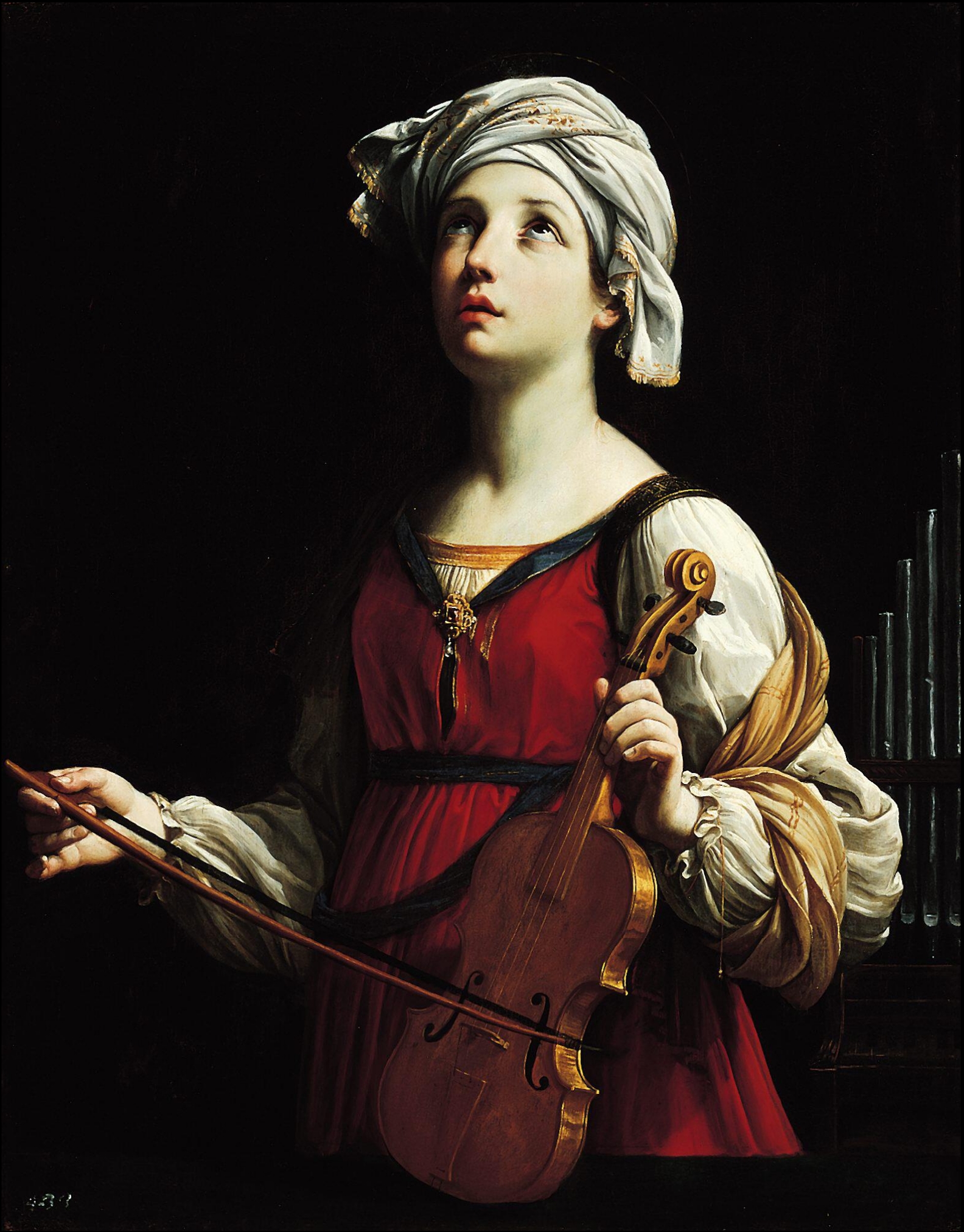
St. Cecilia, patroness of sacred music, gave her name to the nineteenth-century movement that drove operatic settings from the Catholic sanctuary and restored Gregorian chant and the polyphony of Palestrina to the heart of the liturgy. Photo: Guido Reni, public domain.
Event 3 of 57
By the middle of the nineteenth century the sound of a sung High Mass in much of Catholic Europe was the sound of the theater. Orchestras filled the loft; sopranos took solos; the Gloria and Credo were set to melodies a congregation might have heard the night before at the opera. Sacred words carried profane music, and the line between the temple and the concert hall had all but vanished. Into this stood a Bavarian priest named Franz Xaver Witt, who looked at what Catholic worship had become and decided to give it back its own voice. In 1868 he founded the society that would carry St. Cecilia’s name across the Catholic world, and the Caecilian Movement was born.
The Caecilian reform did not set out to compose a new kind of Catholic music. It set out to recover two things the Church already possessed and had let slip: her own Gregorian chant, and the sacred polyphony of Palestrina and the sixteenth-century masters. Like Guéranger at Solesmes a generation earlier, Witt’s instinct was backward toward the tradition, not forward toward novelty, a genuine restoration, and one of the healthiest streams feeding the liturgical movement.
A Priest Against the Opera House
Franz Xaver Witt (1834–1888) was a Catholic priest trained at Regensburg, a church musician and composer who knew the repertoire from the inside. In the 1860s he began publishing calls for the reform of church music, indicting the operatic and orchestral excess that had crept into the Mass and the decline of the chant that had been displaced to make room for it. His complaint was not aesthetic snobbery. It was theological: music in the liturgy is not a performance offered to the congregation but a prayer offered to God, and music borrowed from the stage trained the faithful to listen as an audience rather than to worship.
In 1868, at a rally of Catholics in Bamberg, Witt gathered the first formal body of the movement, the Allgemeiner Cäcilien-Verband (the General Caecilian Society), placed under the patronage of St. Cecilia, the early Roman martyr long honored as the patroness of sacred music. From his Regensburg base he also launched the journal Musica Sacra (1868) to spread the reform’s scores and principles. What had begun as one priest’s protest became an organized program with publications, choirs, and a network that would soon cross borders.
In 1868 Witt founded the Caecilia Society in order to revive the use of Gregorian chant and polyphony, and to promote the composition of new liturgical music in an older style in Catholic churches.
— Franz Xaver Witt, summarizing the society’s founding aim
Palestrina and the Chant
The Caecilians held up a clear model. The unaccompanied polyphony of the Roman Renaissance (above all Giovanni Pierluigi da Palestrina, with Lassus, Victoria, and the Anerios beside him) was treated as the consummate ideal of Catholic sacred music, and Gregorian chant as the Church’s own native song. Against the soprano solo and the orchestral Mass they set the a cappella choir and the unison line of the chant: music that effaced the performer and lifted the text. The aim was the recovery of holiness in sound.
The Caecilians were not liturgical revolutionaries, and it would be a distortion to read the later ruptures of the twentieth century back into them. They wanted Latin, chant, and polyphony — the very things the Traditional Latin Mass preserves. Their reform was conservative in the truest sense: a return to the Church’s own treasure. They are rightly counted among the movement’s faithful founders, not its later innovators.
The Pope Sets His Seal
The reform did not remain a private German enthusiasm for long. On 16 December 1870, Pope Pius IX gave the Caecilian society his official sanction in the brief Multum ad movendos animos, endorsing its aims and encouraging its spread. With Rome’s blessing the movement multiplied: Caecilian societies soon sprang up across the Netherlands, Italy, Belgium, Poland, Bohemia, Croatia, Hungary, Switzerland, and into North America. A reform born in a Bavarian parish had become an international current within the universal Church.
The Ground It Prepared
The Caecilian Movement’s deepest significance lies in what it made possible. For three and a half decades it kept alive, in parish lofts and cathedral choirs across the Catholic world, exactly the convictions a saintly pope would one day write into the law of the Church: that operatic music had no place in the liturgy, that Gregorian chant was the Roman Rite’s proper song, and that the polyphony of Palestrina was its supreme model. When St. Pius X promulgated Tra le sollecitudini in 1903, he was not inventing a program. He was ratifying one.
Its reforming function, however, was fulfilled in St. Pius X’s motu proprio on sacred music (1903). Caecilianism had generated and maintained interest in reforming Church music, in reviving the Renaissance masters, in promoting Gregorian chant, and in unifying liturgical practice; the points conspicuously emphasized in the motu proprio.
— Caecilian Movement, New Catholic Encyclopedia
Historians note that the Caecilians sometimes leaned on the editions of chant available to them (the Regensburg books), rather than the older manuscripts the monks of Solesmes were painstakingly recovering. It would be Solesmes’ paleographic scholarship that Pius X would ultimately enshrine as the standard. The Caecilians won the principle; Solesmes refined the chant itself. The two streams converged in 1903, to the good of the whole Church.
❝…to revive the use of Gregorian chant and polyphony… in Catholic churches.
— on the founding aim of Witt’s Caecilian Society, 1868
Witt died in 1888, fifteen years before the motu proprio that vindicated his life’s work. But the seed he planted in 1868 grew straight. The Caecilian Movement was a genuine, faithful restoration (chant and polyphony recovered, the opera house turned out of the sanctuary), and it fed the healthy stream of the liturgical movement that ran, unbroken and in communion, from Guéranger’s Solesmes to the throne of St. Pius X.
- “Franz Xaver Witt,” Wikipedia (founding of the Caecilia Society, 1868; Witt 1834–1888; papal recognition 1870)
- “Cecilian Movement,” Wikipedia (Allgemeiner Cäcilien-Verband, Bamberg 1868; Pius IX sanction 1870; international spread; Palestrina/chant aims)
- “Caecilian Movement,” New Catholic Encyclopedia (via Encyclopedia.com), Pius IX, brief Multum ad movendos animos, 16 December 1870; patronage of St. Cecilia; fulfillment in Pius X’s 1903 motu proprio
- Pope St. Pius X, Tra le sollecitudini (motu proprio on sacred music, 22 November 1903)
- Robert Hayburn, Papal Legislation on Sacred Music (1979)