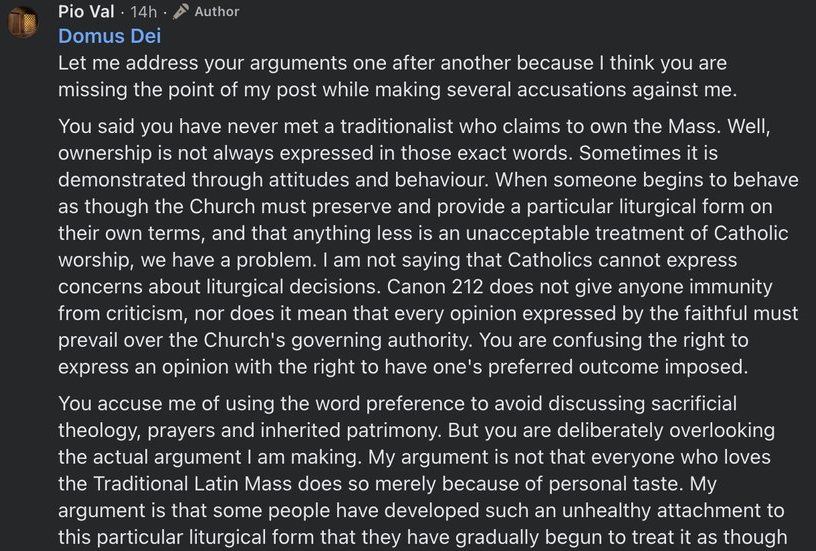
This essay answers a series of posts by Pio Val, a Catholic writer on Facebook, defending the restriction of the older Roman liturgy. His posts are shown below as he published them. Names and photographs of the commenters he quotes have been blurred, since our argument is with how he uses them.
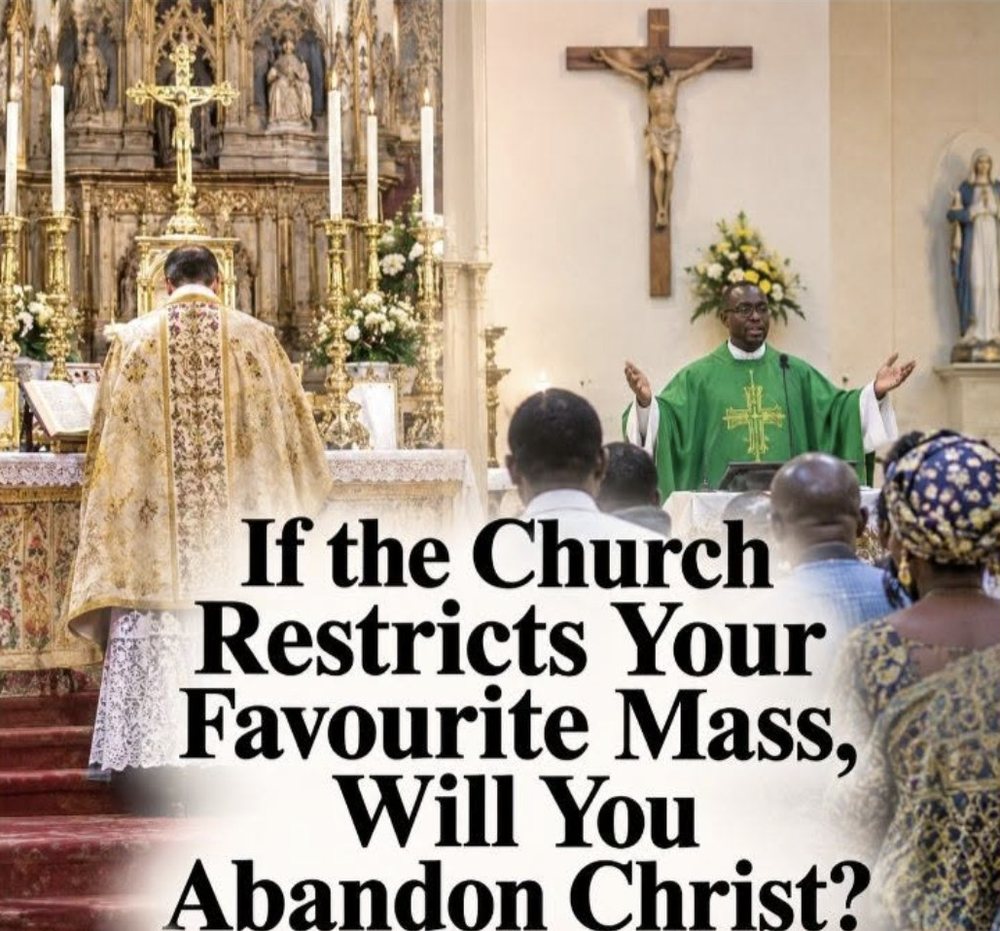
His argument runs as follows. The Church acted within her authority, and justifiably given the considerations of the time, because both forms celebrate the same Holy Sacrifice and she sought greater liturgical unity. Her later provisions for those attached to the older Mass were a mother’s accommodation, and no admission of error. African Catholics, he observes, received the reform and moved on, while the polemics persist mostly in certain European circles.
He closes with a challenge to Catholics attached to the Traditional Latin Mass: if the Church restricted it further tomorrow, would you abandon the Eucharist? Would your Catholic identity depend on one liturgical form?
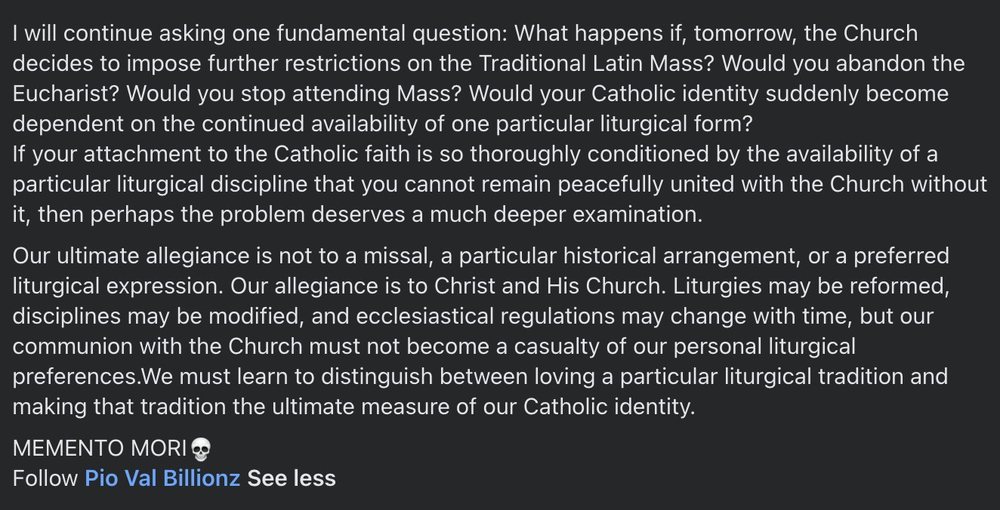
No. And it is a loaded question. We would be at Mass the following Sunday, as would nearly every Catholic we know who loves the old rite. The question assumes two things, and both are false: that love for the older liturgy is a matter of taste, and that doubting the wisdom of its restriction means withholding trust from the Church. On both counts Pio Val asks more of traditional Catholics than the law of the Church asks.
Here is our answer, point by point.
An inheritance is not a preference
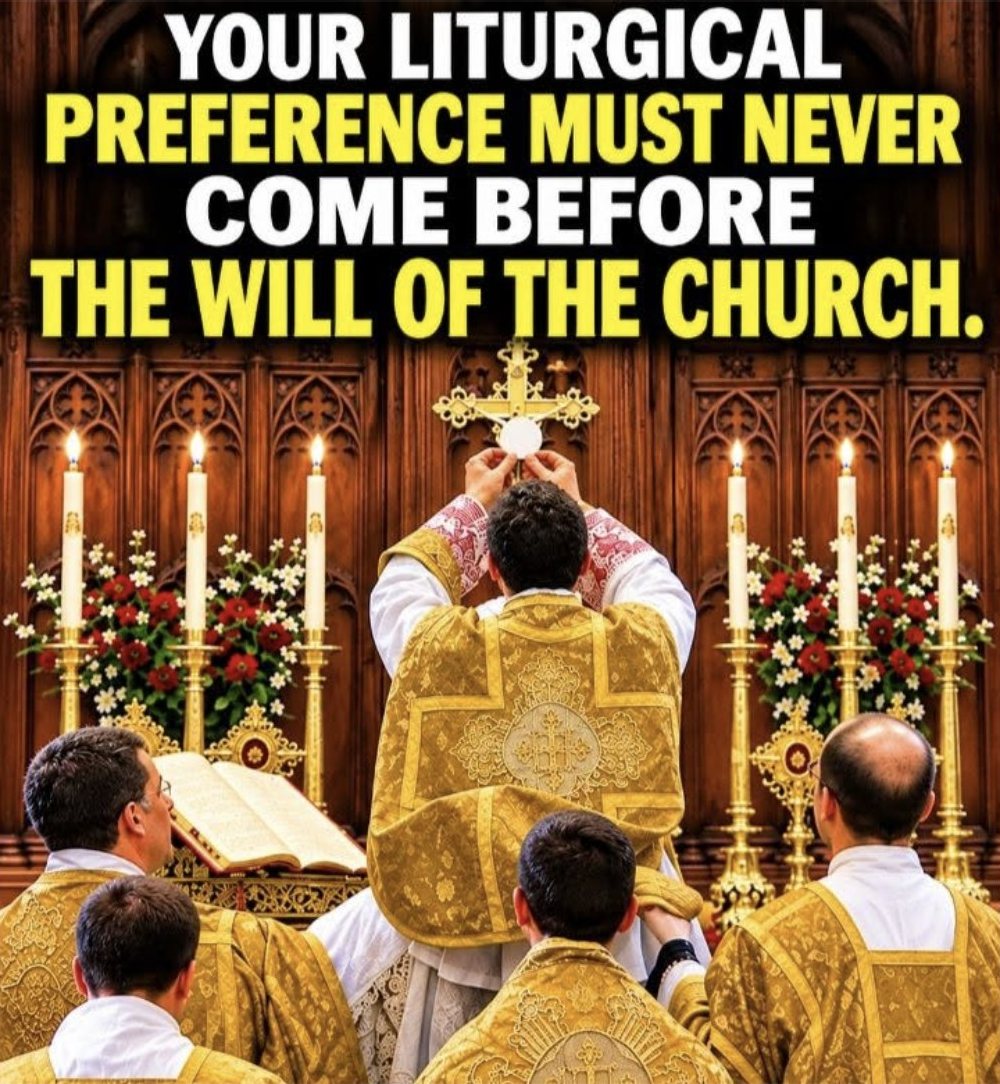
Pio Val writes of “personal liturgical preferences” and a “preferred liturgical expression.” That word does all his work for him. Call it a preference and the argument is over before it starts, because a preference, like a favourite hymn, can be given up without loss.
The older Roman Mass is a different kind of thing. It grew over many centuries, with roots running through the ancient Roman sacramentaries into the early centuries of Christian worship, and generations of saints, popes, bishops and ordinary faithful handed it on. Those who love it are attached to the theology its prayers express, to its plain witness to the sacrificial character of the Mass, and to praying as their forebears prayed.
A preference is something you can give up without loss. An inheritance is something you are bound to hand on.
An Inheritance, Not a PreferencePio Val also files the whole matter under “liturgical discipline” and “disciplinary arrangements.” The Catechism files it elsewhere. The law of prayer is the law of faith, it teaches, and the liturgy is a constitutive element of Tradition (§1124). The next paragraph states the limit that follows: even the supreme authority in the Church “may not change the liturgy arbitrarily” (§1125). Liturgical law is real law, but what it governs is something the Church received.
Benedict XVI drew the consequence as pope, and nothing in the posts answered here engages it. What earlier generations held sacred stays sacred for us, he wrote, and cannot suddenly be forbidden outright or treated as harmful (Letter to the Bishops, 2007).
Heirs, not owners
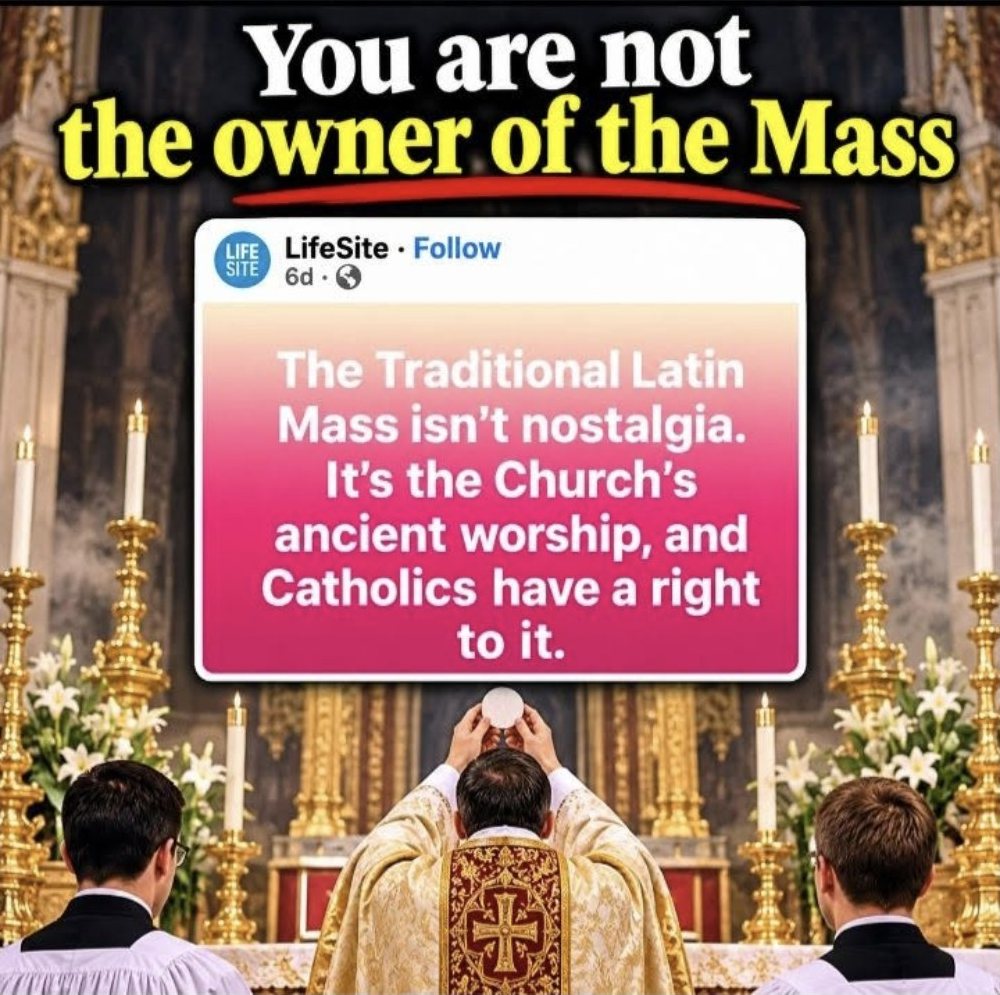
In a later post Pio Val answers the slogan that Catholics “have a right” to the older Mass. “You are not the owner of the Mass,” he replies. It “is not your personal property,” and “you have no right over how it should be celebrated.”
No Catholic owns the Mass. On that we need no instruction. As the law has stood since 2021, no one can claim a legal entitlement to the older form either, since its celebration depends on the bishop and the Holy See.
But nobody claims to own the Mass. It is a straw man, and his whole post is spent knocking it down. Owning the liturgy is not the only alternative to having no standing in it. The Church’s own documents describe a third position. Canon 212 §2 leaves the faithful free to make their spiritual needs and their wishes known to their pastors. In 2004 the Holy See spoke of “the right of all of Christ’s faithful” to a liturgy celebrated as the Church’s books prescribe (Redemptionis Sacramentum §12). The Council taught that the laity, according to their knowledge and competence, are “permitted and sometimes even obliged to express their opinion” on what concerns the good of the Church, through the channels the Church provides (Lumen Gentium §37). A request put to one’s own bishop is such a channel. So “you have no right over how it should be celebrated” is false as he wrote it. Lay Catholics do have rights concerning the celebration of the liturgy, and Rome has listed them. Those rights concern the approved books. They show that the layman has standing in the matter.
His own premises point the same way. “We did not invent it,” he writes, and the Church “is its custodian.” Both statements are true, and both bind those who govern the liturgy as much as those who attend it. A custodian is not an owner. Benedict XVI said so of his own office on the day he took possession of his cathedral: “The Pope is not an absolute monarch whose thoughts and desires are law” (homily, 7 May 2005). He means the sacrament. The rite that carried it was received too, down to the 1960s, when large parts of it were newly composed. That is where the question arises.
The law of inheritance has a name for this arrangement: a trust. The trustee has real authority to manage what he holds. The beneficiaries cannot give him orders. They may, however, ask what has become of the estate, and “it was never yours” does not answer them.
No one in this argument owns the Mass. A custodian guards what he was given, and an heir may ask what became of it.
An Inheritance, Not a PreferencePio Val tells these Catholics that the Church “is not your private liturgical service provider.” Nobody said it was. His own post grants that a Catholic may love a liturgical tradition and “defend its legitimate place in the Church.” That is what these Catholics are doing. He grants it in one paragraph and calls it arrogance in the next.
The post calls the Catholics it addresses arrogant and entitled, says they throw tantrums, and warns them against making an idol of their Mass. He cannot see their hearts, and he does not know them. A family asking its bishop for the Mass that Benedict XVI opened to it in 2007 is doing what the Church’s law invites. A post about humility should not hand out insults to strangers.
Older than Trent
The older Roman Mass has relatives. In the West there are the Ambrosian and Mozarabic rites; in the East the Byzantine, Coptic, Syriac and Armenian liturgies, among others. None of them began as a draft. Each was received, prayed and handed on, changing slowly enough that every generation could recognise in its worship the worship of the one before.
This is the sense in which these rites reach back toward the apostles. The Roman Canon was substantially in place by the time of St Gregory the Great, around the year 600. When St Pius V issued his Missal in 1570 he codified what Rome already prayed, and he left standing every rite that could show two hundred years of use. Popes have revised that Missal since, and commissions did the work, as with the Holy Week reform of 1955. Those were changes to a rite already there. The reformed Missal keeps the Roman Canon as one Eucharistic Prayer among several. Our claim concerns how each rite came to be. A Catholic at the older Mass prays, in large part, the words that Gregory the Great, Francis of Assisi, Ignatius of Loyola and Thérèse of Lisieux prayed.
St Pius V did not write the Mass. He inherited it, as every pope before him had.
An Inheritance, Not a PreferencePio Val calls it a “particular historical arrangement.” The phrase would suit a seating plan. It does not suit one of the oldest continuous forms of Christian worship.
A reform made by committee
The reformed Missal came about differently. Its texts were assembled between 1964 and 1969 by a commission of bishops and expert consultors, the Consilium, working at a speed and on a scale without precedent in the history of the Roman Rite.
The Council fathers had asked for less. They called for a revision of the rite of Mass (Sacrosanctum Concilium §50). They also directed that Latin be preserved in the Latin rites while allowing wider use of the mother tongue (§36), that Gregorian chant keep pride of place (§116), and that nothing be changed unless the good of the Church genuinely and certainly required it (§23). Few of the bishops who voted for that text in 1963 expected new Eucharistic Prayers, a rewritten Offertory, or the near-disappearance of Latin.
The bishops’ reaction to the draft was mixed. At the 1967 Synod, where many members had sat at the Council, the “normative Mass” was celebrated and put to a vote. The same Synod approved the addition of three new Eucharistic Prayers by the required majority (Catholic World Report). On the shape of the rite as a whole it was less sure. The critical study that Cardinals Ottaviani and Bacci sent to Paul VI in 1969 records 187 voters, of whom 43 voted against, 62 approved only with reservations and 4 abstained (text). That leaves at most 78 approving outright. A vote with reservations is a conditional yes, and the Synod was advisory. Even so, fewer than half approved without reservation. The draft was revised before the Order of Mass appeared in 1969. The study judged the published rite identical in substance to the one the Synod had doubted.
In 1967 the bishops were shown a draft of the new Mass. Fewer than half approved it without reservation.
An Inheritance, Not a PreferenceThe reform has its own defence, and Paul VI gave it. Introducing the new rite in November 1969, he told the faithful that the Church had reason for regret, almost for bewilderment, and that in parting with Latin and chant she was giving up something beyond price. He judged that the people’s understanding of the prayer, and their part in it, were worth more (general audience, 26 November 1969). The Council’s call for fuller participation stands behind that judgment. Our answer is that participation was already being won inside the old rite, through hand missals and the dialogue Mass, and that the same gain did not require so great a cost.
Joseph Ratzinger, later Benedict XVI, wrote about the reform as it was carried out after the Council, and more harshly than this essay does. Organic growth, he said, had given way to “a fabrication, a banal product of the moment” (preface to the French edition of Klaus Gamber’s The Reform of the Roman Liturgy, 1992; translation). He went on celebrating the reformed Mass for the rest of his life. We hold the same. A Catholic may accept a rite as valid and lawful and still judge that it was badly made. Our complaint is with the degree and the manner of what followed the Council’s call for revision.
Who is allowed to question?
Pio Val asks why some Catholics cannot “move forward with the Church” and trust her authority. The reformed Mass exists because Catholics before the Council refused to do exactly that. The Liturgical Movement began as a work of recovery: chant, hand missals and the people’s part in the Mass, all inside the old rite. In its later years scholars such as Josef Jungmann, whose Missarum Sollemnia appeared in 1948, went further and argued that the rite itself, some fifteen centuries old, should be revised. Pius XII corrected the movement’s excesses in Mediator Dei (1947) and adopted several of its proposals. The Church now remembers these men as pioneers of renewal.
If Catholics could loyally question a liturgy of fifteen hundred years’ standing, Catholics can loyally question one that is not yet sixty. Pio Val may reply that the reformers proposed and Rome decided, while we criticise what Rome has decided. But the Missal of St Pius V was the Church’s law when they wrote, and they criticised it all the same. Pio Val cannot have it both ways. He needs either a reason why criticism was fidelity then and is restlessness now, or a different argument.
If it was loyal to question a rite fifteen centuries old, it cannot be disloyal to question one that is not yet sixty.
An Inheritance, Not a PreferenceAnswering the weakest voice
Three recent posts use the same method. Pio Val finds the weakest comment under his posts, sets it on a graphic, and answers that in place of the argument. Twice he names it a reason for Traditionis Custodes. The commenters’ names and photographs, visible in the originals, are blurred here.
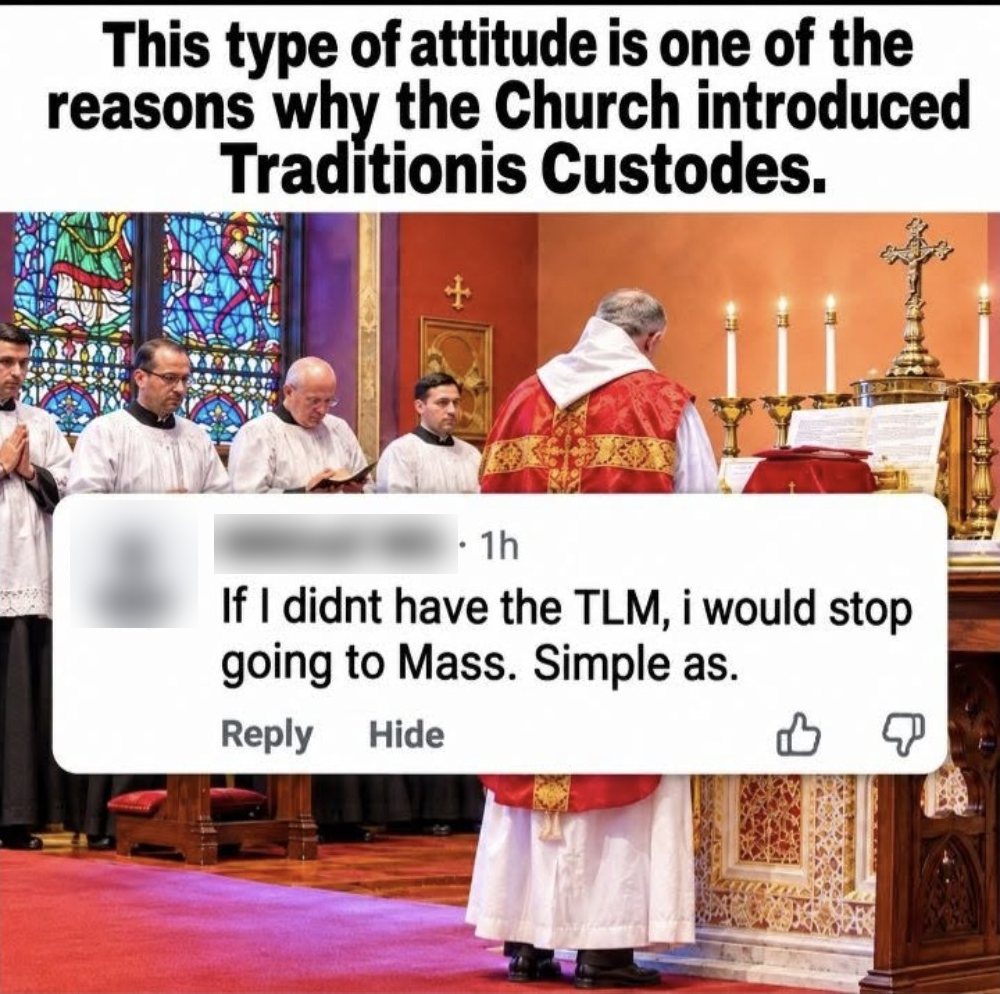
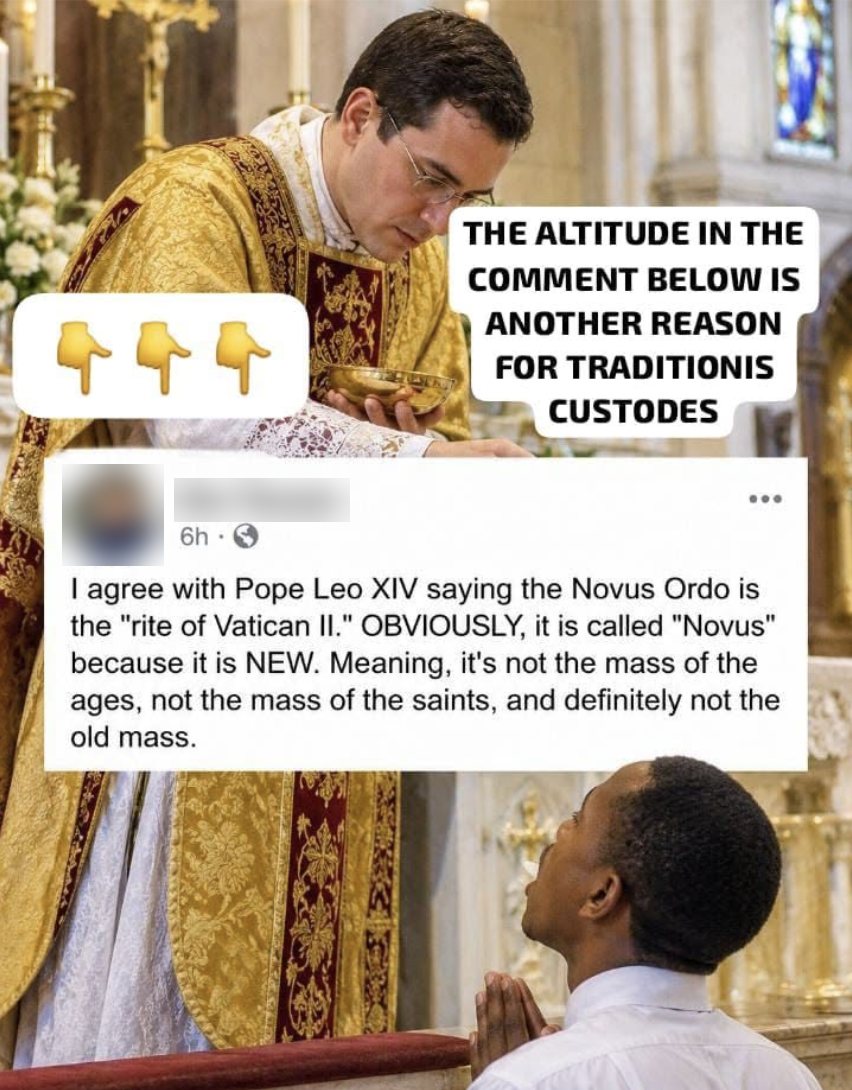
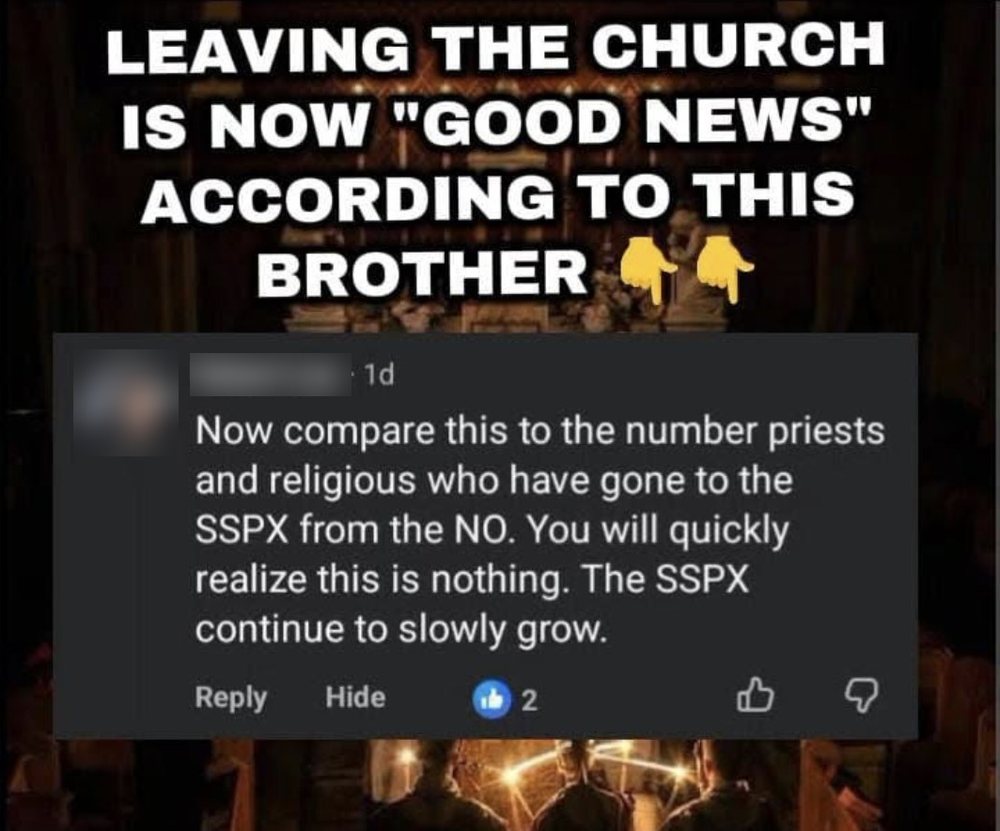
The first commenter wrote that without the older Mass he would stop going to Mass. Pio Val is right to rebuke that. Missing Sunday Mass on purpose is grave matter, and no love of any rite excuses it. We said so in his comment section before we said anything else.
The second commenter wrote that the reformed Mass is new, and so cannot be called the Mass of the ages or the Mass of the saints. He is wrong to deny it those names. The same Christ is offered and received in both forms, and the reformed Mass has formed saints.
A third graphic, on a priest’s return from the Society of St Pius X, works the same way. The commenter replied that more priests had gone in the other direction. That was a poor answer to good news. But the headline has the man calling departures from the Church “good news,” and he wrote no such thing.
None of these three men speaks for us. Our objection is to what Pio Val builds on them.
From one man to a movement
The post speaks of “some people” and “some of you,” and Pio Val pointed to those words when we challenged him. The caption’s last paragraph drops the qualifier. It asks how the Church can reconsider the restrictions “when this is the very attitude you continue to display.” The people asking for the restrictions to be reconsidered are all the Catholics who attend the older Mass. The sentence lands on them. That is a hasty generalisation, and a “some” two paragraphs earlier does not cure it.
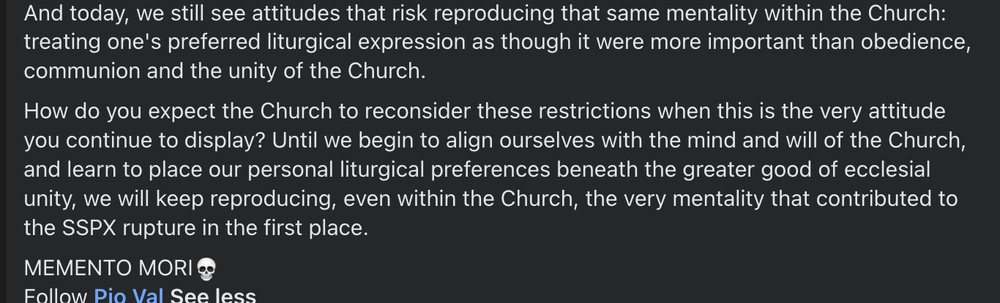
Thousands of families attend the older Mass, obey their bishops, and have never said anything of the kind. They did not write the comment, and they are the ones living under the restrictions.
A few attitudes, a whole people
Francis gave his reasons in his letter to the bishops. One was that, in what many said and how they behaved, the choice of the older books had come to go with a rejection of the Council and of the Church herself. Attitudes were part of Rome’s case.
What the letter describes, though, is rejection of the Council and of the Church’s authority. The first commenter rejects neither. He says he would miss Mass, which is a sin against the Sunday precept and no theory about the Council. Pio Val goes further than the Pope did. On his graphics every foolish comment becomes “another reason” for restricting people who never made it.
The second comment’s claim that the reformed Mass is new was first made by the pope who promulgated it. On 26 November 1969 Paul VI called it a new rite and “a change in a venerable tradition that has gone on for centuries” (general audience). A week earlier he had also insisted that it remained the same Mass. He was right both times. The sacrifice is the same and the rite is new. The commenter kept only the second half. Pio Val keeps only the first when he concludes, “So they are the same mass.” The same sacrifice, yes. The same rite, no, and nobody who has attended both would say so.
The fork in his argument
Pio Val asks what formed the saints, the ceremonies or the Eucharist. It was the Eucharist. But if the form of the rite adds nothing so long as the sacrament is valid, then nothing was gained by the reform of 1969, and nothing is gained by restricting the older form now.
The Church has never thought so. The whole liturgical reform rested on the conviction that the form of the rite shapes the people who pray it. Traditional Catholics hold the same conviction. They ask which form hands on more of what the Church received. The reformers asked the same question of the old rite.
So which is it? If the form of the rite matters, then caring which form one prays is more than a preference. If it does not matter, restricting one form gains nothing. He will say the gain is unity. The Church already holds one faith and one communion across many rites, so her unity cannot depend on a single form. And if he says the form matters and the Church has chosen, the question of which form better hands on the faith stays open to argument, as it did for the reformers before 1969. He says the form is nothing when he calls our attachment a preference, and he says it is important enough to restrict when he defends the law. He cannot say both.
The rule applied evenly
If a rite may be restricted because some who attend it have bad attitudes, the reformed Mass would fail the same test. Francis acknowledged in that same letter that abuses occur in its celebration. Nobody proposes restricting it for that, and rightly so. The Church corrects the offenders and leaves the rite alone. Pio Val could answer that abuses of the reformed Mass break its own rules, while Francis’s complaint was about the use being made of the older books. The fault still lies with the users in both cases, and only in one was the remedy applied to the rite.
Pio Val replies that different situations can call for different responses, and that the Church has authority to regulate the 1962 Missal. Neither is in dispute. He keeps defending the Church’s authority because nobody here is attacking it. We are asking whether the burden falls on the people who earned it. Bishop Thomas Tobin of Providence, no dissenter, said in 2021 that the document seemed to place everyone who favours the older Mass, more or less, “into one category” (EWTN News).
Authority is not the same as prudence
Pio Val’s opening paragraph makes two claims a sentence apart. The Church had the authority to restrict the older liturgy, and her decision was “perfectly justifiable” in the circumstances of the time. The second does not follow from the first. A superior can act within his rights and still act unwisely, and the Church has never asked the faithful to pretend otherwise.
Her own law provides for this. Canon 212 opens with the duty to obey what the pastors decide. Its third paragraph then gives the faithful, according to their knowledge and competence, the right and at times the duty to tell their pastors what they think about matters touching the good of the Church, so long as they do it with reverence. Obedience governs what a Catholic does. It leaves him free to think a decision mistaken and to say so respectfully.
One of his shorter posts tests the point. Young Argentines held up a banner asking Pope Leo XIV for the traditional Mass as he drove by. Pio Val’s caption told them to stop treating the Church as a democracy and to “humbly do what the Church prescribes.”
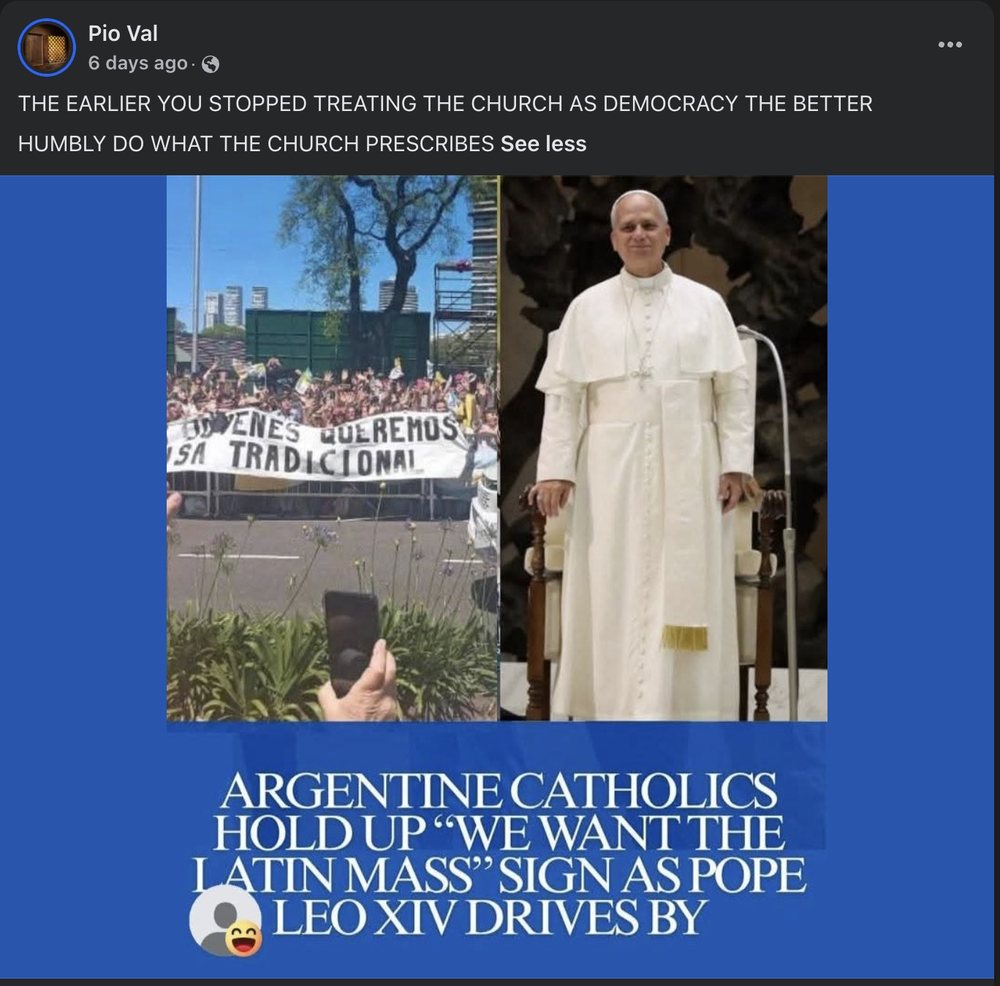
Nobody in that crowd claimed a vote. They were young Catholics asking the Pope for the Mass. A banner held up to the Pope is a petition, and canon 212 §2 protects it: the faithful are free to make their needs and wishes known to their pastors. In our own exchange Pio Val wrote that he was “not saying that Catholics cannot express concerns about liturgical decisions.” Here some did, peacefully and to the Pope himself, and he told them to stop. Which is it?
The Council also supplied a standard to judge by. Sacrosanctum Concilium §23 allows no innovation unless the good of the Church genuinely and certainly requires it, and asks that new forms grow organically from existing ones. A Catholic who asks whether the reform met that standard is holding the reform to the Council’s own terms.
Some who love the older Mass do speak with contempt of the reformed Mass, of the Council, or of the Pope. They deserve the rebuke, and traditional Catholics should be the first to deliver it. We have. That gives Pio Val no licence to charge their conduct to everyone else.
More severe than the popes
Pio Val presents his position as simple confidence in the Church. Set beside what the popes have said and done since 1970, it turns out to be stricter than most of theirs.
| Pope | Act | What it did |
|---|---|---|
| Paul VI | Indult for England and Wales, 1971 | Allowed bishops there to permit the older Mass for certain groups on special occasions |
| John Paul II | Quattuor Abhinc Annos, 1984; Ecclesia Dei, 1988 | Permitted the 1962 Missal and asked bishops to apply the permission broadly and generously |
| Benedict XVI | Summorum Pontificum, 2007; Universae Ecclesiae, 2011 | Let any priest use the 1962 Missal in Masses without a congregation, and told pastors to grant it to stable groups who asked |
| Francis | Traditionis Custodes, 2021; decree for the Fraternity of St Peter, 2022 | Restricted the older Mass for the sake of unity, then granted the Fraternity the faculty to use the 1962 books |
| Leo XIV | Letter to the bishops of France, sent through Cardinal Parolin, March 2026 | Asked for concrete solutions to include those attached to the older Mass, within the Council’s directions on the liturgy |
Four things in this record tell against him.
Start with whether the attachment is legitimate. Pio Val calls it a preference. John Paul II called the wishes of these Catholics “rightful aspirations” (Ecclesia Dei). Under Benedict XVI the Holy See described the older use as “a precious treasure to be preserved” (Universae Ecclesiae §8).
Then there is the original restriction, which he thinks perfectly justifiable. Benedict XVI wrote that the 1962 Missal was “never juridically abrogated” and so, in principle, had always been permitted. A pope who thought the near-total prohibition of the 1970s well judged would not have written that sentence. Paul VI told the cardinals in 1976 that the new Order of Mass had been promulgated in place of the old, and Francis judged in 2021 that the concessions had failed. Popes have differed on this within living memory. A layman who sides with Benedict XVI on a question the popes themselves have answered differently is no rebel, whatever a graphic says.
On loyalty, his closing questions are put to traditional Catholics as a class. Nobody asks such questions of people he trusts. Benedict noted that many of them plainly accepted the Council and were faithful to the Pope and the bishops. Even Francis, who restricted the older Mass more tightly than any pope since Paul VI, wrote in the same letter that he was saddened by “abuses in the celebration of the liturgy on all sides” (Letter to the Bishops, 2021). Seven months later he granted the Fraternity of St Peter the faculty to use the 1962 books in its own churches, while suggesting that his new law be kept in view as far as possible (decree). The use of those books belongs to the Fraternity’s founding charism. No pope grants that to a whole institute while thinking the attachment unhealthy in itself.
Last comes obedience. He tells us to embrace whatever the Church legitimately determines. From 2007 to 2021 the Church determined that any priest of the Latin rite could offer this Mass privately without asking leave, and that groups of the faithful could ask their pastors for it. Catholics took her at her word. Parishes formed, vocations came, and children were raised at this Mass. The attachment he calls “unhealthy” in some grew up under the law of that time and with the Church’s leave. He is scolding Catholics for accepting what the Church offered them.
A provision is no endorsement, he may say. One renewed by three popes in succession, and extended to whole institutes, is no concession to a disorder.
The events of this year sharpen the point. On 1 July 2026 the Society of St Pius X consecrated four bishops against the Holy See’s repeated warnings, and the next day the Holy See declared the Society in schism (Crux). Rome’s quarrel there was with disobedience. Catholics who love the same Mass and stay in communion have been treated differently. Leo XIV has left Francis’s limits in place. Asked on 16 November 2026 whether he would loosen them, he answered “not right now.” He said the Church would go on following Francis’s decision, and he noted that the law allows dispensations (Catholic Standard). Yet he allowed the older Mass at the Altar of the Chair in St Peter’s in October 2025, and in March 2026 he asked the French bishops, through Cardinal Parolin, for “concrete solutions” that include those attached to it, in keeping with the Council’s directions on the liturgy (Adoremus). John Paul II acted the same way in 1988, condemning the schismatic act and providing for the faithful in a single document.
Traditionis Custodes names the reformed books as the sole expression of the Roman Rite’s law of prayer, and Francis’s letter looks to a time when those attached to the older form return to the reformed rite. On that aim Pio Val has Francis with him. It is the current law, and we obey it.
But the law restricts a practice. It nowhere says that the practice was only ever a taste. Pio Val reserves his “much deeper examination” for Catholics who cannot stay at peace with the Church without the older form. Those who petition for it and obey in the meantime are outside that description, and his posts ought to say so. They say “you.”
The African experience
Pio Val admires the way African Catholics received the reform and got on with their lives, and he contrasts it with the polemics of “certain European Catholic circles.” A reform received peacefully shows that the faithful obeyed. It does not show that the reform was wise. In his post on the priest who returned from the Society he insists that numbers do not settle truth. They do not settle it here either.
Africa has also benefited from the liturgical variety he thinks unnecessary. The Council disclaimed any wish to impose rigid uniformity (Sacrosanctum Concilium §37), and in 1988 Rome approved the Zaire Use of the Roman Missal for the dioceses of what is now the Democratic Republic of Congo. The Zaire Use belongs to the reformed Missal. Even so, it shows that Rome does not treat a second form within the Roman Rite as a threat in itself.
If the Roman Rite has room for Kinshasa, it has room for its own past.
An Inheritance, Not a PreferencePio Val writes that there should be “one Catholic Church, united in her worship.” A maxim older than this quarrel points the way, and John XXIII cited it with approval in 1959: unity in essentials, liberty in doubtful matters, charity in all things (Ad Petri Cathedram §72). If unity meant a single form, the Church would have to give up the Byzantine, Maronite and Coptic liturgies, the Ambrosian rite of Milan, the Ordinariate missal she approved in 2015, and the Zaire Use itself. He will answer that Traditionis Custodes concerns the Roman Rite alone. Milan, the Ordinariates and Kinshasa all lie within the Latin Church, and Rome counts none of them a wound to unity. Together they show that unity has never meant a single form.
Nor is devotion to the older Mass a European peculiarity. Communities that celebrate it exist in Nigeria and Gabon. Among its best-known defenders in the College of Cardinals is an African, Robert Sarah of Guinea, who headed the Vatican’s liturgy office from 2014 to 2021. And Benedict XVI observed in 2007 that young people with no memory of the old rite were finding it and being drawn to it. Nostalgia does not explain that.
The question turned around
We return to the question Pio Val says he will keep asking. If the Church restricted the older Mass further tomorrow, would we abandon the Eucharist?
Traditional Catholics have already been asked this in practice, twice in five years. In 2021 many lost the Mass they loved from their parish churches. In July of this year a road out of full communion opened in front of them at Écône. Those of us still in the pews of our dioceses, and of the Fraternities in union with Rome, have given our answer. We obey, we go to Mass, and we keep asking our bishops and the Holy Father for what John Paul II said we may rightly hope for.
The question was put to us at Écône in July. We are still here.
An Inheritance, Not a PreferenceThe question has a second weakness: it is only ever put to one side. Suppose the Church required Catholics attached to the reformed Mass to attend the older form exclusively. Many would object, some loudly, and no one would conclude that they loved a missal more than Christ. People would assume they loved the way they had been taught to pray. Traditional Catholics ask for the same assumption.
Pio Val ends by distinguishing love for a liturgical tradition from making that tradition the measure of one’s Catholic identity. Grant the distinction. Here is another, which the popes have observed and his post does not: between refusing the Church’s authority and doubting the wisdom of one of its decisions.
We have answered his question. We ask him now to answer the argument we actually make.
And we are left with a question he does not raise. How did the form of Mass that nourished the Roman Church for most of her history come to need defending from Catholics?
References
- Sacrosanctum Concilium, Second Vatican Council, 1963 (§§23, 36, 37, 50, 116).
- Lumen Gentium, Second Vatican Council, 1964 (§37).
- Catechism of the Catholic Church, §§1124–1125.
- Code of Canon Law, canon 212 §§2–3.
- John XXIII, Ad Petri Cathedram, 29 June 1959 (§72).
- Paul VI, General Audience, 26 November 1969, EWTN (the “new rite” address).
- Paul VI, Address to the Consistory, 24 May 1976.
- John Paul II, Ecclesia Dei, 2 July 1988.
- Congregation for Divine Worship, Redemptionis Sacramentum, 2004 (§12).
- Benedict XVI, Homily at the Lateran Basilica, 7 May 2005.
- Benedict XVI, Letter to the Bishops accompanying Summorum Pontificum, 7 July 2007.
- Pontifical Commission Ecclesia Dei, Universae Ecclesiae, 2011 (Latin Mass Society translation).
- Francis, Letter to the Bishops accompanying Traditionis Custodes, 16 July 2021.
- Decree of Pope Francis concerning the Fraternity of St Peter, 11 February 2022.
- Cardinals Ottaviani and Bacci, Letter to Paul VI with the attached critical study of the new Order of Mass, September 1969 (1967 Synod vote; “identical in substance”).
- The Ghost of Synods Past: The Synod of 1967, Catholic World Report, 23 May 2024 (the vote on the Eucharistic Prayers).
- Joseph Ratzinger, preface to Klaus Gamber, La Réforme liturgique en question (Le Barroux: Éditions Sainte-Madeleine, 1992); English translation, New Liturgical Movement.
- Traditional Latin Mass restrictions leave unanswered questions, says Providence bishop, EWTN News (Bishop Tobin, July 2021).
- Pope Urges Liturgical Unity, Inclusion of Traditional Latin Mass Faithful, Adoremus, 9 May 2026.
- SSPX declared to be in schism, clerics excommunicated, Crux, July 2026.
- On return flight to Rome, Pope Leo answers questions, Catholic Standard, 17 November 2026 (in-flight press conference of 16 November).