A second reply to Pio Val, a Catholic writer on Facebook. Our first, “An Inheritance, Not a Preference” answered his case for restricting the older Roman Mass. This one answers a single post.
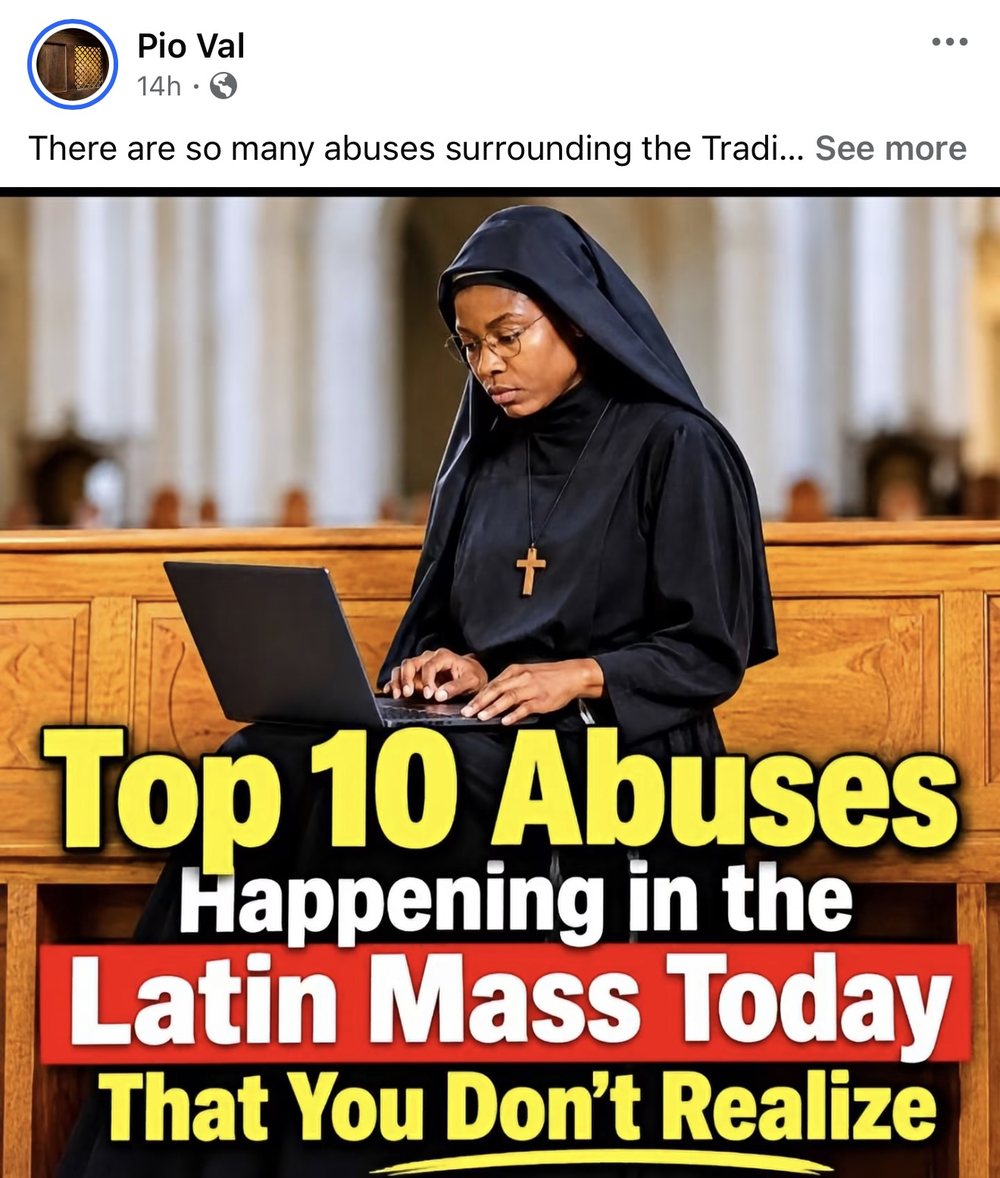
Pio Val has published a graphic titled “Top 10 Abuses Happening in the Latin Mass Today That You Don’t Realize.” Read the title, then read the list. Every item on it is a sin or an error a man can commit. Not one of them is anything done to the Mass.
A liturgical abuse, in the Church’s own sense, is something done to the liturgy: a prayer rewritten, a rubric ignored, a rite made up on the spot. That is what the Congregation for Divine Worship and the Discipline of the Sacraments legislated about in Redemptionis Sacramentum, and it is about what happens at the altar. Pio Val’s ten are of another kind. He lists thinking the reformed Mass invalid, looking down on those who attend it, rejecting the Council, skipping Mass, disobeying a bishop, mistaking reverence for holiness, promoting suspicion of the Pope, spiritual superiority, making traditionalism one’s whole identity, and being willing to go into schism. Each is conditioned: he writes “simply because” of attachment to the older Mass, and we will come back to that.
He is not using the word in that sense, and we should say so before answering him. He means something broader, and it is good English: a man can abuse a thing he has been given, as he abuses a trust or a privilege, by what he makes of it. He says so himself in the tenth item. “The Traditional Latin Mass belongs to the Church; the Church does not belong to the Traditional Latin Mass.” Grant him the word, then, and take the list at its strongest. It still fails, for a reason that has nothing to do with the word.
Those ten are sins and errors of persons. Some are grave. None of them is done to the Mass, and none of them belongs to one kind of Catholic. Pride, disobedience and contempt for one’s neighbour can be found in every parish on earth.
What the post does
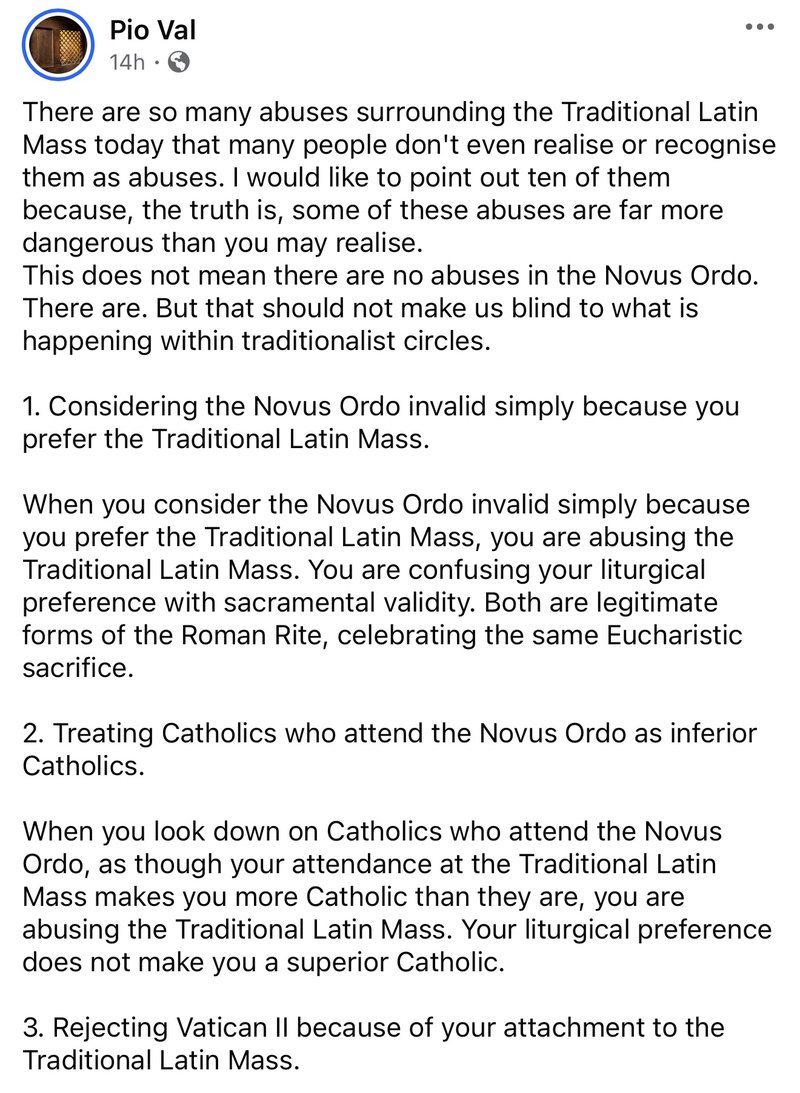
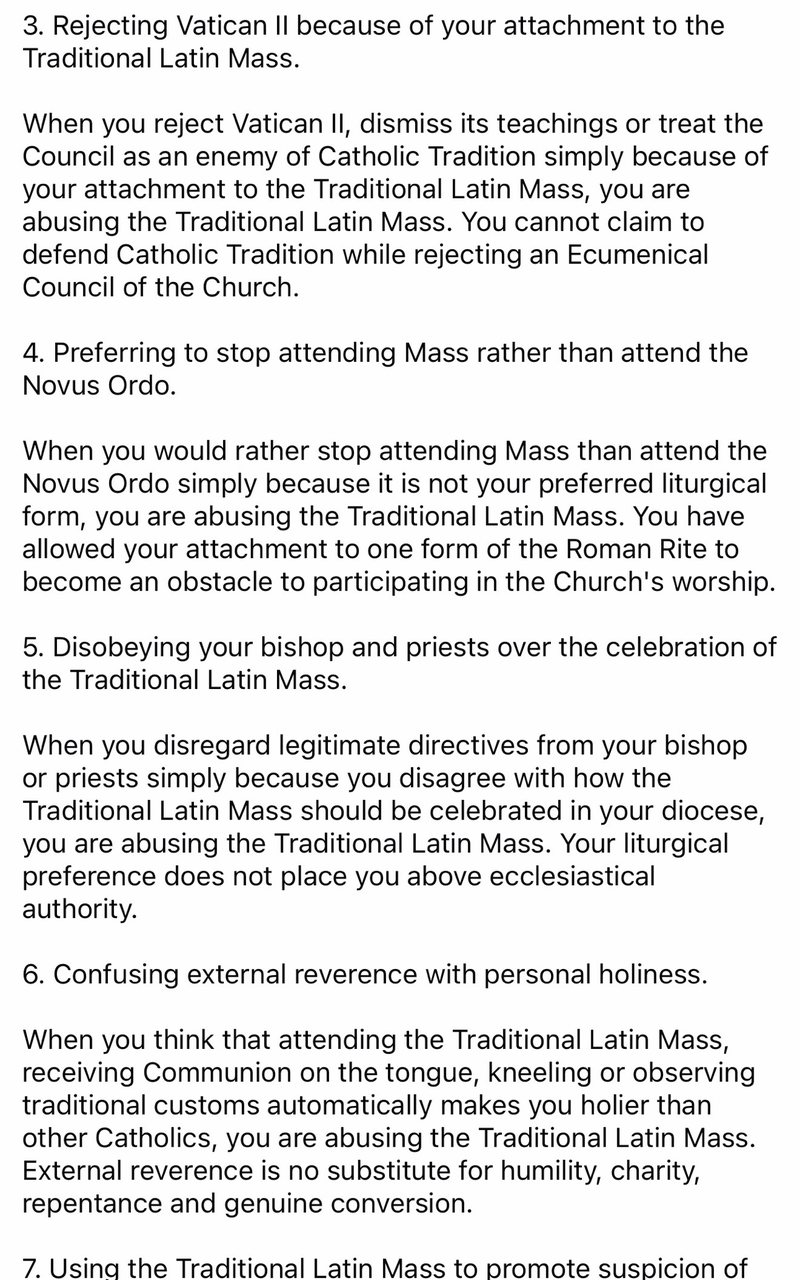
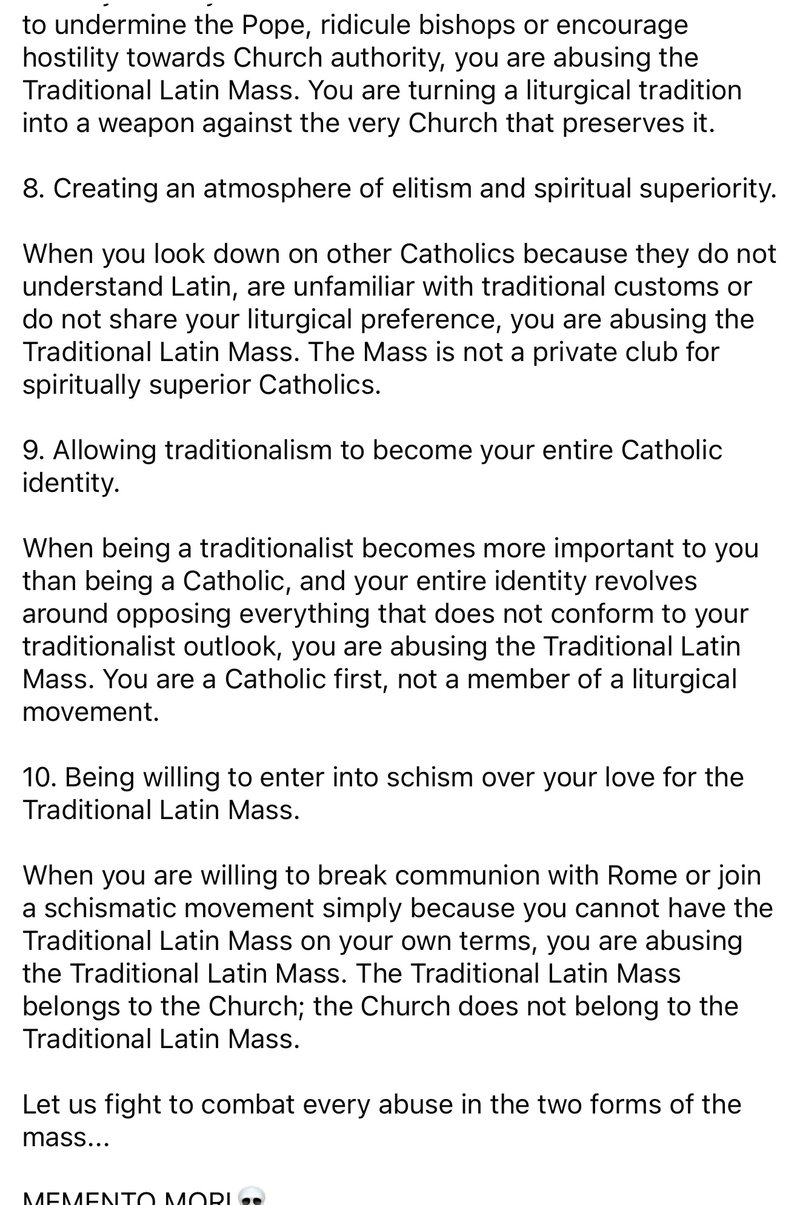
Taken one at a time, each item is true. If you think the reformed Mass invalid, you are wrong. If you would leave the Church over a missal, you are in grave danger. We grant all ten, and so would most of the traditional Catholics we know. Where one would not, he should be answered by name.
And every item is cast as a conditional. “When you reject Vatican II, dismiss its teachings or treat the Council as an enemy of Catholic Tradition simply because of your attachment to the Traditional Latin Mass, you are abusing the Traditional Latin Mass.” We have no quarrel with the conditionals. Our quarrel is with the frame around them. The title does not say ten ways a Catholic can go wrong. It says these abuses are “happening in the Latin Mass today.” The introduction says there are so many “surrounding the Traditional Latin Mass” that many people “don’t even realise or recognise them as abuses,” and that they are found “within traditionalist circles.” Then the refrain names the Mass ten times: “you are abusing the Traditional Latin Mass.”
Ten conditionals under that title stop reading as warnings and begin reading as a census. Nothing in the post tells a reader whether this is one pew in a hundred or ninety-nine of them. The reader supplies the number, and the title has already told him which number to supply.
So ten sins are pinned to one form of the Mass and to the Catholics who attend it. A reader who has never met one of us comes away with a portrait. These people think your Mass is invalid. They think you are a lesser Catholic. They reject the Council, ridicule bishops and undermine the Pope, and are willing to go into schism. That is what the graphic tells the world, whatever its author meant by it.
The eighth item shows the difficulty. “Creating an atmosphere of elitism and spiritual superiority.” The fault is real and we have met it. But an atmosphere is a charge about a room, and the post gives a reader no way to tell which rooms. Under that title, every room is one of them.
Try it on anyone else
Here is the test. Write his post about the other half of the Church. We have kept his ten, in his order, and changed only who they are about.
Top 10 Abuses Happening in the Novus Ordo Today That You Don’t Realize. Treating the older Mass as harmful simply because you prefer the new one. Treating the Catholics who attend it as backward Catholics. Rejecting what the Church did before 1962 because of your attachment to the reform. Preferring to stay home rather than attend a Mass in Latin. Disobeying your bishop when he permits the older Mass in your parish. Confusing informality with sincerity. Using the reformed Mass to promote suspicion of everything before 1965. Creating an atmosphere of condescension towards people who pray the rosary. Allowing “the spirit of Vatican II” to become your entire Catholic identity. Being willing to leave the Church when she teaches something hard.
That is ten for ten, and every item describes someone real. It is still a smear. It hangs the faults of some around the neck of everyone who attends that Mass, and the title announces as a feature of the rite what is at most a fault in some of the people at it. Set it in yellow capitals over a stock photograph and it would travel for a week. We would not publish it. We do not think he would either, and that is the reason this one should come down. Our Lord gave the rule: “All things therefore whatsoever you would that men should do to you, do you also to them” (Matt. vii. 12).
A list of the worst things some people do is not a portrait of a people. Put any other group in the title and everyone would see it.
Ten Abuses, and Not One of Them Is in the MassThe word for it
The Church has a name for this, and it is not a mild one. A man is guilty of rash judgment who, in the Catechism’s words, “even tacitly, assumes as true, without sufficient foundation, the moral fault of a neighbor” (CCC 2477). A title is not tacit. This one assumes of a whole congregation what is true of a part of it,.
There is a plainer word, too, for judging a class of people by the worst that can be said of some of them, and for carrying on after the difference has been pointed out. The word is bigotry, in the dictionary’s second sense: behaviour characteristic of a bigot. He told us he meant some and not all, and we believe him. What we cannot square with that is the title he published afterwards.
We use it of the post. We do not use it of the man’s soul. We cannot see his heart, and we say nothing about his standing before God. A post can be judged by what it does, and this one takes ten sins and stamps them with the name of other Catholics’ Mass.
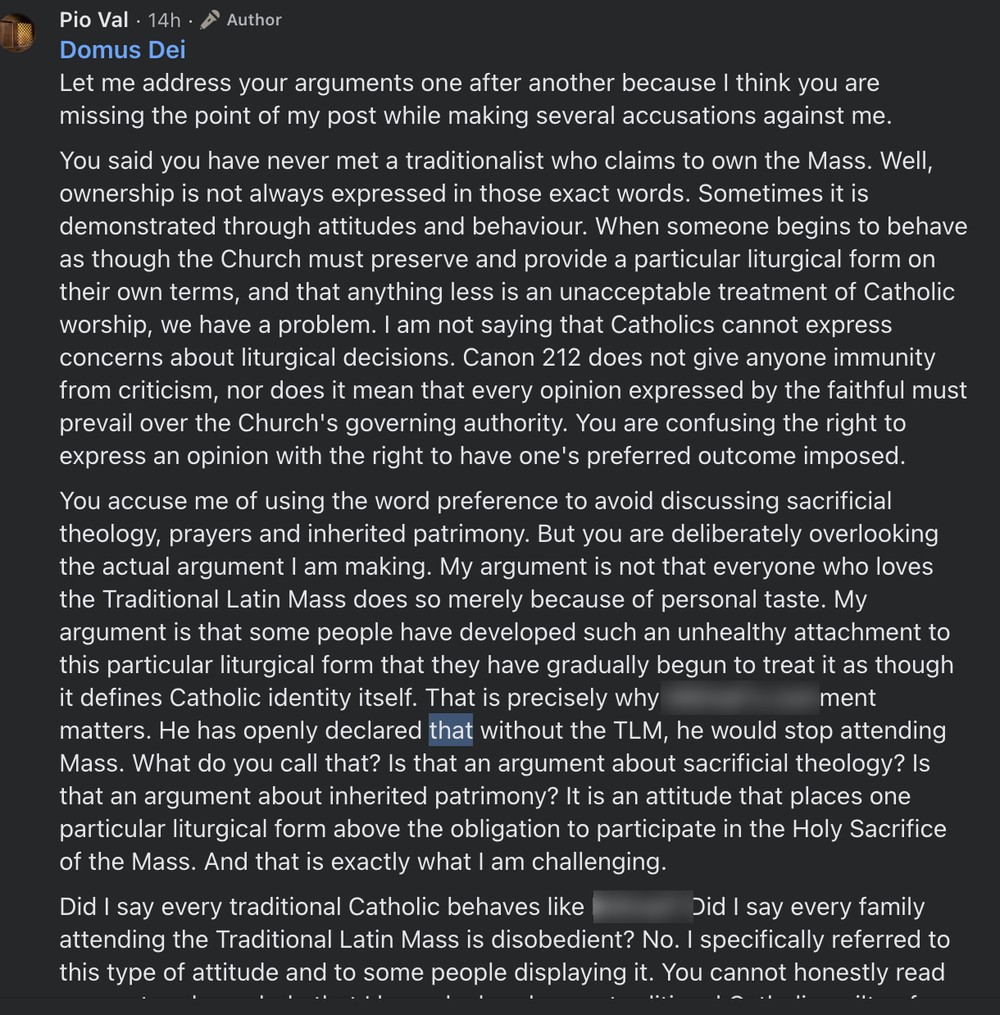
The difference had been pointed out. We put it to him in his own comment section, and he answered: “Did I say every family attending the Traditional Latin Mass is disobedient? No. I specifically referred to this type of attitude and to some people displaying it.” He wrote that on 17 November. The top-ten graphic went up between three and five hours later.
The evidence does not support the portrait either. The sociologists Stephen Cranney and Stephen Bullivant went looking for data because there was none. “The extent to which the TLM community is a schismatic hotbed of negative attitudes towards Vatican II is ultimately an empirical one that is scientifically investigable, and on this point there has been a clear lack of objective, systematically collected data,” they wrote in 2024. When they asked, nearly two-thirds said they accept the teachings of the Second Vatican Council to some degree: 22 percent strongly, 27 percent agreeing and 15 percent somewhat, against 4 percent who strongly disagreed. They also found that the Society of St Pius X has 103 chapels in the United States, against nearly 500 parishes outside it that offered the older Mass after the 2021 restrictions (Catholic Review). The authors say their research challenges portrayals of Trads at both ends of the debate, and we take that correction as readily as we offer it. That is a real community with a real problem in part of it. It is not the community on his graphic, and it is not one a top-ten list will mend.
He told us he meant some, not all. Then he put it in a title that says all.
Ten Abuses, and Not One of Them Is in the MassThe abuses he skipped
He brackets the list at both ends. It opens with “This does not mean there are no abuses in the Novus Ordo. There are,” and it closes with “Let us fight to combat every abuse in the two forms of the mass.” We take him at his word on both. They are the best sentences in the post, and they are the ones the title contradicts.
The abuses in the reformed Mass are abuses in the proper sense. They happen at the altar and they break the Church’s liturgical law. Francis wrote that he was “saddened by abuses in the celebration of the liturgy on all sides,” and, “in common with Benedict XVI,” deplored the fact that “in many places the prescriptions of the new Missal are not observed in celebration, but indeed come to be interpreted as an authorization for or even a requirement of creativity, which leads to almost unbearable distortions” (Letter to the Bishops, 2021). “On all sides” is the right standard, and it is his own closing standard too.
The same paragraph goes on, and we will not cut it where it stops helping us. Francis adds that he is “nonetheless saddened that the instrumental use of Missale Romanum of 1962 is often characterized by a rejection not only of the liturgical reform, but of the Vatican Council II itself, claiming, with unfounded and unsustainable assertions, that it betrayed the Tradition and the ‘true Church’.” That is Pio Val’s third item in the Pope’s own words, and against the men it fits it is a fair charge. It is also a charge about men and not about a Missal, which is the whole of our argument, made by the Pope who restricted the thing we love. Our point is narrower than his title: these ten are not abuses of the rite, and the title says they are.
What we ask
The faults on his list are real where they exist. Name the man who commits one and correct him.
On that we are not even in disagreement. In the reply above he names a commenter who said he would stop attending Mass without the older rite, and says of it: “It is an attitude that places one particular liturgical form above the obligation to participate in the Holy Sacrifice of the Mass. And that is exactly what I am challenging.” So did we, on that same page, to that same man. That is the method we are asking for, and it is his own.
We will not accept a graphic that tells the Catholic world this is who we are. It is false, it is unjust, and the distinction had been put to him before he published it.
Correct the sinner. Do not publish his sins under the name of his Mass.
Ten Abuses, and Not One of Them Is in the MassHe should give it a title that matches its contents, ten ways a man can misuse an inheritance, or take it down. That is a thing some men do, and naming it that way would cost him nothing he should want to keep.
References
- Pio Val, “Top 10 Abuses Happening in the Latin Mass Today That You Don’t Realize,” Facebook post, 17 November 2026, reproduced in Exhibits 1 to 4. His reply to Domus Dei is Exhibit 5. Read in a single session on 18 November 2026, his reply showed “20h” and the graphic “16 hours ago”, which places the reply three to five hours before the list.
- Congregation for Divine Worship and the Discipline of the Sacraments, Redemptionis Sacramentum, 25 March 2004.
- Catechism of the Catholic Church, §§2477–2478 (rash judgment, detraction, calumny; and the duty to interpret a neighbour favourably).
- Francis, Letter to the Bishops accompanying Traditionis Custodes, 16 July 2021.
- Pope Leo XIV meets with authors of book on Latin Mass in U.S., Catholic Review / OSV News, 6 March 2026, reporting Stephen Cranney and Stephen Bullivant, Trads: Latin Mass Catholics in the United States, scheduled for publication by Oxford University Press in November 2026.