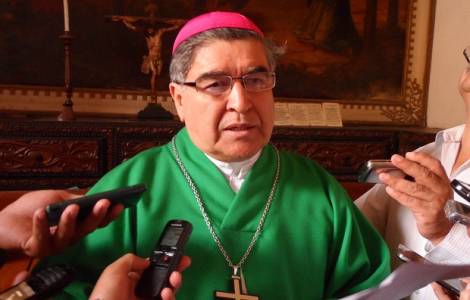
Felipe Arizmendi Esquivel was born on 1 May 1940 in Chiltepec, in the municipality of Coatepec Harinas, State of Mexico. He studied humanities and philosophy at the seminary of Toluca and then dogmatic theology at the Pontifical University of Salamanca in Spain, earning his licentiate and pursuing a private specialization in liturgy. He was ordained a priest for the Diocese of Toluca on 25 August 1963. As a young priest he served three parishes and was pastor of an Otomí indigenous community from 1967 to 1970, an early formation in native ministry, before serving as spiritual director and then, from 1981 to 1991, rector of the Toluca seminary.
On 7 February 1991 Pope John Paul II named him Bishop of Tapachula, near the Guatemalan border; he was consecrated on 7 March 1991. On 31 March 2000 he was appointed Bishop of San Cristóbal de Las Casas in Chiapas, one of Mexico's oldest dioceses, succeeding the influential and controversial Samuel Ruiz García, and began his ministry there on 1 May 2000. For nearly eighteen years he ministered to a largely indigenous flock (Tzeltal, Tsotsil, Ch'ol, Tojolabal and Zoque peoples) championing the permanent diaconate among indigenous men, Scripture and liturgy in native languages, and the inculturation of the faith, while navigating Rome's cautions about the Ruiz legacy. Pope Francis accepted his resignation on 3 November 2017 and created him a cardinal in the consistory of 28 November 2020, assigning him the titular church of San Luigi Maria Grignion de Montfort.
Widely described as theologically conservative yet pastorally devoted to the poor and the indigenous, Arizmendi became the recognized voice of inculturation in the Mexican Church, later serving as the prelate responsible for the Doctrine of the Faith in the Mexican Episcopal Conference. A prolific author of some three dozen books and a long-running newspaper columnist, he lived to see the Vatican grant, in November 2024, its formal approval to indigenous liturgical adaptations of the Roman Rite for the peoples of Chiapas: the fruit of a labor begun by Samuel Ruiz and carried, patiently and within the bounds of orthodoxy, by Arizmendi himself.
Consequential Quotes
With them, we discovered ways to celebrate the liturgy with Indigenous Catholic rites. Those are not pagan rites. They are full of Catholic spirituality, in Chiapas's cultural ways.
These rites are a form of incarnation of faith in expressions that are very specific to these cultures. We did not invent them, but we adopted what they live and which is in accordance with the Roman rite.
The content of the Mass is not changed, but the way it is expressed.
Rome is open to such adaptations, but they must be faithful to the Catholic creed and to the cultures at the same time.
Major Works & Initiatives
Restoration of the indigenous permanent diaconate
Wrote to the newly elected Pope Francis asking him to revisit the ordination of indigenous permanent deacons, which the Vatican had restricted in San Cristóbal for over a decade. Francis responded at once, and ordinations, long suspended, resumed shortly thereafter in a diocese that already held one of the largest bodies of deacons in the world.
Vatican-approved indigenous liturgical adaptations of Chiapas
As chief promoter of the diocese's decades-long inculturation work, he saw the Dicastery for Divine Worship grant its approval on 8 November 2024 to adaptations of the Roman Rite for the Tseltal, Tsotsil, Ch'ol, Tojolabal and Zoque peoples, only the second such approval in post-conciliar history after the Zaire Use, including contemplative dance, an incense ministry, and the role of the community principal.
Scripture and liturgy in indigenous languages
Continued and systematized the translation of the Bible and the Mass into indigenous tongues; the Bible was rendered into Tsotsil and Tzeltal, with the Missal in Tzeltal prepared for publication, so that the faithful of Chiapas could pray in their mother languages.
Author, columnist, and doctrine office of the CEM
A writer for religious and civil media since 1979 and author of roughly thirty books, he sustained a regular newspaper column (in El Sol de Toluca) into his cardinalate and served as the prelate responsible for the Doctrine of the Faith within the Mexican Episcopal Conference.
Controversies
The indigenous permanent diaconate and Rome's review
Under Samuel Ruiz, San Cristóbal ordained hundreds of married indigenous men as permanent deacons, by 2000 the diocese counted the largest concentration of deacons of any in the world. When Arizmendi succeeded Ruiz in 2000 he acceded to the Vatican's request to suspend further ordinations; a 2002 letter from Rome and, in 2005, a directive of the Congregation for Divine Worship halted ordinations until an "underlying ideological problem" over the diaconate and the role of deacons' wives could be resolved and priestly celibacy safeguarded. Arizmendi worked within these constraints rather than against them, and in 2013 successfully petitioned Pope Francis to lift the restriction, allowing ordinations to resume. Supporters credit him with preserving the indigenous Church while restoring it to full standing in Rome.
Succeeding Samuel Ruiz amid liberation-theology tensions
Arizmendi inherited a diocese shaped by Ruiz, a leading figure of the Latin American "church of the poor" whose closeness to indigenous movements and mediation in the 1994 Zapatista uprising drew both admiration and Vatican suspicion. More reserved in temperament than his predecessor, Arizmendi defended Ruiz publicly while distancing himself from liberation theology as such; one historian summarized his stance as not believing "in liberation theology, but in a church for the poor." Some on the Ruiz side feared he would dismantle the indigenous project, while conservative critics were wary of its continuation; he steered a middle course, keeping the pastoral vision alive within orthodox limits.
Statements on homosexuality (2020)
Around his creation as cardinal in November 2020, news coverage revived earlier statements in which Arizmendi described the presence of homosexuality among indigenous communities as a "contagion" spreading from cities, universities and the media, and noted his opposition to same-sex marriage and adoption in Mexico. LGBT advocates criticized the remarks as prejudicial; the cardinal's defenders characterized them as consistent with traditional Catholic teaching on sexuality, of a piece with his broadly conservative doctrinal outlook.