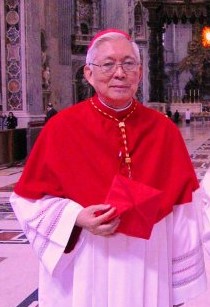
Gaudencio Borbon Rosales was born on 10 August 1932 in Batangas City, Philippines. He was ordained a priest for the Diocese of Lipa on 23 March 1958 and spent his early ministry as a seminary instructor, spiritual director, and parish priest. Pope Paul VI named him an auxiliary bishop of Manila in 1974 (consecrated 28 October 1974). He went on to serve as bishop of the mission territory of Malaybalay in Bukidnon and then as Archbishop of Lipa (1992), earning a reputation as a missionary shepherd of notable personal simplicity, with the episcopal motto Si mortuum fuerit, fructum affert ("If it dies, it bears fruit," John 12:24).
On 15 September 2003 Pope John Paul II appointed him the 31st Archbishop of Manila, succeeding the long-serving Cardinal Jaime Sin; he was installed in November 2003. Pope Benedict XVI created him a cardinal in the consistory of 24 March 2006, assigning him the titular church of Santissimo Nome di Maria a Via Latina. As archbishop he launched "Pondo ng Pinoy," a movement inviting the faithful to give a daily 25-centavo coin as an act of love for the poor, and he was a leading voice in the Church's opposition to the Reproductive Health Bill and to abortion.
Rosales resigned as Archbishop of Manila in 2011, four months after his 79th birthday, and was succeeded by the future Cardinal Luis Antonio Tagle. He had voted in the 2005 conclave that elected Benedict XVI but was over 80 and ineligible for the 2013 conclave. Now in his nineties and living in retirement, he is the longest-lived Filipino cardinal.
Consequential Quotes
Little acts of kindness, if sustained by similar constant little acts, can grow into great expressions of daily charity and compassion.
I love not being noticed. I hardly realized then that simplicity of life was my original preference.
It was a suspicious idea. But it took only three years to prove to many doubting Thomases that, with the blessing of Providence, the movement of Pondo ng Pinoy was not only real and genuine, but also credible.
How do you thank God for 90 years? I never thought in my wildest dream that I would reach 90 years old.
Major Works & Initiatives
Pondo ng Pinoy
His signature charity movement, inviting the faithful to drop a 25-centavo coin daily as an act of love: conceived as catechesis, not merely fundraising, and funding works for the poor across the Archdiocese of Manila.
31st Archbishop of Manila
Led the Philippines' premier see as successor to Cardinal Jaime Sin, guiding it through the post-EDSA years before handing it to the future Cardinal Luis Antonio Tagle.
Missionary Bishop of Malaybalay
Served in the Bukidnon mission territory of Mindanao, where he built a reputation as a brave, missionary bishop living only on essentials.
Opposition to the RH Bill
Helped lead the Catholic bishops' resistance to the Reproductive Health Bill and issued a September 2010 pastoral letter condemning abortion, publicly calling for the bill's rejection.
Controversies
Rebuked by Rome over Latin-Mass limits
After Benedict XVI's 2007 Summorum Pontificum freed the Traditional Latin Mass, the Archdiocese of Manila under Rosales issued guidelines confining it to roughly a monthly celebration in a chapel of the Metropolitan Cathedral. In a letter dated 6 March 2009, Cardinal Darío Castrillón Hoyos, president of the Pontifical Commission Ecclesia Dei, told him the "Archdiocesan Guidelines" were "simply not acceptable as they stand" and asked him to reconsider, adding that there was "simply no legitimate reason" the old Mass could not be celebrated in any church or chapel of the archdiocese. The guidelines were later withdrawn; Rosales publicly denied forbidding the Latin Mass, saying his restriction was aimed at celebrations by the Society of St. Pius X.