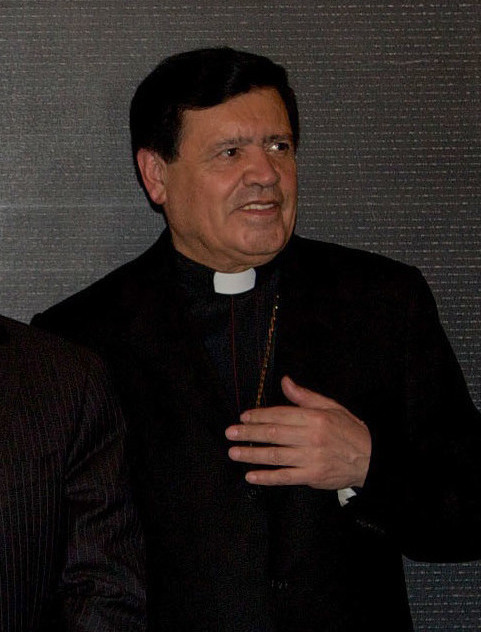
Norberto Rivera Carrera was born on 6 June 1942 in La Purísima, a village in the municipality of Tepehuanes in the Archdiocese of Durango, Mexico, to Ramón Rivera Cháidez and Soledad Carrera. He entered the seminary of Durango in 1955 and was sent to Rome, where he studied at the Pontifical Gregorian University and earned a licentiate in theology. On 3 July 1966 he was ordained a priest by Pope Paul VI in St. Peter's Basilica. Returning to Mexico, he spent nearly two decades in pastoral work in Durango and Zacatecas while serving as professor of dogmatic theology and prefect of discipline at the Durango seminary.
On 5 November 1985 Pope John Paul II named him Bishop of Tehuacán, in the state of Puebla, and he received episcopal ordination on 21 December 1985. Ten years later, on 13 June 1995, the same pope appointed him Archbishop Primate of Mexico; he was installed in the Metropolitan Cathedral on 26 July 1995. In the consistory of 21 February 1998 John Paul II created him a cardinal, assigning him the titular church of San Francesco d'Assisi a Ripa Grande in Rome. He took part in the conclaves of 2005 and 2013, which elected Benedict XVI and Francis, and had earlier chaired the family commission of the Mexican episcopate and the family section of CELAM.
A doctrinal conservative, Rivera governed one of the largest Catholic archdioceses in the world for twenty-two years, defending Church teaching on marriage, the family and the sanctity of life against a rapidly secularizing capital — he was among the most vocal opponents of Mexico City's 2009 same-sex-marriage and adoption law. His tenure was also gravely marked by sustained accusations that he shielded abusive clergy, above all in the case of the priest Nicolás Aguilar Rivera, and by his long public defense of the Legionaries of Christ founder Marcial Maciel. Rivera submitted his resignation on reaching seventy-five in June 2017; Pope Francis accepted it on 7 December 2017, and Cardinal Carlos Aguiar Retes succeeded him. In October 2018 gunmen posing as couriers forced their way into his Mexico City home; the cardinal was unharmed, but an auxiliary police officer, José Javier Hernández Nava, was killed in the shootout.
Consequential Quotes
This perverse example cannot spread. It is necessary to constitutionally defend the family.
It is unjust, inadmissible and condemnable.
accusations of homosexuality, but not of pedophilia
We are happy and satisfied that the judge confirmed what we have always said: This isn't a case to be judged in the United States.
Major Works & Initiatives
Bishop of Tehuacán
Named to the Diocese of Tehuacán in Puebla by John Paul II (episcopal ordination 21 December 1985), where he governed for a decade before his promotion to Mexico City.
Chairman for the Family, Mexican Episcopal Conference
Led the Mexican bishops' Commission for the Family (1989–1995) and headed the family section of the Latin American Episcopal Council, CELAM (1993–1995), shaping the Church's public advocacy on marriage and life.
Archbishop Primate of Mexico
Appointed 13 June 1995 and installed 26 July 1995; led the archdiocese for twenty-two years as a leading conservative voice in Mexican public life until his retirement in 2017.
Cardinal, titular church of San Francesco d'Assisi a Ripa Grande
Created cardinal by John Paul II in the consistory of 21 February 1998; a cardinal elector in the 2005 and 2013 conclaves and a member of Roman dicasteries.
Controversies
The Nicolás Aguilar case and the Los Angeles litigation
As Bishop of Tehuacán, Rivera in 1987 arranged for the priest Nicolás Aguilar Rivera (no relation) to transfer to the Archdiocese of Los Angeles; a letter Rivera said he sent Cardinal Roger Mahony on 23 March 1987 referred to the priest's "homosexual problems" (the Los Angeles archdiocese said it never received it). In Los Angeles Aguilar was accused of molesting altar boys and fled to Mexico in January 1988, a day after the archdiocese learned of the allegations; a Los Angeles grand jury later indicted him on nineteen counts of lewd acts involving ten children, and dozens of victims eventually came forward on both sides of the border. In September 2006 Joaquín Aguilar Méndez, who said Aguilar had raped him in Mexico City in 1994 when he was a boy, sued Rivera and Mahony in Los Angeles Superior Court, alleging a conspiracy to conceal the priest's history. Rivera said he had heard "accusations of homosexuality, but not of pedophilia" when he approved the transfer, maintained that he was unaware of any molestation, and in 2007 asked the Vatican to laicize Aguilar. On 16 October 2007 the court dismissed the suit for lack of jurisdiction over the Mexican cardinal — his spokesman calling it vindication, the plaintiff's attorney "a legal technicality" that did not reach the merits — and a second, related suit (filed anonymously) was dismissed on the same jurisdictional grounds on 16 November 2007. Aguilar was convicted in Mexico in 2003 on lesser charges but avoided prison and disappeared. The dismissals turned on jurisdiction, not on a finding that the underlying allegations were false or true.
Defense of Marcial Maciel and the Legionaries of Christ
Rivera was for years a prominent defender of Father Marcial Maciel Degollado, founder of the Legionaries of Christ, as former seminarians accused Maciel of sexually abusing them. When the allegations drew wide attention around 2001, Rivera publicly dismissed them, and he continued to defend Maciel even after the Vatican in 2006 disciplined the priest by ordering him to a life of prayer and penance withdrawn from public ministry. Maciel's guilt, including the fathering of children and decades of abuse, was later acknowledged by the Legion itself and by the Holy See, and critics have pointed to Rivera's stance as emblematic of the Mexican hierarchy's slowness to confront the scandal. In Rivera's defense, Maciel and his order answered directly to Rome and were never under the cardinal's jurisdiction.