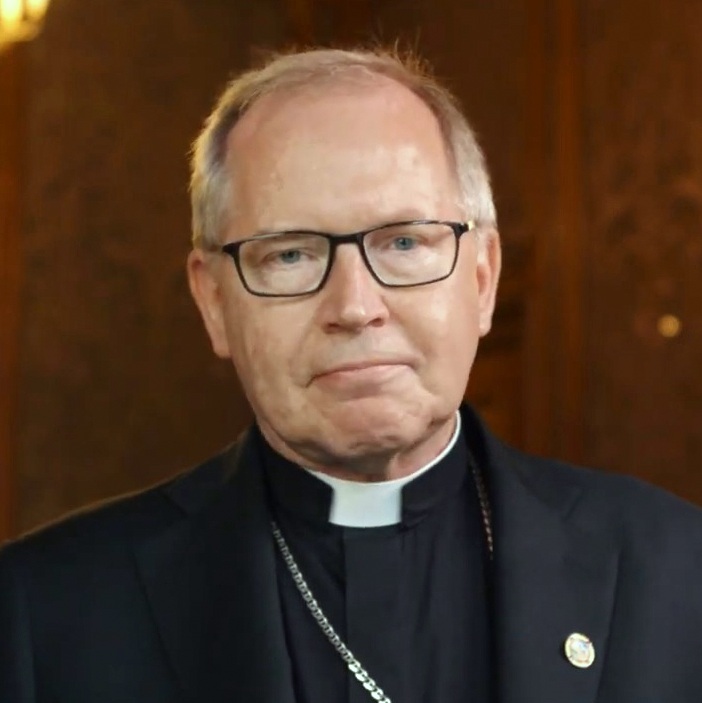
Willem Jacobus Eijk was born on 22 June 1953 in Duivendrecht, Netherlands. He studied medicine at the University of Amsterdam, took his medical degree in 1978, and worked as a doctor in internal medicine before studying for the priesthood at Rolduc seminary. He was ordained a priest on 1 June 1985. He holds doctorates in medical bioethics research and in philosophy, taught ethics and moral theology, co-founded an association organising conferences and publications on medical ethics, and served on the International Theological Commission from 1997 to 2000.
On 17 July 1999 he was appointed Bishop of Groningen-Leeuwarden and received episcopal ordination on 6 November 1999. On 11 December 2007 he was appointed Archbishop of Utrecht, and in 2011 he was elected president of the Dutch Bishops' Conference. In Utrecht he set out a restructuring that would draw the archdiocese's 326 parishes into 48 larger territorial units, warning that by 2025 two-thirds of its churches would be withdrawn from divine worship as Mass attendance fell.
Benedict XVI created him a cardinal in the consistory of 18 February 2012, assigning him the titular church of San Calisto. He took part in the conclave of March 2013 that elected Pope Francis and, as a cardinal elector, in the 2025 conclave that elected Pope Leo XIV. A former member of the Pontifical Academy for Life's governing council, he remains a prominent voice on euthanasia, assisted suicide and Catholic sexual ethics in Dutch and international debate.
Consequential Quotes
The priest must not be present when euthanasia or assisted suicide are performed. This way, the presence of the priest might suggest that the priest is backing the decision or even that euthanasia or assisted suicide are not morally illicit in some circumstances.
Our answer to suffering should not be to offer euthanasia or assisted suicide, but adequate, professional and loving palliative care — of which, from a Christian perspective, pastoral care is an indispensable part.
When one breaks the principle that human life is an essential value, one steps on the slippery slope. Dutch experiences teach that we will be confronted time and again with the question whether the ending of life shouldn’t also be possible with less serious forms of suffering.
The practice of the Catholic Church, based on her faith, is not determined and does not change statistically when a majority of an episcopal conference votes in favor of it, not even if unanimously.
They passed on faith in Christ to their children very little, if at all, let alone to their grandchildren. Older Catholics are dying, and young Catholics, in most cases, are no longer having their children baptized.
Those who still go to church on Sunday today do so out of strong conviction and have a personal relationship with Christ and a personal prayer life.
Major Works & Initiatives
Member, Pontifical Academy for Life (from 2004; governing council from 2005)
Appointed to the Pontifical Academy for Life on 4 August 2004 and to its governing council on 23 March 2005, reflecting his standing in Catholic bioethics.
Manual of Catholic Medical Ethics: Responsible Healthcare from a Catholic Perspective (co-editor)
Reference work on Catholic medical ethics co-edited by Eijk; English edition published by Connor Court Publishing (2014).
Utrecht parish restructuring plan
Plan announced in a November 2014 letter to parishes to consolidate the archdiocese's 326 parishes into 48 territorial units, each with a single church as eucharistic centre, in response to falling attendance.
De band van de liefde: Katholieke huwelijksmoraal en seksuele ethiek (The Bond of Love)
Book presenting Catholic teaching on marital morality and sexual ethics, holding that sexual activity belongs within marriage and joins procreation with the unitive love of the spouses.
Controversies
Criticism of Amoris laetitia and of the German intercommunion proposal, 2015–2018
Ahead of the 2015 Synod on the Family, Eijk published an essay describing civil remarriage after divorce, without an annulment, as a form of structured and institutionalised adultery, and he later became a critic of Pope Francis's Amoris laetitia, saying in 2018 that it had sown doubt and that Francis should state more clearly that marriage is one and unbreakable. In May 2018 he wrote that Francis's response to the German bishops' draft intercommunion proposal was 'completely incomprehensible' and that the Pope should have given clear directives based on the Church's doctrine and practice. Supporters presented his interventions as a defence of clear doctrine; critics, including fellow pastorally minded bishops, favoured a more accommodative approach. The characterisations remain contested.
Parish consolidation and church closures in Utrecht, 2014–2015
Eijk's plan to consolidate Utrecht's 326 parishes into 48 territorial units, with many churches withdrawn from worship, drew organised lay resistance. The group Bezield Verband Utrecht collected 12,000 signatures on a petition to Pope Francis warning of 'catastrophic consequences' and accusing the cardinal of destroying church communities. An archdiocesan spokesman replied that plummeting attendance had made the existing parishes unsustainable, that Eijk had warned of the need for cutbacks rather than imposed decisions himself, and that the petition's comparisons made dialogue hard. The dispute is documented by Catholic News Service reporting of April 2015.
Removal of a transgender parish treasurer, 2015
In June 2015 Eijk ordered the removal of Rhianna Gralike, the transgender treasurer of the Norbertus parish for eastern Flevoland and Northern Veluwe, over the objections of the parish board, as reported in the Dutch press and summarised on his Wikipedia page. The decision was criticised by the parish board and in Dutch media coverage; the archdiocese presented it as a matter of consistency with Church teaching and parish office. Details beyond the reported removal and the board's objection are contested in the available coverage.
Sources
- Holy See Press Office — biography
- Wikipedia
- National Catholic Register (CNA) — priests should speak clearly on assisted suicide, 17 December 2019
- CatholicPhilly (CNS) — bishops warned of euthanasia's slippery slope, 1 August 2017
- Catholic World Report (CNA) — foreign bishops respond to German intercommunion proposal, 23 May 2018
- National Catholic Register — the Pastoral Council and the collapse of the Catholic faith in the Netherlands, 1 February 2023
- CatholicPhilly (CNS) — Dutch archdiocese, lay Catholics at odds over parish consolidations, 21 April 2015