Dom Guéranger Refounds Solesmes Abbey
The spark that ignited the Restorationist phase of the Liturgical Movement—a return to the pure Roman liturgy against Gallican innovations
Faithful / Restorationist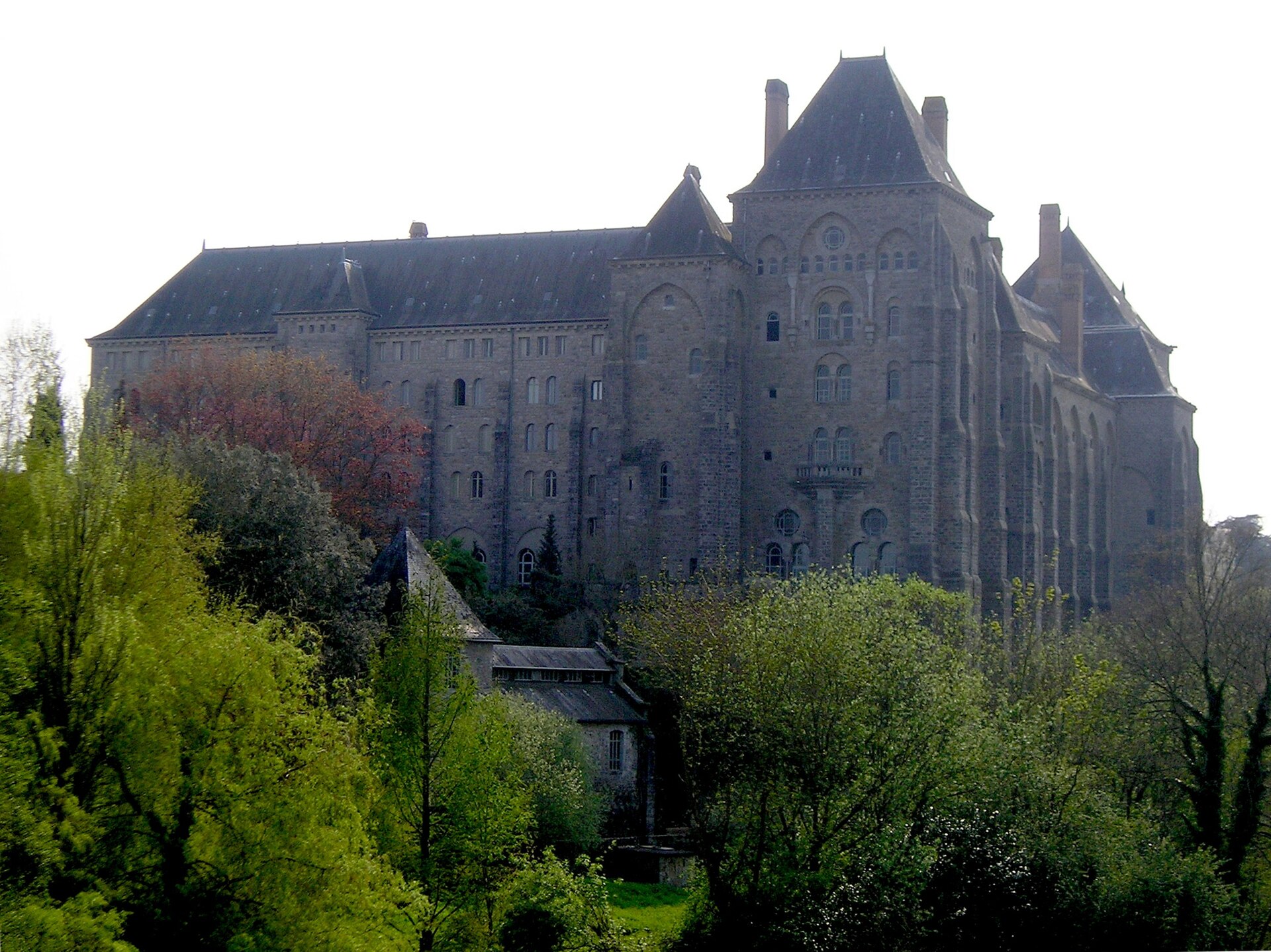
The Abbey of Saint-Pierre de Solesmes, restored to Benedictine life in 1833
Public Domain
The French Revolution had accomplished what centuries of warfare could not: the near-complete destruction of monastic life in France. By 1833, not a single Benedictine monastery remained active in the nation that had once been called “the eldest daughter of the Church.” Abbeys that had stood for a thousand years lay in ruins, their libraries scattered, their choirs silenced, their communities dispersed or martyred.
It was into this devastation that a young priest named Prosper Guéranger stepped forward with an audacious vision: to restore not merely a monastery, but the very heart of Catholic worship itself.
On July 11, 1833, Guéranger and five companions took possession of the derelict Priory of Solesmes in the Sarthe region of northwestern France. The buildings were crumbling. The church was stripped bare. But Guéranger saw not ruins—he saw the foundation of a restoration that would reshape Catholic worship for generations.
The Problem: Gallicanism and Liturgical Chaos
To understand Guéranger’s mission, one must understand what he was fighting against. During the 17th and 18th centuries, a movement known as Gallicanism had swept through the French Church. In its liturgical form, this meant independence from Rome—dozens of French dioceses had abandoned the Roman Missal and Breviary in favor of locally-composed “neo-Gallican” liturgies.
These new liturgies introduced novel prayers, suppressed ancient feasts honoring the saints, altered the calendar, and in many cases reflected Jansenist theological errors. By the time of the Revolution, liturgical practice in France was a patchwork of competing local uses, most of them invented within living memory.
Guéranger understood that liturgical fragmentation was not merely an aesthetic problem—it was an ecclesiological one. When each diocese invents its own prayers, the Church’s unity of worship dissolves, and with it, the lived experience of Catholic universality. The Roman Rite was not simply a liturgy; it was the liturgy of the Western Church, received from tradition and safeguarded by the Apostolic See.
Guéranger saw the neo-Gallican liturgies as a symptom of a deeper disease: the attempt to create a national Church independent of Rome. His response was not innovation but restoration—a return to the pure Roman liturgy as it had been received from the ages of faith.
❝“The liturgy is the arsenal of orthodoxy. It is the living tradition of the Church made audible and visible. To abandon the Roman liturgy is to cut oneself off from the vine.”
— Dom Prosper Guéranger
The Restorationist Vision
What made Guéranger’s approach distinctive was its fundamentally restorationist character. He was not interested in creating something new. He sought to recover what had been lost—the authentic Roman Rite, Gregorian chant as preserved in medieval manuscripts, the monastic Divine Office as prayed by generations of Benedictines.
From Solesmes, Guéranger launched a multi-front campaign:
Liturgical scholarship: His massive work Institutions Liturgiques (1840-1851) systematically demolished the historical claims of the neo-Gallican liturgists, demonstrating that their “ancient” practices were modern inventions.
Spiritual formation: His multi-volume L’Année Liturgique (The Liturgical Year) taught ordinary Catholics to understand and pray with the rhythms of the Church’s calendar—a work that would influence Catholic piety for over a century.
Chant restoration: The monks of Solesmes undertook painstaking paleographic study of medieval manuscripts, stripping away Baroque corruptions to recover the authentic melodies of Gregorian chant.
“We wish to restore in France the Benedictine Order, not as an archaeological curiosity, but as a living spring of prayer and sacred learning. The monk’s first duty is the Opus Dei—the Work of God—which is the solemn liturgy. From this fountain, all else flows.”
— Dom Prosper Guéranger, Letter to the Bishop of Le Mans, July 1833
Seeds of a Movement
Guéranger’s influence spread far beyond the walls of Solesmes. Within decades, the neo-Gallican liturgies were disappearing across France as diocese after diocese returned to the Roman books. His scholarship provided the intellectual foundation; his example at Solesmes provided the living model.
This “Liturgical Movement” in its original form was about return—return to the sources, return to Rome, return to tradition. It would inspire Pope St. Pius X’s reforms of sacred music in 1903 and his encouragement of frequent Communion. It would shape the revival of Gregorian chant that continues to this day.
The term “Liturgical Movement” would later be claimed by reformers with very different intentions. What began as Guéranger’s restoration would, by the mid-20th century, be redirected toward innovation, experimentation, and eventually the wholesale replacement of the Roman Rite that Guéranger had labored to preserve. As you follow this timeline forward, note carefully how the original Restorationist vision was gradually—and then suddenly—transformed into something its founders would not have recognized: the usurpation of the ancient rite with something altogether alien to the faith and to tradition—the Novus Ordo Mass.
Joseph Ratzinger, who initially had enthusiastically supported reform, would later refer to it as “a fabricated liturgy, a banal on-the-spot product” when he finally witnessed the fruits of their labors.
But all of that lay in the future. In 1833, in a ruined priory in the French countryside, a young priest and his five companions began again the ancient rhythm of monastic prayer. They could not have known that they were lighting a spark that would reshape the Catholic world.
The question—still unresolved—is whether the fire they kindled would ultimately illuminate or consume.
- Guéranger was only 28 years old when he refounded Solesmes—younger than most seminary professors today.
- The abbey had been abandoned for 43 years. Wild animals had taken up residence in the cloister.
- He borrowed the entire 17,000 francs purchase price, having taken a vow of poverty. It took decades to repay.
- By his death in 1875, he had founded or restored 6 monasteries and trained hundreds of monks.
- His L’Année Liturgique was left unfinished at his death but was completed by his disciples.
- Guéranger never left France after founding Solesmes, yet his influence reached Rome and reshaped the universal Church.
- The Priory of Solesmes was originally founded in 1010—over 800 years before Guéranger arrived.
- The complete disappearance of neo-Gallican liturgies from France by the 1870s—a direct result of his campaign
- The restoration of Gregorian chant to Catholic worship, culminating in Pius X’s Tra le Sollecitudini (1903)
- The founding of modern liturgical science as an academic discipline
- The spread of the Benedictine revival across Europe and beyond
- Solesmes remains today the world center for Gregorian chant scholarship
- His cause for canonization was opened in 2007—he is currently a Servant of God
This Event Directly Influenced
Related Figures
- Pope St. Pius X
- Dom Lambert Beauduin
- Dom Mocquereau (Chant restoration)
- Guéranger, Prosper. Institutions Liturgiques. 3 vols. Paris: Debécourt, 1840–1851.
- Guéranger, Prosper. L’Année Liturgique. 15 vols. Tours: Mame, 1841–1866.
- Johnson, Cuthbert. Prosper Guéranger (1805–1875): A Liturgical Theologian. Rome: Pontificio Ateneo S. Anselmo, 1984.
- Soltner, Louis. Solesmes and Dom Guéranger. Translated by Joseph O’Connor. Brewster, MA: Paraclete Press, 1995.
- Ruff, Anthony. Sacred Music and Liturgical Reform: Treasures and Transformations. Chicago: Hillenbrand Books, 2007.