Tra le Sollecitudini
A saintly pope gave the liturgical movement its charter — and the phrase that would later be stretched far beyond his meaning.
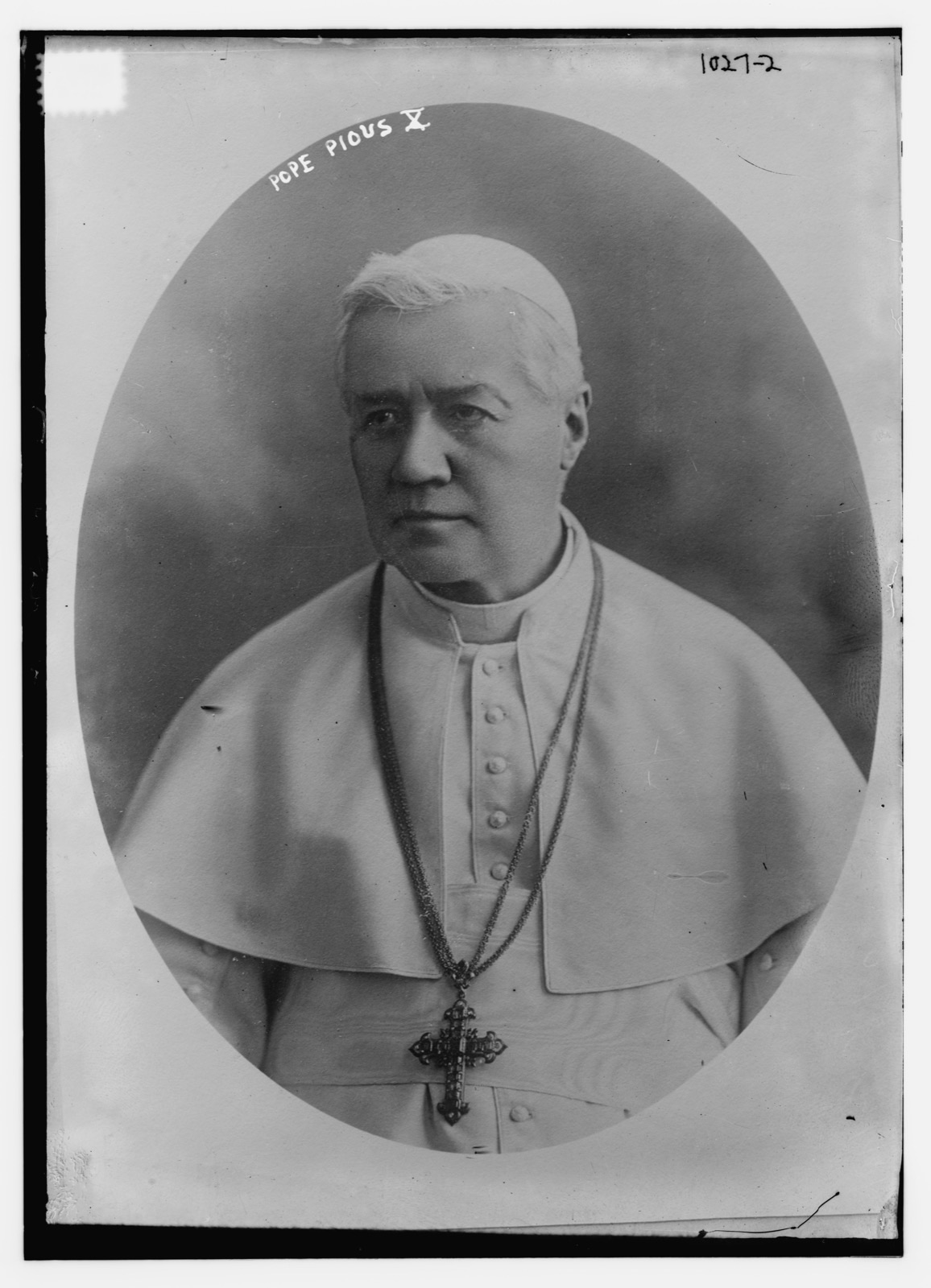
Pope St. Pius X (Giuseppe Sarto), whose 1903 motu proprio on sacred music restored Gregorian chant to the Roman Rite and first gave the Church’s call to “active participation” its papal warrant. Photo: Bain News Service / Library of Congress, public domain.
Event 4 of 57
On 22 November 1903, the feast of St. Cecilia, patroness of sacred music, and barely three months into his pontificate, Pope St. Pius X issued the motu proprio Tra le sollecitudini, “Among the cares” of the pastoral office. It was a law on sacred music. But buried in its opening lines was a single sentence that would be quoted more often, and more variously, than almost any other in the next century of liturgical history. The pope who wrote it was a saint who wanted the faithful to pray the Mass more deeply. The men who later seized on his words would mean by them things he never said.
The phrase “active participation,” so central to twentieth-century liturgical reform, is not a slogan invented at Vatican II or by mid-century reformers. It is the language of a canonized pope in 1903, calling the faithful to enter more fully into the rites of the Church as the Church already had them. Everything that followed claimed his authority — not always his meaning.
A Pastor’s Motu Proprio
Giuseppe Sarto came to the papacy from the parishes. He had been a country curate, a chancellor, a bishop of Mantua, the Patriarch of Venice; a pastor before he was a prince of the Church. His motu proprio reads accordingly. Its concern is not abstract: it is the actual sound of Catholic worship at the turn of the century, where operatic settings, theatrical orchestras, and the conventions of the concert hall had crept into the sanctuary. Pius X called this what he saw it to be, a profanation, and legislated against it with a pastor’s directness.
His remedy was not invention but recovery. The pope ordered the restoration of Gregorian chant, the music the Church had sung for more than a millennium, and of the classical polyphony of Palestrina built upon it. Sacred music, he taught, must possess holiness, true art, and universality; the more a composition departed from these, the less worthy it was of the temple. The Caecilian reformers and the monks of Solesmes, who had spent decades recovering the chant from medieval manuscripts, suddenly found their scholarship written into the law of the universal Church.
These qualities are to be found, in the highest degree, in Gregorian Chant, which is, consequently the Chant proper to the Roman Church… On these grounds Gregorian Chant has always been regarded as the supreme model for sacred music.
— Pope St. Pius X, Tra le sollecitudini (1903)
Sixty years later the Second Vatican Council would echo this judgment almost word for word, declaring in Sacrosanctum Concilium (§116) that Gregorian chant should be given “pride of place” in the Roman liturgy, adding, in the same sentence, that polyphony is “by no means excluded.” The continuity is exact. Pius X did not coin that particular phrase, but the Council’s teaching on chant is, in substance, his.
What the Document Actually Legislated
The motu proprio is usually remembered for one sentence in its introduction. It is worth knowing what the rest of it says, because the rest is specific, and its specificity is the point.
At the summit stands the chant, and Pius X states the rule of thumb plainly: “the more closely a composition for church approaches in its movement, inspiration and savor the Gregorian form, the more sacred and liturgical it becomes; and the more out of harmony it is with that supreme model, the less worthy it is of the temple” (§3). After chant came the classical polyphony of the Roman School, “especially of the sixteenth century” and above all Palestrina (§4). Modern composition was permitted, but only where it met the same three tests, holiness, true art, universality.
And then the prohibitions, which are blunt. The piano is forbidden in church, “as is also that of noisy or frivolous instruments such as drums, cymbals, bells and the like” (§19). Bands are “strictly forbidden” to play in church (§20). Theatrical style, the conventions of the concert hall, and settings that showcase a singer rather than serve the prayer are all excluded. Singers, the document holds, “have a real liturgical office,” and on that ground it rules that women “cannot be admitted to form part of the choir”; where soprano and contralto lines are wanted, they are to be sung by boys (§13).
The Solesmes Connection
None of this came from nowhere. It rested on seventy years of work at Solesmes Abbey, the monastery Dom Prosper Guéranger had refounded in 1833. Under Guéranger’s successors, above all Dom Joseph Pothier and Dom André Mocquereau, the monks had gone through the medieval manuscripts page by page, stripping away later corruptions to recover the melodies underneath. It was painstaking, unglamorous paleography, and in 1903 it became the law of the universal Church.
Its practical fruit arrived in 1908 as the Vatican Edition of the chant books, an official standardised edition drawing heavily on Solesmes scholarship. Guéranger had died in 1875 and never saw it. His project was nonetheless vindicated as completely as a project can be.
Read the reason Pius X gives for restoring the chant to the people: “Special efforts are to be made to restore the use of the Gregorian Chant by the people, so that the faithful may again take a more active part in the ecclesiastical offices, as was the case in ancient times” (§3).
That is an appeal to antiquity, joined to active participation, in the text of a canonised pope, the exact pairing that this timeline elsewhere treats with suspicion. It should be faced squarely rather than passed over. Recovering something ancient is not the error; Mediator Dei would say so explicitly forty-four years later, opening §62 by calling the return to the sources “wise and most laudable.” The error named there is reducing everything to antiquity, and §63 defines it precisely: reaching back while discarding the later patterns Providence introduced. Pius X discarded nothing. He restored the chant inside the rite exactly as he found it. That distinction is the whole argument, and anyone who blurs it will find §3 of this document turned against them.
The Sentence That Launched a Century
And then, in the introduction, the sentence. Pius X explains why he is legislating on something as seemingly small as music: because the temple exists so that the faithful may acquire there the true Christian spirit, and that spirit has a source.
Filled as We are with a most ardent desire to see the true Christian spirit flourish in every respect and be preserved by all the faithful, We deem it necessary to provide before anything else for the sanctity and dignity of the temple, in which the faithful assemble for no other object than that of acquiring this spirit from its foremost and indispensable font, which is the active participation in the most holy mysteries and in the public and solemn prayer of the Church.
— Pope St. Pius X, Tra le sollecitudini (1903)
Read it slowly, because nearly everything that follows in this timeline orbits these words. Active participation, participatio actuosa, in the most holy mysteries and in the public and solemn prayer of the Church is named the “foremost and indispensable font” of the true Christian spirit. Pius X is not asking the Church to change her rites. He is asking the faithful to enter the rites she has (the Roman Mass, sung in chant, prayed in Latin) with their whole soul rather than as passive spectators.
What Beauduin Did With It
Six years later, in 1909, a Belgian Benedictine named Dom Lambert Beauduin stood up at the Catholic Congress of Malines and made this single papal sentence the banner of a movement. Beauduin took Pius X’s “foremost and indispensable font” and built around it a pastoral program: to give the liturgy back to the people, to let the faithful pray the Mass rather than pray at it. In its first generation, this was Pius X’s own vision carried into the parish, hand missals, the dialogue Mass, catechesis on the rites. The early liturgical movement was, in the most literal sense, an attempt to obey a saint.
The instinct behind “active participation” is authentically Catholic and saintly in origin. To want the faithful united in heart and voice to the Church’s prayer is not a modern error; it is the desire of St. Pius X, of the Fathers, of the Church herself. The Traditional Latin Mass, prayed by a congregation that follows, sings, and offers itself with the priest, is active participation as Pius X meant it.
How One Phrase Was Stretched
Here is the hinge of the whole story. Pius X meant interior, prayerful engagement with the unchanged rites of the Church. By the 1960s and after, the same two words, active participation, were increasingly read to require something external and visible: vernacular speech, simplified ceremonies, the priest facing the people, the laity given roles once reserved to clergy. The line was sometimes even misattributed to Beauduin himself, as though it were the slogan of a reform party rather than the teaching of a canonized pope. A phrase that in 1903 justified restoring chant was, in time, invoked to justify setting much of it aside.
To note that Pius X’s words were later applied far beyond his meaning is not to deny the validity or liceity of the reformed liturgy, nor to impugn the Council or any pope; the floor here is firm. It is to insist on a historical fact: the same phrase carried very different cargo in 1903 and in 1969. A saint asked for souls to be drawn into the mysteries. That request stands; later applications stretched it.
❝…the active participation in the most holy mysteries and in the public and solemn prayer of the Church.
— Pope St. Pius X, Tra le sollecitudini, 1903
Reception: Acknowledged Everywhere, Applied Unevenly
How was it received? That depended almost entirely on what a given country’s choirs were already doing. Where the Caecilian reform had taken root (Germany, Austria) the motu proprio was welcomed as papal confirmation of a case those reformers had been making for decades. They had been arguing against operatic settings since the middle of the previous century, and now they had the pope in writing.
Elsewhere it was slow-walked. Where cathedral and parish music had been built around concert repertoire, with paid singers, established programmes and settled local taste, resistance was considerable and implementation was quietly deferred. In Belgium and France application was inconsistent, which is not a small irony, since Belgium would launch the next phase of the Liturgical Movement six years later. In the United States the restriction on women in choirs drew practical objections from parishes that had no boys’ choir and no means of forming one, and in many places it was simply not observed.
Notice what happened here, because it happens again and again in this timeline and this is its first clear instance. A pope legislated, in specific and unmistakable terms, on a matter he judged serious. The legislation was received respectfully and acknowledged almost everywhere. And then, in a great many places, it was not done: not defied, not appealed, not repealed. Just not done. The piano stayed. The choirs stayed. The concert settings stayed for decades.
Rome did not follow up. There was no enforcement campaign, no visitation, no consequence for a parish that carried on as before. Tra le sollecitudini remains in force and has never been abrogated. Its long-term influence came not from being obeyed but from the vocabulary it left behind, above all two words in its introduction, which outlived every specific rule the document laid down. That is worth holding onto: the sentence that was never legislation is the part that changed the century, and the parts that were legislation are the parts that quietly lapsed.
Pius X died in 1914 and was canonized in 1954; the only pope of modern times raised to the altars until John XXIII and John Paul II. He never lived to see what would be done in the name of his sentence. He had asked for the chant to be restored and for souls to be drawn into the mysteries of the Roman Rite. That was his charter. Everything else in this timeline is, in one way or another, a contest over what it meant.
- Pope St. Pius X, Tra le sollecitudini (motu proprio on sacred music, 22 November 1903)
- Second Vatican Council, Sacrosanctum Concilium (1963), §§14, 116
- Pope St. John Paul II, Chirograph for the Centenary of Tra le sollecitudini (2003)
- Dom Lambert Beauduin, Liturgy the Life of the Church (1914; trans. Virgil Michel, 1926)
- Robert Hayburn, Papal Legislation on Sacred Music (1979)