Sacrosanctum Concilium
The Council ordered the revision. It did not order the outcome, and on several points the outcome is what the text forbids.
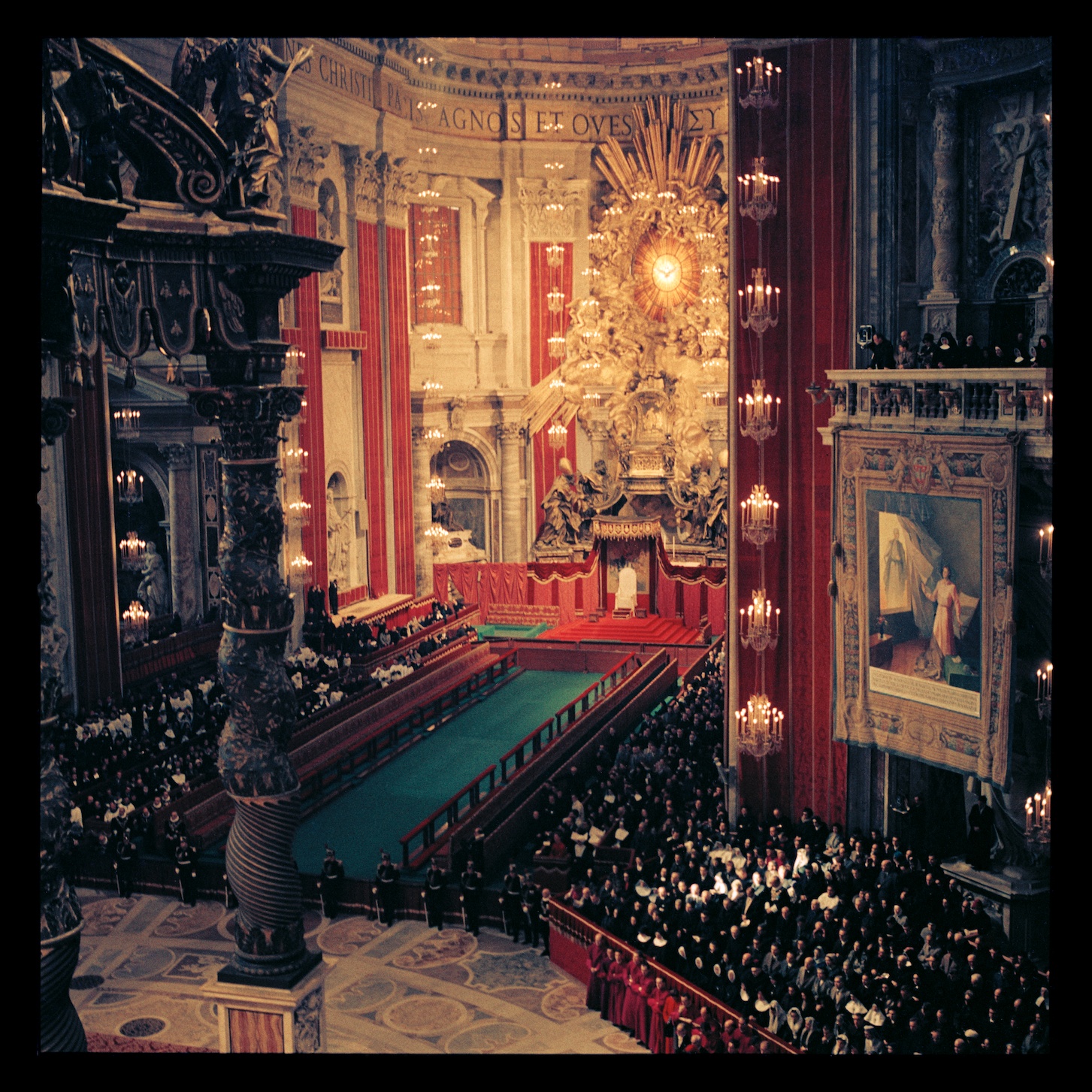
The Second Vatican Council in session in St. Peter’s Basilica, where the Constitution on the Sacred Liturgy was approved on 4 December 1963. Photo: Lothar Wolleh, CC BY-SA 3.0, via Wikimedia Commons.
Event 28 of 57
On 4 December 1963, the assembled Fathers of the Second Vatican Council approved Sacrosanctum Concilium, the Constitution on the Sacred Liturgy, the first of the Council’s documents, promulgated the same day as Inter mirifica. The vote was overwhelming: 2,147 in favor, 4 against. Such near-unanimity is itself a clue. The Fathers were not voting for a revolution. But they were not voting for the status quo either, and this article previously said they were.
This article used to carry the claim, in its subtitle, its opening and its close, that Sacrosanctum Concilium “mandated almost none of what was later done in its name,” and that the Council “never authorized a committee to build a new Order of Mass.” That is not what the constitution says, and the claim cannot survive three paragraphs of its own text. §21 orders a general restoration of the liturgy. §25 orders the liturgical books revised and experts employed on the task. §50 orders the rite of the Mass itself revised, simplified, and pruned. Those three paragraphs did not appear anywhere in this article, or anywhere else in this section of the site. They do now, quoted whole, because an argument that depends on the reader not having read §50 is not an argument this site is willing to make.
The true claim is narrower, and it survives contact with the text: the Council ordered the revision; it did not order the outcome. Nearly every structural feature of the 1969 Missal can point to a warrant in §50. A short and specific list cannot, and on several of those, the constitution says the opposite of what happened.
To grasp this is to hold the key to the whole dispute, and to hold it in a way that stays in communion with the Church. The constitution did not abolish Latin. It did not abolish Gregorian chant. It did not call for Mass facing the people. On the contrary, it explicitly preserved the first two and never mentioned the third. The problem was not the Council. The problem was what was done in the Council’s name.
What the Constitution Actually Said
The genuine Liturgical Movement’s best aim, drawing the faithful into the sacred action rather than leaving them spectators, was here raised to the authority of an ecumenical council. Sacrosanctum Concilium §14 made that aim explicit, calling for the “fully conscious, and active participation” of the faithful in the liturgy, which it named the aim “to be considered before all else.” The constitution permitted a wider use of the vernacular; it asked that rites be marked by a “noble simplicity” (§34); it called for revision “in the light of sound tradition” (§4). But it set that reform inside firm walls.
Read those walls today and they are remarkable. On Latin: “the use of the Latin language is to be preserved in the Latin rites” (§36.1), though the same paragraph opens “Particular law remaining in force,” and §36.2 immediately extends the vernacular’s limits. On music: Gregorian chant, “specially suited to the Roman liturgy,” should be given “pride of place” (§116), qualified by “other things being equal,” and in the same breath polyphony is “by no means excluded.” On method: “there must be no innovations unless the good of the Church genuinely and certainly requires them,” and any new forms “should in some way grow organically from forms already existing” (§23). And on authority: regulation of the liturgy “depends solely on the authority of the Church, that is, on the Apostolic See and, as laws may determine, on the bishop” (§22.1), with territorial bodies given competence in §22.2, before §22.3 adds that “no other person, even if he be a priest, may add, remove, or change anything in the liturgy on his own authority.”
Both are routinely cited on this side of the argument in truncated form, and truncation flatters us. §22 is regularly quoted as though it reserved the liturgy to Rome alone; it does not: it names the bishop in the same sentence and hands territorial conferences real competence in the next. §36.1 is quoted as a fortress for Latin; it is a sentence that begins by preserving particular law and is followed immediately by §36.2 extending the vernacular. The safeguards in this constitution are genuine. They are also qualified in their own text, and a reader who meets the qualifications first from an opponent will rightly stop trusting the page that hid them.
So much for the walls. Now the part this article previously left out altogether, the three paragraphs that ordered the work.
§21. “…holy Mother Church desires to undertake with great care a general restoration of the liturgy itself. For the liturgy is made up of immutable elements divinely instituted, and of elements subject to change. These not only may but ought to be changed with the passage of time if they have suffered from the intrusion of anything out of harmony with the inner nature of the liturgy or have become unsuited to it.”
§25. “The liturgical books are to be revised as soon as possible; experts are to be employed on the task, and bishops are to be consulted, from various parts of the world.”
§50. “The rite of the Mass is to be revised in such a way that the intrinsic nature and purpose of its several parts, as also the connection between them, may be more clearly manifested… For this purpose the rites are to be simplified, due care being taken to preserve their substance; elements which, with the passage of time, came to be duplicated, or were added with but little advantage, are now to be discarded; other elements which have suffered injury through accidents of history are now to be restored to the vigor which they had in the days of the holy Fathers, as may seem useful or necessary.”
— Second Vatican Council, Sacrosanctum Concilium, 4 December 1963
Read it slowly, because the whole dispute turns on it. §50 authorises three verbs: simplify, discard, restore. A commission acting under it could remove the Last Gospel and the second Confiteor as duplications, prune the rubrics, and bring back the Prayer of the Faithful as a patristic restoration, and point to the text for every one of them. The Council did authorise experts to do this: §25 says so in as many words.
What §50 does not authorise is a fourth verb: compose. And the clearest test case is the Offertory. The prayers of the traditional Offertory (Suscipe sancte Pater, Offerimus tibi Domine, In spiritu humilitatis, Veni sanctificator, Suscipe sancta Trinitas) were removed, which §50 covers, and then replaced with newly written prayers, which §50 does not. Nothing in “simplify, discard, restore” reaches the composition of new texts, and §23 requires that whatever is adopted “grow organically from forms already existing.” That is the strongest form of the traditional objection, and it is strong precisely because it does not need §50 to say something §50 does not say.
Particular law remaining in force, the use of the Latin language is to be preserved in the Latin rites.
— Second Vatican Council, Sacrosanctum Concilium §36.1, 4 December 1963
A Document Two Sides Could Read
If the constitution was so conservative, how did it become the warrant for so radical a reform? The answer lies in the nature of conciliar compromise. Sacrosanctum Concilium was drafted in a process where the reformist wing of the movement (well-organized, staffed by influential periti, and led by men who already held the movement’s commissions) had a powerful hand. The result was a text both sides could read in their own favor.
The conservative majority saw their explicit safeguards: Latin, chant, organic development, restraint. The reformist minority saw the open-ended phrases they had worked into the same text: “active participation” as the paramount aim, the door to the vernacular extended, the call for the rites to be “revised,” the warm and elastic phrase “noble simplicity.” Each clause of restraint was matched by a clause of openness. These were the embryonic ambiguities. They were not lies; they were seams. And when the time came to implement the constitution, it was the reformist reading, not the conservative one, that would govern, because the same men who wrote the openings now controlled the body that carried them out.
This is not a conspiracy theory; it is simply how the politics of a conciliar text work. The Fathers voted for the safeguards in good faith. The implementers leaned on the openings with method. Both were reading the same document, and §54, for instance, conceded a place to the vernacular even as §36 declared Latin “preserved.” The ambiguity was real, and it was load-bearing.
The Gap Between Text and Implementation
Set the constitution beside what was actually done after 1963. The gap is real, but it is not where it is usually placed, so it is worth drawing precisely rather than dramatically.
The revision itself (§21), the revision of the books by experts (§25), and the revision of the rite of the Mass: simplified, duplications discarded, patristic elements restored (§50). The Consilium was not a usurpation. A commission of experts revising the books is the literal content of §25, and it is a mistake to describe the body as freelancing. The vernacular’s extension (§36.2, §54), communion under both kinds in determined cases (§55), and the restored Prayer of the Faithful (§53) are all in the text as well. Anyone arguing that the 1969 book came from nowhere has not read the constitution.
The disappearance of Latin. §36.1 preserves it. It did not survive in parish life.
The disappearance of chant. §116 gives it pride of place and says polyphony is “by no means excluded.” Both went.
Mass facing the people. Never mentioned in the constitution, never mandated afterwards, universal within a decade.
The stripping of images. §125 orders that the practice of placing sacred images in churches “is to be maintained.” Sanctuaries were stripped.
A composed Offertory. §50 authorises discarding and restoring; it does not authorise composition, and §23 requires organic growth from existing forms.
Note what this list is and is not. It is not a claim that the Council was disobeyed by men acting without authority: they had authority, from §25. It is the narrower and more awkward observation that on four of these five points no one ever legislated the outcome at all. There is no decree to appeal against, because no decree was ever issued; the practice simply moved, and the texts that said otherwise were left standing and unenforced. The fifth, the new Offertory, was promulgated with the Order of Mass by Paul VI’s apostolic constitution Missale Romanum (3 April 1969), and it is the one point for which §50 gives no warrant.
One need not impute bad faith to everyone involved to see the plain fact: the liturgy that was built did not match the blueprint the Council approved. The reform claimed the Council’s authority while departing from the Council’s text. This was precisely the danger Pius XII had already named, the false “antiquarianism” that would discard living forms to chase reconstructed ones, fifteen years before the Council opened.
This way of acting bids fair to revive the exaggerated and senseless antiquarianism to which the illegal Council of Pistoia gave rise.
— Pope Pius XII, Mediator Dei §64, 20 November 1947
When the traditional movement speaks of a “betrayal,” it does not mean a betrayal of the Church, and not of a true council. It means a betrayal of what that council actually said. The distinction is everything. To make Vatican II itself the villain, to treat the Council as a rupture and set oneself against it, is not the traditional Catholic position. It is a departure from communion, and it is also bad history.
An Honest Reading — and a Catholic One
The reformed rite that issued from this process is valid; that is the floor of any honest discussion and is never in question here. What is in question is whether the implementation honored the constitution that authorized it, and the answer has to be given in parts, because it is not the same answer for the whole book. On the structure of the rite, the implementers had a mandate and used it. On Latin, chant, the images, the orientation of the altar and the composition of new prayers, they had no mandate, and in four of those five the text says the reverse of what came to pass.
Read honestly, then, Sacrosanctum Concilium is neither the traditional cause’s enemy nor quite the friend this page once claimed. It is a document that ordered a real revision inside real limits, and whose limits were never repealed and never enforced. To recover the traditional liturgy is therefore not to reject the Council but to hold it to its own text, which is a stronger position than pretending the Council asked for nothing, because it is one an opponent with a copy of §50 cannot demolish in a sentence.
The pattern here is the one this whole section has been tracing. Two thousand one hundred and forty-seven bishops voted for a revision inside limits. The revision happened. The limits did not hold, and no one ever revoked them, §36.1 still preserves Latin, §116 still gives chant pride of place, §125 still orders the images maintained. Every one of those sentences is in force today. Every one of them describes a Church almost nobody has seen.
That is not a rupture, and it is not a conspiracy. It is what happens when a body that agrees on what it wants works continuously for decades against an authority that legislates once and then declines to govern the matter again. The same thing had already happened to Mediator Dei, which was likewise never overruled, only outrun. Sacrosanctum Concilium was outrun by its own implementation.
How far the result drifted from the text was plain even inside the reform. Fr. Joseph Gelineau, S.J., a consultor of the Consilium, is widely quoted as writing in 1976, in Demain la liturgie, that the Roman Rite as it had been known no longer existed. That is the distance between the modest charter of 1963 and the rite of 1969.
Latin to be preserved, chant to hold pride of place, new forms to grow organically from existing ones. Set that beside what followed – and beside the attendance data usually cited to prove the reform’s effect. Did the New Mass Empty the Pews? →
- Second Vatican Council, Sacrosanctum Concilium (Constitution on the Sacred Liturgy), 4 December 1963, §§4, 14, 21, 22, 23, 25, 34, 36, 50, 53, 54, 55, 116, 125
- Pope Paul VI, apostolic constitution Missale Romanum (3 April 1969), at vatican.va
- Pope Pius XII, Mediator Dei (Encyclical on the Sacred Liturgy), 20 November 1947, §64
- Joseph Gelineau, S.J., Demain la liturgie: Essai sur l’évolution des assemblées chrétiennes (Paris: Cerf, 1976), as commonly quoted; Gelineau is listed among the Consilium’s consultors in Annibale Bugnini, The Reform of the Liturgy 1948–1975 (Liturgical Press, 1990), p. 946
- Domus Dei, “The Liturgical Movement & the Second Vatican Council” (companion essay)