Byzantine Rite
Θεία Λειτουργία
Theia Leitourgia · the Divine Liturgy, the name of its Eucharist
Also called the Constantinopolitan rite, the Greek rite
The rite of Constantinople, prayed by fourteen Catholic Churches and by the Eastern Orthodox.
IKnow it
In Brief
The Byzantine rite is the rite of the Church of Constantinople, one of the five Eastern traditions named in the Code of Canons of the Eastern Churches, and today the most widely celebrated rite of the Christian East.1,2,3 Its eucharistic prayers came from Antioch and, by tradition, Cappadocia. In Robert Taft's account its shape was set in Justinian's Hagia Sophia and completed by the monks of Palestine and Mount Athos. Its essentials have changed little since the fourteenth century.4,5,6,7 Fourteen Catholic Churches celebrate it. So do the Eastern Orthodox Churches, which are not in full communion with Rome.8,9,10
At a Glance
- Tradition
- Constantinopolitan1
- Type
- Rite
- Status
- Living
- Celebrated by (Catholic)
- Fourteen Catholic Churches sui iuris, above all the Ukrainian Greek Catholic and Melkite Churches3,8as of 2026
- Also celebrated by
- The Eastern Orthodox Churches: Constantinople, Alexandria, Antioch, Jerusalem, Moscow and the others9,10,11as of 2026
- Faithful
- About 7 million Catholics; roughly 200 million Eastern Orthodox (our estimate from Pew's figures)2,3as of Catholic returns mostly 2022; Pew's 2010 data, published 2017
- Where today
- Ukraine and the Carpathians, Romania, Hungary, Slovakia, Greece, the Balkans, Russia and the Levant; established communities in the Americas, Western Europe and Australia3as of 2026
- Liturgical languages
- Greek, Church Slavonic, Arabic, Ukrainian, Romanian, Hungarian and the vernacular of each Church3,9
- Principal anaphoras
- St John Chrysostom on most days; St Basil the Great ten days a year. On Lenten weekdays, the Liturgy of the Presanctified Gifts, which has no anaphora.5,9
- Calendar
- Varies by Church: the Julian, the Revised Julian or the Gregorian calendar. Since 2023 the Ukrainian Greek Catholic Church in Ukraine keeps its fixed feasts on the new style, with the traditional date of Easter.12,13
- Eucharistic bread
- Leavened wheat bread (prosphora); its stamped centre, the Lamb, is cut out at the Preparation14,15
- Chalice
- Wine mixed with water at the Preparation; hot water (the zeon) is added before Communion; where it has lapsed, the 1996 Instruction asks for its return16,17
- Communion
- Both kinds together, received standing: by spoon in most Churches, by intinction from the priest's hand among the Melkites. Infants are communed from baptism among the Orthodox and in many Catholic Churches; elsewhere the practice is to be restored.1,15,17,18
- Sanctuary
- Screened from the nave by the iconostasis, a wall of icons with central Holy Doors and two side doors15,17
- Chant
- Sung throughout; traditionally without instruments20
- Signature vestments
- Priest: the phelonion over the sticharion, with stole (epitrachelion), belt and cuffs. Deacon: sticharion and the long stole (orarion).21
- Principal books
- Euchologion and Hieratikon (Liturgikon), Evangelion and Apostolos, Horologion, Typikon, Octoechos, Menaion, Triodion, Pentecostarion9
Where to Experience It
Its heartlands run from Ukraine and the Carpathians to the Levant, where the Melkites pray it in Arabic and Greek.3 Emigrants carried it abroad. The United States has Ruthenian, Ukrainian, Melkite and Romanian eparchies, and there are established Ukrainian and Melkite communities in Canada, Brazil, Argentina and Australia.3,22
In parishes of the Byzantine Catholic Metropolia of Pittsburgh the pew book prints the whole Liturgy and its rubrics, so you can follow the service.15 Each Church keeps its own directory of parishes.
Find a parish
Your First Visit
What follows holds for most Byzantine parishes, Catholic and Orthodox. Where customs differ between Churches, follow the congregation around you.
IIUnderstand it
The Shape of the Liturgy
The Divine Liturgy moves from the table of preparation to the altar and out again to the people. The Little Entrance with the Gospel book marks the Liturgy of the Word, and the Great Entrance with the Gifts marks the Liturgy of the Faithful.9,38 Josef Jungmann, the historian of the Roman Mass, matched the Little Entrance with the Roman introit. The Great Entrance, which "takes the place of our offertory", he called "a climax in the Byzantine liturgy".19
The Little Entrance was once the beginning of the service. In Chrysostom's time the people went in first, and the bishop entered to greet them with "Peace to all". Between the seventh and eighth centuries the preparation of the Gifts was moved ahead of that entrance, and then the antiphons were placed before it. The procession with the Gospel book is now "a vestige of the ancient entrance".47,48
The eighth-century commentary attributed to St Germanus of Constantinople says the preparation "signifies the place of Calvary". Nicholas Cabasilas, the fourteenth-century commentator, insisted that its rites are "only a description and a symbol", and that the bread "remains bread".49,50 Cabasilas gave each procession a practical purpose, the reading of the Gospel and the offering of the sacrifice. He also saw in them the Saviour's first appearance, "obscure and imperfect", and his "perfect and supreme manifestation".50 The Orthodox theologian Alexander Schmemann criticized this kind of reading, which turns the Little Entrance into a picture of Christ going out to preach, as "illustrative symbolism". For him the meaning of the Eucharist lies in "the entry of the Church into the kingdom of God".51
Each step below gives its Greek name. Most also give the Church Slavonic, spelled as in the Russian books, and the Ukrainian, as the Ukrainian Greek Catholic Church's own texts have it.52,53,54 The English in the order is our own translation of the Greek. Both anaphoras are Antiochene in shape.9
The order of the Divine Liturgy
- Preparation (Proskomide)Προσκομιδή ProskomidēПроскомидия ProskomidiyaПроскомидія Proskomydiia
- Opening blessingΕὐλογημένη ἡ βασιλεία Eulogēmenē hē basileiaБлагословенно царство Blagoslovenno tsarstvoБлагословенне царство Blahoslovenne tsarstvo
- Great LitanyΤὰ Εἰρηνικά Ta EirēnikaВеликая ектения Velikaya ekteniyaМирна єктенія Myrna yekteniia
- AntiphonsἈντίφωνα AntiphōnaАнтифоны AntifonyАнтифони Antyfony
- Little EntranceΜικρὰ Εἴσοδος Mikra EisodosМалый вход Malyi vkhodМалий вхід Malyi vkhid
- Troparia and kontakiaἈπολυτίκιον · Κοντάκιον Apolytikion · KontakionТропар · Кондак Tropar · KondakThe hymns of the day, as the Typikon prescribes.38
- TrisagionΤρισάγιος Ὕμνος Trisagios HymnosТрисвятое TrisvyatoeТрисвяте Trysviate
- Epistle and GospelἈπόστολος · Εὐαγγέλιον Apostolos · EuangelionАпостол · Евангелие Apostol · EvangelieАпостол · Євангеліє Apostol · Yevanheliie
- LitaniesἘκτενής EktenēsСугубая ектения Sugubaya ekteniyaСугуба єктенія Suhuba yekteniia
- Cherubic Hymn and Great EntranceΧερουβικὸς Ὕμνος · Μεγάλη Εἴσοδος Cheroubikos Hymnos · Megalē EisodosХерувимская песнь · Великий вход Kheruvimskaya pesn' · Velikii vkhodХерувимська пісня · Великий вхід Kheruvymska pisnia · Velykyi vkhid
- Litany of the OfferingΠληρώσωμεν τὴν δέησιν ἡμῶν Plērōsōmen tēn deēsin hēmōn"Let us complete our prayer to the Lord." Most petitions are answered "Grant this, O Lord".38
- Kiss of Peace and CreedἈγαπήσωμεν ἀλλήλους · Σύμβολον τῆς Πίστεως Agapēsōmen allēlous · Symbolon tēs PisteōsСимвол віри Symvol viry
- AnaphoraἉγία Ἀναφορά Hagia AnaphoraАнафора AnaforaАнафора Anafora
- Lord's PrayerΠάτερ ἡμῶν Pater hēmōnОтче наш Otche nashОтче наш Otche nash
- "Holy things for the holy"Τὰ ἅγια τοῖς ἁγίοις Ta hagia tois hagioisСвятая святым Svyataya svyatymСвятеє святим Sviateie sviatym
- Fraction and zeonΜελισμός · Ζέον Melismos · ZeonРаздробление · Теплота Razdroblenie · TeplotaThe Lamb is broken into four; one portion is placed in the chalice, and hot water is poured in.38
- CommunionΜετὰ φόβου Θεοῦ Meta phobou TheouЗі страхом божим Zi strakhom bozhym"Approach with the fear of God, with faith and love."38
- Dismissal and antidoronἈπόλυσις · Ἀντίδωρον Apolysis · AntidōronОтпуст · Антидор Otpust · AntidorВідпуст VidpustThe prayer behind the ambo, the dismissal, and blessed bread given to the people.38
The shape of its anaphoras
- 1. Opening dialogue
- 2. Preface / thanksgiving
- 3. Pre-Sanctus
- 4. Sanctus
- 5. Post-Sanctus
- 6. Institution narrative
- 7. Anamnesis
- 8. Offering
- 9. Epiclesis (after anamnesis)
- 10. Intercessions
- 11. Commemorations / diptychs
- 12. Intercessions
- 13. Commemorations / diptychs
- 14. Intercessions
- 15. Doxology
- 1. Opening dialogue
- 2. Preface / thanksgiving
- 3. Pre-Sanctus
- 4. Sanctus
- 5. Post-Sanctus
- 6. Institution narrative
- 7. Anamnesis
- 8. Offering
- 9. Epiclesis (after anamnesis)
- 10. Intercessions
- 11. Commemorations / diptychs
- 12. Intercessions
- 13. Commemorations / diptychs
- 14. Intercessions
- 15. Doxology
- Opening dialogue
- Preface / thanksgiving
- Pre-Sanctus
- Sanctus
- Post-Sanctus
- Institution narrative
- Anamnesis
- Offering
- Epiclesis (after anamnesis)
- Intercessions
- Commemorations / diptychs
- Doxology
Each colour is one part of the eucharistic prayer, in the order the prayer says it. Compare every anaphora.
What makes it distinctive
- The iconostasis, a screen of icons with three doors, stands between the nave and the sanctuary.17,38
- Leavened bread: the Council of Florence (1439) ruled on the old dispute over it, teaching that the body of Christ is truly confected in leavened or unleavened wheat bread and that priests should use either, "each priest according to the custom of his western or eastern church".58
- The deacon leads the people's prayer in litanies, most petitions answered "Lord, have mercy".38
- In the anaphora, a single epiclesis after the words of institution asks the Father to send the Holy Spirit upon the people and the Gifts (see Theology & Spirit).38
- Zeon: just before Communion the deacon pours hot water into the chalice in the form of a cross, with the words "The warmth of faith, full of the Holy Spirit." Cabasilas read the warm water, which "shares the nature of fire", as a sign of the Holy Spirit.38,50,59
- Communion in both kinds together, usually by spoon, after the prayer "I believe, O Lord, and I confess, that thou art, in very truth, the Christ, the Son of the living God", which in Russian use the priest says aloud.38,59
- Standing: the Council of Nicaea ruled that prayer be made standing on Sundays and from Pascha to Pentecost.29
History
Origins
None of the rite's anaphoras originated in Constantinople. Robert Taft, following Engberding, held that the anaphora of St John Chrysostom descends from a Greek "Anaphora of the Apostles" in use at Antioch by the middle of the fourth century. That lost original also lies behind the Syriac Anaphora of the Twelve Apostles.4 The prayer before the Sanctus has phrases found elsewhere only in Chrysostom's homilies. From them Taft argued that Chrysostom, who came from Antioch to be bishop of Constantinople, was the redactor of that prayer's expanded text. He judged it "the only probable one under the circumstances". He proposed, as a hypothesis, that Chrysostom made the additions after becoming bishop there (398–404). Stefano Parenti (2020) faults Taft's method and doubts the attribution.4,9 The doubt is older than Parenti. Dom Prosper Guéranger wrote in 1840 that Chrysostom "n'est point l'auteur de la Liturgie qui porte son nom" (is not the author of the liturgy that bears his name). Until the sixth century it seems to have been called the Liturgy of the Apostles.60 The anaphora of St Basil, traditionally attributed to the fourth-century bishop of Caesarea in Cappadocia, survives in Egyptian, Armenian, Syriac and Byzantine versions.5,9 Guéranger thought its attribution better proven.60 By the eleventh century the Chrysostom anaphora had come to dominate, and in the Great Church it was celebrated daily.9
The Great Church
The cathedral liturgy of Justinian's Hagia Sophia, dedicated in 537, gave the rite its outline. No church even half its size was ever built again in Byzantium. Taft argues that the building shaped the ritual it housed.6 The entrance chants and the procession of the Gifts belong to this cathedral rite.6 The eleventh-century chronicler Cedrenus records that Justin II introduced the Cherubic Hymn, sung at that procession, in 573–574; it may already have been sung in some churches before then. Its composer is unknown.39,48,61
The monastic synthesis
Theodore of Stoudios (d. 826) brought monks of St Sabas from Palestine to the capital, and their office was combined with the cathedral's.7 Taft described the hybrid as "a Palestinian horologion with its psalmody and hymns grafted onto a skeleton of litanies and their collects from the euchology of the Great Church".62 After the crusaders sacked Constantinople in 1204 the old cathedral office disappeared from Hagia Sophia, replaced first by Latin offices and, after 1261, by the Studite office. At Thessalonica the cathedral office survived into the fifteenth century.9 The monastic synthesis, codified on Mount Athos in the fourteenth century, became in Taft's words "basically the Byzantine Rite we know today".7 Olkinuora notes that this account has since been "seriously reconsidered" (see Disputed Questions).9
Print, languages and reform
The Melkites of Antioch had definitively exchanged their older Antiochene rite for Constantinople's by the end of the twelfth century, long before the first printed books.63 Printing fixed the texts. The first edition of the liturgies appeared at Rome in 1526, and the Euchologion was printed at Venice the same year.38 Patriarch Nikon's seventeenth-century reform, which brought the Russian books into line with contemporary Greek practice, provoked the schism of the Old Believers, or Old Ritualists, who kept the pre-Nikonian forms.9 Rome printed its own corrected Greek Euchologion in the 1750s. Benedict XIV wrote in 1755 that it had been revised "to avoid the slightest injury to the Greek rite".64 In the twentieth century the Ruthenian and Ukrainian Greek Catholic Churches both used the Ruthenian recension, Church Slavonic editions prepared in Rome. The Congregation for the Oriental Church began sending them to the Ukrainian bishops in 1941, with an extract of the Liturgikon and the Liturgy of St John Chrysostom; the full Liturgikon followed in 1942.65,66 The Ukrainian Church calls its heritage the Kyivan tradition.54 Its 2024 Service Book replaced Ukrainian translations made from the Roman editions of 1942 (Slavonic) and 1950 (Greek). It is now the only authorized Ukrainian text of the Liturgies of St John Chrysostom and St Basil.52,67
The Catholic Churches
From the sixteenth century, Byzantine communities entered communion with Rome while keeping their rite. The metropolitan of Kyiv and bishops of his province entered at Brest in 1595–96, the clergy of Mukachevo at Uzhhorod in 1646, the Romanians in 1698–1700, and the Melkite Catholic patriarchate from 1724.63,68,69,70 In each case only part of the mother Church entered the union.8
Benedict XIV forbade the Melkite Catholics to pass to the Latin rite in 1743. In Allatae sunt (1755) he recalled that the popes had never asked Eastern Christians returning to communion "to give up their own rite", though he also held that "the Latin rite should be preferred to all other rites".64,71
Latinization spread all the same, some of it adopted and some imposed. The Ruthenian Synod of Zamość (1720), which Rome confirmed in 1724, "restrained or removed" Greek usages and abolished the zeon. In 1929 Rome required Ruthenian priests going to the United States to be celibate.8,64,72,73
The correction came gradually. A Roman decree of 1881 ordered the Greek rite at the monastery of Grottaferrata, near Rome, "restored integrally".71 Leo XIII's Orientalium dignitas (1894) punished any Latin missionary who drew Eastern faithful to the Latin rite.74 Pius XII promised in 1944 that Eastern Christians would never be forced to abandon their legitimate rites.75
The Second Vatican Council declared that no Church is "superior to the others as regards rite", and told Eastern Catholics who had "fallen short" to "take steps to return to their ancestral traditions".76 Its decree on ecumenism conceded that the Eastern Churches' principle of governing themselves by their own disciplines was "not always indeed carried out in practice".77 At Balamand in 1993 the joint Catholic–Orthodox commission agreed that "uniatism", as a method of union, could no longer be accepted, and affirmed the Eastern Catholic Churches' "right to exist".78 John Paul II wrote in 1995 that "conversion is also required of the Latin Church, that she may respect and fully appreciate the dignity of Eastern Christians".79 The 1996 Instruction asked the Eastern Catholic Churches to restore infant Communion. It called for "an organic recuperation of the proper usages" in church space, images, vestments and furnishings, even where that meant "taking distance" from past directions of the Roman congregations.17
Milestones
- 537Justinian dedicates Hagia Sophia, the Great Church whose cathedral rite shapes the liturgy6
- 573–574Justin II orders the Cherubic Hymn sung in the Liturgy, as the chronicler Cedrenus reports39,61
- 692The Council in Trullo names the liturgies of St James and St Basil, and sets the Presanctified Liturgy on the weekdays of Lent80
- c. 780–800Barberini gr. 336 holds the liturgy of Basil, the Presanctified, and the liturgy later called Chrysostom's, though it gives his name only before a few of its prayers9,38,48,61
- c. 800–826Theodore of Stoudios brings monks of St Sabas to Constantinople; in Taft's account their office merges with the cathedral's7
- 1204The Fourth Crusade sacks Constantinople; the cathedral office vanishes from Hagia Sophia9
- 14th c.The monastic synthesis is codified on Mount Athos, in Taft's account7
- 1526The liturgies are first printed at Rome; the Euchologion is printed at Venice38
- 1595–96The Union of Brest: the metropolitan of Kyiv and bishops of his province enter communion with Rome, keeping their rite68
- 1755Benedict XIV's Allatae sunt restates Rome's protection of the Eastern rites (after Demandatam, 1743), while still ranking the Latin rite first64,71
- 1894Leo XIII's Orientalium dignitas forbids drawing Eastern faithful to the Latin rite74
- 1964Orientalium Ecclesiarum calls Eastern Catholics back to their ancestral traditions76
Texts & Books
Three Divine Liturgies are in regular use, and a fourth, St James, occasionally. The rest of the year's prayer is spread across a shelf of books, which the Typikon combines day by day.9 Some of their hymns reached the West. Guéranger took hymns for The Liturgical Year "from the Greek Anthology and Menaea" as well as from the Roman and Mozarabic breviaries.81
| Text | When it is used | Attribution |
|---|---|---|
| Anaphora of St John Chrysostom | Most days of the year9 | By tradition St John Chrysostom. Taft judged him the probable redactor of an older Antiochene anaphora, perhaps while bishop of Constantinople (398–404); Parenti (2020) doubts it. The attribution seems first to appear between the mid-6th and 8th c.4,9 |
| Anaphora of St Basil (Byzantine) | Ten days: the five Sundays of Great Lent, the eves of Christmas and Theophany, Holy Thursday, Holy Saturday and St Basil's day (1 January)9 | By tradition St Basil of Caesarea. Its core seems to be 4th-century; Streza (2016) finds that Basil left his print on the Byzantine text, while Parenti (2020) doubts the attribution.5,9 |
| Liturgy of the Presanctified Gifts | Prescribed for the weekdays of Great Lent; many parishes celebrate it on Wednesdays and Fridays and on the first three days of Holy Week. It has no anaphora; Communion is from Gifts consecrated at an earlier Liturgy.9,14,80 | Manuscripts and printed books generally ascribe it to St Gregory the Dialogist (Pope Gregory I), some to Epiphanius or Germanus. The ascription probably dates from the 13th–15th c.; Rome's 1950 Hieratikon names no author, and directs that the dismissal name no composer.9,38,82 |
| Anaphora of St James | Occasionally, chiefly on the feast of St James9 | By tradition St James, the Lord's brother and first bishop of Jerusalem; the Council in Trullo (692) is the first dated text to credit him with it. Its history before the manuscripts of the 8th–9th c. is unclear.9,38,80 |
| Book | What it contains | Catholic edition |
|---|---|---|
| Euchologion | The priest's book of the liturgies and the sacraments9 | Greek: Rome, 1754, printed by Propaganda Fide and approved by Benedict XIV65,83 |
| Hieratikon (Liturgikon, Sluzhebnik) | The celebrant's book of the three Divine Liturgies9 | Greek: Rome, 1950, with the Holy See's approval. Church Slavonic (Ruthenian recension): Rome, 1942. Chrysostom and Basil only: Ukrainian, 2024 (UGCC Synod, with the Holy See's agreement); English, 2007 (Pittsburgh Metropolia)15,52,66,82,84 |
| Evangelion and Apostolos | The Gospel and Epistle readings, arranged for the liturgical year9 | Church Slavonic (Ruthenian recension): Rome; the altar Gospel was in the press in 1941, the Apostol to follow65 |
| Horologion | The fixed prayers of the Hours9 | Melkite: The Liturgical Prayer Books, 4 vols, 1997–2000, arranged by season with the Octoechos and Menaion; obligatory from Pascha 199785 |
| Typikon | The rule that governs how the other books are combined on any given day9 | None in the Ruthenian recension; its Ordo Celebrationis covers the chief services86 |
| Psalter | The psalms, divided into twenty kathismata9 | — |
| Octoechos (Parakletike) | Hymns for the weekly cycle of the eight tones9 | Melkite: in the 1997–2000 set (vols 1 and 4)85 |
| Menaion | Proper hymns for each day of the fixed calendar9 | Melkite: in the 1997–2000 set, month by month85 |
| Triodion | The pre-Lenten and Lenten season through Holy Week9 | Melkite: 1997–2000 (vol. 2, February to Holy Week)85 |
| Pentecostarion | From Pascha to the Sunday of All Saints9 | Melkite: 1997–2000 (vol. 3)85 |
| Manuscript | Date | Significance |
|---|---|---|
| Vatican Library, Barberini gr. 336 | late 8th c. | The oldest surviving Byzantine euchologion, a South Italian codex: the earliest Greek text of St Basil's anaphora and the first manuscript witness of the Presanctified Liturgy9,38 |
| London, British Library, Add. 34060 | 12th c. | An eleventh-century order of celebration (diataxis) of the Great Church's patriarchal Liturgy, preserved in a twelfth-century portion of the manuscript7 |
| Translation | Church | Status |
|---|---|---|
| The Divine Liturgies of Our Holy Fathers John Chrysostom and Basil the Great | Byzantine Catholic Metropolitan Church of Pittsburgh (English) | Promulgated 2007; the parishes' pew book15 |
| New Ukrainian translation of the Divine Liturgies | Ukrainian Greek Catholic Church (Ukrainian) | In use from 25 March 2024; translations into other languages are to be adapted67 |
| Service Book of the Holy Orthodox-Catholic Apostolic (Greco-Russian) Church | Russian Orthodox usage (English) | Isabel Hapgood's translation, 1906; public domain59 |
Theology & Spirit
The Byzantine liturgy's own texts describe the Church on earth joining the worship of heaven and awaiting the Kingdom. The Liturgy proper opens with the priest's blessing of the Kingdom. At the Great Entrance the faithful sing of themselves as "the Cherubim mystically representing", laying "all cares terrestrial" aside.38,59 The anamnesis goes on from the Cross and the Resurrection to remember "the Second and glorious Coming-again".59 The English is Isabel Hapgood's 1906 translation of the Russian books.
Maximus the Confessor read the church building itself as an image of creation, the sanctuary signifying the intelligible world and the nave the world of sense.87 The commentary attributed to Germanus (c. 730), which its manuscripts ascribe to Basil more often than to Germanus, opens: "The church is an earthly heaven in which the super-celestial God dwells and walks about." Taft traces the familiar phrase "heaven on earth" to this chapter.48,49,88 The Russian Primary Chronicle has Prince Vladimir's envoys say of the Liturgy in Constantinople, "We knew not whether we were in heaven or on earth". Timothy (Kallistos) Ware took the story to mean that worship, for the Orthodox, "is nothing else than 'heaven on earth'".89
Deification
Deification, the teaching that God became man so that man might share the divine life, is the rite's spiritual emphasis. The Catechism teaches it in the words of Irenaeus, Athanasius and Aquinas.90 John Paul II called divinization "one of the achievements particularly dear to Eastern Christian thought", and wrote that in it, and particularly in the sacraments, Eastern theology attributes "a very special role" to the Holy Spirit, through whose power "deification already begins on earth".79
The epiclesis and the consecration
After the words of institution the priest asks the Father to send the Holy Spirit "upon us, and upon these Gifts", and blesses the bread and the cup, "transmuting them by thy Holy Spirit".59 Byzantine Catholics pray the same epiclesis. The Russian books, which Hapgood translates, also set the troparion of the Third Hour within it. The Pittsburgh book does not.15,59
Answering Latin critics, Cabasilas held that the Lord's words "were spoken in a narrative manner". He added that none of the Apostles or teachers of the Church had ever said they were "sufficient to consecrate the offerings".50 The Catholic Encyclopedia reported in 1909 that Orthodox theologians all counted the epiclesis as at least an essential part of the consecration. Some held that it alone consecrates; the greater number, "and now apparently all", required the words of institution as well.91 Ware wrote in 1964 that for Orthodox theology the consecration "is not complete until the end of the Epiclesis". He added that the Orthodox do not teach that it is effected "solely by the Epiclesis", and that they regard the whole eucharistic prayer as "a single and indivisible whole".89 In a 1982 dialogue text, which carries no magisterial force, the joint Catholic–Orthodox commission wrote that "the entire celebration is an epiclesis".92
On the Catholic side, the Council of Florence, in its decree for the Armenians, named the words of Christ, spoken by the priest in his person, as the form of the sacrament. Trent taught that Christ's body and blood are there under the species "immediately after the consecration" and "by the force of the words".58,93 Pius X rejected as an error the opinion that among the Greeks those words take effect only once the epiclesis has been said, since the Church has no power to alter the substance of a sacrament.94
The Catechism places the epiclesis "at the heart" of the Eucharist. It teaches that "in the institution narrative, the power of the words and the action of Christ, and the power of the Holy Spirit" make Christ's body and blood sacramentally present. It quotes Chrysostom, whose name this rite's daily anaphora bears: "This is my body, he says. This word transforms the things offered."90 Rome's 1996 Instruction said that in their texts and whole spirit the Eastern Churches maintain the sense of the liturgy "as uninterrupted epiclesis".17 Benedict XVI wrote in 2007 that reflection on the Eucharist is enriched by contemplating "the profound unity between the invocation of the Holy Spirit and the institution narrative".95
Adrian Fortescue proposed that the early Church would have called "the whole great Eucharistic prayer" the form, and that the Church "always dramatically represents things as happening successively which really must happen at one instant". On his reading, Eastern Catholics can pray the epiclesis after the words of institution and still hold that those words consecrate.96 Fortescue also judged it "quite certain" that the Roman rite "once had an Epiklesis of the Holy Ghost". He thought it had been removed "apparently deliberately, because of the growing Western insistence on the words of institution", and saw its remnant in the Supplices te rogamus. Jungmann looked elsewhere, calling the Quam oblationem, viewed technically, "the epiklesis of the Roman Mass".19,97
Icons
The veneration of icons rests on the Second Council of Nicaea (787). The Council decreed that holy images, "whether painted or made of mosaic", be set up in the churches. The veneration paid to them is not the full adoration (latria) owed to God alone, and "the honour paid to an image traverses it, reaching the model".98
Sacred Arts
The iconostasis
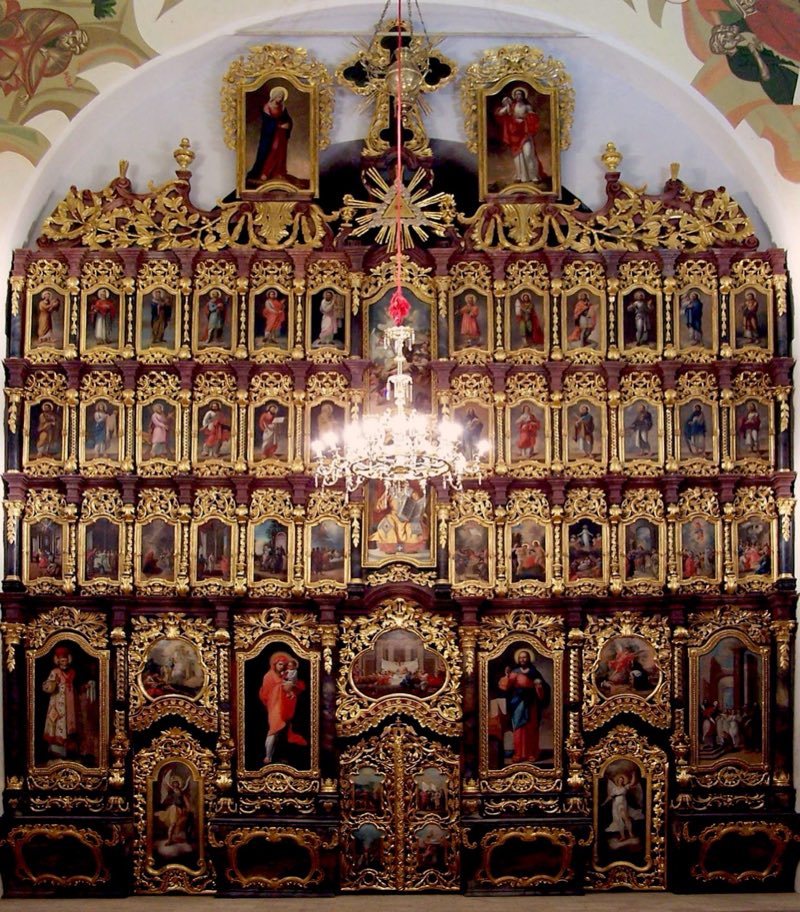
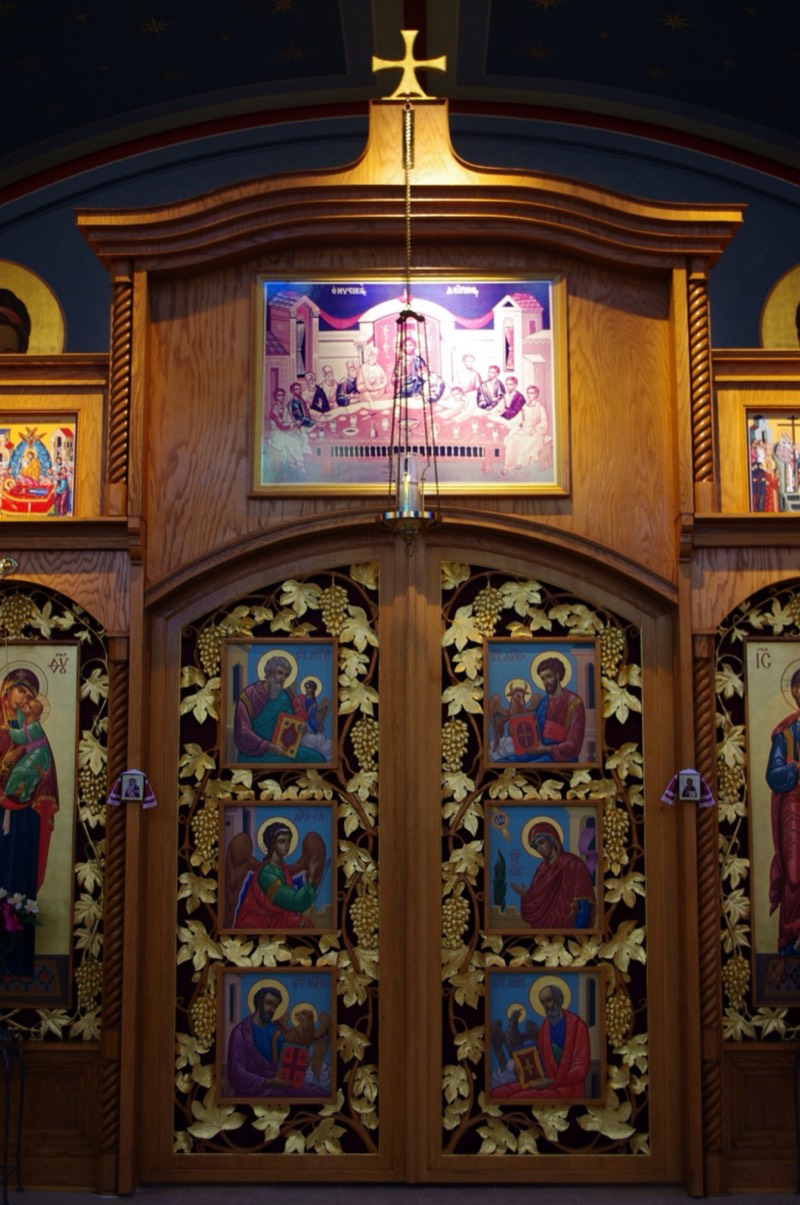
The iconostasis grew from the low barrier that fenced the sanctuary in the ancient church. Where the West came to adorn the reredos behind the altar, the East adorned the barrier in front of it.99 Every iconostasis carries at least an icon of Christ to the right of the central Holy Doors, as the faithful face them, and of the Theotokos to the left. The Annunciation is usually painted on the doors themselves.99 The high screen of several tiers, common in Slavic churches, is found in Catholic churches as well as Orthodox ones.99 The solid screen is comparatively recent. Ware notes that in many places the space between the columns of the older screen was filled in only in the fifteenth or sixteenth century.89
Chant
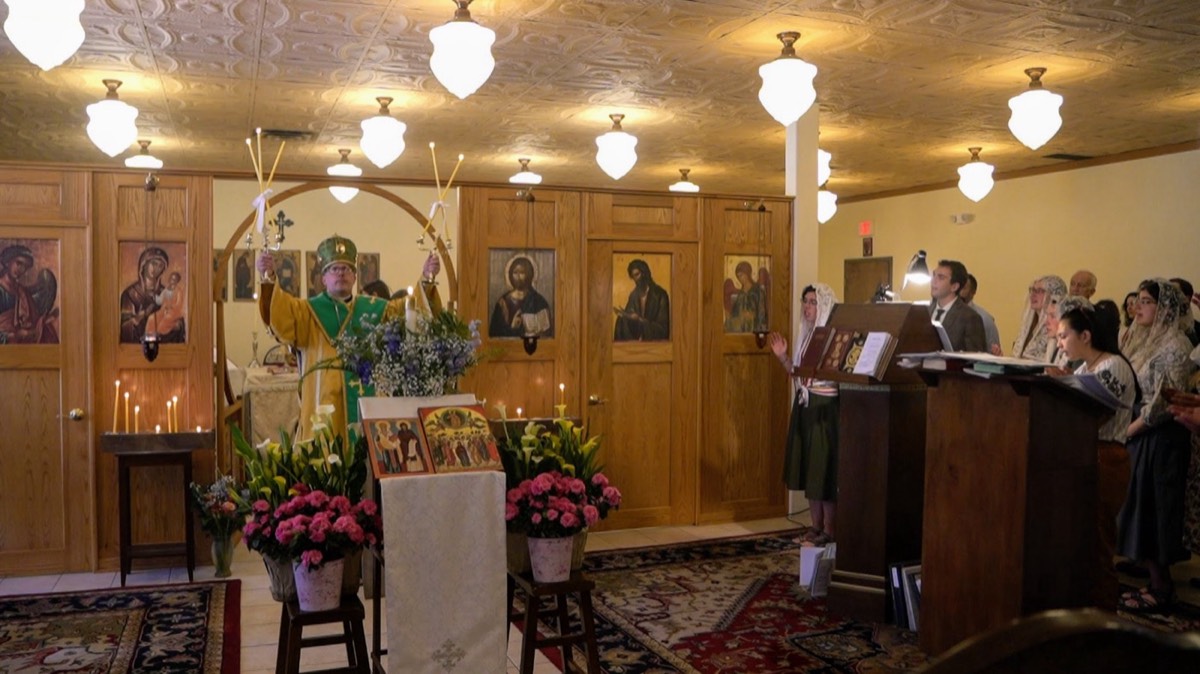
The hymnody runs on eight tones. Each governs a week, beginning at Saturday Vespers, and the hymns are gathered in the Octoechos, much of which tradition credits to St John of Damascus.100 In Russia, Znamenny chant, the oldest canonical chant of the Church of Rus', was displaced by part-singing from the mid-seventeenth century, except among the Old Believers. Composers of the Moscow Synodal School later used its melodies as the basis for choral arrangements.101 In the Carpathians the whole congregation sings prostopinije, a plain chant in unison.102
Architecture
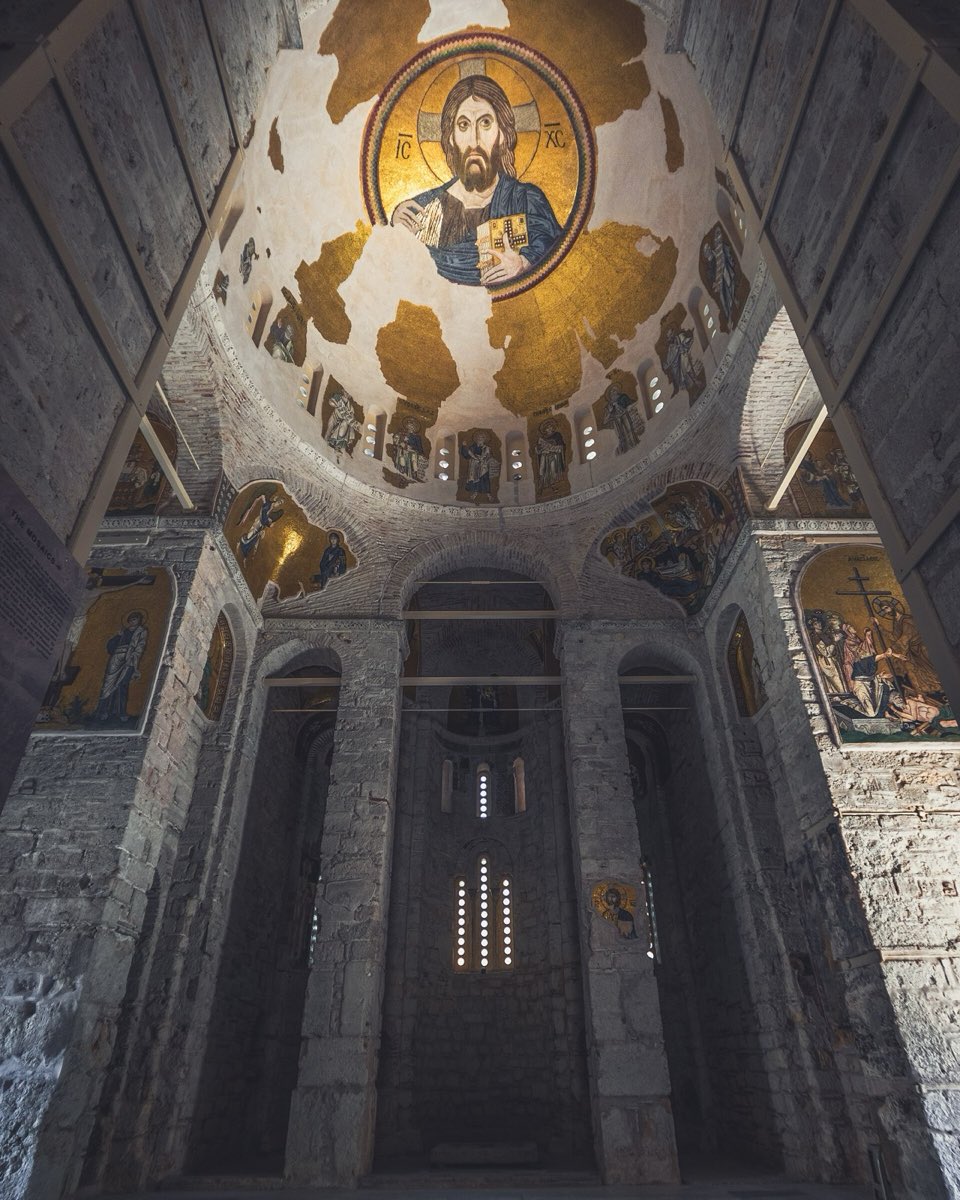
From the Macedonian period (after 867) Byzantine builders turned increasingly to the domed church on a cross plan.103 Its classic Middle Byzantine form is the cross-in-square. A central dome originally rested on four columns over the naos, with a threefold sanctuary to the east and a narthex to the west, as in the churches of the Pantokrator monastery in Constantinople (c. 1118–1136).104 The priest at the altar traditionally faces east, just as the people do.17 Jungmann found that their facing the same way "appears to have always been the rule in the East", and Joseph Ratzinger called prayer toward the east "a tradition that goes back to the beginning".19,105
Family & Relations
Roots & influences
- West Syriac Riteinfluence, 4th c., through the Greek Anaphora of the Apostles behind both
- Rite of Jerusaleminfluence, dating debated
Uses & recensions
- Ruthenian usagerecension
- Ukrainian usage (Kyivan tradition)recension
- Melkite usagerecension
Compare with
- Roman Rite: Jungmann set its Little Entrance beside the Roman introit and its Great Entrance beside the offertory, and he and Fortescue looked for Rome's epiclesis in different prayers19,97
- Coptic Rite: St Basil's anaphora also survives in an Egyptian version5,9
- Armenian Rite: St Basil's anaphora also survives in an Armenian version5,9
IIIStudy it
The Rite Today
The rite's fourteen Catholic Churches number about seven million faithful. The Ukrainian Greek Catholic Church alone accounts for more than half.3,8 The table sums each Church's diocesan returns on GCatholic, nearly all dated 31 December 2022; catholic-hierarchy.org has most of the same figures, dated a year later.3,107 Several of the smaller Churches, in Russia, Belarus and Albania, have little or no hierarchy of their own.3
Among the Orthodox, Pew estimated nearly 260 million people (2010 data, published in 2017). About a fifth of them are Oriental Orthodox, who do not use this rite, so by our calculation the Byzantine-rite Orthodox number roughly 200 million.2 The Orthodox communion is itself divided. In 2018 the Moscow Patriarchate broke Eucharistic communion with the Ecumenical Patriarchate over the Church in Ukraine.11
Recent developments
- On 1 September 2023 the Ukrainian Greek Catholic Church in Ukraine and the Orthodox Church of Ukraine both moved their fixed feasts to the new style, keeping the traditional date of Easter.12,13
- On 25 March 2024 a new Ukrainian translation of the Divine Liturgies of St John Chrysostom and St Basil took effect in the Ukrainian Greek Catholic Church.67
- Receiving the Eastern Churches in Rome on 14 May 2025, Pope Leo XIV urged them to preserve their traditions "without attenuating them".108
- On 29 November 2025 Pope Leo XIV and Patriarch Bartholomew expressed their "shared desire to continue the process of exploring" a way to celebrate Easter together every year.109
- In June 2026 the Pope spoke of the "painful exodus of Eastern Christians from their own lands, caused above all by war".110
| Church | Kind | Faithful | Year |
|---|---|---|---|
| Ukrainian Greek Catholic Church | Major archiepiscopal Church | 4.13 million3 | 2021–22 |
| Melkite Greek Catholic Church | Patriarchal Church | 1.55 million3 | 2005–22 |
| Ruthenian Greek Catholic Church | Metropolitan Church (Pittsburgh), with jurisdictions subject to the Holy See | 369,0003 | 2022 |
| Romanian Church United with Rome, Greek-Catholic | Major archiepiscopal Church | 470,0003 | 2022 |
| Hungarian Greek Catholic Church | Metropolitan Church | 293,0003 | 2022 |
| Slovak Greek Catholic Church | Metropolitan Church | 207,0003 | 2022 |
| Italo-Albanian Catholic Church | Two eparchies and a territorial abbey (Grottaferrata) | 55,0003 | 2022 |
| Greek Catholic Church of Croatia and Serbia | Two eparchies (Križevci; Ruski Krstur) | 44,0003 | 2022 |
| Macedonian Greek Catholic Church | One eparchy | 11,0003 | 2022 |
| Bulgarian Greek Catholic Church | One eparchy | 10,0003 | 2022 |
| Belarusian Greek Catholic Church | Apostolic Administration (erected 2023) | 5003 | 2023 |
| Greek Byzantine Catholic Church | Two apostolic exarchates (Greece; Istanbul) | 6,0003 | 2021–22 |
| Russian Greek Catholic Church | Two apostolic exarchates without their own hierarchs | no published figure3 | |
| Albanian Greek Catholic Church | Other Church sui iuris, without a hierarchy of its own | no separate figure8 |
As of September 2026.
Disputed Questions
Is the Byzantine rite 'West Syrian'?
- No: it is a tradition in its own right.The Code of Canons of the Eastern Churches, which lists the Constantinopolitan tradition separately; Robert Taft, who describes the rite as a Constantinopolitan and Palestinian synthesis1,7
- Its eucharistic prayers are West Syrian in type.Robert Taft, who derives the Chrysostom anaphora from an Antiochene original; Damaskinos Olkinuora, who places all the rite's anaphoras in the Antiochian or West Syrian classification4,9
In our assessment the first position concerns the rite and the second its anaphoras. The rite is Constantinopolitan, and its anaphoras are Antiochene in shape.1,9
Did St John Chrysostom write the anaphora that bears his name?
- Probably, as the redactor of an older Antiochene prayer.Robert Taft (1990), from phrases in the prayer found elsewhere only in Chrysostom's homilies4
- The attribution is doubtful.Stefano Parenti (2020), who criticizes Taft's methodology; in Olkinuora's summary, the attribution to Chrysostom seems to appear only between the mid-sixth and eighth centuries9
In our assessment the question is open, though Olkinuora still calls Taft's multi-volume series the most extensive study of the Liturgy of St John Chrysostom.9
Did St Basil write the anaphora of St Basil?
- He wrote both the shorter Egyptian text and the longer Byzantine one.Raes, Bouyer and Gibson5
- He wrote only the Egyptian text; a successor expanded it.Hanssens (1932)5
- The Byzantine text is his revision of an older prayer preserved in the Egyptian version.Capelle (1960)5
- Basil's own vocabulary is visible in the Byzantine text.Streza (2016), using the Thesaurus Linguae Graecae5
- The attribution to Basil is doubtful.Stefano Parenti (2020) and other recent scholarship9
Scholars disagree. Engberding's study found the Egyptian version the oldest.5
How was today's rite formed?
- A synthesis: Constantinople's cathedral rite and the Palestinian monastic office, joined by the Studite monks and codified on Mount Athos.Robert Taft's classic account7
- The monastic–cathedral scheme is too simple, and Palestinian influence may have come earlier.Damaskinos Olkinuora, who notes that most twentieth-century scholarship assumed Palestinian liturgy was monastic and Constantinopolitan liturgy cathedral, whereas "Palestinian influence on Constantinople was not only monastic"; Stig Frøyshov, who argues that the office of Jerusalem was at least partly in use in Constantinople before the seventh century9
In Olkinuora's summary, recent research "has significantly revised previous thinking regarding the processes of liturgical synthesis, and the discussion is an ongoing one". Olkinuora adds, citing Parenti (2022), that Frøyshov's views "have not been universally embraced".9
A Word from Domus Dei
Editorial · the view of Domus Dei
Rome has not always served the Byzantine Catholic Churches well. For a time its own congregations pressed Latin habits on them, and as late as 1996 it found eastward prayer "threatened in numerous Eastern Catholic Churches by a new and recent Latin influence".17 The Council forbade them to alter their rite except "to obtain for themselves an organic improvement", and Rome now asks them to keep that inherited rite whole and to restore what has been lost.17,76
For the Latin rite the same Council required that new forms "should in some way grow organically from forms already existing".111 Paul VI promulgated his new Roman Missal on 3 April 1969, to take effect on the First Sunday of Advent, as the general revision for which the Council had laid the basis.112 He defended it that November. In a general audience he traced the change to "una volontà espressa dal Concilio" (a will the Council expressed). The Council had ordered the rites of the Mass "simplified", with "due care being taken to preserve their substance", and its accretions "discarded". He called the reform "un atto di obbedienza" (an act of obedience) and "un fatto di coerenza della Chiesa con se stessa" (an instance of the Church's consistency with herself), and added, "Non è un arbitrio" (it is not arbitrary).111,113 The Council did ask for pruning. It also asked for restoring, but it bound every new form to grow organically from the old: the same test the Council set for the East.76,111 The Missal added three new Eucharistic Prayers.112 The Catechism teaches that even the Church's supreme authority "may not change the liturgy arbitrarily, but only in the obedience of faith and with religious respect for the mystery of the liturgy".90 Cardinal Ratzinger, the future Benedict XVI, wrote in 2004 that the pope "has the task of a gardener, not that of a technician who builds new machines and throws the old ones on the junk-pile".114 Measured by the Council's rule of organic growth, the Missal of 1969 was made, not grown.
Go Deeper
On Domus Dei
- The Eastern Liturgies: Byzantine, Maronite, Coptic, and BeyondOur essay on the Eastern rites and the latinization they survived
- The Eastern Catholic ChurchesHow the unions came about
- The 24 Catholic ChurchesEvery Church sui iuris on one board
Official resources
- Ukrainian Greek Catholic Church
- Metropolitan Cantor Institute (Byzantine Catholic Archeparchy of Pittsburgh)
- Melkite Eparchy of Newton
- Ecumenical Patriarchate of Constantinople
- Orthodox Church in America
Recommended reading
- Brightman, F. E., Liturgies Eastern and Western, vol. 1: Eastern Liturgies, Oxford: Clarendon Press, 1896.The Greek texts of the liturgies, free on archive.org Read online
- Cabasilas, Nicholas, A Commentary on the Divine Liturgy, tr. J. M. Hussey and P. A. McNulty, London: SPCK, 1960.The fourteenth-century commentary on what each part of the Liturgy means, with the Greek case on the epiclesis (chs. 27–30) Read online
- Germanus of Constantinople (attributed), On the Divine Liturgy, tr. Paul Meyendorff, Crestwood, N.Y.: St Vladimir's Seminary Press, 1984.How eighth-century Constantinople read its church and its Liturgy, with an introduction to the rite of Hagia Sophia Read online
- Taft, Robert F., The Byzantine Rite: A Short History, Collegeville, Minn.: Liturgical Press, 1992.How the rite was formed, phase by phase Read online
- Taft, Robert F., The Great Entrance, Orientalia Christiana Analecta 200, Rome: Pontificium Institutum Studiorum Orientalium, 1978.A history of the Great Entrance and the other rites before the anaphora Read online
- Taft, Robert F., Liturgy in Byzantium and Beyond, Aldershot: Variorum, 1995.Collected studies, among them 'A Tale of Two Cities', which uses Holy Week to trace the monastic synthesis
- Mateos, Juan, A History of the Liturgy of St. John Chrysostom, vol. 1: The Liturgy of the Word, tr. Steven Hawkes-Teeples, Eastern Christian Publications, 2016.The Liturgy of the Word: the entrance, the antiphons and the Trisagion Read online
- Schulz, Hans-Joachim, The Byzantine Liturgy: Symbolic Structure and Faith Expression, New York: Pueblo, 1986.How the rite and its commentators grew together with Byzantine doctrine and art Read online
- Solovey, Meletius Michael, The Byzantine Divine Liturgy: History and Commentary, tr. Demetrius E. Wysochansky, Washington: Catholic University of America Press, 1970.A Ukrainian Catholic history of the Liturgy with a commentary on each part Read online
- Olkinuora, Damaskinos, “Liturgy of the Byzantine Rite”, St Andrews Encyclopaedia of Theology, 2024.A free, peer-reviewed overview with a current bibliography Read online
- Ware, Timothy (Kallistos), The Orthodox Church, Harmondsworth: Penguin, 1964.The standard Orthodox introduction; its chapter on worship covers the Liturgy and the icons in a few pages (later editions paginate differently) Read online
- Schmemann, Alexander, The Eucharist: Sacrament of the Kingdom, Crestwood, N.Y.: St Vladimir's Seminary Press, 1988.The Liturgy read as the Church's entry into the Kingdom Read online
- Fortescue, Adrian, The Orthodox Eastern Church, London: Catholic Truth Society, 1907.A Catholic account of Orthodoxy; pp. 386–388 take up the epiclesis Read online
- Fortescue, Adrian, The Uniate Eastern Churches: The Byzantine Rite in Italy, Sicily, Syria and Egypt, ed. George D. Smith, London: Burns, Oates & Washbourne, 1923.Rome's legislation protecting the rite, and latinization and restoration among the Italo-Greeks and Melkites (the title uses the older term 'Uniate') Read online
- Jungmann, Josef A., The Mass of the Roman Rite: Its Origins and Development (Missarum Sollemnia), tr. Francis A. Brunner, 2 vols., New York: Benziger, 1951–1955.A history of the Roman Mass that often sets it beside the Byzantine Read online
Sources
- Magisterial / canonicalCode of Canons of the Eastern Churches, Vatican City: Libreria Editrice Vaticana, 1990, can. 28 §2; can. 697; can. 881 §1; can. 671 §1; can. 671 §3; can. 671 §2; can. 713 §2. LinkVerified 2026-09-12 · URL repointed 18 Sep 2026 to the Latin text on vatican.va (part 1; cann. 656–657 are in part 2, codex-can-eccl-orient-2), because the caedm.ca English extract (616A) carries cc. 27–38 only; cann. 28, 40 §1, 656, 657 read there in the Latin, 18 Sep 2026. English translation: cann. 27–28 read in the caedm.ca PDF; cann. 671, 697, 707, 710, 713 read in the IntraText English edition; can. 881 §1 in IntraText, 2026-09-14
- ReferencePew Research Center, Orthodox Christianity in the 21st Century, 2017, 'roughly 20%' Oriental Orthodox. LinkVerified 2026-09-12 · read (8 Nov 2017 report)
- ReferenceGCatholic.org, Byzantine Churches sui iuris and their jurisdictions, 2026, rite pages; diocese pages; 'official language' fields; Russian, Belarusian and Southern Albania pages; Ukrainian diocese pages, summed; Ukrainian rite page; Melkite diocese pages, summed; Melkite rite page; Ruthenian diocese pages, summed; Ruthenian rite page; Romanian diocese pages, summed; Romanian rite page; Hungarian diocese pages, summed; Hungarian rite page; Slovak diocese pages, summed; Slovak rite page; Italo-Albanian diocese pages, summed; Italo-Albanian rite page; Croatia and Serbia diocese pages, summed; Croatia and Serbia rite page; Macedonian diocese page; Macedonian rite page; Bulgarian diocese page; Bulgarian rite page; Belarusian diocese page; Belarusian rite page; Greek diocese pages, summed; Greek rite page; Russian diocese pages; Russian rite page. LinkVerified 2026-09-12 · rite pages read; each Byzantine diocese page summed, 14 Sep 2026 (totals undated)
- ScholarshipTaft, Robert F., “The Authenticity of the Chrysostom Anaphora Revisited: Determining the Authorship of Liturgical Texts by Computer”, Orientalia Christiana Periodica 56, 1990, 5–51, pp. 20, 32–33; pp. 33–36; p. 33.Verified 2026-09-12 · read in the Variorum reprint (Taft 1995, no. III); abbreviations and conclusions checked; pp. 20, 32–36 re-read 13 Sep 2026
- ScholarshipStreza, Ciprian, “The Authorship of the Byzantine Anaphora of Saint Basil under Investigation with the TLG Database”, Revista Teologică 98, no. 3, 2016, 133–194, pp. 135–136; p. 134; p. 135; p. 194; pp. 138–139. LinkVerified 2026-09-12 · full PDF read; pp. 133–139 and conclusions p. 194 checked
- ScholarshipTaft, Robert F., “The Liturgy of the Great Church: An Initial Synthesis of Structure and Interpretation on the Eve of Iconoclasm”, Dumbarton Oaks Papers 34–35, 1981, 45–75, §1; §§5, 7.Verified 2026-09-12 · read in the Variorum reprint (Taft 1995, no. I), §§1, 5, 7
- ScholarshipTaft, Robert F., Liturgy in Byzantium and Beyond, Aldershot: Variorum, 1995, no. VI, p. 23; nos. I–II.Verified 2026-09-12 · reprinted studies nos. I–III and V–VI read (incl. 'A Tale of Two Cities', no. VI; its p. 23 re-read 13 Sep 2026)
- ReferenceCatholic Near East Welfare Association (CNEWA), The Catholic Eastern Churches, the four categories of Eastern Catholic Churches; the Catholic Eastern Churches. LinkVerified 2026-09-12 · read in a browser (automated requests are blocked): the unions, latinization, and the four canonical categories listing the fourteen Byzantine Churches
- ScholarshipOlkinuora, Damaskinos, “Liturgy of the Byzantine Rite”, St Andrews Encyclopaedia of Theology, 2024, §1; §§3.3.1–3.3.3; §3.2; §§2, 2.3; §3.3; §3.3.2; §3.3.1; §2.3; §2; §2.4; §§3.2, 3.3.4; §3.3.3; §3.3.4; §§3.3.1, 3.3.3. LinkVerified 2026-09-12 · signed, peer-reviewed entry read in full (§§2–3)
- Magisterial / canonicalPontifical Council for Promoting Christian Unity, Directory for the Application of Principles and Norms on Ecumenism, 1993, §122; §125; §§123–124. LinkVerified 2026-09-12 · §§122–125 read verbatim on christianunity.va; §115 read 2026-09-14
- ReferenceVatican News, Russian Orthodox Church Breaks 'Eucharistic Communion' with Patriarchate of Constantinople, 2018. LinkVerified 2026-09-12 · read
- Primary textUkrainian Greek Catholic Church, Historical Decision: The UGCC in Ukraine Switches to a New Calendar, 2023. LinkVerified 2026-09-12 · read on ugcc.ua
- ReferenceReligious Information Service of Ukraine (RISU), On September 1, 2023, UGCC and OCU to Transition to New Calendar, 2023. LinkVerified 2026-09-12 · read (OCU decision to use the New Julian calendar, preserving the Paschalion)
- Magisterial / canonicalCouncil of Hierarchs of the Byzantine Metropolitan Church sui iuris of Pittsburgh, Norms of Particular Law of the Byzantine Metropolitan Church sui iuris of Pittsburgh, U.S.A., 1999, c. 707 §1; c. 707 §2; c. 707 §4. LinkVerified 2026-09-12 · cc. 697, 707, 710 read
- Primary textByzantine Catholic Metropolitan Church sui iuris of Pittsburgh, The Divine Liturgies of Our Holy Fathers John Chrysostom and Basil the Great, Pittsburgh, 2006, glossary, s.v. 'Lamb'; p. 81; glossary, s.v. 'Icon Screen'; foreword and rubrics; rubrics; rubrics at the words of institution and the Epiklesis; p. 80; foreword; rubrics at the Epiklesis. LinkVerified 2026-09-12 · PDF read: foreword, rubrics, glossary, pp. 80–81; the profound bows at the words of institution and the Epiklesis re-read 13 Sep 2026
- Primary textMetropolitan Cantor Institute, Byzantine Catholic Archeparchy of Pittsburgh, The Divine Liturgy: Preparatory Rites. LinkVerified 2026-09-12 · read
- Magisterial / canonicalCongregation for the Eastern Churches, Instruction for Applying the Liturgical Prescriptions of the Code of Canons of the Eastern Churches, Vatican City: Libreria Editrice Vaticana, 1996, §67; §51; §104; §107; §§39, 51, 108; §9; §§39, 107; §39. LinkVerified 2026-09-12 · full text read; §§12, 39, 51, 59, 67, 104, 107, 108 checked
- ReferenceRaczka, Philip, “An Explanation of the Divine Liturgy”, Melkite Eparchy of Newton. LinkVerified 2026-09-12 · read
- ScholarshipJungmann, Josef A., The Mass of the Roman Rite: Its Origins and Development (Missarum Sollemnia), tr. Francis A. Brunner, 2 vols., New York: Benziger, 1951–1955, vol. I, p. 255; vol. I, p. 264; vol. II, p. 5; vol. II, p. 190; vol. I, p. 264; vol. II, pp. 5, 190. LinkVerified 2026-09-13 · archive.org scan (vols. I-II combined); vol. I pp. 255, 264 and vol. II pp. 5, 190 by running heads
- Primary textMetropolitan Cantor Institute, Byzantine Catholic Archeparchy of Pittsburgh, The Sound of Our Worship. LinkVerified 2026-09-12 · read
- ReferenceMelkite Eparchy of Newton, Byzantine Liturgical Vestments. LinkVerified 2026-09-12 · PDF read
- ReferenceZiegler, J. J., “Eastern Catholics in the United States: A Look at the Numbers”, Catholic World Report, 2025. LinkVerified 2026-09-12 · full article read (based on the 2025 Official Catholic Directory)
- ReferenceSt. Nicholas of Myra Byzantine Catholic Mission, New Orleans (Archeparchy of Pittsburgh), What to Expect at Divine Liturgy (Mass), 2025. LinkVerified 2026-09-14 · read; an unsigned blog post
- ReferenceOrthodox Church in America, Children and the Divine Liturgy. LinkVerified 2026-09-12 · read
- Magisterial / canonicalCode of Canon Law, Vatican City: Libreria Editrice Vaticana, 1983, can. 1248 §1; cann. 913–914, 923; can. 844 §2; can. 919 §§1, 3. LinkVerified 2026-09-12 · cann. 844, 919, 923 read on vatican.va; cann. 913–914 read 2026-09-12; can. 1248 §1 read on vatican.va 2026-09-14; cann. 6 §1, 912, 924 §§1–2 and 926 read on vatican.va 2026-09-15; can. 916 read 2026-09-16: 'A person who is conscious of grave sin is not to celebrate Mass or receive the body of the Lord without previous sacramental confession unless there is a grave reason and there is no opportunity to confess'
- ReferenceByzantine Catholic Eparchy of Parma, The Divine Liturgy. LinkVerified 2026-09-14 · read in a browser and in the Wayback capture of 16 Jul 2026
- ScholarshipCaridi, Cathy, “Can a Catholic Ever Attend an Orthodox Liturgy Instead of Sunday Mass?”, Canon Law Made Easy, 2015. LinkVerified 2026-09-14 · read: 'it does not satisfy one's Sunday obligation, except perhaps in extremely unusual circumstances'. A canonist's opinion
- ScholarshipMcNamara, Edward, “Sunday Precept and the Orthodox Divine Liturgy”, ZENIT, reproduced by EWTN, 2014. LinkVerified 2026-09-14 · read. An opinion, not a ruling, by a professor of liturgy; he defers to Eastern particular law
- Primary textFirst Council of Nicaea, “Canons”, Nicene and Post-Nicene Fathers, 2nd series, vol. 14, 1900, can. 20. LinkVerified 2026-09-12 · can. 20 read (NPNF tr. Percival)
- ReferenceSt. Michael Byzantine Catholic Church, Merrillville (Eparchy of Parma), Visiting a Byzantine Church. LinkVerified 2026-09-12 · read
- ReferenceSt. Michael the Archangel Byzantine Catholic Church, Pittston, Welcome Visitors. LinkVerified 2026-09-12 · read (icon veneration, bowing rather than genuflecting)
- ReferenceWhiteford, John, “Prostrations at the Liturgy”, OrthoChristian.com. LinkVerified 2026-09-14 · read; the rules are 'subject to local practice'
- ReferenceSt Petersburg Podvorye of Optina Monastery (Russian Orthodox), О поклонах и крестном знамении (On bows and the sign of the cross). LinkVerified 2026-09-14 · read (Russian); the podvorye quotes Archbishop Averky (Taushev)
- ReferenceHoly Elijah Church, Krasnodar (Russian Orthodox), Правило о поклонах и крестном знамении (The rule on bows and the sign of the cross). LinkVerified 2026-09-13 · read: a waist bow with the sign of the cross at 'Take, eat…', 'Drink of it, all of you…' and 'Thine own of Thine own…'; 2026-09-14: its Sunday prostrations
- ReferenceErmoshin, Antoniy (priest), Tatarstan Metropolia of the Russian Orthodox Church, “Можно ли делать земные поклоны в воскресные дни? (May one make prostrations on Sundays?)”, Вопросы священнику (Questions to a priest), 2019. LinkVerified 2026-09-14 · read (Russian)
- ReferenceSt. Andrew Greek Orthodox Church, South Bend, Indiana, “Should Orthodox Christians Kneel on Sundays?”, Daily Message (reproducing a text of Archbishop Christodoulos of Athens, with the parish priest's note), 2019. LinkVerified 2026-09-14 · read: the parish priest's note; kneeling 'simply tolerated' is a committee's proposal, given as the synod's view; a reproduction, original unseen
- Primary textOrthodox Church in America, “Sign of the Cross”, The Orthodox Faith, vol. 2. LinkVerified 2026-09-12 · read
- Primary textBrightman, F. E., Liturgies Eastern and Western, vol. 1: Eastern Liturgies, Oxford: Clarendon Press, 1896, pp. 367, 377–379, 383, 394; pp. 367, 377–379; pp. 356–361; pp. 361–362; pp. 362–363; pp. 364–367; pp. 367–368; pp. 368–369; pp. 353, 369–370; pp. 371–372; pp. 373–377; pp. 377–379; pp. 380–381; pp. 382–383; pp. 383–390; pp. 390–392; pp. 392–393; pp. 393–394; glossary, s.v. 'Ζέον'; pp. 395–397; pp. 397–399; pp. 400–411; glossary, s.v. 'Cancelli'; glossary, s.v. 'Ektene'; pp. 386–387; p. 394; pp. 395–396; pp. lxxxiii, lxxxv; pp. lxxxviii–lxxxix; p. xciii; p. liii; pp. 361–362, 377–379. LinkVerified 2026-09-12 · archive.org full text; pp. lxxxiii, lxxxv, lxxxviii–lxxxix checked; order locators spot-checked 13 Sep 2026 (pp. 362, 377–378, 393, 394; glossary s.v. Zeon, Cancelli, Ektene). Checked 19 Sep 2026 for the Ge'ez entry: Preface p. xiii, the Ethiopic translations are the Rev. C. J. Ball's ('the Rev. C. J. Ball for the Ethiopic (including the collation of the British Museum manuscripts)'); p. lxiii, the Egyptian rite; pp. lxxii-lxxiii, the Rome printing of 1548 ('Testamentum novum.. Missale') and the Lord's anaphora there; pp. 194-244, the Ethiopic Liturgy of the Apostles from BM Or. 545 (1670-75); p. 232, 'THIS bread… IS MY BODY' (a rubric between) and 'DRINK… THIS CUP'
- ScholarshipTaft, Robert F., The Great Entrance, Orientalia Christiana Analecta 200, Rome: Pontificium Institutum Studiorum Orientalium, 1978, p. 63; p. 68. LinkVerified 2026-09-13 · archive.org search inside, 13 Sep 2026; the 1978 printing (first published 1975); pp. 42, 63, 68 read in context
- ReferenceExaltation of the Holy Cross Ukrainian Catholic Parish, How to Receive Eucharist in the Ukrainian Catholic Church. LinkVerified 2026-09-12 · read
- Primary textOrthodox Church in America, “Receiving Communion”, Questions and Answers. LinkVerified 2026-09-12 · read
- Primary textHoly Trinity Greek Orthodox Cathedral, San Francisco, Receiving Holy Communion. LinkVerified 2026-09-12 · read
- ReferenceGuthrie, Ron, “A Visitor's Guide to the Divine Liturgy”, Assumption Greek Orthodox Church. LinkVerified 2026-09-12 · read (its sign-of-the-cross symbolism line is not used)
- Primary textOrthodox Church in America, “Communion Questions”, Questions and Answers. LinkVerified 2026-09-12 · read
- ReferenceSt. Barbara Byzantine Catholic Church, Dayton (Eparchy of Parma), Frequently Asked Questions. LinkVerified 2026-09-12 · read
- Primary textRussian Orthodox Church Outside of Russia, Diocese of Great Britain and Western Europe, Visiting the London Cathedral. LinkVerified 2026-09-12 · read (dress requirements for visitors)
- ScholarshipMateos, Juan, A History of the Liturgy of St. John Chrysostom, vol. 1: The Liturgy of the Word, tr. Steven Hawkes-Teeples, Eastern Christian Publications, 2016, pp. 43, 121, 132. LinkVerified 2026-09-13 · archive.org search inside; pp. 43, 121, 132 read in context
- ScholarshipSchulz, Hans-Joachim, The Byzantine Liturgy: Symbolic Structure and Faith Expression, New York: Pueblo, 1986, p. 25; pp. 35, 38; p. 8; p. 67. LinkVerified 2026-09-13 · archive.org search inside, 13 Sep 2026; pp. 8, 25, 35, 38, 67 read in context
- Primary textGermanus of Constantinople (attributed), On the Divine Liturgy, tr. Paul Meyendorff, Crestwood, N.Y.: St Vladimir's Seminary Press, 1984, p. 85; ch. 1, p. 57. LinkVerified 2026-09-13 · archive.org search inside, 13 Sep 2026; p. 57 (the opening chapter) and the introduction on authorship, p. 13, read
- Primary textCabasilas, Nicholas, A Commentary on the Divine Liturgy, tr. J. M. Hussey and P. A. McNulty, London: SPCK, 1960, p. 41; p. 28; ch. 37, pp. 90–91; ch. 29, p. 76. LinkVerified 2026-09-13 · archive.org search inside, 13 Sep 2026; pp. 28, 41, 70, 76, 90–91 read in context; ch. 27 begins p. 69, ch. 29 p. 71, and the ch. 30 head falls below the passage cited on p. 76
- ScholarshipSchmemann, Alexander, The Eucharist: Sacrament of the Kingdom, Crestwood, N.Y.: St Vladimir's Seminary Press, 1988, pp. 30–31, 50. LinkVerified 2026-09-13 · archive.org search inside, 13 Sep 2026; pp. 30-31, 50, 214, 222 read in context
- Primary textSynod of Bishops of the Ukrainian Greek Catholic Church, Служебник (Service Book), 2024: published excerpt, 2024, preface. LinkVerified 2026-09-12 · read (Ukrainian PDF; excerpt only, pp. 5-11 and 91)
- Primary textUkrainian Greek Catholic Church, Додаток до Служебника (supplement to the Service Book: the people's parts), 2024, 2024. LinkVerified 2026-09-12 · read (Ukrainian PDF)
- Primary textSynod of Bishops of the Ukrainian Greek Catholic Church, Христос – наша Пасха: Катехизм Української Греко-Католицької Церкви (Christ Our Pascha: Catechism of the UGCC), 2011, foreword. LinkVerified 2026-09-12 · read (Ukrainian PDF)
- ScholarshipZheltov, Mikhail, “Liturgiya svyatitelya Ioanna Zlatousta”, Pravoslavnaya entsiklopediya, vol. 41, 289–295. LinkVerified 2026-09-12 · read (names of the parts of the Liturgy)
- Primary textRussian Orthodox Church Outside of Russia (orthodox.net), Divine Liturgy of St. John Chrysostom, English with Parts in Slavonic. LinkVerified 2026-09-12 · PDF text extracted; Church Slavonic headings and incipits checked
- Primary textMetropolitan Cantor Institute, Byzantine Catholic Archeparchy of Pittsburgh, Divine Liturgy of Saint John Chrysostom. LinkVerified 2026-09-12 · read (outline of the Liturgy)
- Magisterial / canonicalCouncil of Florence, “Decrees (Laetentur caeli, 1439; Exsultate Deo, 1439)”, Decrees of the Ecumenical Councils, ed. Norman Tanner, 1990, Laetentur caeli, DS 1303; DS 1321. LinkVerified 2026-09-12 · Exsultate Deo (DS 1321) and Laetentur caeli (DS 1303) read in Tanner's translation; DS numbers and Latin checked in Denzinger
- Primary textHapgood, Isabel F., Service Book of the Holy Orthodox-Catholic Apostolic (Greco-Russian) Church, Boston: Houghton Mifflin, 1906, p. 115; pp. 116, 119; pp. 79–80, 94; p. 104; pp. 105–106; p. 105. LinkVerified 2026-09-12 · archive.org full text; pp. 79–80, 94, 104, 105–106, 116 checked by running heads (public domain); p. 119 (running head) for the Communion of the laity; the zeon rubric on p. 115 (inferred: the page falls between running heads 113 and 116); the troparion of the Third Hour in the epiclesis, p. 105
- ScholarshipGuéranger, Prosper, Institutions liturgiques, vol. 1, Le Mans: Fleuriot, 1840, p. 228. LinkVerified 2026-09-13 · archive.org full text; p. 228 by running head; the English gloss is ours
- ScholarshipSolovey, Meletius Michael, The Byzantine Divine Liturgy: History and Commentary, tr. Demetrius E. Wysochansky, Washington: Catholic University of America Press, 1970, p. 226; p. 51. LinkVerified 2026-09-13 · archive.org search inside, 13 Sep 2026; pp. 51, 226 read in context
- ScholarshipTaft, Robert F., “Mount Athos: A Late Chapter in the History of the Byzantine Rite”, Dumbarton Oaks Papers 42, 1988, 179–194, p. 182. LinkVerified 2026-09-13 · archive.org full text read locally; p. 182 by running head
- ReferenceGallaro, George D., “Melkite Greek Catholic Church”, New Catholic Encyclopedia, 2nd ed., 2003. LinkVerified 2026-09-12 · read
- Magisterial / canonicalBenedict XIV, Allatae sunt, 1755, §18; §§18, 20, 21; §16. LinkVerified 2026-09-12 · English tr. read; §§16, 18, 20, 21 (§21 quotes Demandatam)
- Primary textSacred Congregation for the Oriental Church, “Circular to the Ukrainian Ordinaries on the typical liturgical books of the Ruthenian recension (prot. 1219/28)”, Ukrainian text reproduced by the UGCC Patriarchal Liturgical Commission, 12 Oct 2016, 1941, §4; §§5–6. LinkVerified 2026-09-12 · read (Ukrainian)
- Primary textMetropolitan Cantor Institute, Byzantine Catholic Archeparchy of Pittsburgh, Liturgikon. LinkVerified 2026-09-12 · read
- Primary textUkrainian Greek Catholic Church, UGCC Head Proclaims New Service Book, 2024. LinkVerified 2026-09-12 · read on ugcc.ua (in use from 25 March 2024)
- Magisterial / canonicalJohn Paul II, Apostolic Letter for the Fourth Centenary of the Union of Brest, 1995. LinkVerified 2026-09-12 · read on vatican.va
- Magisterial / canonicalJohn Paul II, Apostolic Letter for the 350th Anniversary of the Union of Uzhhorod, 1996. LinkVerified 2026-09-12 · read on vatican.va
- Magisterial / canonicalJohn Paul II, Apostolic Letter for the 300th Anniversary of the Union of the Greek-Catholic Church of Romania with the Church of Rome, 2000. LinkVerified 2026-09-12 · read on vatican.va
- ScholarshipFortescue, Adrian, The Uniate Eastern Churches: The Byzantine Rite in Italy, Sicily, Syria and Egypt, ed. George D. Smith, London: Burns, Oates & Washbourne, 1923, pp. 32–34; p. 182. LinkVerified 2026-09-12 · archive.org full text; pp. 32-34 and 182 (running head) read
- ReferenceShipman, Andrew J., “Ruthenian Rite”, Catholic Encyclopedia, vol. 13, 1912. LinkVerified 2026-09-12 · read (Zamosc changes; zeon abolished)
- Primary textNorth American Orthodox–Catholic Theological Consultation, On the Occasion of the Eighty-fifth Anniversary of the Promulgation of the Decree Cum data fuerit, 2014. LinkVerified 2026-09-12 · PDF read: the 1929 decree of the Sacred Congregation for the Oriental Church, art. 12
- Magisterial / canonicalLeo XIII, Orientalium Dignitas, 1894. LinkVerified 2026-09-12 · English translation read (introduction and first provision); Latin text not seen
- Magisterial / canonicalPius XII, Orientalis Ecclesiae, 1944, §27. LinkVerified 2026-09-12 · §27 read on vatican.va
- Magisterial / canonicalSecond Vatican Council, Orientalium Ecclesiarum, 1964, §§3, 6; §6. LinkVerified 2026-09-12 · §6 read in full on vatican.va; §3 read. §6 re-read in Latin on vatican.va by review round 7 (14 Sep 2026, _audit/byzantine-2026-09-14-r7.md)
- Magisterial / canonicalSecond Vatican Council, Unitatis Redintegratio, 1964, §16. LinkVerified 2026-09-12 · §§14-17 read on vatican.va
- Primary textJoint International Commission for Theological Dialogue between the Catholic Church and the Orthodox Church, Uniatism, Method of Union of the Past, and the Present Search for Full Communion (Balamand), 1993, §§3, 12. LinkVerified 2026-09-12 · §§3 and 12 read on christianunity.va
- Magisterial / canonicalJohn Paul II, Orientale Lumen, 1995, §21; §6. LinkVerified 2026-09-12 · §6 read on vatican.va
- Primary textCouncil in Trullo (Quinisext), “Canons”, Nicene and Post-Nicene Fathers, 2nd series, vol. 14, 1900, cann. 32, 52; can. 52; can. 32. LinkVerified 2026-09-12 · cann. 32 and 52 read (NPNF tr. Percival)
- Primary textGuéranger, Prosper, The Liturgical Year, vol. 1: Advent, tr. Laurence Shepherd, Dublin: James Duffy, 1870, vol. 1, p. 125. LinkVerified 2026-09-13 · archive.org full text (edition per the archive.org record): p. 81, between the running heads 'THE ORDINARY OF THE MASS. 81' and '82 ADVENT.', for 'The voice of the Priest is no longer heard; yea, even at the altar, all is silence'; p. 125 read earlier, the next running head being 126
- Primary textἹερατικόν, Rome, 1950, pp. 155, 227; verso of the title page. LinkVerified 2026-09-14 · Eichstätt copy: the verso, p. 155 and p. 227 viewed as images
- Magisterial / canonicalBenedict XIV, “Ex quo primum (On the Euchologion)”, English translation, Papal Encyclicals Online, 1756. LinkVerified 2026-09-14 · read: the Euchologion 'printed in 1754, at the press of the Congregation for the Propagation of the Faith'
- Primary textMetropolitan Cantor Institute, Byzantine Catholic Archeparchy of Pittsburgh, New service books: Introduction. LinkVerified 2026-09-14 · read
- Magisterial / canonicalGregorios III, Melkite Greek Catholic Patriarch of Antioch, “Letter on the Liturgy”, reproduced on byzcath.org, 2011, §3; ch. 4, no. 1; §3. LinkVerified 2026-09-14 · read (a reproduction): §3, the four volumes of 1997–2000; ch. 4 no. 1, Maximos V's 1996 decree, binding from Pascha 1997
- Primary textMetropolitan Cantor Institute, Byzantine Catholic Archeparchy of Pittsburgh, Typikon. LinkVerified 2026-09-12 · read
- Primary textMaximus the Confessor, “Mystagogia”, selections tr. Luke Dysinger, drawing on G. C. Berthold, Maximus Confessor: Selected Writings (1985), Mystagogia 24. LinkVerified 2026-09-12 · chs. 21 and 24 read in Berthold's translation
- ScholarshipTaft, Robert F., The Byzantine Rite: A Short History, Collegeville, Minn.: Liturgical Press, 1992, p. 18. LinkVerified 2026-09-13 · archive.org search inside, 13 Sep 2026; pp. 18, 19 read in context
- ScholarshipWare, Timothy (Kallistos), The Orthodox Church, Harmondsworth: Penguin, 1964, pp. 269–270; p. 290; p. 276. LinkVerified 2026-09-13 · archive.org search inside, 13 Sep 2026; 1964 printing (later editions paginate differently); pp. 269–270, 276, 289, 290 read in context
- Magisterial / canonicalCatholic Church, Catechism of the Catholic Church, 2nd ed., Vatican City: Libreria Editrice Vaticana, 1997, §460; §§1106, 1353, 1375; §1125. LinkVerified 2026-09-12 · §§460, 1105–1106, 1353, 1375, 1377 read on vatican.va; §1125 read on vatican.va; §1203 (ENG0015 __P3C) and §1367 (__P41) read on vatican.va 2026-09-15
- ReferenceFortescue, Adrian, “Epiklesis”, Catholic Encyclopedia, vol. 5, 1909. LinkVerified 2026-09-12 · read; its account of the two Orthodox schools is used, paraphrased; its dated tone is not
- Primary textJoint International Commission for Theological Dialogue between the Catholic Church and the Orthodox Church, The Mystery of the Church and of the Eucharist in the Light of the Mystery of the Holy Trinity (Munich), 1982, I.5.c. LinkVerified 2026-09-12 · I.5.c and I.6 read on christianunity.va; a dialogue document, not magisterium
- Magisterial / canonicalCouncil of Trent, “Session XIII: Decree concerning the Most Holy Sacrament of the Eucharist”, The Canons and Decrees of the Sacred and Oecumenical Council of Trent, tr. J. Waterworth, 1848, ch. 3. LinkVerified 2026-09-12 · ch. 3 read ('immediately after the consecration'; 'by the force of the words')
- Magisterial / canonicalPius X, “Ex quo nono (letter to the Apostolic Delegates in the East, 26 December 1910)”, Acta Apostolicae Sedis 3, 1911, 117–121, p. 119 (DS 3556). LinkVerified 2026-09-12 · Latin text read in the AAS scan at p. 119 (= DS 3556); no official English exists
- Magisterial / canonicalBenedict XVI, Sacramentum Caritatis, 2007, §48. LinkVerified 2026-09-12 · §§13, 48 read on vatican.va
- ScholarshipFortescue, Adrian, The Orthodox Eastern Church, London: Catholic Truth Society, 1907, pp. 387–388. LinkVerified 2026-09-13 · archive.org full text of the 1908 printing (first published 1907; 1907 pagination not checked); pp. 386-388 by running heads
- ScholarshipFortescue, Adrian, The Mass: A Study of the Roman Liturgy, London: Longmans, Green, 1912, pp. 405–406. LinkVerified 2026-09-13 · archive.org full text, pages fixed from the running heads: p. 100, the older theory that the Gallican family came from Asia Minor, 'brought to Lyons by the disciples of St John', and 'This theory is now abandoned'; p. 106, 'That it is related to the Gallican liturgies and not to that of Rome (as the Roman rite is now) seems obvious'; p. 184 (the medieval additions 'take nothing from its dignity') and p. 394 (Pius V's Missal of 1570 'for the first time admits it as part of the Mass'), each between its running heads
- Magisterial / canonicalSecond Council of Nicaea, “Definition”, Decrees of the Ecumenical Councils, ed. Norman Tanner, 1990, definition. LinkVerified 2026-09-12 · definition on the veneration of images read
- ReferenceShipman, Andrew J., “Iconostasis”, Catholic Encyclopedia, vol. 7, 1910. LinkVerified 2026-09-12 · read; its dated post-Florence motive claim is NOT used
- Primary textMetropolitan Cantor Institute, Byzantine Catholic Archeparchy of Pittsburgh, Eight Tones. LinkVerified 2026-09-12 · read
- ReferenceMorosan, Vladimir, “Znamenny Chant for the 21st Century”, Orthodox Arts Journal, 2023. LinkVerified 2026-09-12 · read
- Primary textMetropolitan Cantor Institute, Byzantine Catholic Archeparchy of Pittsburgh, Byzantine Leaflet 23: Prostopinije. LinkVerified 2026-09-12 · read
- ReferenceGietmann, Gerhard, “Byzantine Architecture”, Catholic Encyclopedia, vol. 3, 1908. LinkVerified 2026-09-12 · read
- ReferenceHendrix, David, “Monastery of Christ Pantokrator”, The Byzantine Legacy. LinkVerified 2026-09-12 · read (plan description)
- ScholarshipRatzinger, Joseph, The Spirit of the Liturgy, San Francisco: Ignatius Press, 2000, ch. 3. LinkVerified 2026-09-13 · ch. 3 read in the publisher's own excerpt (IgnatiusInsight, via the Wayback Machine); no page numbers, so cited by chapter
- ReferenceHellenic Ministry of Culture, Ιερά Μονή Δαφνίου (Monastery of Daphni), All of Greece One Culture. LinkVerified 2026-09-12 · read (Greek)
- ReferenceCheney, David M., Catholic-Hierarchy.org: current dioceses by rite, 2026, diocese pages. LinkVerified 2026-09-14 · diocese pages read; most GCatholic figures recur, a year later
- Magisterial / canonicalLeo XIV, Address to the Participants in the Jubilee of the Oriental Churches, 2025. LinkVerified 2026-09-12 · read on vatican.va (14 May 2025)
- Magisterial / canonicalLeo XIV and Bartholomew I, Joint Declaration, 2025. LinkVerified 2026-09-12 · read on vatican.va (29 Nov 2025)
- Magisterial / canonicalLeo XIV, Address to the Members of ROACO, 2026. LinkVerified 2026-09-12 · read on vatican.va (18 Jun 2026)
- Magisterial / canonicalSecond Vatican Council, Sacrosanctum Concilium, 1963, §23; §50; §§23, 50. LinkVerified 2026-09-14 · §4 read on vatican.va 17 Sep 2026, verbatim: the Council 'declares that holy Mother Church holds all lawfully acknowledged rites to be of equal right and dignity; that she wishes to preserve them in the future and to foster them in every way', and desires that 'where necessary, the rites be revised carefully in the light of sound tradition'. §47 read on vatican.va 15 Sep 2026, verbatim: 'At the Last Supper, on the night when He was betrayed, our Saviour instituted the eucharistic sacrifice of His Body and Blood'; §23 read on vatican.va; §50 read, and re-read in Latin and English on vatican.va 14 Sep 2026: 'ritus, probe servata eorum substantia, simpliciores fiant' (the substance clause governs the simplifying); 'restituantur vero ad pristinam sanctorum Patrum normam' / 'restored to the vigor which they had in the days of the holy Fathers'; §54 and §116 read on vatican.va 16 Sep 2026: 'a suitable place may be allotted to their mother tongue'; 'The Church acknowledges Gregorian chant as specially suited to the Roman liturgy: therefore, other things being equal, it should be given pride of place in liturgical services'
- Magisterial / canonicalPaul VI, Missale Romanum: Apostolic Constitution on the New Roman Missal, 1969, opening and closing paragraphs; the paragraph on the Eucharistic Prayer. LinkVerified 2026-09-14 · read on vatican.va (given at Rome, Holy Thursday, 3 April 1969): promulgation of the new Missal, effective the First Sunday of Advent (30 Nov 1969); SC as the basis of the revision. Re-read 14 Sep 2026 in English and Latin for the Eucharistic Prayer: 'The major innovation concerns the Eucharistic Prayer … we have decided to add three new Canons to this Prayer' ('tres novi Canones adderentur statuimus'; vatican.va's Latin prints the typo 'stauiimus')
- Magisterial / canonicalPaul VI, Udienza generale, 19 novembre 1969. LinkVerified 2026-09-13 · vatican.va (IT): 'esso è dovuto ad una volontà espressa dal Concilio'; 'è un atto di obbedienza; è un fatto di coerenza della Chiesa con se stessa'; 'Non è un arbitrio'; 'è un passo in avanti della sua tradizione autentica'; 'nulla è mutato nella sostanza della nostra Messa tradizionale'; re-read 2026-09-16: 'nuovo rito della Messa. La Messa sarà celebrata in una forma alquanto differente'. English glosses are ours
- ScholarshipRatzinger, Joseph, “Review of Alcuin Reid, The Organic Development of the Liturgy”, Adoremus Bulletin, online edition, November 2004, 2004. LinkVerified 2026-09-12 · full text read (dated 26 July 2004); identity with the book's printed preface not confirmed