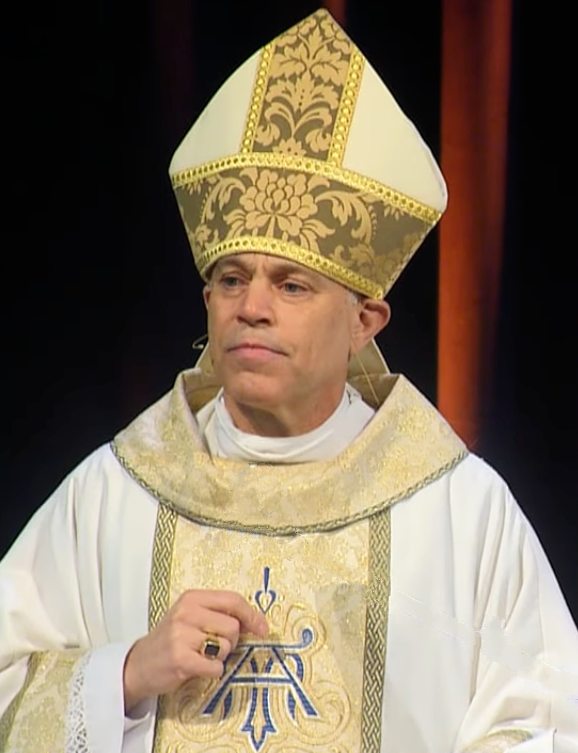
Salvatore Joseph Cordileone
Salvatore Joseph Cordileone was born on June 5, 1956, in San Diego, California, the son of a Sicilian-American fishing family. Ordained a priest of San Diego on July 9, 1982, he trained as a canon lawyer and served in Rome at the Apostolic Signatura, the Church's supreme tribunal. Pope John Paul II named him an auxiliary bishop of San Diego in July 2002, and he was ordained that August; in 2009 Benedict XVI sent him across the bay as Bishop of Oakland.
On July 27, 2012, Benedict named him Archbishop of San Francisco, and he was installed on October 4, the feast of St. Francis. He chaired the American bishops' work on the promotion and defense of marriage, and in 2014 founded the Benedict XVI Institute for Sacred Music and Divine Worship to reclaim the sense of the sacred in the liturgy. His 2015 effort to write affirmations of Catholic moral teaching into archdiocesan school handbooks brought public protests.
A theological and liturgical traditionalist who celebrates the older Roman Rite himself, he gave it a weekly home at Star of the Sea parish from 2013 and a monthly celebration in St. Mary's Cathedral in 2021; when Traditionis Custodes came, he answered that the Traditional Latin Mass 'will continue to be available' in San Francisco. In May 2022 he drew national attention by notifying Speaker Nancy Pelosi, a San Francisco Catholic, that she was not to be admitted to Holy Communion over her advocacy for abortion.
- 2021-08Statement on Traditionis Custodes: 'The Traditional Latin Mass will continue to be available here in the Archdiocese of San Francisco and provided in response to the legitimate needs and desires of the faithful.' No site was closed and no condition added. ↗
Here, at last, is a shepherd the traditional Catholic can thank. Long before Traditionis Custodes, Archbishop Cordileone gave the ancient Mass a settled home in San Francisco — a weekly celebration at Star of the Sea from 2013, and, in 2021, a monthly Mass in the cathedral itself, an honor the old rite rarely receives. He celebrates it himself. He built an institute named for Benedict XVI to recover the sense of the sacred. When the restriction came, he did not reach for the knife.
His own statement after the 2021 motu proprio is the measure of him: the Traditional Latin Mass, he said, 'will continue to be available' in his archdiocese, 'provided in response to the legitimate needs and desires of the faithful.' He framed that fidelity carefully, in loyalty to Pope Francis and without disdain for the reformed liturgy — which is precisely the disposition a peacemaker should have. He protects the old without warring on the new.
Add to this his courage in the public square — most visibly his 2022 decision on Communion and abortion — and the picture is of a bishop unafraid to stand for what the Church has always held. He is, in the plainest sense, a friend of Tradition, and the faithful of San Francisco are the richer for him.