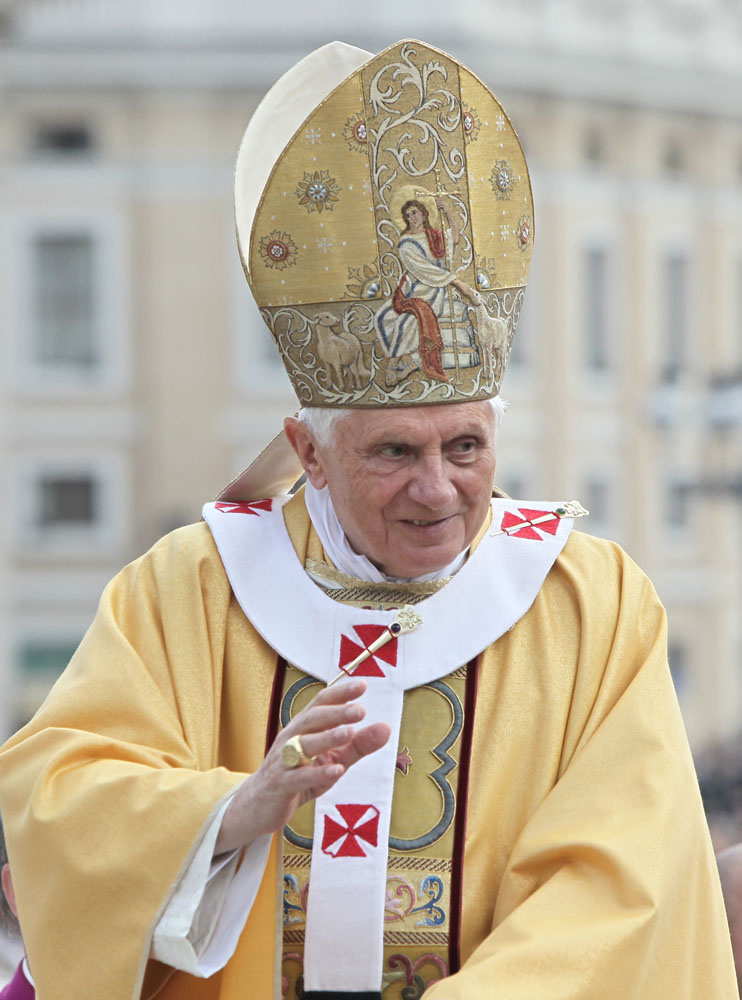
Benedict XVI
Joseph Aloisius Ratzinger was born on 16 April 1927 in Marktl am Inn, Bavaria, the son of a police officer. Ordained in 1951, he became one of the most brilliant theologians of his generation, teaching at Bonn, Münster, Tübingen, and Regensburg and serving as a peritus at the Second Vatican Council. In 1972 he helped found the theological review Communio; in 1977 he was made Archbishop of Munich and a cardinal; and in 1981 John Paul II appointed him Prefect of the Congregation for the Doctrine of the Faith, where for nearly a quarter-century he was the Church's guardian of doctrine.
Elected pope on 19 April 2005, he took the name Benedict XVI. Long before, as a cardinal, he had become the most clear-sighted critic of the post-conciliar liturgical collapse, lamenting that an organic inheritance had been replaced 'as in a manufacturing process — with a fabrication, a banal on-the-spot product.' As pope he set out to heal that wound: he freed the traditional Latin Mass, pursued a 'reform of the reform' to restore reverence to the new rite, and welcomed former Anglicans with their own dignified patrimony intact.
On 11 February 2013 he stunned the world by renouncing the papacy — the first pope to resign since Gregory XII in 1415 — citing his failing strength. He took the title 'Pope Emeritus' and lived quietly within the Vatican until his death on 31 December 2022. His resignation, and the rise of his very different successor, opened one of the strangest and most dramatic chapters in modern Church history.
Before he was Benedict, Joseph Ratzinger was the most clear-eyed critic of the liturgical revolution ever to wear the red hat. He had watched the reform from within the Church's highest counsels, and he named its sickness without flinching: what should have grown like a living thing had instead been manufactured. 'In the place of liturgy as the fruit of development,' he wrote, 'came fabricated liturgy… a banal on-the-spot product.'
He did not say it from the outside. His fellow founder of the review Communio, the Oratorian Louis Bouyer — a man who had actually sat on Bugnini's Consilium, the body that built the new Mass — left a memoir damning the whole enterprise. Bouyer called Annibale Bugnini 'a man as bereft of culture as he was of basic honesty,' and recounted how Bugnini had deceived both the commission and Pope Paul VI himself, telling each that the other demanded the changes. When Bouyer finally protested to the Pope, Paul VI could only ask: 'But is it possible? He told me that you were unanimous in approving it.' This was the testimony Ratzinger carried with him to the Chair of Peter.
And so, once pope, he acted. Summorum Pontificum (2007) was his masterstroke: with a stroke of the pen he declared that the ancient Mass had 'never been abrogated' and was 'always permitted,' and handed it back to every priest in the Latin Church. 'What earlier generations held as sacred,' he wrote, 'remains sacred and great for us too.' He would not pit the old against the new, but called them 'two usages of the one Roman rite,' meant to be 'mutually enriching' — for in the history of the liturgy 'there is growth and progress, but no rupture.'
His aim was larger than the old Mass alone. He sought a 'reform of the reform' — to draw the new rite back toward its own original intent of reverence and continuity: Holy Communion received kneeling and on the tongue, the crucifix restored to the center of the altar, priest and people together turned toward the Lord. The two forms, set side by side, would heal one another.
Even his welcome of the Anglicans bore this stamp. With Anglicanorum Coetibus (2009) he received former Anglicans into full communion with their own reverent patrimony intact — a liturgy of Cranmerian dignity and sacral English. One can only suspect he meant it as more than a generous gesture: a living example, planted in the heart of the Latin Church, of what worship offered with beauty and awe might yet recall the new rite to its purpose.
Through all of it ran one conviction: that the Second Vatican Council must be read by a 'hermeneutic of continuity,' not of rupture. He distinguished the 'Council of the Fathers' — the real Council — from the 'Council of the media' that, he said, 'created so many disasters… seminaries closed, convents closed, banal liturgy.' He loved the Council; he refused to let it be made a guillotine upon the Church's past.
His reign was shadowed by drama, and its end by tragedy. The progressive cardinals of the St. Gallen Group — who, in Cardinal Danneels' own laughing word, called themselves 'the mafia' — had opposed his election and longed for another kind of pope. When in 2013 he laid down the office, the first to do so in six centuries, a fog of theories followed him: that he was pushed, that the resignation was void, that two popes now reigned. Benedict called such talk 'absurd' and pledged obedience to his successor. But the sharpest wound was the simplest: the man who followed him would take his great gift away, and with Traditionis Custodes (2021) move to suppress the very Mass Benedict had freed.
No modern pope did more to reconcile the Church with her own worship, and none was so swiftly undone. He was the friend that Tradition had awaited for half a century — a quiet, scholarly Bavarian who handed back to the faithful the inheritance their fathers had been told to forget. For that, the traditional Catholic will keep his memory green. Requiescat in pace.