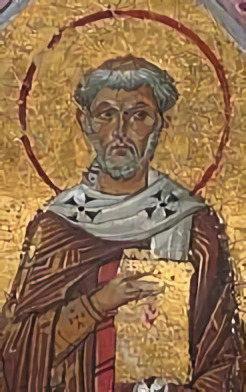
St Leo I
Leo the Great was a Tuscan by origin who rose through the Roman clergy as deacon and archdeacon under Popes Celestine I and Sixtus III, entrusted with affairs of state long before he wore the tiara. He was away on an imperial peace mission in Gaul when Sixtus III died in 440; recalled to Rome, he was consecrated on 29 September of that year. He would reign for twenty-one years, until his death on 10 November 461 — and he is the first of only two popes whom history has surnamed 'the Great.'
His name is bound forever to the great Christological crisis of the East. In 449 he sent his Tome — a dogmatic letter to Flavian, Patriarch of Constantinople — defining that in the one Person of Christ two whole natures, divine and human, abide unconfused and undivided, against the Monophysite error of Eutyches. A packed synod at Ephesus, the 'Robber Council,' contemptuously rejected it; but two years later, at the Council of Chalcedon in 451 — the Fourth Ecumenical Council — Leo's Tome was read aloud to the assembled bishops of the East, who rose and acclaimed it: 'Peter has spoken through Leo!' It remains the charter of orthodox Christology.
He was as jealous for the rights of Peter's chair as for the faith. When Chalcedon's Canon 28 sought to raise Constantinople to second rank in the Church on the strength of its being the imperial city, Leo refused to ratify it, answering the Eastern court that no see could be made apostolic by the favour of princes. In his ninety-six surviving sermons and one hundred and forty-three letters he became the patristic age's clearest voice on the papacy — that Peter himself still governs through the Roman pontiff. And in the world's collapse he stood between Rome and ruin: meeting Attila the Hun in 452, and interceding with Genseric the Vandal in 455 to spare the city from fire and slaughter. Benedict XIV declared him a Doctor of the Church in 1754.
In the autumn of 451, before the assembled bishops of the East at the Council of Chalcedon — the Fourth Ecumenical Council — Leo's Tome was read aloud. The Fathers did not merely approve it. Hearing in it the very faith of Peter, they rose and acclaimed it. It is the East's own witness, from its own ecumenical council, to where the rock of the Church stands.
Among the more than two hundred and sixty Successors of Peter, only two have been surnamed 'the Great,' and Leo I was the first to earn it. He is the pope who gave the East its Christology and the whole Church its clearest patristic doctrine of the papal office — a Doctor of the Church, and one of the towering figures of the first Christian millennium.
His Tome is the heart of it. Read to the assembled bishops of the East at Chalcedon, it drew from them not a grudging vote but a shout of recognition: 'Peter has spoken through Leo.' It is worth dwelling on who said this. Not a Roman partisan, but the gathered episcopate of the East, in the most authoritative council of the age, acknowledging in the Roman bishop's letter the voice of the Prince of the Apostles. The rock spoke, and the East knew the voice.
He was no less the guardian of Peter's prerogatives. When the same council moved, in its Canon 28, to make Constantinople second in the Church because it was the seat of empire, Leo struck the canon down — telling the imperial court that there can be 'no sure building save on that rock which the Lord has laid for a foundation,' and that Constantinople, however royal, could never be made 'an Apostolic See.' The primacy of the Church, he taught, is not the gift of emperors to the imperial city; it is Peter's confession, and Peter's chair. We note in candour that the East, which venerates Leo, has always read the jurisdiction he claimed very differently — and that this very fault line would tear open under a later Leo in 1054.
Nor was his greatness only of the study. Twice he stood between Rome and annihilation: riding out to meet Attila in 452, and confronting Genseric in 455. We will not gild the tale — the Huns' withdrawal owed something to plague and famine as well as to the Pope, and against the Vandals Leo could not prevent the sack, only spare the city from the torch and its people from the sword. But a shepherd who walks out unarmed to meet the barbarian for his flock has shown the world what the office is for.
A pillar of the Faith: the patristic giant of the papacy, the Tome that anchored Chalcedon, the voice the East itself called Peter's. When we ask where the rock of the Church stands, Leo the Great gave the answer — and the Fourth Ecumenical Council said amen.