‹ The Popes
St Leo IX
152nd Roman Pontiff

St Leo IX

LEO Nonus
Bruno von Egisheim-Dagsburg
151st Successor of St Peter · 1049–1054 · Germany · b. Eguisheim, Duchy of Swabia
1049
Elected
1054
Reign ended
5 years
Length
11th
Century
The Life

Bruno of Egisheim-Dagsburg was born in Alsace in 1002, a kinsman of the Emperor Conrad II, and served some twenty years as Bishop of Toul before the Emperor named him to the papacy. Insisting that he first be canonically received by the clergy and people of Rome, he was enthroned as Leo IX on 12 February 1049. He proved the most consequential pope in two centuries: the launch-point of what would become the Gregorian Reform, who drew into Rome's service the very men who would carry it forward — Hildebrand, the future Gregory VII; Humbert of Silva Candida; and the circle of Peter Damian.

Where his predecessors had sat in Rome, Leo travelled — crossing the Alps again and again to hold reforming synods in person across Italy, Germany, and France, waging open war on the simony and clerical corruption that had disgraced the age. He even took up the sword: in 1053 he personally led an army against the Normans of southern Italy, was utterly defeated at the Battle of Civitate, and spent nine months in honourable captivity at Benevento before his release in March 1054.

His pontificate is shadowed by the breach with the East — though he was dead before the deed was done. Patriarch Michael Cerularius of Constantinople had closed the Latin churches of the city, and the old quarrels over unleavened bread, the Filioque, and above all the primacy of Rome flared into crisis. Leo asserted the rights of Peter's chair in a series of grave letters and sent legates — Humbert, Frederick of Lorraine, and Peter of Amalfi — to Constantinople. But Leo died on 19 April 1054; and it was only on 16 July, three months after his death, that his legates laid a bull of excommunication on the altar of Hagia Sophia. Cerularius excommunicated them in return. The anathemas were personal, not understood as a final rupture for generations — and were at last lifted by Rome and Constantinople together in 1965. Leo IX was canonized a saint; his feast is kept on 19 April.

Major Works & Initiatives
The reform of the Church (from 1049)
His Roman synod of 1049 and a tireless circuit of synods across Europe, condemning simony and clerical unchastity and restoring the moral credibility of the Holy See.
The launch of the Gregorian Reform
He gathered the reforming generation — Hildebrand (the future Gregory VII), Humbert of Silva Candida, Frederick of Lorraine — making his pontificate the seedbed of the great eleventh-century renewal of the papacy.
The defence of Roman primacy (1053)
His letters to Patriarch Michael Cerularius and to the Eastern Emperor, asserting the precedence of the Roman Church over all the sees as the chair of Peter — the doctrinal heart of his dealings with the East.
Canonical election (1049)
His refusal to take the papacy by imperial appointment alone, insisting first on canonical reception by the clergy and people of Rome — itself a reforming act.
The Battle of Civitate (1053)
His ill-fated military campaign against the Normans of southern Italy, ending in defeat and his own captivity — the high-water mark of the medieval warrior-papacy.
In His Own Words
Controversies
The Great Schism of 1054
His pontificate carries the date of the East-West rupture — yet Leo had no part in the act itself. He died on 19 April 1054; his legates laid the bull of excommunication on the altar of Hagia Sophia on 16 July, three months later, in a dead pope's name during a vacancy, their commission canonically lapsed with his death. The anathemas were personal, not church-wide, were not felt as a definitive schism for generations, and were jointly lifted by Rome and Constantinople in 1965.
A pope in armour: Civitate (1053)
Leo personally raised and led an army against the Normans, was crushed at Civitate, and was taken captive — a spectacle of a warrior-pope that troubled even reformers like Peter Damian, who doubted that the successor of the Prince of the Apostles should ride to battle with the sword.
Humbert and the Donation of Constantine
The 1053 letter to Cerularius, drafted by Cardinal Humbert, buttressed the claims of Roman primacy in part by appeal to the Donation of Constantine — a document later exposed by Lorenzo Valla as a forgery. The primacy of Peter's chair rests on the words of Christ to Peter, not on that spurious grant; honest history notes that Leo's legation leaned on a prop it did not need and could not keep.
Domus Dei’s Last Word
The Pope & Tradition
A Saint, Not a Schismatic

History remembers Leo IX for the one thing he did not do: break the Church in two. The 'Great Schism of 1054' is dated to his pontificate, and the careless reader lays it at his door — yet Leo was three months in his grave before his legates laid the anathema on the altar of Hagia Sophia. He excommunicated no one. The man whose reign bears the wound of the schism was its occasion, not its author.

Who he truly was is a far brighter thing. Leo IX is the saint who lifted the papacy out of the squalor of the tenth century — the relentless reformer who crossed the Alps to hunt down simony and corruption synod by synod, who would not even accept the office by imperial fiat without canonical election, and who gathered around him the very men who would become the Gregorian Reform. Without Leo IX there is no Gregory VII, and perhaps no rescue of the medieval Church.

The primacy he pressed upon the East was not invention but memory. As he reminded Constantinople, it was the Roman Church that 'received, protected, and defended Athanasius and all the Catholics, and restored them to their own sees after they had been driven out' — Rome as the mother and the refuge of the orthodox in their persecutions, the one head 'which the voice of Christ placed first.' In his own account it was Cerularius who innovated, closing the Latin churches of his city and reaching to subject the ancient sees of Alexandria and Antioch 'with novel ambition and contrary to right and justice' — though the East, then as now, saw the matter the other way, holding that Rome's claim to a universal jurisdiction was itself the novelty upon the ancient communion of equal sees.

Honesty requires the rest. The tragedy owed much to Cerularius's intransigence and to the hot temper of Leo's own legate, Cardinal Humbert, whose sharpened translations and ready anathema did real harm — and whose case for Rome leaned partly on the Donation of Constantine, a forgery the primacy never needed. Above all it owed to the cruel timing: the legation acted in a dead pope's name, its authority doubtful, with Leo himself beyond recall. One wonders what his living hand might have stayed.

A saint, and no schismatic. The mutual anathemas of 1054 were personal, were never a clean break, and were buried at last when Paul VI and Athenagoras lifted them in 1965. What endures of Leo IX is the reformer's holiness and the clear confession of Peter's chair as the refuge of the persecuted and the head of the churches. He is a friend of the Church's unity whose death, by a bitter irony, removed the one authority that might have kept the door from slamming shut.

References & Further Reading
1.
BookLetter to Michael Cerularius, 'In terra pax hominibus' (the 'authority and privileges of the Roman Church' passage) — Pope St. Leo IX · PL 143:744-769 (here col. ~767); critical ed. C. Will, 'Acta et Scripta' (1861); trans. P. E. Sigmund, 'The Catholic Concordance' (Cambridge, 1991), p. 113 · 1053The keystone quote, from the long 1053 letter drafted by Humbert. The Latin is verified verbatim in Will's critical edition ('quisquis Romanae ecclesiae auctoritatem vel privilegia ... imminuere nititur ... Ipsa enim Athanasium ... suscepit, fovit, defendit et sedibus propriis pulsos restituit'); the English is Sigmund's published translation. Note: the line is sometimes misattributed online to Leo XIII — it is Leo IX.
2.
Letter to the Emperor Constantine IX Monomachos — Pope St. Leo IX · C. Will, 'Acta et Scripta' (1861), Doc. III; trans. W. L. North · 1054Primary source — 'one head which the voice of Christ placed first'; Rome answers for all the churches.
3.
Pope St. Leo IX — Catholic Encyclopedia · newadvent.org · 1910Standard reference on his life, reforms, and the legation of 1054.
4.
Common Declaration of Pope Paul VI and Patriarch Athenagoras I (lifting the 1054 anathemas) — Holy See · vatican.va · 1965Primary source — the 1965 mutual lifting of the excommunications of 1054.
5.
BookThe Eastern Schism — Steven Runciman · Oxford University Press · 1955The classic study of the estrangement of Rome and Constantinople, including 1054.
6.
BookThe Papacy and the Orthodox: Sources and History of a Debate — A. Edward Siecienski · Oxford University Press · 2017A balanced, scholarly history of the primacy question between East and West.
7.
BookPope Leo IX and the Medieval Papacy — ed. Robinson / sources · Manchester Medieval Sources · 2004Translated primary sources on Leo IX's reforming pontificate.
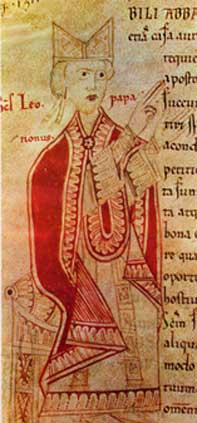
Portrait: Wikimedia Commons / Wikimedia Commons
Share on Social Media