The First Dialogue Mass at Maria Laach
When the Liturgical Movement Crossed from Contemplation to Engineering
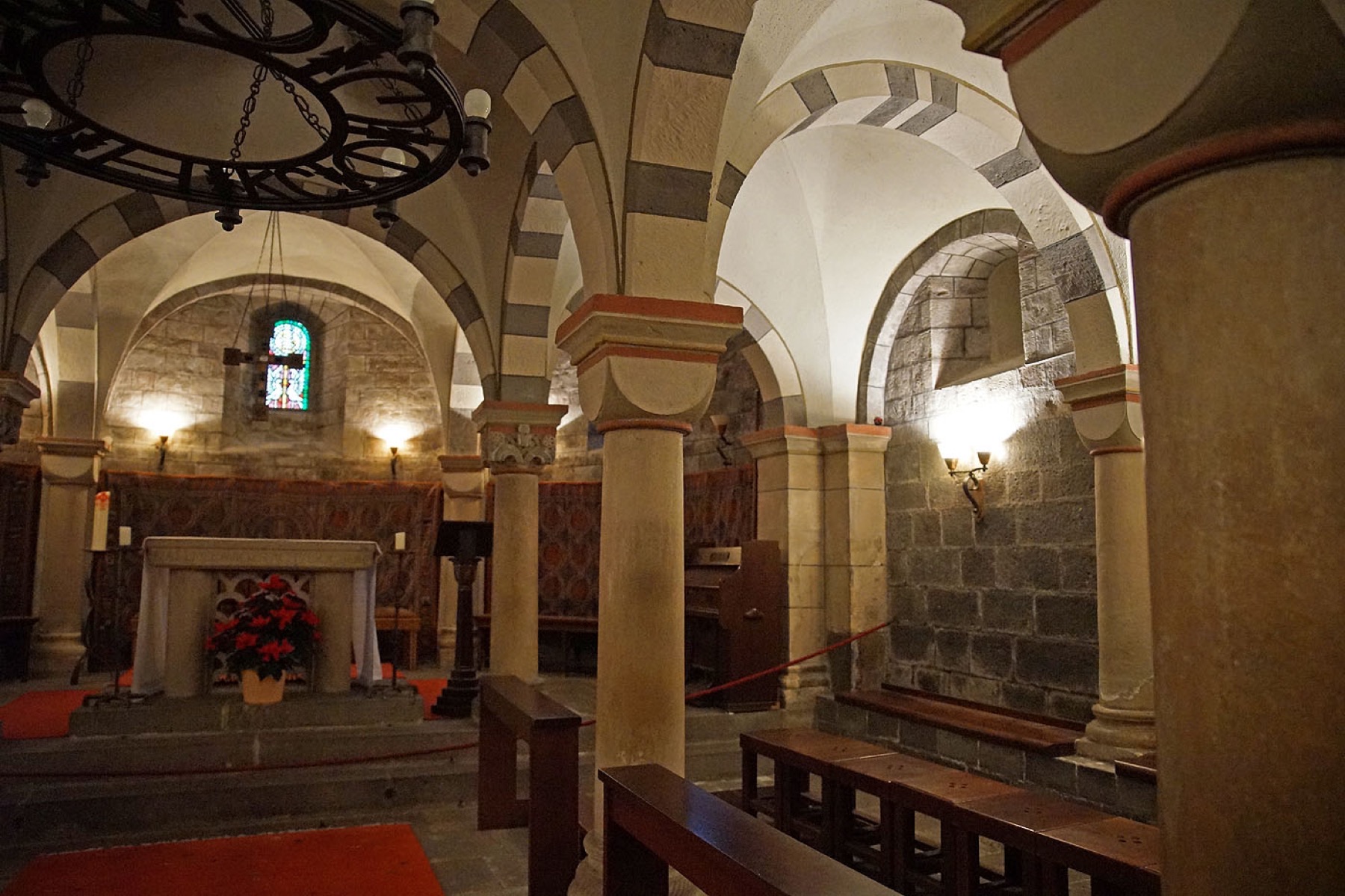
The crypt of Maria Laach Abbey—where theory became practice, and the Liturgical Movement crossed a line it could not uncross.
Photo: Heribert Bechen, CC BY-SA 2.0, via Wikimedia Commons. · Event 9 of 57
On the morning of August 6, 1921, something happened in the crypt chapel of Maria Laach Abbey that had not happened anywhere in the Latin Rite within living memory. Prior Albert Hammenstede, with the explicit permission of Abbot Ildefons Herwegen, celebrated a Missa recitata, a “Dialogue Mass” in which the entire congregation spoke the responses and recited the Gloria, Credo, Sanctus, and Agnus Dei aloud, in unison. The altar was freestanding. The priest stood behind it, facing the people. The laity brought forward bread and wine in a formal Offertory procession. One participant later recalled: “We, the congregation, were the altar boys and girls answering his invitations to prayer.”
Every one of these features was unprecedented in ordinary Catholic worship. Every one of them would become, within fifty years, the universal norm of the Roman Rite. The question this article must answer is not what happened in that crypt (the facts are well documented), but what it meant. And the answer, viewed from the full arc of the liturgical movement, is sobering: August 6, 1921 is the day the movement crossed from contemplation to engineering.
What Made It Unprecedented
To grasp the magnitude of the 1921 experiment, set it against the only two forms of Mass any Catholic alive at the time had ever experienced.
At a Low Mass, the priest stood at the altar with his back to the congregation, facing liturgical east with the people. A single altar server made the responses. The congregation was silent. The faithful might follow along in a hand missal or pray the Rosary. The entire liturgy was in Latin. The experience was contemplative, hierarchical, and interior.
At a High Mass, the same eastward orientation prevailed, but with the addition of chant. A trained schola sang the Propers and the Ordinary. Deacon and subdeacon assisted. Incense was used. The congregation still did not speak; their role was to receive the sacred action through attentive prayer.
The Dialogue Mass demolished both models. It took the Low Mass format (no deacon, no incense, no chanted Propers), but injected the congregation directly into the ritual action. The people spoke what had belonged to the server. They recited what had belonged to the schola. They physically carried gifts to the altar. And the priest turned around.
The 1921 Dialogue Mass was not a development of either the Low Mass or the High Mass. It was the invention of a third form: assembling elements from early Christian archaeology, Benedictine scholarship, and pastoral theory into a liturgy that had no precedent in the living tradition. This is precisely the method that Peter Kwasniewski identifies as the hinge between Phase One (education: love the inherited liturgy) and Phase Two (experiment: rearrange the liturgy according to historical research). Maria Laach’s crypt is where that hinge swung.
The Theological Claims Embedded in the Arrangement
Every liturgical arrangement makes a theological statement. The 1921 Dialogue Mass made several, and they were not accidental.
The freestanding altar with the priest behind it embodied the claim that the Mass is primarily a meal at which the community gathers around a table. Guardini would later articulate this explicitly: “The explanatory principle, in the conception of the Mass, is the meal.” He lamented that sacrifice had “become the concept from which the entire Mass is understood” and called this an “encroachment.”
The versus populum orientation reinforced the meal-claim by turning the priest into the host of a gathering rather than the leader of a common offering. The 20th-century reformers justified this by appeal to early Christian practice, arguing that in the Roman basilicas the priest stood on the west side of the altar and “faced the people.” This claim has been thoroughly challenged by Uwe Michael Lang and Joseph Ratzinger.
❝“The explanatory principle, in the conception of the Mass, is the meal… the form of the meal is constantly frustrated by that of the sacrifice, and something indeterminate is created.”
— Romano Guardini, Essays on the Structure of the Mass, ⚠ see the note below on what this quotation may and may not be made to say
This page previously ran a longer version of the passage above, opening with the sentence “The essence of Mass is therefore not sacrifice.” That sentence has been withdrawn from the quotation, though not from your view, and the reason should be stated plainly rather than quietly fixed.
What is attested: Guardini does write, in Essays on the Structure of the Mass, that the explanatory principle in the conception of the Mass is the meal, and that the form of the meal is frustrated by that of the sacrifice. That is on the record and it is quite damaging enough for the argument this article makes.
What is not: “The essence of Mass is therefore not sacrifice” is a far heavier claim (it would have a Catholic theologian denying that the Mass is essentially a sacrifice) and we have not been able to confirm it as his wording in the work itself. It travels in traditionalist secondary literature under headings that assert exactly that conclusion, which is the signature of a critic’s inference migrating into the author’s mouth. Until someone reads it in the edition, this site will not put that sentence between quotation marks and hang Guardini’s name beneath it. The argument does not need it.
“Protestantizing”: The Immediate Reaction
News of the crypt Mass spread rapidly through the Rhineland, and the reaction was sharp. Critics accused the Maria Laach monks of “Protestantizing” Catholic worship. The charge was not sophisticated, but it was not unfounded either.
The specific features of the 1921 Mass (freestanding table-altar, minister facing the congregation, assembly speaking the liturgical texts, emphasis on the meal aspect) mapped point for point onto the changes Martin Luther had introduced four centuries earlier when he redesigned Catholic worship into the Deutsche Messe. Luther too had turned the priest around. Luther too had put the liturgical texts into the mouths of the congregation. Luther too had reframed the Mass from sacrifice to supper.
Mediator Dei: The Church Sounds the Alarm
Twenty-six years later, Pope Pius XII addressed the Liturgical Movement directly in his 1947 encyclical Mediator Dei. The document praised the movement’s genuine achievements but also issued specific warnings that read as though the Pope had the 1921 crypt Mass open on his desk.
Pius XII warned against those who would “restore the altar to its primitive table-form,” treat later liturgical developments as deformations, or reduce the distinction between the ministerial priesthood and the common priesthood of the faithful. State the warning precisely, though, because the loose version of it is not what the encyclical says, and the loose version is what this page used to print.
§61. “The same reasoning holds in the case of some persons who are bent on the restoration of all the ancient rites and ceremonies indiscriminately. The liturgy of the early ages is most certainly worthy of all veneration. But ancient usage must not be esteemed more suitable and proper, either in its own right or in its significance for later times and new situations, on the simple ground that it carries the savor and aroma of antiquity. The more recent liturgical rites likewise deserve reverence and respect. They, too, owe their inspiration to the Holy Spirit, who assists the Church in every age even to the consummation of the world.”
§62. “Assuredly it is a wise and most laudable thing to return in spirit and affection to the sources of the sacred liturgy. For research in this field of study, by tracing it back to its origins, contributes valuable assistance towards a more thorough and careful investigation of the significance of feast-days, and of the meaning of the texts and sacred ceremonies employed on their occasion. But it is neither wise nor laudable to reduce everything to antiquity by every possible device. Thus, to cite some instances, one would be straying from the straight path were he to wish the altar restored to its primitive table form…”
— Pius XII, Mediator Dei, 20 November 1947
The earlier version welded §62 to §61 as a single quotation, in reverse document order, with no paragraph numbers, and with the opening sentence of each cut away. Both cuts mattered, and both cut in the site’s favour. §61 opens by calling the early liturgy “worthy of all veneration” and goes on to insist that the later rites deserve equal reverence, so the paragraph is not a defence of antiquity against novelty, it is a refusal to rank the two by age at all. §62 opens by calling the return to the sources “wise and most laudable.” Pius XII did not condemn looking back. He condemned reducing everything to what was found there.
Here is the fact that decides how this article ends. Of the practices pioneered in that crypt, the table altar and the priest facing the people were never legislated, not by Pius XII, not by the Council, not by the Missal of 1969. No text anywhere commands them. Mediator Dei named the table altar an error in 1947 and was never abrogated, corrected or repudiated on the point; the 1969 Missal did not reverse it, because the 1969 Missal never addressed it. The crypt’s arrangement became the universal practice of the Latin Church without a single line of law requiring it. (See Mediator Dei: Praise and Warning for the eight practices the encyclical named and what became of each.)
From Experiment to Agenda: The 1951 Congress
In 1951, on the thirtieth anniversary of the crypt Mass, Maria Laach hosted a liturgical congress that reveals how completely the experimental spirit of 1921 had hardened into a reform program. The congress gathered reform-minded clergy and scholars who passed a series of resolutions that went far beyond anything the 1921 participants could have imagined.
The 1951 resolutions called for: reforming the Offertory prayers of the Roman Canon; restructuring the Canon itself; introducing the vernacular for Scripture readings; having the priest celebrate portions of the Mass at a side altar facing the people; and restoring the Offertory procession as a standard feature. These were not abstract theological proposals. They were specific liturgical-engineering blueprints, and they were forwarded directly to Rome.
The pipeline is direct and documented. What was improvised in a Rhineland crypt in 1921 became a scholarly program in the 1930s and 1940s, a concrete legislative agenda in 1951, and the universal law of the Roman Rite by 1970. The trajectory from experiment to imposition took exactly forty-nine years.
“Plumber’s Work”: The Pioneers Repudiate Their Children
The most devastating testimony against the post-conciliar reform comes not from traditionalist critics but from the heirs of the pioneers themselves.
Fr. Petrus Tschinkel of Klosterneuburg Abbey, a close associate and disciple of Fr. Pius Parsch, one of the Dialogue Mass movement’s most important figures gave an interview in which he stated flatly that Parsch “would not at all have agreed with the changes of the post-conciliar era. That’s not what he wanted. Yes, the liturgy in the mother tongue. That is all, however.”
Tschinkel then related a story about Romano Guardini. A priest from Munich who knew Guardini personally had visited St. Gertrude’s in Klosterneuburg shortly after the Council. Tschinkel asked how Guardini felt about the new liturgical texts. The priest answered: “When he got the new texts, he looked at them for a long time… and then he said to me: Klempnerarbeit!”—“Plumber’s work!”
The chain is three deep: Guardini said it to a Munich priest, who said it to Tschinkel, who said it in a 1992 interview. This article is the source from which the Klempnerarbeit line reaches the rest of this site, so the qualification belongs here rather than anywhere it is repeated.
And the date rules out the obvious reading. Guardini died on 1 October 1968. The Missal of Paul VI was promulgated in April 1969 and took effect in 1970. He never saw it. “The new texts” he studied for a long time can only have been the interim reforms: Inter Oecumenici (1964), the 1965 Ordo Missae, or the Missa normativa tried before the Synod of Bishops in 1967. Any page on this site that has Guardini judging the Novus Ordo is wrong, and the correction is not a concession: it means the movement’s own theological architect had already reached that verdict before the reform’s most far-reaching stage.
❝“Pius Parsch would not at all have agreed with the changes of the post-conciliar era. That’s not what he wanted. Yes, the liturgy in the mother tongue. That is all, however. But also, the Mass as mystery, as a reality hic et nunc… After the Second Vatican Council these liturgical forms are nothing but idling: only text after text. Not a trace of internal disposition nor of mystery.”
— Fr. Petrus Tschinkel, 1992
The Crypt as Laboratory
The image that best captures August 6, 1921 is not “bold experiment” or “prophetic forerunner.” It is laboratory. In the crypt of Maria Laach, the compounds of the Liturgical Movement (historical research, pastoral zeal, patristic archaeology, communitarian theology) were combined for the first time in a controlled practical test.
But compounds that behave well in a controlled laboratory can behave very differently when released into the general population. The Maria Laach crypt was a controlled environment: a monastic community of scholars and serious Catholic intellectuals, steeped in liturgical formation, acting under legitimate monastic authority. The post-conciliar reform took those same compounds and injected them into every parish in the world, without formation, without preparation, without understanding, and with a bureaucratic ruthlessness that would have appalled every monk in that crypt.
The pioneers were not wrong about everything. The gap between the liturgy’s richness and the average layperson’s experience was real. The desire to help Catholics enter more deeply into the sacred mysteries was noble. But the method they chose, rearranging the liturgy to match a theory rather than forming the faithful to receive the liturgy as given, contained a fatal flaw. It assumed that the problem was in the rite, not in the people.
That is the legacy of the crypt. Not a catastrophe, but the seed of one. Planted with love, watered with scholarship, and harvested by men whose vision of the Church the planters would not have recognized.
Set the two ends of this article beside each other. In 1921 a prior in a Rhineland crypt turned an altar around, with his abbot’s permission and nobody else’s. In 1947 a pope named that arrangement an error in an encyclical. That encyclical was never abrogated, never corrected, never repudiated, and the freestanding altar and the priest facing the people were never commanded by anyone: not by the Council, not by the Missal of 1969, not by any instruction since. By 1970 both were the ordinary experience of nearly every Catholic on earth.
There is no moment in that sequence where a law changed, because no law ever did. There is no villain in it either, and no hidden hand: the crypt Mass was celebrated by permission, the 1951 resolutions were forwarded to Rome openly, and the men who carried the practice forward were the same men across five decades, doing in public what they had always said they wanted to do. What beat Mediator Dei was not an argument. It was forty-nine years of people who agreed with each other outlasting a Magisterium that saw the danger, said so once, and then declined to govern the matter again. Mediator Dei was never overruled. It was outrun, and this crypt is where the running started.
- Orientation: Low/High Mass: priest and people face east together. Dialogue Mass: priest faces congregation across freestanding altar.
- Congregation: Low Mass: silent (server responds). High Mass: choir sings. Dialogue Mass: entire congregation speaks responses, Gloria, Credo, Sanctus, Agnus Dei.
- Offertory: Low/High Mass: priest alone prepares gifts. Dialogue Mass: laity bring forward bread and wine in formal procession.
- Theology: Low/High Mass: sacrifice offered to God, priest and people facing the Lord together. Dialogue Mass: communal meal-action with assembly as co-offerers.
- Phase One (Guéranger): Learn and love the inherited liturgy. Explain its meaning. Help the faithful enter into it. The rite itself is not touched.
- Phase Two (Herwegen, etc.): Historical research produces conviction that the rite has “accretions.” Scholars implement changes—versus populum, congregational responses—that conflict with existing law.
- Phase Three (Bugnini): Experimental spirit hardens into reform program. The entire Roman Rite is redesigned: Mass, lectionary, calendar, Divine Office, sacraments.
- The Hinge: The 1921 Dialogue Mass is the hinge between Phase One and Phase Two. Before it, the Movement received the liturgy. After it, the Movement redesigned the liturgy.
- Fr. Petrus Tschinkel: “Pius Parsch would not at all have agreed with the changes of the post-conciliar era. That’s not what he wanted.”
- Romano Guardini: Reportedly, on seeing the reformed texts: “Klempnerarbeit!” Plumber’s work. Second-hand and undated; he died in 1968, so the target can only be the 1964–67 interim reforms, not the new Missal.
- Joseph Ratzinger: “The Liturgical Movement had been attempting to teach us to understand the Liturgy as a living network of Tradition that cannot be torn apart into little pieces.”
- Fr. Louis Bouyer: Consultor to the Consilium who later expressed deep regret, describing the reform process as captured by ideologues.
The 1951 Congress: Experiment Becomes Agenda
In 1951, on the thirtieth anniversary of the crypt Mass, Maria Laach hosted a liturgical congress that reveals how completely the experimental spirit of 1921 had hardened into a reform program. The congress gathered reform-minded clergy and scholars who passed resolutions that were not abstract theological proposals — they were specific liturgical-engineering blueprints, forwarded directly to Rome.
The congress passed resolutions calling for the following reforms, each of which became, within two decades, either universal law or the subject of active experimentation under the Consilium:
- I. Reforming the Offertory prayers of the Roman Canon, deemed to anticipate the Consecration.
- II. Restructuring the Roman Canon itself to restore “primitive” forms identified through patristic scholarship.
- III. Introducing the vernacular for Scripture readings at Mass.
- IV. Having the priest celebrate portions of the Mass at a freestanding altar, facing the people.
- V. Restoring the Offertory procession, in which the laity carry bread and wine to the altar, as a standard feature of Sunday Mass.
- New Catholic Encyclopedia (2nd ed.), “Liturgical Movement, Catholic”
- Pius XII, Mediator Dei (1947)
- Romano Guardini, Vom Geist der Liturgie (1918)
- Romano Guardini, Essays on the Structure of the Mass
- Joseph Ratzinger, The Spirit of the Liturgy (Ignatius Press, 2000)
- Peter Kwasniewski, Reclaiming Our Roman Catholic Birthright (Sophia Institute Press, 2020)
- Peter Kwasniewski, “‘Plumber’s Work!’: Romano Guardini and Petrus Tschinkel on the Liturgical Reform” (New Liturgical Movement, 2020)
- Uwe Michael Lang, Turning Towards the Lord: Orientation in Liturgical Prayer (Ignatius Press, 2004)
- Alcuin Reid, The Organic Development of the Liturgy, 2nd ed. (Ignatius Press, 2005)
- Annibale Bugnini, The Reform of the Liturgy 1948–1975 (Liturgical Press, 1990)
- Carol Byrne, “History of the Dialogue Mass” series