Mediator Dei: Praise and Warning
Pope Pius XII issues the first papal encyclical devoted entirely to liturgy, praising the movement’s renewal but condemning the archaeologism, the blurring of priesthood, and the private experimentation that threatened to devour it.
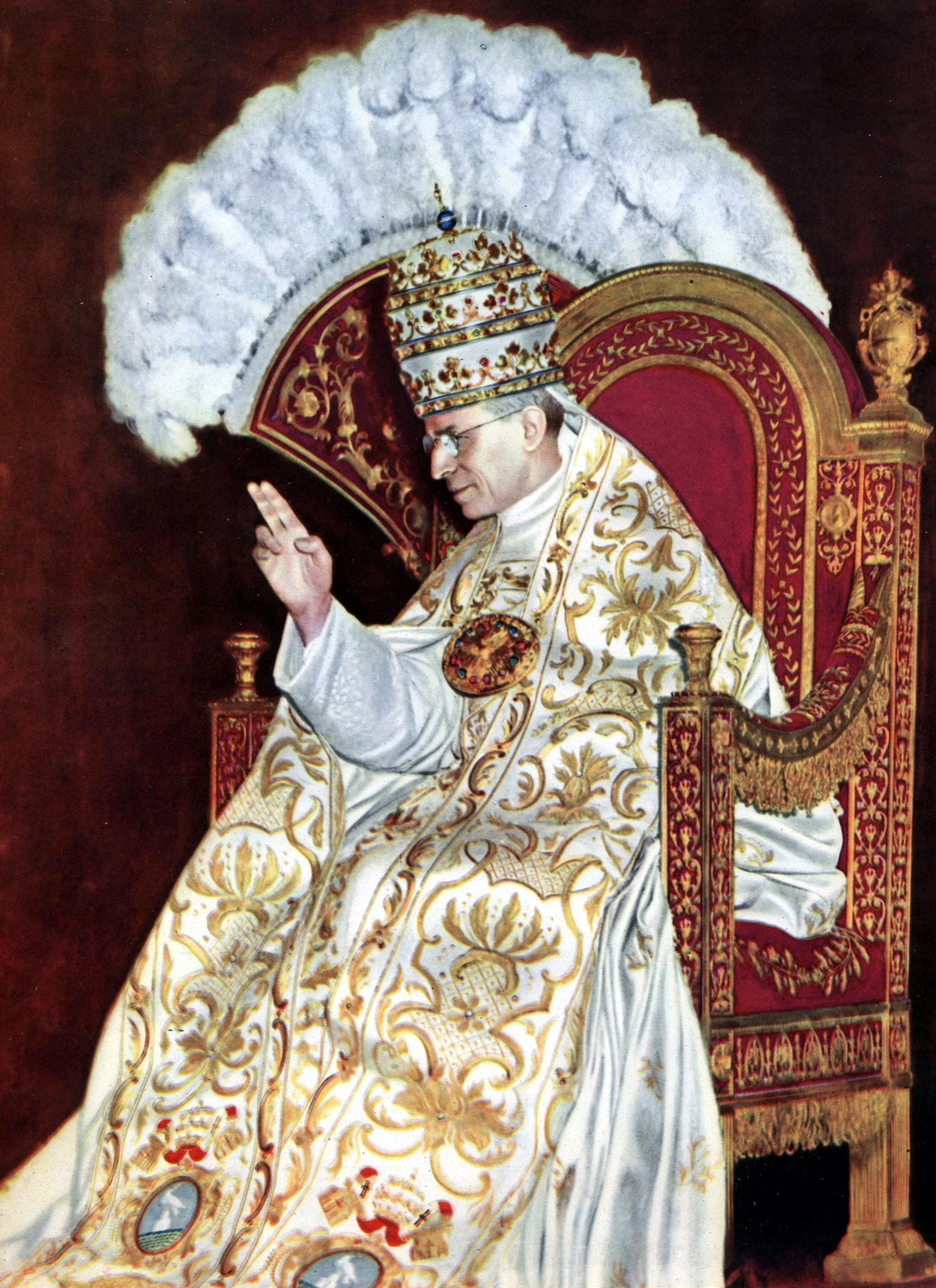
Pope Pius XII promulgates Mediator Dei, November 20, 1947—the first papal encyclical devoted entirely to the sacred liturgy
Photo: Joachim Specht (1949), public domain, via Wikimedia Commons. · Event 12 of 57
He saw everything coming. On November 20, 1947, two years after the most destructive war in human history, the Venerable Pope Pius XII promulgated the longest and most detailed papal statement on liturgy the Church had ever produced. Mediator Dei was not a routine administrative document. It was the work of a pope who understood that the most dangerous threat to the Church in that hour was not the Soviet armies massing in Eastern Europe. It was the work already under way in her own sanctuaries: in the experimental chapels of Klosterneuburg and Maria Laach, in the paraliturgical gatherings of the Centre de Pastorale Liturgique in Paris, in the pages of Orate Fratres at Collegeville, Minnesota. Something was stirring in the Western Church that mixed genuine piety with dangerous theology, and Pius XII intended to separate the wheat from the tares before the harvest was lost.
He failed. Not because his diagnosis was wrong (it was devastating in its precision), but because the very men he empowered to carry out his remedies were, in many cases, sympathetic to the disease.
I. The Climate: A Church Under Siege
To understand Mediator Dei, one must understand the Church into which it was born. By 1947, Catholic Europe was in ruins—not only physically but spiritually. The war had shattered every institution the old Christendom had built. France, long the eldest daughter of the Church, was the epicenter of crisis. In 1943, two chaplains of the Young Christian Workers (JOC), Henri Godin and Yvan Daniel, had published a slim volume with an explosive title: France, pays de mission?—Is France mission territory? It appeared in September 1943 under the patronage of Cardinal Emmanuel Suhard of Paris, who answered it by founding the Mission de Paris. The working class had been lost. The rural parishes were emptying. An entire civilization was being de-Christianized from within, and the Church’s ancient structures seemed powerless to stop it.
This was the atmosphere in which two overlapping but distinct intellectual currents gained enormous momentum in Catholic thought; currents that would converge in ways neither their originators nor the Pope fully anticipated.
II. Two Currents, One River
The first was the Liturgical Movement itself, now entering what Peter Kwasniewski has identified as its second, more radical phase. What had begun under Dom Gueranger at Solesmes as a recovery of monastic prayer, and developed at Maria Laach and Klosterneuburg into scholarly study and pastoral experimentation, was by the 1940s producing innovations that went beyond anything contemplated by its founders. Pius Parsch was celebrating Mass facing the people. Dialogue Masses were spreading through German-speaking parishes. The Centre de Pastorale Liturgique in Paris, founded in 1943, was publishing aggressive proposals for vernacularization and structural reform. Private individuals (even though they be clerics, as the Pope would soon remind the world) were deciding for themselves how to celebrate the sacred mysteries.
The second current was the Nouvelle Theologie. Arising primarily among French Jesuits at Fourviere-Lyon and French Dominicans at Le Saulchoir, this movement challenged the neo-Scholastic theology that had dominated Catholic intellectual life since Leo XIII’s Aeterni Patris in 1879. Its leading figures (Henri de Lubac, Yves Congar, Marie-Dominique Chenu, Jean Danielou) advocated a return to the sources: Scripture, the Church Fathers, and the liturgy itself, rather than the textbook Thomism of the Roman schools. Their Dominican critic Reginald Garrigou-Lagrange, horrified at what he saw as a replay of Modernism, published a devastating broadside in 1946: “La Nouvelle Theologie, ou va-t-elle?”—Where is the new theology leading? His answer: straight to Modernism.
The two movements were not identical. But they shared a common method, the appeal to antiquity against later development, and a common enemy: the established structures of the post-Tridentine Church. Where the liturgical innovators argued that the early Christian “meal” was more authentic than the medieval Mass, the Nouvelle Theologiens argued that the patristic vision of nature and grace was more authentic than Baroque Scholasticism. Both movements practiced what would later be called ressourcement; a return to sources. And both, in the eyes of Rome, risked replacing the living tradition with an idealized reconstruction of the past.
The Liturgical Movement and the Nouvelle Theologie were distinct but allied currents. They shared a method (return to sources over organic development), a philosophical posture (historical consciousness against Scholastic timelessness), and increasingly, personnel. De Lubac’s Corpus Mysticum (1944) directly influenced liturgical theology by reframing the Eucharist as primarily ecclesial. Congar’s ecumenical ecclesiology eroded the boundaries that had kept Catholic worship distinct. In 1942 de Lubac and Danielou, with Victor Fontoynont and Claude Mondesert, founded the Sources Chretiennes series at Lyon, published by the Dominicans’ Editions du Cerf. By the 1940s, the two rivers were flowing into one.
III. What the Pope Praised
Mediator Dei was not a condemnation. That point is essential and often forgotten by both progressives and traditionalists. Pius XII opened with genuine praise. He traced the renewed interest in liturgy to several Benedictine monasteries and acknowledged it as a movement of the Holy Spirit. The liturgy, he taught, is the public worship of the whole Mystical Body (Head and members), and far more than a collection of rubrics and ceremonies. It is nothing less than the exercise of Christ’s priestly function through the ages.
The encyclical called for active participation. Using the phrase already found in Pius X’s 1903 Tra le sollecitudini, Pius XII urged that the faithful not attend Mass in an “inert and negligent fashion, giving way to distractions and day-dreaming.” He encouraged congregational responses. He praised the study of liturgical sources. He recognized that the liturgy, like the Church itself, is a living organism that grows, matures, and accommodates itself to the needs of the age—provided the integrity of doctrine is safeguarded.
This was groundbreaking. Never before had a pope devoted an entire encyclical to the theology of worship. The document gave the Liturgical Movement something it had never possessed: official papal recognition. As Annibale Bugnini, the ambitious young Vincentian who would later architect the post-conciliar reform, noted with satisfaction, Pius XII had in Mediator Dei “put the seal of his supreme authority on this movement” (The Reform of the Liturgy, p. 6).
IV. What the Pope Condemned
But the praise occupied only one wing of the encyclical. The other wing was a catalogue of errors so precise, so prophetic, and so thoroughly ignored that reading it today produces an uncanny feeling, as though Pius XII had been given a preview of the next half-century and tried, in one massive document, to prevent it.
Those errors can be sorted under six heads, and the deep-dive panel below sets them out with paragraph numbers. But the taxonomy is the lesser half of the achievement. Twice the encyclical stops describing tendencies and names practices: three of them in §59, five in §62. Eight specific things, each identified in 1947 as an error. Both paragraphs have to be quoted the way they were written, because both are almost always quoted short, and §62 quoted short says very nearly the opposite of what it says.
“The Church is without question a living organism, and as an organism, in respect of the sacred liturgy also, she grows, matures, develops, adapts and accommodates herself to temporal needs and circumstances, provided only that the integrity of her doctrine be safeguarded. This notwithstanding, the temerity and daring of those who introduce novel liturgical practices, or call for the revival of obsolete rites out of harmony with prevailing laws and rubrics, deserve severe reproof. It has pained Us grievously to note, Venerable Brethren, that such innovations are actually being introduced, not merely in minor details but in matters of major importance as well. We instance, in point of fact, those who make use of the vernacular in the celebration of the august eucharistic sacrifice; those who transfer certain feast-days, which have been appointed and established after mature deliberation, to other dates; those, finally, who delete from the prayerbooks approved for public use the sacred texts of the Old Testament, deeming them little suited and inopportune for modern times.”
— Pius XII, Mediator Dei, 20 November 1947 (§59)
“Assuredly it is a wise and most laudable thing to return in spirit and affection to the sources of the sacred liturgy. For research in this field of study, by tracing it back to its origins, contributes valuable assistance towards a more thorough and careful investigation of the significance of feast-days, and of the meaning of the texts and sacred ceremonies employed on their occasion. But it is neither wise nor laudable to reduce everything to antiquity by every possible device. Thus, to cite some instances, one would be straying from the straight path were he to wish the altar restored to its primitive table form; were he to want black excluded as a color for the liturgical vestments; were he to forbid the use of sacred images and statues in Churches; were he to order the crucifix so designed that the divine Redeemer’s body shows no trace of His cruel sufferings; and lastly were he to disdain and reject polyphonic music or singing in parts, even where it conforms to regulations issued by the Holy See.”
— Pius XII, Mediator Dei, 20 November 1947 (§62)
The paragraph above was previously numbered §64 here. It is §62, and it was also cut off after the crucifix, dropping the fifth instance entirely. Both are now fixed against the text on vatican.va.
And neither paragraph condemns what it is usually said to condemn. §59 opens by calling the Church a living organism that grows, adapts and accommodates herself to temporal needs: the very sentence reformers would quote for the next twenty years. §62 opens by calling the return to the sources wise and most laudable. What Pius XII condemns is narrower and sharper: novelty out of harmony with prevailing laws and rubrics, and reducing everything to antiquity, which the next paragraph defines as going back to ancient usage while discarding the later patterns introduced by Providence (§63). Any argument that treats every recovery of an ancient form as the error Pius XII named will not survive contact with his own opening sentences, and is not made on this site. What the two paragraphs give is not a prohibition on ressourcement. It is a list of eight specific practices, named in 1947 as errors.
Pius XII named eight practices. Within twenty-five years of the encyclical every one of them was normal in the Latin Church. What follows is the tally, and the second column is the part that matters: only three of the eight were ever legislated. The other five simply happened.
1. Vernacular in the eucharistic sacrifice. Permitted in part by Inter Oecumenici (1964), then throughout the Mass of Paul VI. In law, and universal in practice.
2. Transferring feast-days “appointed and established after mature deliberation.” Done wholesale by the General Roman Calendar of 1969.
3. Deleting Old Testament texts “deeming them little suited and inopportune for modern times.” The Liturgy of the Hours of 1971 omits Psalms 58, 83 and 109 entirely, and some verses of others, “because of the difficulty they can cause because of their psychology” (General Instruction of the Liturgy of the Hours, §131). Bugnini records that Paul VI himself preferred to “omit the imprecatory and historical psalms” (The Reform of the Liturgy, p. 175). The reader may set those reasons beside the encyclical’s.
4. The altar restored to its primitive table form. No conciliar or post-conciliar text ever ordered it, though the 1964 instruction Inter oecumenici (§91) recommended it: “The main altar should preferably be freestanding, to permit walking around it and celebration facing the people.” Neither Sacrosanctum Concilium nor the 1969 Missal requires a table altar or Mass facing the people. Both became near-universal anyway.
5. Black excluded as a colour for vestments. Black was never abolished; the 1969 Missal still permits it for the dead. It disappeared from parish use regardless.
6. Sacred images and statues removed from churches. Sacrosanctum Concilium §125 explicitly orders that the practice of placing sacred images in churches be maintained. Sanctuaries were stripped anyway.
7. The crucifix designed to show no trace of suffering. Never mandated, never mentioned. The resurrexit cross spread on its own.
8. Polyphony disdained or rejected. Sacrosanctum Concilium §116 gives Gregorian chant pride of place and states that polyphony is by no means excluded. It vanished from ordinary parish life all the same.
This is the whole argument of this article in one place, and it is narrower than the usual claim. Five of the eight errors Pius XII named were never commanded by anyone: not by the Council, not by the Missal, not by the Congregation. On three of them the law of 1969 says the opposite of what happened. They did not need legislation. A movement with continuity of personnel and purpose across four pontificates simply outlasted a Magisterium that agreed with it in part, condemned it in part, and never resolved the contradiction. Mediator Dei was not overruled. It was outrun.
First: Archaeologism. The Pope condemned the belief that ancient liturgical forms are ipso facto superior to later developments. He compared it explicitly to the errors of the Synod of Pistoia (1786): a heretical gathering that had proposed vernacular liturgy, stripped altars, and the abolition of religious devotions. Every one of these things would be normal within twenty-five years of the encyclical.
Second: The blurring of priesthood. Pius XII warned against those who taught that “priesthood” meant only the common priesthood of all the baptized, that the hierarchical priesthood arose from a delegation by the community rather than from Christ through apostolic succession.
Third: Private experimentation. The Pope reasserted in the strongest possible terms that the regulation of worship belongs to the Sovereign Pontiff alone. Private individuals “may not be left to decide for themselves in these holy and venerable matters.”
Fourth: The denigration of devotion. Mediator Dei defended Eucharistic adoration, devotion to the Sacred Heart, the Rosary, and other “pious exercises” against those who dismissed them as medieval accretions incompatible with the “pure” liturgy of the early Church.
Fifth: A false account of participation. The encyclical calls for active participation and then qualifies it: participation is not measured by external activity at every moment, and interior participation, contemplation, silent prayer, spiritual communion, is not a lesser kind.
Sixth: Inverting the rule of prayer and the rule of belief. Against the claim that the liturgy determines doctrine without qualification, Pius XII insisted the liturgy “does not decide or determine independently and of itself what is of Catholic faith” (§48).
❝“This way of acting bids fair to revive the exaggerated and senseless antiquarianism to which the illegal Council of Pistoia gave rise.”
— Pius XII, Mediator Dei, §64
V. The Men Behind the Errors
Mediator Dei, in the diplomatic style of papal encyclicals, named no names. But the targets were unmistakable to every informed reader in the Catholic world of 1947.
The archaeologism condemned in paragraph 62 (restoring the altar to table form, stripping churches of images, redesigning the crucifix) pointed directly to the experiments at Klosterneuburg, where Pius Parsch had installed a freestanding versus populum altar and was celebrating the Betsingmesse as a model of “primitive” worship recovered. It pointed to the Jugendbewegung circles in Germany where Romano Guardini’s students were already stripping their chapels to bare essentials.
The errors on priesthood (the reduction of the ordained minister to a delegate of the community) reflected currents in both the Liturgical Movement and the Nouvelle Theologie. De Lubac’s Corpus Mysticum, published in 1944, had reframed the relationship between the Eucharistic Body and the Ecclesial Body in ways that blurred the distinction between the priest who consecrates and the community that participates. The “people’s altar” concept was inseparable from a “people’s priesthood” concept.
The condemnation of private experimentation was directed at the entire network of liturgical centers and parish laboratories that had sprung up across Germany, Austria, Belgium, and France: sanctuaries where clerics were, on their own initiative, modifying ceremonies, introducing vernacular elements, rearranging the sanctuary, and treating the Mass as raw material for pastoral creativity.
VI. The Paradox: How the Innovators Claimed Victory
Here is the great irony of Mediator Dei. The very men whom the encyclical warned against immediately claimed it as a vindication. The progressivist reading strategy was breathtaking in its audacity: accept the praise, ignore the warnings, and cite the encyclical’s endorsement of “active participation” as papal authorization for everything the document actually condemned.
Bugnini saw the document not as a brake but as a spur, writing that Pius XII had “put the seal of his supreme authority” on the movement (p. 6).
The progressivists were not entirely wrong to claim partial victory. Mediator Dei did grant the Liturgical Movement something priceless: official recognition as a legitimate current in the Church. And by calling for “active participation”, however carefully he qualified the term, Pius XII handed his opponents a slogan they would wield with devastating effect for the next half-century.
VII. The Fundamental Contradiction
Here we arrive at the darkest paradox in the story of Mediator Dei, a paradox that traditionalist historians have struggled with ever since.
Six months after issuing the most comprehensive papal condemnation of liturgical experimentation in the history of the Church, Pius XII appointed Annibale Bugnini as Secretary of the newly formed Pontifical Commission for Liturgical Reform (May 28, 1948). Bugnini was a thirty-five-year-old Vincentian priest, born 14 June 1912 and so a fortnight short of thirty-six, with academic credentials, editorial connections through the journal Ephemerides Liturgicae, and progressive liturgical sympathies. His later program would match what Mediator Dei (§8) had warned against: “certain enthusiasts, over-eager in their search for novelty, are straying beyond the path of sound doctrine and prudence.”
The Commission, established in the wake of the encyclical, was ostensibly meant to implement its principles. In practice, it became the institutional vehicle through which the very reforms Mediator Dei condemned were gradually introduced under the cover of papal authority. The reformed Easter Vigil of 1951. The restructured Holy Week rites of 1955. The rubrical simplifications that suppressed octaves, vigils, and first vespers. Each step was small. Each was presented as prudent modernization. Paul VI would later call the Vigil and Holy Week reforms “the first stage of updating the Roman Missal for the present-day mentality” (Missale Romanum, 1969).
“The commission enjoyed the full confidence of the Pope, who was kept abreast of its work by Monsignor Montini and even more, on a weekly basis, by Father Bea, confessor of Pius XII.”
— Annibale Bugnini, The Reform of the Liturgy 1948–1975 (Liturgical Press, 1990), p. 9
How could this happen? During periods when the aging Pope was ill and isolated, Bugnini’s channel of influence ran through men who were sympathetic to the reform agenda. One does not need conspiracy theories to explain what happened. One needs only to understand how institutions work: the man who controls the secretary’s desk controls the outcome.
VIII. Mediator Dei and Humani Generis: The Twin Defenses
Mediator Dei was not Pius XII’s only attempt to hold the line. Three years later, on August 12, 1950, he issued Humani Generis, this time targeting the Nouvelle Theologie directly. Where Mediator Dei had condemned liturgical archaeologism, Humani Generis condemned theological relativism: the tendency to historicize dogma, to treat truth as evolving with the times, to replace the precision of Scholastic philosophy with the ambiguities of existentialism and phenomenology.
The encyclical named no names, but the targets were well known. De Lubac was asked by his religious superiors not to publish or teach, a silence that lasted from 1950 to 1958. Congar was removed from teaching in 1954 and sent to Jerusalem, then Cambridge, then Strasbourg in a series of disciplinary transfers. Chenu had been silenced earlier.
Together, Mediator Dei and Humani Generis formed a two-front defense: the first guarding the liturgy from archaeologism, the second guarding theology from relativism. Both were issued by a pope who understood that the two threats were related, that you could not rewrite the lex orandi without eventually rewriting the lex credendi. Both were clear, comprehensive, and authoritative. Neither was ever repealed, corrected, or repudiated. Both were, within fifteen years of his death, simply unenforced.
❝“Never before had a dogmatic encyclical been so quickly and so completely disavowed by the very men who had fallen under its condemnation.”
— Fr. Dominique Bourmaud, One Hundred Years of Modernism: A Genealogy of the Principles of the Second Vatican Council (Angelus Press, 2006), writing of Humani Generis, not of Mediator Dei
Bourmaud is describing Humani Generis (1950), not Mediator Dei, and the distinction matters twice over. It is why he can call it a dogmatic encyclical: Humani Generis is a doctrinal intervention, while Mediator Dei is a disciplinary and theological one on worship. This page quotes him here because the two encyclicals were a single defensive strategy, and both met the same fate. But the sentence should not be read as a judgment on Mediator Dei, and it is not offered as one.
IX. The Rehabilitation
Pius XII died on October 9, 1958. His successor, Angelo Giuseppe Roncalli, took the name John XXIII (canonised in 2014) and immediately began reversing the disciplinary measures of the previous pontificate. Congar, de Lubac, Danielou, Rahner, Kung (theologians who had been silenced, censured, or viewed with official suspicion) were invited to Rome as periti for the Second Vatican Council.
The liturgical reformers fared even better. Bugnini was named Secretary of the Pontifical Preparatory Commission on the Liturgy in 1960, then Secretary of the Consilium for implementing the Council’s Constitution on the Sacred Liturgy. From that position, he oversaw the creation of the Novus Ordo Missae, promulgated by Paul VI (canonised in 2018) in 1969. The relationship between that book and the errors Mediator Dei condemned needs stating exactly, because it is usually overstated. Post-conciliar law legislated one of the eight, the vernacular (SC §36; Inter oecumenici, 1964), with the calendar and the psalter following in 1969 and 1971. It did not legislate the table altar, Mass facing the people, the stripped sanctuary, the unwounded crucifix, or the loss of polyphony. Those arrived in the parishes without a text ordering them, and in several cases against a text saying the reverse.
A detail that only became visible decades later concerns the footnotes. The liturgy schema put before the Council in October 1962 carried notes covering, in John O’Malley’s words, “a wide variety of sources but with a generous sprinkling from the encyclical Mediator Dei”; the draft presented at the second session in 1963 still carried over 125 of them. The text Paul VI promulgated in December 1963 has 42: twenty-three citing Scripture, nine citing liturgical books, six the Fathers, four the Council of Trent. Every footnote citing anything else was gone, and that category included every papal document: Tra le sollecitudini, Divini cultus, Musicae sacrae disciplina, De musica sacra, and Mediator Dei.
This page used to say the references were “systematically stripped” and the encyclical “quietly erased.” That goes further than the evidence, and the evidence is strong enough without it. The removal was a stylistic decision, and a member of the commission said so. Pierre-Marie Gy, a member of the conciliar liturgical commission, recorded that it was determined the Constitution’s style “would be that traditionally adopted in Councils; it would be wholly biblical,” with references retained only for biblical, liturgical and patristic quotations. On that account nothing was aimed at Mediator Dei in particular; it fell with every other papal citation, including two by Pius X and Pius XI whom no one was trying to bury. Gy added that the constitution nonetheless “relies considerably on the great encyclical of Pius XII and time and again it uses its very terminology, without quotation marks or reference.”
What survives that explanation is not motive but effect, and the effect is what this site claims. A document that had been drafted showing its descent from half a century of papal teaching was promulgated showing none of it. Whatever the intention, the continuity became invisible on the page, and a reader of the promulgated text has no footnote pointing back to the encyclical that was supposed to govern the reform. That is a fact about the document, provable by counting, and it needs no theory of intent attached to it.
Source: Susan Benofy, “Footnotes for a Hermeneutic of Continuity: Sacrosanctum Concilium‘s Vanishing Citations,” Adoremus Bulletin 21.1 (2015); see also Matthew Hazell, “‘Mediator Dei? Never heard of it!'”, New Liturgical Movement, June 2015.
X. The Lesson of the Encyclical
What, then, is the legacy of Mediator Dei? Traditionalists have read it as a prophecy, the last clear warning before the flood. Progressives have read it as the document that legitimized the very movement it tried to restrain. Both readings contain truth, and that is precisely what makes the encyclical so heartbreaking.
Pius XII saw the danger with extraordinary clarity. He identified the specific errors (archaeologism, the blurring of priesthood, private experimentation, the denigration of devotion) with a precision that reads like a checklist of what happened after 1965. He drew the theological lines in exactly the right places. He reasserted the principle that only the Sovereign Pontiff has authority over the liturgy.
But he also, perhaps unavoidably, gave the movement the one thing it needed most: the papal seal of legitimacy. And he entrusted the implementation of his own encyclical to men who did not share his vision. The Commission for Liturgical Reform, the appointment of Bugnini, the reformed Holy Week rites—these were not betrayals by outsiders. They were actions taken under papal authority by a pope who believed he could control the forces he was channeling.
Pius XII had named the danger himself: it is “neither wise nor laudable to reduce everything to antiquity by every possible device” (§62). And Mediator Dei, for all its brilliance, could not stop what it had correctly described, because naming an error and governing against it are two separate acts, and Rome performed only the first.
Read today, the encyclical is the pre-conciliar papacy’s clearest sight of what was coming, and its plainest demonstration that seeing is not the same as governing. It named eight practices. All eight became normal, and five of them without any law ever requiring it; on three, the Council’s own text says the opposite of what happened. Yet the encyclical was never abrogated, never corrected, never repudiated. Every word of it still stands.
That is the finding this site holds to, and it is deliberately narrow. There is no villain in it, no hidden hand, no claim about any man’s interior life. Pius XII was not deceived about doctrine; he was outmatched in governance: fast to diagnose, slow to enforce, and confident that a movement handed papal recognition could be steered by the very men he had just finished warning. It could not. What defeated Mediator Dei was not an argument but a calendar. A movement with continuity of personnel and purpose across four pontificates outlasted a Magisterium that agreed with it in part, condemned it in part, and never resolved the contradiction. Mediator Dei was never overruled. It was outrun.
Pius XII rejected antiquarianism – the assumption that older is automatically better – seventeen years before the body that produced the new Missal first met. Much of that Missal was built by precisely that method. Did the New Mass Empty the Pews? →
The Arc of Intervention: 1943–1962
Pius XII spent his pontificate building a two-front defense: Mediator Dei to guard the liturgy, Humani Generis to guard theology. Neither was ever repealed. But within four years of his death the men they targeted were back: rehabilitated by John XXIII and appointed periti of the Council whose documents the encyclicals no longer governed.
The Principal Players
Pius XII was surrounded by men working at cross-purposes: Garrigou-Lagrange sounding the alarm from Rome, de Lubac and Congar advancing the new theology from France, Bugnini quietly building the institutional machinery of reform from inside the Vatican, and Montini and Bea serving as intermediaries with sympathies the Pope may not have fully understood.
What Mediator Dei Specifically Rejected
The errors condemned in Mediator Dei can be organized into six categories. Each is documented by paragraph number. Each became common practice after the Council; few were ever legislated.
1. Archaeologism (§§ 61–64)
The belief that ancient liturgical forms are inherently superior to later developments. Pius XII called this “exaggerated and senseless antiquarianism” and compared it to the condemned Synod of Pistoia (1786). Specifically condemned: restoring the altar to table form, excluding black vestments, forbidding sacred images, redesigning the crucifix to remove signs of suffering, and rejecting polyphonic music.
2. The Blurring of Priesthood (§§ 82–84)
The teaching that “priesthood” means only the common priesthood of all the baptized, that the hierarchical priesthood arises from community delegation, and that the Mass is therefore a “concelebration” in which the priest acts merely as the people’s representative.
3. Private Liturgical Authority (§§ 57–58)
The claim that individual priests or local communities can modify liturgical practice on their own authority. The encyclical reasserted: “The Sovereign Pontiff alone enjoys the right to recognize and establish any practice touching the worship of God.”
4. Liturgical Exclusivism (§§ 172–185)
The tendency to denigrate popular devotions (Eucharistic adoration, the Rosary, novenas, devotion to the Sacred Heart) as obstacles to “authentic” liturgical participation.
5. False Understandings of Participation (§§ 79–81, 105–111)
While promoting genuine “active participation,” the encyclical clarified that this does not require external activity at every moment. Interior participation (contemplation, silent prayer, spiritual communion) is equally valid.
6. Inverting the Rule of Prayer and the Rule of Belief (§48)
The claim that liturgy is merely whatever the community does when it assembles, that the lex orandi (rule of prayer) determines the lex credendi (rule of belief) without qualification. Pius XII insisted on the reverse priority: “The sacred liturgy does not decide or determine independently and of itself what is of Catholic faith.”
Mediator Dei condemned six specific categories of error: archaeologism (ancient = better), priesthood-blurring (priest = community delegate), private experimentation (liturgy as playground), anti-devotionalism (Rosary as obstacle), false participation (exterior = active), and the primacy of liturgy over doctrine. Every category became common practice after the Council, though few were ever legislated.
Three Interpretive Traditions
The Progressive Reading
Progressives read Mediator Dei as the document that legitimized the Liturgical Movement and opened the door to Vatican II. They emphasize the encyclical’s praise of the movement, its call for active participation, its recognition that liturgy is a “living organism” that develops with the times. The warnings about archaeologism are treated as minor qualifications. In this reading, the trajectory from Mediator Dei through Sacrosanctum Concilium to the Novus Ordo Missae represents continuous, organic development under papal guidance.
The Traditional Reading
Traditionalists read Mediator Dei as a prophetic warning that was systematically ignored and ultimately betrayed. They note that every specific error condemned by the encyclical was subsequently implemented: the table altar, the stripped sanctuary, the blurred priesthood, the suppression of devotions, the end of Latin. They point to the removal of Mediator Dei citations from the final text of Sacrosanctum Concilium as evidence of deliberate erasure. In this reading, the post-conciliar reforms were not an organic development but a revolution; one that could only succeed by suppressing the very magisterial document that was supposed to govern liturgical development.
The Tragic Reading
A third interpretation holds that Mediator Dei was both prophecy and catalyst—that Pius XII’s attempt to channel the Liturgical Movement inadvertently accelerated it. By giving the movement papal recognition, he transformed scattered experiments into an officially sanctioned program. By calling for active participation, he provided a slogan that could be stretched to justify anything. By establishing the Commission for Liturgical Reform and staffing it with progressives, he created the institutional machinery that would eventually dismantle everything the encyclical was meant to protect. In this reading, Pius XII’s fundamental error was not theological but strategic: he believed that the movement could be reformed from within. It could not.
Progressives read Mediator Dei as a green light. Traditionalists read it as a red light that was run. The tragic reading holds that it was both: the Pope saw the danger clearly but gave the movement the one thing it needed, legitimacy, and entrusted implementation to men who didn’t share his vision. The result was a dam built by the same engineers who wanted the flood.
Events That Led Here
- Pius XII. “Mediator Dei.” Encyclical on the Sacred Liturgy, November 20, 1947. Vatican translation.
- Pius XII. “Mystici Corporis Christi.” Encyclical on the Mystical Body, June 29, 1943.
- Pius XII. “Humani Generis.” Encyclical on False Opinions, August 12, 1950.
- Garrigou-Lagrange, Reginald. “La Nouvelle Theologie, ou va-t-elle?” Angelicum 23 (1946): 126–145.
- Bugnini, Annibale. “The Reform of the Liturgy (1948–1975).” Collegeville: Liturgical Press, 1990.
- Kwasniewski, Peter. “Reclaiming Our Roman Catholic Birthright.” Angelico Press, 2020.
- Reid, Alcuin. “The Organic Development of the Liturgy.” 2nd ed. San Francisco: Ignatius Press, 2005.
- Mettepenningen, Jurgen. “Nouvelle Theologie, New Theology.” London: T&T Clark, 2010.
- Bonneterre, Didier. “The Liturgical Movement: From Dom Gueranger to Annibale Bugnini.” Kansas City: Angelus Press, 2002.
- De Mattei, Roberto. “The Second Vatican Council: An Unwritten Story.” Loreto Publications, 2012.
- Godin, Henri and Yvan Daniel. “France, pays de mission?” Paris: Cerf, 1943.
- Bourmaud, Dominique. “One Hundred Years of Modernism.” Kansas City: Angelus Press, 2006.
- Congar, Yves. “My Journal of the Council.” Collegeville: Liturgical Press, 2012.
- O’Malley, John W. “What Happened at Vatican II.” Harvard University Press, 2008.