Orate Fratres & The American Movement
Dom Virgil Michel, the Liturgy-Justice Synthesis, and the Collegeville Pipeline
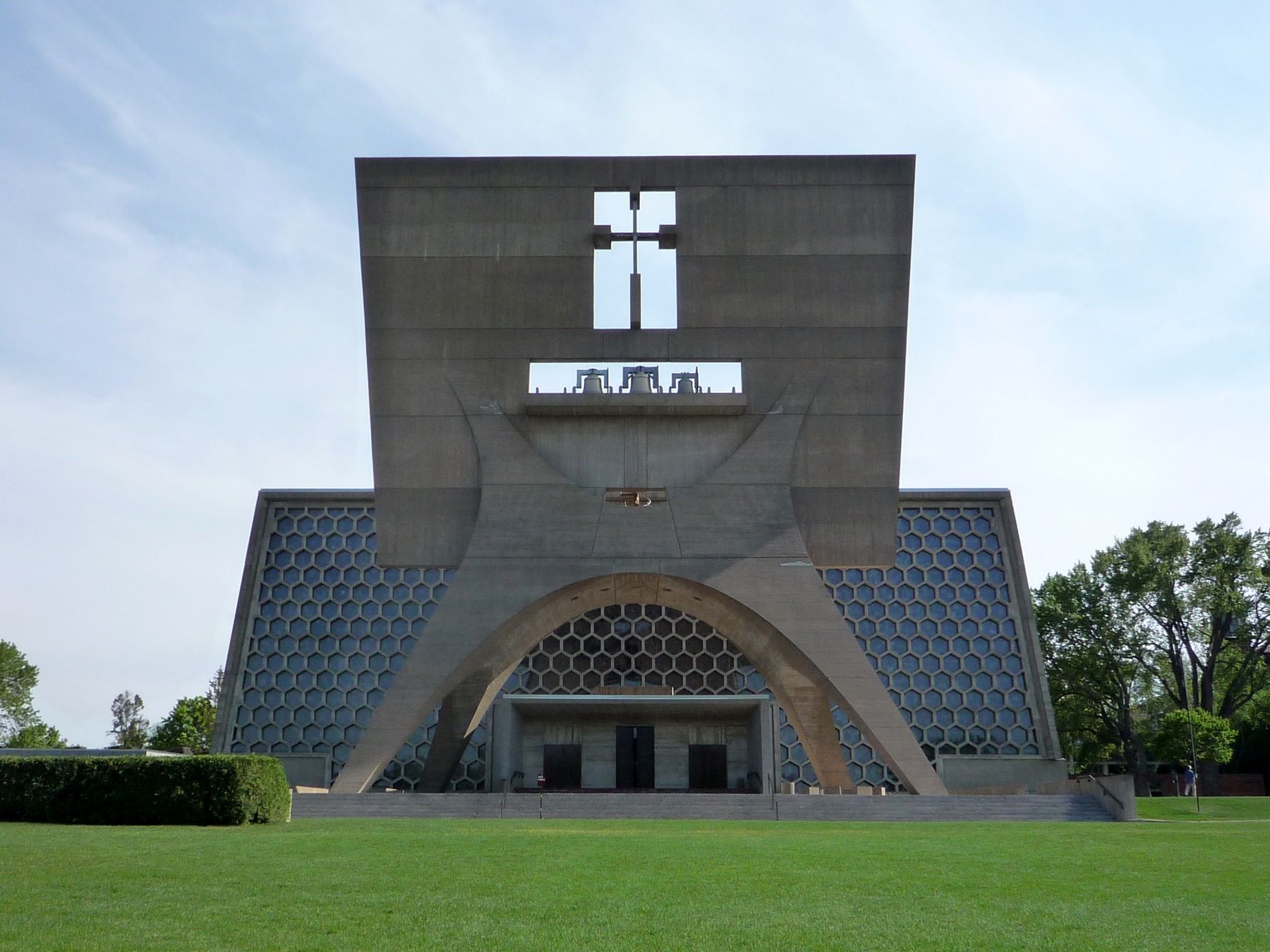
St. John’s Abbey, Collegeville, Minnesota—the cradle of the American liturgical movement and the institution that would carry Virgil Michel’s legacy in directions he could not have foreseen.
Photo: Bobak Ha’Eri, CC BY 3.0, via Wikimedia Commons. · Event 10 of 57
On the first Sunday of Advent, 1926, a new journal appeared in the mailboxes of several hundred American Catholic clergy and religious. It was called Orate Fratres (“Pray, Brethren”), and its first editorial announced, with a directness unusual for liturgical scholarship, that Catholic worship in America was in crisis. Not because the rubrics were wrong or the Latin was incomprehensible, but because the faithful had been reduced to spectators at a rite they no longer understood. The editor was a thirty-six-year-old Benedictine monk named Virgil Michel. He was brilliant, tireless, theologically original, and entirely orthodox. Within twelve years he would be dead. Within fifty, the institutions he built would be unrecognizable.
The story of Dom Virgil Michel is not the story of a man who broke things. It is the story of a man who built things that other men broke, and who has the peculiar misfortune of being posthumously claimed by both the people who love what he built and the people who demolished it. Understanding his actual legacy, and the distance between what he intended and what his successors accomplished, is essential for any honest assessment of the liturgical movement in America.
The Man from St. Paul
George Francis Michel was born on June 26, 1890, in St. Paul, Minnesota, the second of fifteen children in a devout German-Catholic family. He entered St. John’s Abbey at Collegeville while still a teenager, taking the religious name Virgil. He earned a doctorate in English and a licentiate in theology from the Catholic University of America, where he studied under Thomas Edward Shields, a pioneer of educational philosophy who argued that liturgy was not merely a duty but a pedagogical act, that the rites of the Church, properly understood, taught the faith more effectively than any catechism. The seed was planted.
Michel returned to Collegeville and was appointed dean of St. John’s University. He was by all accounts a formidable intellect with an extraordinary breadth of interest: philosophy, education, economics, social theory, and theology all fell within his active engagement. He was a Thomist by training and temperament, deeply committed to the Catholic intellectual tradition, and increasingly convinced that something fundamental had gone wrong in the relationship between American Catholics and their worship. But it was not until he went to Europe that he understood what to do about it.
The European Encounter
In 1924, Michel’s abbot, Alcuin Deutsch, sent him to Rome for further studies at the Pontifical Athenaeum of Sant’Anselmo. Michel found the philosophy instruction, dominated by Joseph Gredt’s dry neo-scholastic manual approach, deeply unsatisfying. But what he found outside the classroom changed his life.
At Sant’Anselmo he encountered Lambert Beauduin, the Belgian Benedictine who had electrified the 1909 Malines Congress with his call to make the liturgy the center of Catholic pastoral life. Beauduin was not a revolutionary. He did not advocate structural changes to the rite. His program was educational: put missals in the hands of the faithful, explain the liturgical year, restore Gregorian chant where it had decayed, and help ordinary Catholics understand what was happening at the altar. Michel absorbed this vision wholesale. He later translated Beauduin’s foundational work La Piété de l’Église into English, one of the first major acts of cross-pollination between the European and American movements.
He visited Maria Laach, Solesmes, and the major European centers of liturgical scholarship. By the time he returned to Minnesota in 1925, he had a plan: bring the European liturgical movement to America, but on American terms, adapted to the practical, apostolic, socially engaged character of the American Church.
Orate Fratres and the Liturgical Press
Abbot Deutsch gave Michel the support he needed. In 1926, two institutions were born simultaneously at Collegeville: Orate Fratres, a monthly journal of liturgical education, and the Liturgical Press, a publishing house dedicated to making liturgical scholarship accessible to ordinary Catholics. Both were unprecedented in the English-speaking world.
Orate Fratres was not an academic journal in the European mold. Michel conceived it as a bridge between scholarship and the pew: a periodical that could translate the best liturgical theology into language that parish priests, religious sisters, and educated laypeople could use. Its editorial policy was clear: the liturgy, as the Church had received it, was the primary school of Christian formation. The problem was not the rite itself but Catholic ignorance of what the rite contained. The solution was not to change the Mass but to change the worshipper’s understanding of it.
This is Phase One of the liturgical movement in its purest American expression—the spirit of Guéranger transposed for the New World. Michel loved the Roman Rite as it existed. He wanted Catholics to enter more deeply into what they already possessed, not to rearrange it according to archaeological theories. His 1937 masterwork, The Liturgy of the Church, is a sustained, eloquent meditation on the inherited liturgy (its structure, its symbolism, its theological grammar) written with a convert’s wonder and a scholar’s precision.
“Virgil Michel is an eloquent and insightful guide to the time-tested grandeur and subtle poetry of the Roman Rite. It was precisely the Church’s liturgy in its traditional form that inspired his fervent commitment to ongoing education for the sake of a deeper participation in divine worship. He is thus an exemplary figure of the healthy phase of the Liturgical Movement, prior to its radicalization at the hands of progressive iconoclasts.”
— Peter Kwasniewski, blurb for the Arouca Press edition of The Liturgy of the Church
The Michel Syllogism
Michel’s most original theological contribution was a synthesis so elegant it can be stated as a syllogism, and so powerful that it continues to shape Catholic social thought nearly a century later.
He drew the premises from two papal sources. From Pius X: the liturgy is the indispensable source of the true Christian spirit. From Pius XI (Quadragesimo Anno, 1931): the true Christian spirit is indispensable for the regeneration of society. The conclusion writes itself: the liturgy is the primary basis of social regeneration.
Major premise (Pius X): The liturgy is the indispensable source of the true Christian spirit.
Minor premise (Pius XI): The true Christian spirit is indispensable for social regeneration.
Conclusion (Michel): Therefore, the liturgy is the primary basis of social regeneration.
This was not a rhetorical trick. It was a theological claim rooted in the doctrine of the Mystical Body of Christ, and Michel developed it with systematic rigor. His argument ran as follows: if the faithful are incorporated into Christ through Baptism, and if they exercise that incorporation primarily through the liturgical act, then the liturgy is where Christians learn that they are not isolated individuals but members of one Body. And if they are members of one Body, then the suffering of any member is the concern of every member. Social responsibility does not arise from secular philosophy imposed on Christian consciences; it arises organically from the liturgical act itself, which teaches the faithful who they are.
❝“The members of the Mystical Body of Christ who are truly living up to the graces of their incorporation with Christ will be inspired to carry their Christ-like spirit into all their human actions and relations.”
— Virgil Michel, O.S.B., “The Liturgy the Basis of Social Regeneration” (1935)
The Ojibwe Years and the Catholic Worker
In 1930, Michel’s eyesight failed; the result of years of relentless intellectual work. He was sent by his superiors to serve on the Ojibwe reservation in northern Minnesota, a pastoral assignment that might have been intended as a rest but became instead a crucible. Living among the poorest Catholics in the state, watching families struggle with poverty, racism, and institutional neglect, Michel’s Mystical Body theology stopped being abstract. If these people are members of Christ’s Body, he realized, then every Catholic who ignores their suffering is ignoring Christ.
He returned to Collegeville in 1933 with a fire that would not go out. Within months he had connected with Dorothy Day and Peter Maurin, the founders of the Catholic Worker movement. The partnership was natural: Day and Maurin needed a theological framework for their radical commitment to the poor, and Michel had one that was entirely Catholic, entirely liturgical, and entirely immune to Marxist co-optation. He introduced the Divine Office, particularly Compline, into Catholic Worker houses, grounding their social activism in the rhythms of communal prayer. Day would later identify Michel as one of the most important intellectual influences on the movement.
Death and the Unfinished Work
On November 26, 1938, Virgil Michel died suddenly at Collegeville. He was forty-eight years old. The cause of death was streptococcal infection, a disease that antibiotics, commercially available just two years later, would have cured. He left behind twelve years of published work, two institutions of national significance, an international network of collaborators, and a movement that was only beginning to find its stride.
Michel died of streptococcal infection on November 26, 1938, at the age of forty-eight. Penicillin, commercially available just two years later, would have cured him. He was buried at St. John’s Abbey wearing the Benedictine habit, with the Office of the Dead sung in Latin over his coffin by the community he had served since boyhood.
— Paul Marx, O.S.B., Virgil Michel and the Liturgical Movement (1957)
The Collegeville Trajectory
Michel’s immediate successor as editor of Orate Fratres was Godfrey Diekmann, O.S.B. (1908–2002), a younger Collegeville monk who had studied at Maria Laach. Diekmann was brilliant, ambitious, and possessed of a pastoral urgency that Michel would have recognized. He was also something Michel was not: a man willing to move from educating the faithful about the existing liturgy to redesigning the liturgy for the faithful. The distinction is the hinge on which the entire American movement turns.
The trajectory is visible in the journal’s own history. Michel founded Orate Fratres in 1926 with an explicitly Latin title as a statement of principle: the journal existed to help Catholics pray the rite they had. In 1951, Diekmann renamed it Worship. The name change was not cosmetic. It signaled a shift from the traditional rite as the object of education to “worship” as a universal category amenable to restructuring. The Latin title had pointed backward, toward what had been received. The English title pointed forward, toward what might be invented.
Michel planted a garden. Diekmann turned it into a laboratory.
Within Kwasniewski’s three-phase framework, Phase One (education: receive and love the inherited liturgy), Phase Two (experiment: rearrange the liturgy according to historical research), Phase Three (ideology: reconstruct the liturgy to match a predetermined pastoral vision)—Michel belongs to Phase One with early Phase Two tendencies. Diekmann carried the torch directly into Phase Three. The pipeline is concrete: Michel founds Orate Fratres (1926) → Diekmann renames it Worship (1951). Michel explains the Roman Rite lovingly → Diekmann drafts its replacement. The American liturgical movement was captured from within.
Today, Collegeville is home to the Godfrey Diekmann Center for Patristics and Liturgical Studies, the Virgil Michel Scholar programs connecting liturgy and social justice, and Worship magazine; all firmly situated in the progressive liturgical camp. The Liturgical Press, Michel’s own creation, remains one of the largest Catholic publishers in the English-speaking world. Its catalog now reflects the post-conciliar consensus that Michel’s original vision, properly understood, always pointed toward the reforms of 1969. This is the institutional victory: the man who loved the traditional liturgy has been made the patron saint of its demolition.
Two Camps, One Man
Virgil Michel is now claimed by both sides of the liturgical divide, and both have genuine warrant for the claim. The progressive camp emphasizes the liturgy-social justice nexus, the call for active participation, and the late-career reform suggestions. The traditional camp emphasizes The Liturgy of the Church, the consistently sacrificial language, the Thomistic philosophical framework, and the Guéranger-style love of the inherited rite.
The honest assessment requires holding both realities. Michel’s work was overwhelmingly faithful to the inherited tradition. His institutions became the most effective pipeline for that tradition’s dismantling. He cannot be blamed for what men did with his legacy after his death, but neither can the institutional trajectory be treated as an accident unrelated to the movement he built.
The Cautionary Pattern
The story of Virgil Michel is not a villain story. It is something more instructive and more painful: a story about what happens when a good man builds institutions on the assumption that his successors will share his reverence for what they have inherited. Michel assumed that Catholics who studied the liturgy more deeply would love it more fiercely. He did not anticipate that a generation of scholars, formed by his own tools and inspired by his own enthusiasm, would conclude that the liturgy they had studied needed not to be received but to be redesigned.
Dom Virgil Michel, O.S.B., died on November 26, 1938. He was buried at St. John’s Abbey wearing the Benedictine habit, with the Office of the Dead sung in Latin over his coffin by the community he had served since boyhood. The liturgy he loved has not been celebrated regularly at St. John’s for more than half a century.
- Lambert Beauduin, O.S.B. (1873–1960): Belgian Benedictine who launched the pastoral liturgical movement at the 1909 Malines Congress. Michel met him at Sant’Anselmo and translated his foundational work into English.
- Alcuin Deutsch, O.S.B. (1877–1951): Abbot of St. John’s who sent Michel to Europe and supported the founding of Orate Fratres and the Liturgical Press.
- Dorothy Day (1897–1980) & Peter Maurin (1877–1949): Founders of the Catholic Worker movement. Michel provided the theological framework connecting liturgy to social justice.
- Thomas Edward Shields (1862–1921): Pioneer of educational philosophy at CUA who argued that the liturgy was pedagogical. Michel studied under him.
- Godfrey Diekmann, O.S.B. (1908–2002): Michel’s successor as editor, who renamed Orate Fratres to Worship, served as a Vatican II peritus, co-founded ICEL, and spent his later career advocating progressive reforms.
- 1926: Orate Fratres founded — Latin title signals fidelity to the received rite
- 1926: Liturgical Press founded, publishes missals and educational materials
- 1940: National Liturgical Weeks begin, annual conferences for education
- 1951: Orate Fratres renamed Worship, signals shift from received rite to universal category
- 1960s: Liturgical Weeks draw 15,000–20,000 become platforms for innovation
- 1963: ICEL co-founded; Diekmann among founders
- Today: Collegeville houses Diekmann Center, Virgil Michel Scholar programs, Worship magazine, all progressive
- The Progressive Reading: Emphasizes the liturgy-social justice nexus, the call for “active participation,” late-career reform suggestions. Reads Michel through the lens of what came after.
- The Traditional Reading: Emphasizes The Liturgy of the Church and its sacrificial language, the Thomistic framework, Guéranger-style love of the inherited rite. Reads Michel through what he actually wrote. Arouca Press now republishing his works.
- The Honest Verdict: Both camps have genuine warrant. Michel’s work was overwhelmingly faithful to the inherited tradition. His institutions became the pipeline for that tradition’s dismantling. The question is whether the movement contained structural vulnerabilities. The answer is plainly yes.
This Event Directly Influenced
Related Figures & Events
- Beauduin & the Malines Congress (1909)
- Maria Laach: The German Center (1914)
- The First Dialogue Mass (1921)
- Virgil Michel, O.S.B.
- Godfrey Diekmann, O.S.B.
- Dorothy Day & the Catholic Worker
- Virgil Michel, O.S.B., The Liturgy of the Church: According to the Roman Rite (Collegeville: Liturgical Press, 1937; reprinted Arouca Press, 2023)
- Virgil Michel, O.S.B., “The Liturgy the Basis of Social Regeneration,” Orate Fratres 9 (1935)
- Pius X, Tra le sollecitudini (1903)
- Pius XI, Quadragesimo Anno (1931)
- Pius XII, Mystici Corporis Christi (1943)
- Paul Marx, O.S.B., Virgil Michel and the Liturgical Movement (Liturgical Press, 1957)
- R. W. Franklin and Robert L. Spaeth, Virgil Michel: American Catholic (Liturgical Press, 1988)
- Keith F. Pecklers, S.J., The Unread Vision: The Liturgical Movement in the United States of America, 1926–1955 (Liturgical Press, 1998)
- Kathleen Hughes, R.S.C.J., The Monk’s Tale: A Biography of Godfrey Diekmann, O.S.B. (Liturgical Press, 1991)
- Peter Kwasniewski, Reclaiming Our Roman Catholic Birthright (Sophia Institute Press, 2020), ch. 2
- Alcuin Reid, The Organic Development of the Liturgy, 2nd ed. (Ignatius Press, 2005)