The Mont-César Conference
At the Belgian abbey where Dom Lambert Beauduin had launched the whole movement in 1909, the scholars who would shape the coming reform met again — and the cradle of the Liturgical Movement showed itself as a node in a fast-growing international network.
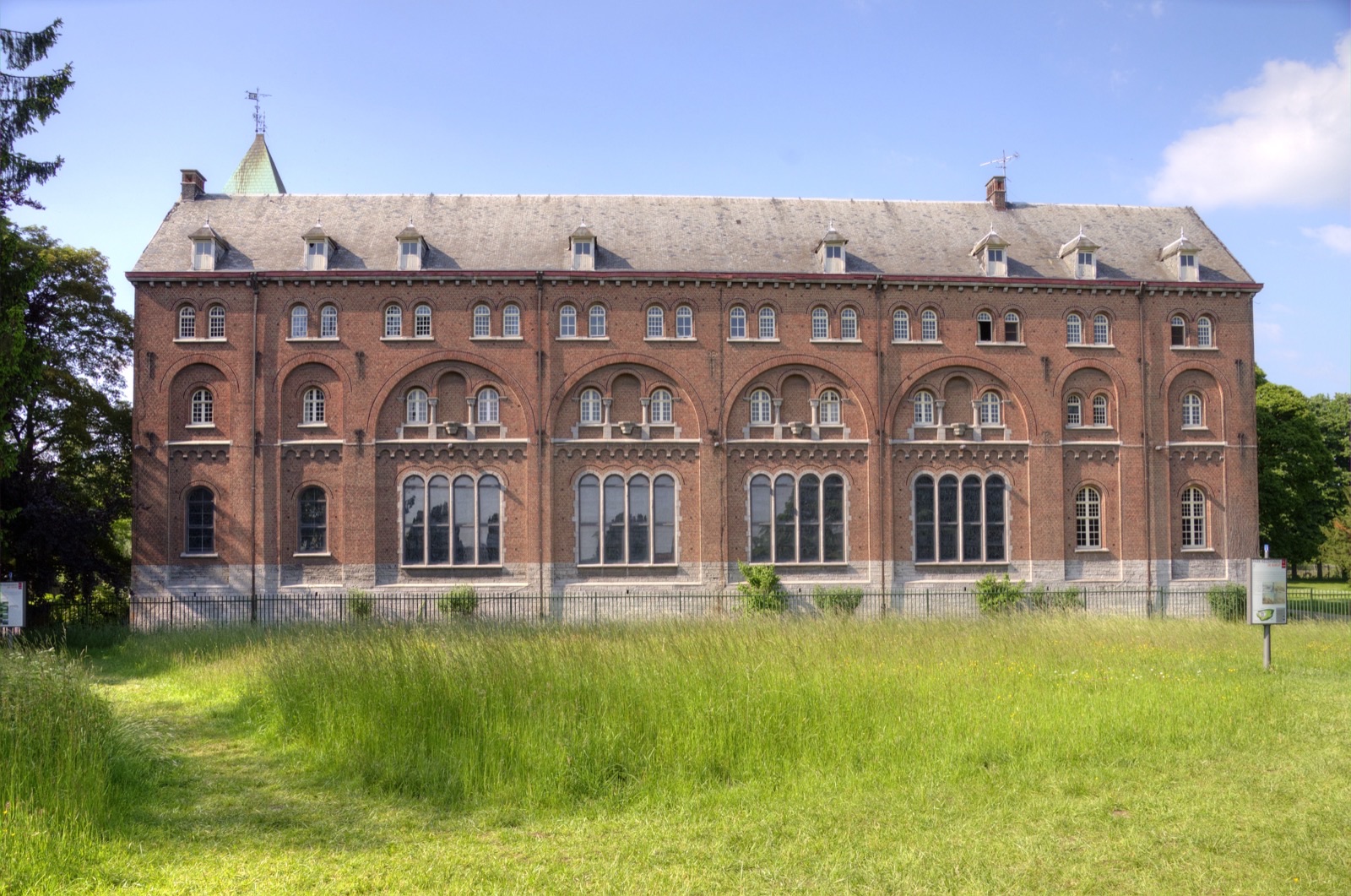
Keizersberg Abbey (Mont-César) on its hill in Leuven (Louvain), Belgium — the Benedictine house where Dom Lambert Beauduin founded the modern Liturgical Movement in 1909 and where Dom Bernard Capelle built it a scientific foundation. Photo: Helmut Schutz, CC BY-SA 3.0, via Wikimedia Commons.
Event 18 of 57
There is a hill on the northern edge of Leuven (Louvain, in the older French) crowned by a Benedictine abbey the Flemish call Keizersberg and the French call Mont-César. Monks from Maredsous settled there in 1888, and the house was formally erected in 1899. It would be hard to name a more important address in the whole story of the Liturgical Movement. For it was here, in September 1909, that a young priest of the community, Dom Lambert Beauduin, lit the fuse: from Mont-César he launched the movement that would carry liturgical renewal far beyond Belgium’s borders. By the 1950s the abbey was no longer just a birthplace but a working hub, and somewhere in that decade its scholars gathered, as they often did, to take the measure of a reform now gathering real speed.
The Cradle on the Hill
Beauduin’s genius was an idea more than a technique. In 1909 he proposed, in his words, “to have the Christian people all live the same spiritual life, to have them all nourished by the official worship of holy Mother Church.” The next year, 1910, he and his confreres began publishing Les Questions Liturgiques et Paroissiales, the journal that became the movement’s house organ. The point was pastoral: to draw ordinary lay Catholics into the Church’s public prayer, not to leave the Mass to the clergy and the choir while the faithful told their beads alongside it.
To have the Christian people all live the same spiritual life, to have them all nourished by the official worship of holy Mother Church.
— Dom Lambert Beauduin, O.S.B., La piété de l’Église (1914), trans. Dom Virgil Michel, O.S.B.
A note of precision is owed here, because the line is so often garbled. The famous sentence that liturgical participation is “the primary and indispensable source of the true Christian spirit” is not Beauduin’s own coinage — it is Pope St. Pius X, from the 1903 motu proprio Tra le sollecitudini. Beauduin took it as his banner. The movement he founded at Mont-César thus began under a papal text, in continuity with the Church’s own desire for fuller participation in her worship.
From Birthplace to Workshop
Beauduin himself left Mont-César in 1925 for other foundations; he would die in 1960. But the abbey did not coast on his memory. Under Dom Bernard Capelle, abbot of Mont-César from 1928 to 1952 and holder of the chair of liturgy at the University of Louvain from 1936 to 1956, the house acquired what Beauduin’s charism had lacked: a rigorous scholarly apparatus. Convinced that the movement now needed a scientific foundation, Capelle recruited the patrologist Dom Bernard Botte and helped lay the groundwork for serious academic liturgical study, work that fed directly into the Institut Supérieur de Liturgie in Paris.
By mid-century the abbey on the Keizersberg was no longer merely the place where the movement was born. It had become a node in an international network of liturgical centers (Maria Laach in Germany, Klosterneuburg in Austria, the Centre de Pastorale Liturgique in Paris) whose scholars increasingly met, corresponded, and coordinated. The Belgian cradle had become one of the movement’s working brains.
Capelle was no bystander to the official reform either. He served as a consultor to the Sacred Congregation of Rites and contributed to the deliberations of the commission Pius XII established for reform of the liturgy; he would later be named to the preparatory liturgical commission of the Second Vatican Council. When the international congresses of the postwar decade convened (at the Mont Sainte-Odile and elsewhere, and at Lugano in 1953) Mont-César’s abbot was among the voices heard.
A Node in the Network
The 1950s were the decade in which the Liturgical Movement passed from scholarship and pilgrimage into machinery. A run of expert congresses — Maria Laach (1951), Sankt Odilien (1952), Lugano (1953) — pressed concrete reform proposals up toward Rome, and several of them bore fruit in the Holy Week changes of 1951 and 1955. Mont-César sat squarely inside this network: its men taught the teachers, edited the journals, and advised the congregations. A gathering at the Belgian cradle in 1954 belongs naturally to that current: the international fellowship of liturgists consolidating, comparing notes, and pushing the agenda forward.
Honesty requires a plain admission. The abbey, Beauduin’s founding role, Capelle’s scholarship and his place in the reform commissions, and the wider postwar congress series are all firmly documented. A discrete, formally titled “Mont-César Conference” held specifically in 1954, however, is not something the readily available historical record independently and unambiguously confirms. We present this card as a window onto a verifiable reality, the abbey as a living reform center in the 1950s, rather than as the report of a single, precisely dated event. Readers should treat the year as a marker of the era, not as a hard primary-source citation for a named congress.
The Movement’s Two Faces
It would be a caricature to read Mont-César as a den of revolutionaries. Capelle, for all his reforming energy, is on record urging restraint, that nothing in the liturgy should be altered except in cases of genuine necessity, since the liturgy is itself a monument of Tradition. That instinct sat alongside a real appetite for change, and the tension between the two is the whole drama of these years. The same network that produced careful patristic scholarship also produced proposals that, gathered and accelerated by others, would eventually outrun what any of these men had asked for.
The men of Mont-César were serious scholars and faithful monks who loved the Church’s prayer. To trace how the movement they served was later carried further than many of them intended is not to impugn their motives or their holiness. The validity and liceity of the reformed rite that lay decades ahead are not in question here; what this timeline weighs is prudence, manner, and effect, never legitimacy.
From this hill the movement went out into the world in 1909; to this hill, in one form or another, it kept returning. By 1954 the cradle had become a council chamber, and the reform it had nursed was nearly ready to be debated by the whole Church.
Events That Led Here
Where It Led
- Keizersberg Abbey (Mont-César), Leuven: founding (1899), Beauduin and the 1909 launch of the Liturgical Movement; Les Questions Liturgiques et Paroissiales (1910). Wikipedia, ‘Keizersberg Abbey.’
- Dom Lambert Beauduin, La piété de l’Église: principes et faits (1914); English Liturgy the Life of the Church, trans. Dom Virgil Michel, O.S.B. (1926).
- Pope St. Pius X, Tra le sollecitudini (motu proprio, 22 November 1903), origin of ‘the primary and indispensable source of the true Christian spirit.’
- Dom Bernard Capelle (1884–1961): abbot of Mont-César 1928–1952; chair of liturgy, University of Louvain 1936–1956; recruited Dom Bernard Botte; consultor of the Congregation of Rites; member of the Pian reform commission and of the preparatory liturgical commission of Vatican II. Liturgy Institute; Encyclopedia.com, ‘Capelle, Bernard.’
- Postwar liturgical congress series (Maria Laach 1951, Sankt Odilien 1952, Lugano 1953) and the Holy Week reforms of 1951 and 1955, general historical record.
- UNVERIFIED: a discretely titled ‘Mont-César Conference’ dated specifically to 1954 is not independently confirmed in readily available sources; the year is treated as an era marker.