The Mont Sainte-Odile Congress
High in the Alsatian hills, a small circle of scholars met to map the next stage of reform — and the public never saw the meeting that shaped it.
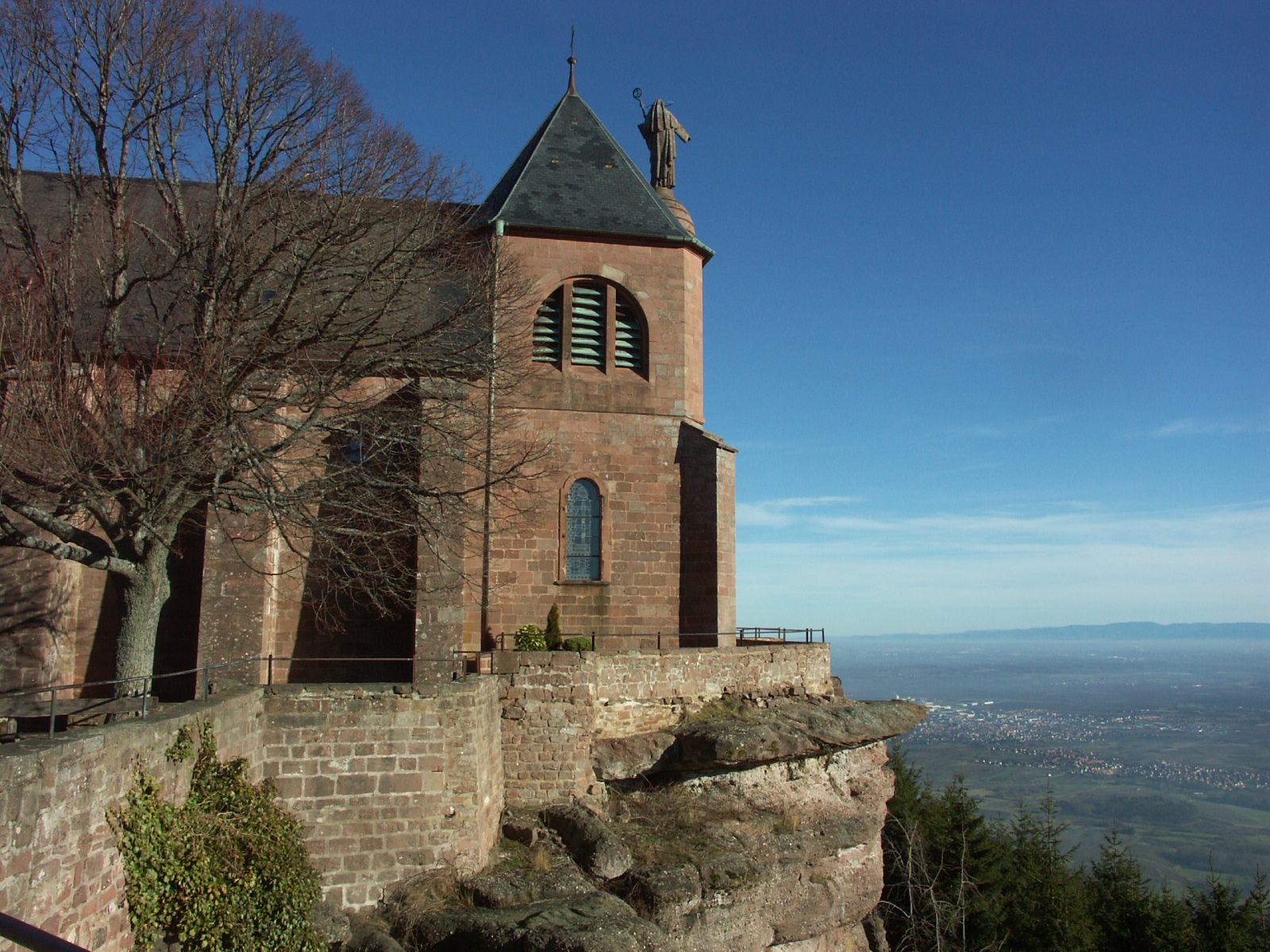
Mont Sainte-Odile (the Odilienberg), the Alsatian pilgrimage height where liturgical scholars gathered in 1952 for the second of the restricted postwar study congresses. Photo: Mattis, public domain.
Event 16 of 57
In the autumn of 1952, a small body of liturgical scholars climbed to the Mont Sainte-Odile (the Odilienberg, the great pilgrimage height that crowns the Vosges above the Alsatian plain), for the second of a remarkable series of postwar study meetings. The year before, at the Abbey of Maria Laach in the Rhineland, a comparable circle had met and drawn up resolutions for the reshaping of the Mass. Sainte-Odile was the next link in that chain. It was not a public assembly and not a council; it was a working congress of specialists, convened to debate, refine, and carry forward proposals that the wider Church would not see for years.
The reform did not begin in the open. Long before any of it reached an ordinary parish, its shape was being argued out in private: at restricted congresses where a handful of scholars, not the faithful and not the bishops at large, decided which changes were ripe. Mont Sainte-Odile in 1952 was one of those rooms.
A chain of quiet congresses
The Sainte-Odile meeting belongs to an identifiable sequence. The leading liturgical scholars of Germany, France, and the Low Countries met at Maria Laach in 1951, at Mont Sainte-Odile in 1952, at Lugano in Switzerland in 1953, and at Mont-César in Belgium in 1954; a rolling series of expert conferences that ran in parallel with the official Roman commission Pius XII had set up in 1948. These were study days, not legislative sessions: scholars presenting papers, comparing experiments, and submitting conclusions upward. But they were also where momentum was made. Each gathering tended to take up the previous one’s agenda and add to it.
Much of what these scholars wanted was genuine and pastoral: that the people should understand and join in the Church’s worship, not merely watch it. The Liturgical Movement at its best recovered real treasures — Gregorian chant, the riches of the liturgical year, the dignity of the Roman Rite. The question this site presses is not whether the impulse was good, but how decisions of such magnitude came to be settled by so few, so quietly.
What was proposed at Sainte-Odile
The conclusions reached at Mont Sainte-Odile in 1952 largely continued the requests made at Maria Laach the year before, with additions. According to the surviving accounts of the congress, the proposals included eliminating some of the celebrant’s genuflections, signs of the cross, and the kissing of the paten; simplifying the formula for the Communion of the faithful to the bare words Corpus Christi; and opening more of the Mass to the singing of the people, especially through newly composed melodies in the vernacular at Communion. The congress also pressed for the whole of Holy Week to be revised in line with the Easter Vigil that had just been restored in 1951.
Elimination of some of the celebrant’s genuflexions, signs of the cross and kissing of the paten; simplification of the formula of Communion of the faithful to “Corpus Christi”; increased opportunities for the faithful to join in the singing of the Mass, especially by newly composed melodies in the vernacular.
— as recorded in accounts of the Mont Sainte-Odile congress, 1952
To a reader today these read less like the wild speculations of outsiders and more like a preview. Several of them (the pruning of repeated signs of the cross and genuflections, the simplified Communion formula, the larger place given to the vernacular and to congregational song) would in fact appear, in one form or another, in the reforms of the following two decades. That is precisely the point the traditional reader notices: the broad lines of the later reform were being drawn, in advance, in rooms like this one.
Why it was kept among scholars
There was nothing sinister in a learned society meeting to study the liturgy; scholars have always done so. What gives the Sainte-Odile congress its weight in this story is its position. It sat at the junction between the academic Liturgical Movement and the official machinery of reform. Its proceedings flowed into the French review La Maison-Dieu, the organ of the Paris Centre de Pastorale Liturgique, and into the conversation of the men who would, a decade later, draft and implement the Council’s liturgical program. The same names recur across these congresses and across the commissions that followed them.
It is fair to say that by 1952 a working consensus among the reforming scholars had already settled on changes the universal Church had never debated and the faithful had never been consulted about. None of this touched the validity of the Mass, then or later; the rite that eventually emerged is valid and licit, and Catholics owe it reverence. But prudence is a separate question from validity. When so much was decided in advance by so few, the later claim that the reform simply unfolded the Council’s wishes deserves to be measured against the record of what had already been resolved before the Council ever met.
The road from Sainte-Odile
The series did not stop in Alsace. The congress at Lugano in 1953 carried the same questions further and turned more openly to the place of the vernacular; the meeting at Mont-César in 1954, at Dom Lambert Beauduin’s own abbey, consolidated the international network of liturgical centers into a coherent whole. By the time the Second Vatican Council opened its first session in 1962, the men who had argued these proposals on the Odilienberg were no longer outsiders petitioning Rome. Many of them were drafting the documents. The quiet congress had become the mainstream.
- Alcuin Reid, The Organic Development of the Liturgy (2nd ed., 2005), on the postwar liturgical study congresses, 1951–1956
- Annibale Bugnini, The Reform of the Liturgy 1948–1975 (Eng. trans., 1990), on the preparatory liturgical movement and the Pian commission
- La Maison-Dieu, the review of the Centre de Pastorale Liturgique (Paris), vehicle for the congress conclusions
- Pope St. Pius X, Tra le sollecitudini (1903), “active participation” as the source of the true Christian spirit
- New Liturgical Movement and contemporary surveys of the 1951–1956 congresses (attribution only)