The Concilium Journal Is Founded
Even before the Council closed, the leading theologians of the reform launched an international journal to define what its “spirit” would mean — and within months the first of them was already backing away.
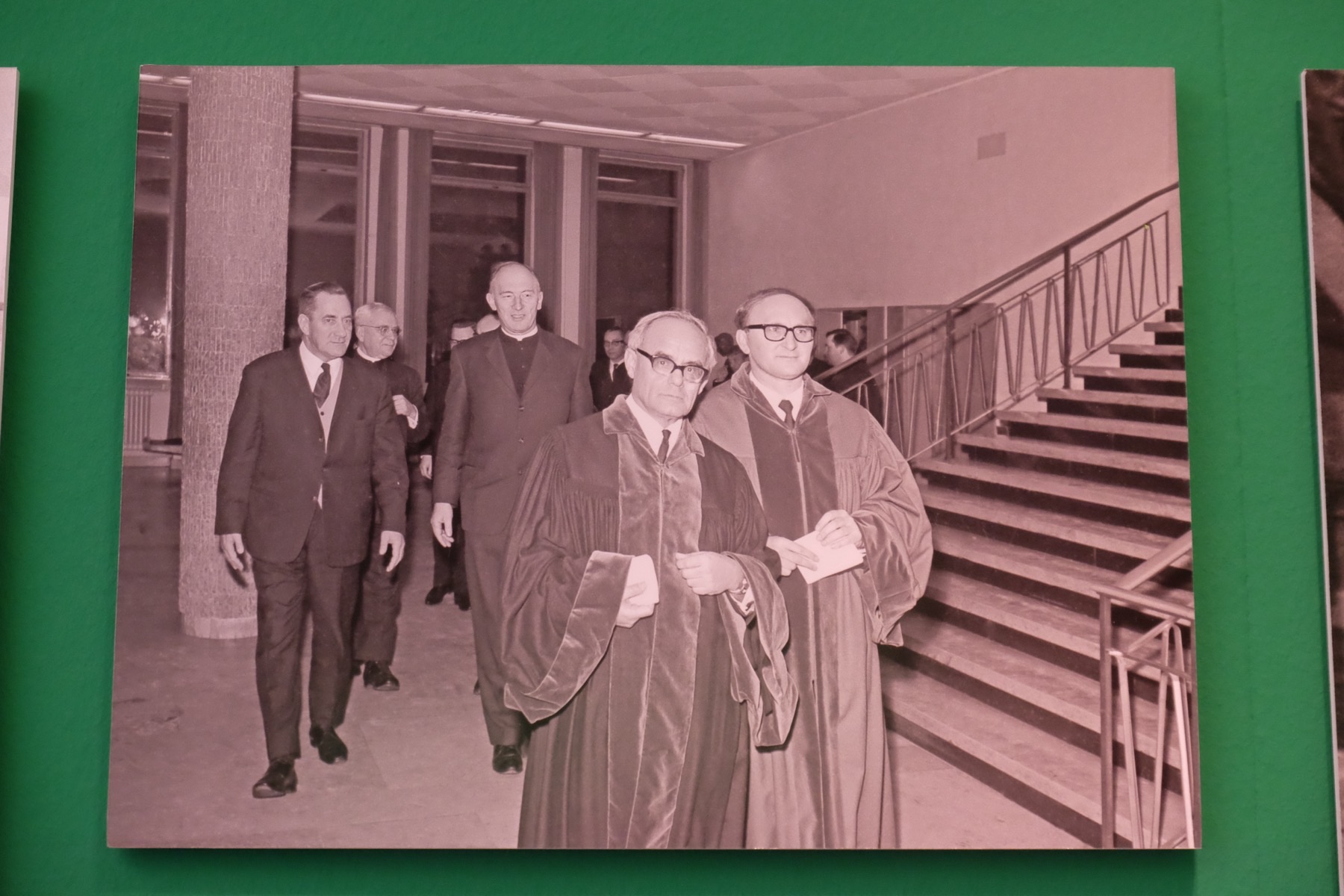
Founded in 1965 as the Second Vatican Council drew to a close, the international review Concilium set out to carry forward what its editors called the “spirit of Vatican II.” Photo: Lambiotte, CC BY-SA 4.0, via Wikimedia Commons.
Event 31 of 57
In 1965, as the Second Vatican Council moved into its final session, a group of the most influential theologians of the age launched an international journal. Its name was Concilium, and its purpose was stated plainly: to keep alive and carry forward the “spirit of Vatican II.” The founders were not fringe figures. They included Karl Rahner, Edward Schillebeeckx, Hans Küng, Yves Congar, and Johann Baptist Metz, men whose names had filled the Council’s working documents. The young Joseph Ratzinger sat on its editorial board. So, at first, did Henri de Lubac and Hans Urs von Balthasar. Within a few short years that founding coalition would fracture, and the line of the fracture would run straight through the central question of the next sixty years: not whether to receive the Council, but how.
A Journal for the “Spirit of the Council”
Concilium was an enterprise of genuine theological weight. Edited from the Netherlands and published simultaneously in several languages, it gathered the periti (the expert theologians) who had shaped the conciliar texts and gave them a permanent platform. Its stated aim, in the words of its own editors, was “to promote theological discussion in the spirit of Vatican II.” The reform, in their view, was not a set of finished documents to be implemented and filed away; it was a living movement, and the journal existed to advance it.
That ambition is the key to understanding what follows. There is a crucial difference between the letter of a council (its actual, voted texts), and an appeal to its spirit. The texts of Vatican II are concrete and limited; Sacrosanctum Concilium, for instance, called for Latin to be preserved and Gregorian chant to keep pride of place. An appeal to the “spirit”, by contrast, can reach beyond what any text actually says. From its first issue, Concilium staked its mission on that spirit.
The deepest division in post-conciliar Catholicism is not between those who accept Vatican II and those who reject it. It is between two readings of the same Council: one that interprets its texts in continuity with the whole of Tradition, and one that treats the Council as a fresh start, a break with what came before. Decades later Benedict XVI would name these the “hermeneutic of continuity” and the “hermeneutic of rupture.” The Concilium project, founded in 1965, was the first great institution of the second reading, and its founders’ quarrel was the first skirmish in a war over interpretation that is still being fought.
The Coalition Cracks
The remarkable thing is how quickly the founders divided. Concilium had gathered theologians who, at the Council, had largely stood on the same side against an older, more cautious Roman establishment. But agreement on what the Council should do masked deep disagreement on what it meant, and on where the reform was now heading.
Henri de Lubac, the great Jesuit scholar of patristics and one of the most consequential theologians of the century, was among the journal’s initial editorial committee. He soon grew alarmed. He came to fear that the project was turning in what he regarded as a deconstructive direction, that the appeal to the “spirit” was being used to dissolve the very Tradition the Council had meant to renew. In May 1965, only months into the venture, de Lubac quietly withdrew.
It would be a grave distortion to cast the Concilium theologians as villains. Rahner, Schillebeeckx, Küng, Congar, and Metz were serious, learned, believing Catholics who had given their lives to the Church’s renewal. Congar in particular was later made a cardinal by John Paul II. To say their journal helped launch a contested reading of the Council is a claim about ideas and their consequences — not a judgment on their faith or their souls. The disagreements recounted here were a family quarrel among Catholics in communion, not a battle between the Church and her enemies.
From Concilium to Communio
De Lubac’s departure was the first crack; it would not be the last. Joseph Ratzinger, who had served on the editorial board and written for the journal in its early years, also moved away from its direction as the turbulent late 1960s unfolded. The decisive answer came in 1972, when de Lubac, von Balthasar, and Ratzinger founded a rival international review: Communio.
Where Concilium appealed to the council’s “spirit”, Communio stood for, in its own words, “the renewal of theology in continuity with the living Christian tradition.” Von Balthasar cast its purpose in terms of resisting a deadly polarization: refusing the false choice between a triumphant progressivism and a reactive traditionalism, and instead recovering the Church as a communio, a communion rooted in Christ.
Negatively: to resist at all costs the deadly polarization brought on by the fervor of traditionalists and modernists alike; positively: to perceive the Church as a central communio, a community originating from communion with Christ.
— Hans Urs von Balthasar, on the founding purpose of Communio (1972)
The two journals would become, in effect, the two intellectual headquarters of post-conciliar Catholicism, and the men who had stood together at the Council now stood across a fault line from one another. The same de Lubac, von Balthasar, and Ratzinger who appeared on Concilium’s early masthead became the founding voices of its great rival. The split was not over loyalty to the Council; all of them revered it. It was over what receiving the Council faithfully required.
Why It Belongs in This Timeline
A history of the liturgy might seem to have little room for a theological journal. But the battle over interpreting Vatican II was, from the start, also a battle over its worship. The same years that produced Concilium produced the Consilium charged with remaking the Mass; the same appeal to a forward-rushing “spirit” that animated the journal animated the swift, sweeping changes to the rite. To read the Council as continuity is to read its liturgical reform as organic development; to read it as rupture is to license a far more radical recasting of Catholic worship.
That is why 1965 matters here. The ink was barely dry on the conciliar documents, and the fight over their meaning had already begun. The founding of Concilium (and the swift defection of de Lubac, soon followed by Ratzinger and von Balthasar into Communio) was the opening move in the long contest between rupture and continuity. It is a contest the Church is still living through, and one that every later event in this timeline, from the new Mass to Summorum Pontificum and beyond, would inherit.
Events That Led Here
- Concilium (journal), founding history and editors, en.wikipedia.org/wiki/Concilium_(journal)
- Concilium: International Journal of Theology, “About us,” concilium-vatican2.org
- Communio: International Catholic Review, “About” / “Our Founders,” communio-icr.com
- Communio, founding history and relationship to Concilium, en.wikipedia.org/wiki/Communio
- John L. Allen Jr., reporting on Ratzinger’s membership of the Concilium editorial board (to 1973) and the 1972 founding of Communio (First Things / Commonweal)
- Henri de Lubac’s May 1965 withdrawal from the Concilium editorial committee (reporting via Roberto de Mattei; CWR)