Summorum Pontificum
A Pope-theologian declares the old Mass was never forbidden — and gives it freely back to the Church.
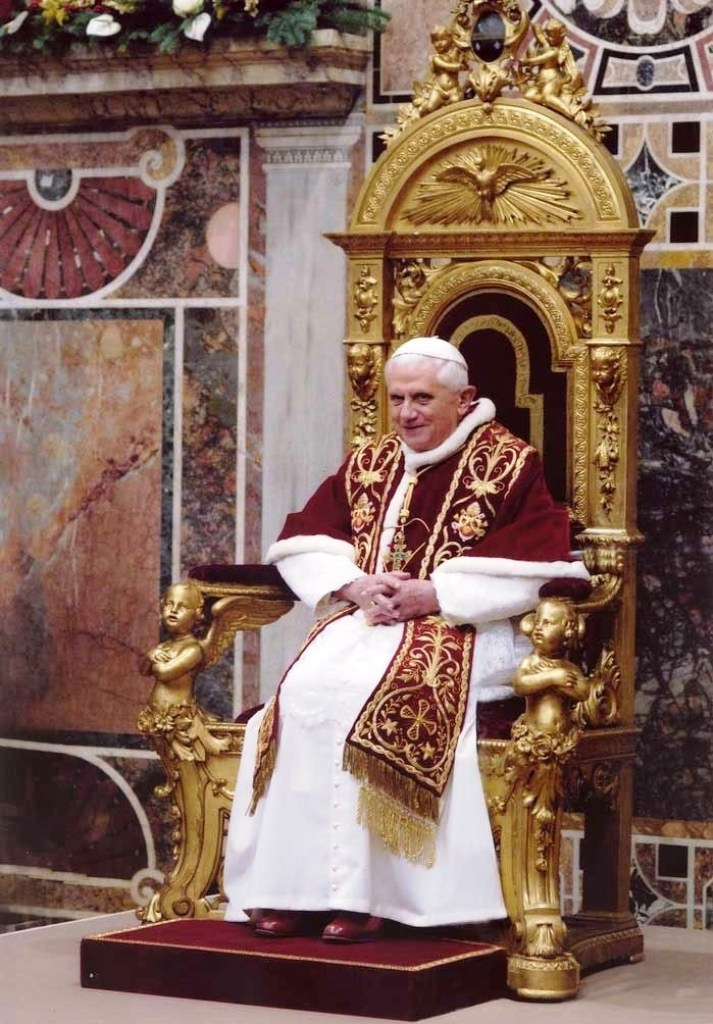
Pope Benedict XVI, whose 2007 motu proprio Summorum Pontificum freed the ancient Roman Rite from two decades of the indult system. Photo: Peter Nguyễn Minh Trung, CC BY 2.0, via Wikimedia Commons.
Event 49 of 57
For forty years traditionalists had pressed one argument: the old Mass had never actually been outlawed. In 2007 a pope agreed, and wrote it into law. Summorum Pontificum declared the 1962 Missal “never abrogated” (art. 1), and Benedict’s accompanying Letter added that it was “never juridically abrogated” and therefore, in principle, always permitted. It freed every Latin-rite priest to offer it, in Masses without the people, without asking anyone’s permission (art. 2).
For most of the period after 1969, the traditional Latin Mass lived on sufferance. Where it survived in communion with Rome, it survived by indult: a special, revocable permission, granted narrowly, hedged with conditions, and dependent on the goodwill of the local bishop. John Paul II had widened the opening: in 1984 the indult Quattuor Abhinc Annos permitted limited use of the 1962 Missal under episcopal control, and in 1988 Ecclesia Dei adflicta appealed for unity and established a commission to shelter those attached to the older rite who wished to remain in full communion. These were real mercies. But the framework remained one of exception and permission: the old Mass was tolerated, not freed.
Then a man was elected pope who had spent his whole life thinking about exactly this question. As Cardinal Joseph Ratzinger, the future Benedict XVI had written with unusual frankness that a rite the Church had held sacred for centuries could not simply be prohibited, that to treat the Church’s own ancient worship as forbidden was to wound her sense of continuity with herself. When he became pope in 2005, he was uniquely placed to act on that conviction.
The Pope-Theologian Acts
On 7 July 2007, Pope Benedict XVI issued the motu proprio Summorum Pontificum and changed the legal and spiritual standing of the traditional Mass at a stroke. Its central claim was the one traditionalists had pressed for four decades: the 1962 Missal was “never abrogated” (art. 1). The accompanying Letter put it fully: the Missal “was never juridically abrogated and, consequently, in principle, was always permitted.” The old Mass had never been forbidden, because, on Benedict’s reading of the Church’s own law and life, it never could have been.
Benedict framed the two rites not as rivals but as two expressions of a single tradition. The Missal of Paul VI he named the ordinary form of the Roman Rite; the 1962 Missal, its extraordinary form, two uses of the one Roman Rite, each legitimate. This was the decisive move. He did not pit the new against the old, nor the old against the new. He kept and celebrated the reformed Mass himself. What he refused was the idea that the two could not stand together within the one continuous tradition that had produced them both.
What earlier generations held as sacred, remains sacred and great for us too, and it cannot be all of a sudden entirely forbidden or even considered harmful.
— Pope Benedict XVI, Letter to the Bishops accompanying Summorum Pontificum, 7 July 2007
It is hard to overstate what those words meant to Catholics who had spent decades being told that their devotion to the Mass of their forefathers was at best an embarrassment and at worst a rebellion. A pope had now said, with the full weight of his office, that what the saints had prayed remained holy, and could not be treated as if it were harmful.
The Hermeneutic of Continuity
Summorum Pontificum did not come from nowhere. It was the liturgical expression of the governing theme of Benedict’s pontificate, announced in his first Christmas address to the Roman Curia in December 2005: that the Second Vatican Council must be read not as a rupture with the Church’s past but as renewal in continuity with her living tradition, one subject-Church enduring across time. He called it the “hermeneutic of reform,” set against a “hermeneutic of discontinuity and rupture”; in 2007 he would speak of a “hermeneutic of continuity” (Sacramentum caritatis, note 6).
If the Church is one continuous subject through history, then her ancient worship cannot suddenly become forbidden or harmful. The rite of Gregory and Trent and the rite of Paul VI must be capable of standing together, because they belong to the same Church. Summorum Pontificum was the hermeneutic of continuity made law.
Steelmanned on its own terms, Benedict’s act was not nostalgia and not a concession wrung from him by pressure. It was an act of healing: an attempt to reconnect the Church organically with her own liturgical past, to let the reform and the tradition it grew from breathe the same air again, and so to close (slowly, by coexistence rather than by decree) the breach that 1969 had opened.
The Years of Flourishing
The effect was immediate and, to many, astonishing. Freed from the indult system, the traditional Mass spread. New communities formed; existing ones grew; young priests learned the older rite; seminaries and religious houses dedicated to it filled. Most strikingly, the congregations gathering for the traditional Mass skewed young (families with many children, converts, students) exactly the demographic the wider Church was losing. What had been a remnant began to look like a renewal.
What It Left Unsettled
For a decade and a half it seemed the breach of 1969 might slowly close, that the two forms might coexist, that the continuity Benedict envisioned might take root. Yet the settlement rested on a delicate balance it could not itself guarantee. It depended on goodwill: on bishops welcoming rather than resisting, on traditional communities receiving the gift without weaponizing it against the reform, on a reading of the Council that not everyone shared. Benedict had answered the juridical question, is the old Mass permitted? — but the deeper ecclesial question of how the two forms should relate, and whether the reformed Mass alone expressed the Council’s intent, he left open.
What one pope grants by motu proprio, another may restrict by motu proprio. In 2021, Traditionis Custodes would reverse Benedict’s framework, declaring the reformed books the “unique expression” of the Roman Rite and placing the older Mass under tight restriction. The reconciliation Benedict offered proved real but fragile, and the most contested chapter of the story was still to come.
Summorum Pontificum remains the high-water mark of the “reform of the reform”: the moment a Pope-theologian put the weight of his office behind the claim that the Church’s ancient worship was never lost, never forbidden, and never anything but sacred. Whatever followed, that act of recognition cannot be unsaid.
The word is juridical – not the customary one – exactly as in “extraordinary minister of Holy Communion.” What the data does and does not show about the two forms is worth reading alongside it. Did the New Mass Empty the Pews? →
Events That Led Here
- Pope Benedict XVI, Summorum Pontificum (motu proprio, 7 July 2007)
- Pope Benedict XVI, Letter to the Bishops accompanying Summorum Pontificum (7 July 2007)
- Pope Benedict XVI, Address to the Roman Curia (Christmas address, 22 December 2005), the “hermeneutic of reform” against a “hermeneutic of discontinuity and rupture”
- Pope Benedict XVI, Sacramentum caritatis (22 February 2007), note 6, the “hermeneutic of continuity”
- Congregation for Divine Worship, Quattuor Abhinc Annos (circular letter granting the indult on the Pope’s authority, 3 October 1984)
- Pope John Paul II, Ecclesia Dei adflicta (apostolic letter, 1988)
- Joseph Cardinal Ratzinger, Milestones: Memoirs 1927–1977 and The Spirit of the Liturgy (on the prohibition of the older rite)