The Consilium — Bugnini as Secretary
The Council had given the principles; now a commission of experts under one driven secretary would write the concrete rite.
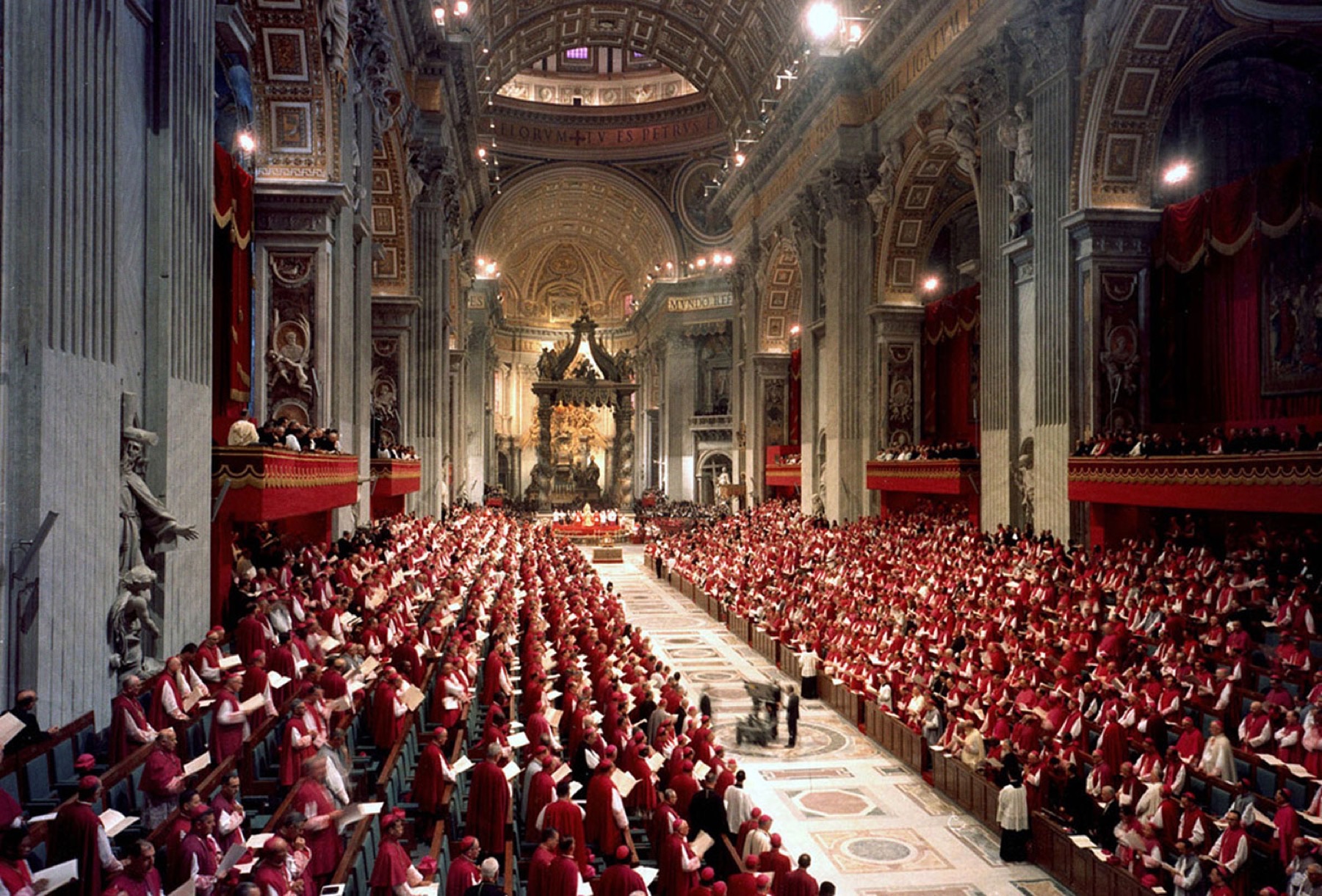
On 25 January 1964, by the motu proprio Sacram Liturgiam, Paul VI established a special commission, known as the Consilium ad exsequendam Constitutionem de Sacra Liturgia, the body charged with turning the Council’s liturgical constitution into actual books. Cardinal Giacomo Lercaro of Bologna presided; Fr. Annibale Bugnini was its secretary and its working engine. Over the next five years this commission, not the Council Fathers, would take the Roman Rite apart and put it back together. Photo: Catholic Press Photo, public domain.
Event 29 of 57
Sacrosanctum Concilium had to be implemented by someone. The Council Fathers had voted, in December 1963, for a constitution of principles: Latin retained, Gregorian chant given pride of place, no innovations unless the good of the Church genuinely required them, and the whole work reserved to ecclesiastical authority. But a constitution of principles is not a Missal. The texts had to be drafted, the rites rebuilt, the books printed. On 25 January 1964, by the motu proprio Sacram Liturgiam, Pope Paul VI established the body that would do it: the Consilium ad exsequendam Constitutionem de Sacra Liturgia, the Council for the implementation of the Constitution on the Sacred Liturgy. Its president was Cardinal Giacomo Lercaro of Bologna; its secretary, a Vincentian priest, Fr. Annibale Bugnini. Here is a distinction that matters more than almost any other in this story, and one that careful Catholics must hold precisely: the Council gave the mandate; the Consilium made the rite.
The Second Vatican Council issued a constitution — a document of principles approved by the world’s bishops and the Pope. The Consilium was a working commission of liturgical experts and bishops, set up afterward to translate those principles into concrete new books. Much that is loosely blamed on, or credited to, “Vatican II” was in fact the work of this commission acting under papal authority. To read the reform honestly, you must keep the two bodies apart: the Council mandated reform in general terms; the Consilium, under Bugnini, decided what the reformed Mass would actually be.
A New Body for a New Rite
The Consilium gathered bishops and liturgical scholars from around the world, but its working engine was a set of specialized study groups, the coetus, each assigned a portion of the liturgy: the Order of Mass, the calendar, the lectionary, the Divine Office, the rites of the sacraments. Each group studied, debated, and drafted; Bugnini coordinated and carried the results forward; Paul VI approved. The structure was lawful and the authority real: the body acted under the Pope, and the rite it would ultimately produce is a valid and licit rite of the Catholic Church. That floor is firm and is not in question here.
What is a matter of legitimate historical judgment is the manner and the speed. A rite that had grown across some fifteen centuries was substantially rebuilt in roughly five years, from the Consilium’s first sessions in 1964 to the new Order of Mass of 1969. To its architects this was the overdue fulfillment of the Council’s mandate. To its critics, including some who sat inside the Consilium itself, it was the replacement of organic growth with deliberate construction, the very danger Pius XII had named in Mediator Dei and that Sacrosanctum Concilium had tried to fence with its rule against innovations not genuinely required.
Bugnini’s Hand on the Wheel
Annibale Bugnini was no newcomer in 1964. He had been secretary of the preparatory commission on the liturgy since 1960, and before that a central figure in the reforms of the 1950s. Now, as secretary of the Consilium, he stood at the precise point where the study groups’ drafts met the Pope’s signature, and that position gave him extraordinary leverage. He was, by wide acknowledgment, the indispensable man: the one who knew every file, drove every deadline, and framed how proposals reached Paul VI.
Even sympathetic insiders noticed how often the secretary’s preference prevailed. Aimé-Georges Martimort, himself a senior figure of the legitimate liturgical movement, was a consultor of the Consilium and the relator for the reform of the Liturgy of the Hours. He told Dom Alcuin Reid in an interview that after the plenary meeting had chosen between his group’s proposals, Bugnini set those decisions aside and proposed another course to Paul VI, which was the one adopted. Reid, a critic of the reform, calls the pattern “Paul VI approves what Bugnini wants” (New Liturgical Movement, 2014). This is not a charge of invalidity or of bad faith; it is a description of how power actually flowed through the commission.
An Insider’s Doubts
Louis Bouyer, who served as a consultor to the Consilium, left a withering account of how the work was actually done, not by serene scholarly consensus but by maneuver, with opposition managed and outcomes steered. Bouyer was no traditionalist firebrand; he was a distinguished member of the legitimate movement who had hoped for genuine renewal. His disillusionment is among the most credible testimonies we have, precisely because of where he sat.
The method itself troubled even friendly observers. Each study group, expert in its own narrow portion, reworked that portion according to scholarly theory and pastoral fashion, but no one stood guard over the organic wholeness of the rite as a living inheritance. The Mass was optimized part by part, and something was lost that no part-by-part optimization could preserve: the unity, density, and accumulated reverence of a liturgy no single generation had designed. That is a criticism of method and prudence, not of the Church’s authority to reform her worship, which is real and which the Consilium exercised under the Pope.
The Bishops Hesitate: The 1967 Synod
The Consilium’s work did not proceed unopposed, and the most telling check came from the bishops themselves. In October 1967, an experimental version of the reformed Mass (the so-called Missa normativa) was celebrated before the Synod of Bishops, and the bishops were asked to vote. The result was a clear signal of unease: of 180 ballots, only 71 gave it unqualified approval; 62 approved it with reservations (placet iuxta modum), 43 voted against it and 4 abstained.
The lesson the Consilium drew was not to halt but to adjust and continue. The Missa normativa shown in 1967 was a draft, not the rite finally promulgated; it was revised, and the project moved toward 1969. But the bishops’ hesitation about the direction was unmistakable, and their reservations, like the warnings of Pius XII and the safeguards of the constitution, did not stop the work. The Consilium itself was folded, in May 1969, into the new Congregation for Divine Worship, with Bugnini carried over as its secretary.
None of this denies the validity or liceity of the reformed rite, impugns the authority of the Council, or questions the legitimacy of Pope Paul VI. The Consilium acted under papal authority, and the Mass it produced is the Catholic Church’s own. The fair and accurate point is narrower and stronger: the concrete shape of the new rite was the work of an expert commission under one secretary’s heavy hand, not the direct composition of the Council Fathers, and the bishops, when finally shown a draft, voted with real hesitation. To say this is to take the historical record seriously, not to break communion.
Much of the heat in liturgical argument comes from collapsing two different things into one. “Vatican II did this” is, very often, false: the Council mandated reform in principle; the Consilium decided the particulars. Honesty cuts both ways. It clears the Council of choices it never made, and it locates responsibility for the concrete rite where it actually lay, in a commission whose methods even its own members questioned. A faithful reading neither vilifies the reformers nor pretends the Fathers drafted what the experts drafted.
By the close of the 1960s the Consilium’s labor was nearly finished. A new Order of Mass, a recomposed Offertory, additional Eucharistic Prayers beside the Roman Canon, a three-year lectionary, a revised calendar and Office — all bore the marks of the study groups and their tireless secretary. What remained was for the Pope to promulgate it. That came on 3 April 1969, and with it the most consequential liturgical change in a thousand years.
Forty-eight members, over two hundred consultors, five years, and a completion date. Of the 1,269 orations in the old Missal, 656 were dropped outright and only about 8% came through unaltered. Did the New Mass Empty the Pews? →
- Pope Paul VI, Sacram Liturgiam, motu proprio implementing the Constitution on the Sacred Liturgy (25 January 1964), at vatican.va
- Second Vatican Council, Sacrosanctum Concilium. Constitution on the Sacred Liturgy (4 December 1963), at vatican.va
- Annibale Bugnini, The Reform of the Liturgy 1948–1975 (Eng. trans., Liturgical Press, 1990)
- Louis Bouyer, The Memoirs of Louis Bouyer (Eng. trans., Angelico Press, 2015)
- A.-G. Martimort, on Consilium decision-making, as reported in Dom Alcuin Reid, “The Consilium ad Exsequendam at 50,” New Liturgical Movement (Part 2, 12 February 2014)
- Vatican Press Office, reply on the alleged Protestant influences on the new Order of Mass, 25 February 1976, Documents on the Liturgy 1963–1979 (Collegeville, 1982), DOL 221, p. 551
- Synod of Bishops, vote on the Missa normativa (26 October 1967): “De liturgia in prima Synodo Episcoporum,” Notitiae 3 (1967) 353–363 (the vote on the Missa normativa, pp. 356–357; the table of all the votes, p. 363)