The Novus Ordo Missae Is Promulgated
On Holy Thursday 1969, by genuine papal authority, the Roman Rite was remade more sweepingly than at any time in four centuries.
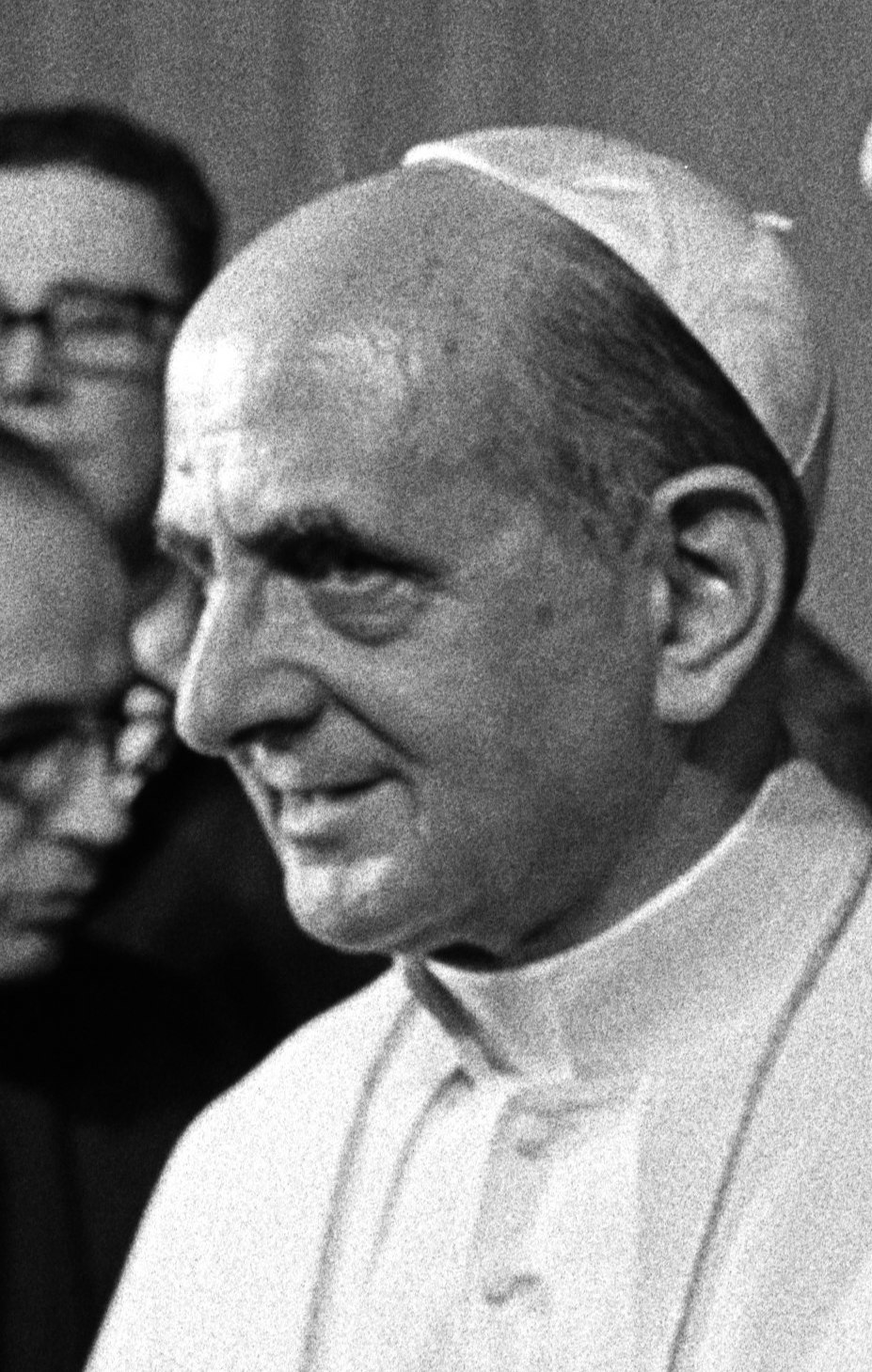
Pope Paul VI, who by the Apostolic Constitution Missale Romanum (3 April 1969, Holy Thursday) promulgated the new Order of Mass for the Latin Church. Photo: White House (Yoichi Okamoto), public domain.
Event 36 of 57
Everything before this date converges on it; everything after flows from it. On 3 April 1969 the Roman Rite was not revised but rebuilt, by the legitimate authority of a true and reigning Pope.
Everything in this story (the monastic renewal at Solesmes, the capture of the movement, the warnings of Pius XII, the careful text of the Council, the decade-long labor of the Consilium) converges on a single date. On 3 April 1969, Holy Thursday, by the Apostolic Constitution Missale Romanum, Pope Paul VI promulgated the Novus Ordo Missae, the new Order of Mass. With the typical edition of 1970 it became the regular worship of the Latin Church. What had been made was not a revision but a new rite.
It is essential to begin with what this event was, plainly stated, because everything else depends on holding it steady. This was an act of genuine papal authority. The Pope who has the power to bind and loose, who guards and governs the Church’s worship, exercised that power and gave the Latin Church a new Missal. The rite he promulgated is a valid and licit Mass of the Catholic Church. To deny that would be to leave the ground on which a faithful Catholic stands. The traditional concern has never been that the new Mass is no Mass. It is something narrower, and harder: that the scale and manner of so vast a change, and the texture of the new prayers, gave less full and less explicit voice to the faith than the rite they displaced.
None of what follows touches the validity of the new Mass. The reformed rite is a valid and licit Mass of the Catholic Church, in which the same Lord is truly offered and truly received. This account has never suggested otherwise, and never will. The objection is not that the Novus Ordo is no Mass: it is that its lex orandi gives a fainter, later, less explicit voice to truths the old rite spoke loudly and early.
What Was Made New
The scope of the reform was without precedent in the history of the Roman Rite. The Consilium, the commission under its secretary Fr. Annibale Bugnini that had taken the liturgy apart group by group, produced a new Order of Mass; replaced the centuries-old Offertory prayers with a newly composed “Preparation of the Gifts”; added new Eucharistic Prayers alongside the venerable Roman Canon; created a three-year Sunday lectionary; and revised the calendar and the Divine Office. The differences between the 1962 Missal and the 1969 Order are not matters of interpretation but of fact, verifiable by setting the two rites side by side.
The most consequential single change was the Offertory. The old rite’s quiet, explicitly sacrificial prayers (the Suscipe, sancte Pater, in which the priest offers “this immaculate host… for my innumerable sins”) gave way to a new blessing modeled on a Jewish berakah, a table grace: “Blessed are you, Lord God of all creation, for through your goodness we have received the bread we offer you: fruit of the earth and work of human hands.” The fact of the change is undisputed; its theological weight is precisely what is debated. The Prayers at the Foot of the Altar were removed, as was the Last Gospel, the Prologue of St. John with which the old Mass closed. The Confiteor was simplified, and the priest’s many signs of the cross over the offerings were sharply reduced.
Blessed are you, Lord God of all creation, for through your goodness we have received the bread we offer you: fruit of the earth and work of human hands, it will become for us the bread of life.
— The Roman Missal, Order of Mass (Latin 1969/1970; English translation ICEL 2010)
The reformers had their stated reasons, and they deserve to be stated fairly: a simpler, shorter, more intelligible rite, closer as they understood it to ancient models and more accessible to modern congregations. Vernacular language, options within the rite, and, in the practice that quickly became universal, the priest facing the people, all served a sincere pastoral aim: to draw the faithful into fuller, more conscious participation. None of this was done in bad faith. What the traditional movement insists is that the elements set aside were precisely those that most explicitly expressed the Mass as the priest’s sacrifice for sin, and that to lower that voice, even without denying the doctrine, forms belief differently over generations, by the oldest law of worship: lex orandi, lex credendi.
The Shock — and Who Felt It
The reaction came quickly and from the highest levels. On 25 September 1969, some nine weeks before the new rite took force, Cardinals Alfredo Ottaviani and Antonio Bacci transmitted to Paul VI a Short Critical Study of the New Order of Mass, drafted by a group of Roman theologians, with a covering letter whose central charge framed the whole controversy that followed: the new Order, the cardinals wrote, “represents, both as a whole and in its details, a striking departure from the Catholic theology of the Mass as it was formulated in Session XXII of the Council of Trent.”
Notice who was speaking. Not schismatics, not cranks: two cardinals of the Roman Church, joined in years to come by a future Pope. Reflecting in 1992, Joseph Cardinal Ratzinger would lament that in the reform “we abandoned the organic, living process of growth and development over centuries, and replaced it, as in a manufacturing process, with a fabrication, a banal on-the-spot product.” Yet it is essential to add what these men did not say. None of them concluded that the new Mass was invalid, and Ratzinger least of all: as Pope Benedict XVI he would celebrate the reformed rite, defend its legitimacy, and labor to reconcile it with the old. Their lament was for the manner of the reform — never a denial that what remained was truly and fully the Mass.
❝We abandoned the organic, living process of growth and development over centuries, and replaced it, as in a manufacturing process, with a fabrication, a banal on-the-spot product.
— Joseph Cardinal Ratzinger, preface to Klaus Gamber, The Reform of the Roman Liturgy (1992)
The Pope Who Named It Himself
Most arresting of all is the candor of Paul VI. In the general audience of 26 November 1969, preparing the faithful for the new rite, he did not pretend that nothing important was happening. He spoke of “a change in a venerable tradition that has gone on for centuries,” of touching a “hereditary religious patrimony” that “seemed to enjoy the privilege of being untouchable and settled.”
A new rite of the Mass: a change in a venerable tradition that has gone on for centuries. This is something that affects our hereditary religious patrimony, which seemed to enjoy the privilege of being untouchable and settled.
— Pope Paul VI, General Audience, 26 November 1969
This is not the language of a man making a minor adjustment. It is the language of a man who knows he is doing something vast, and feels the weight of it. Whatever one finally concludes about the prudence of the reform, Paul VI cannot be accused of hiding its scale. He named it himself. And his pastoral intent was real: he believed, in good conscience, that this was the way to bring the Church’s people more fully into her worship in a new age.
The objection a faithful Catholic may raise is never against the Pope’s authority to reform the rite, nor against the validity of what he promulgated. It is against the magnitude and the manner: a liturgy grown across fifteen centuries was substantially rebuilt in less than ten years, built part by part, with no one set to guard the organic wholeness of the rite as a living inheritance. Doctrine was not denied; but in the texture of the prayers themselves it was, in places, more faintly expressed. To name that is loyalty, not rebellion.
And so the deed was done. The rite of Gregory, of Trent, of the martyrs and missionaries and saints was set aside as the Church’s ordinary worship, and a new Order of Mass put in its place, by a true Pope, in a valid rite, with sincere pastoral hope. The question that remained, and is still unresolved, was what would become of those who could not, in conscience, let the old Mass die. That September, two cardinals would press that question on the Pope directly, and the next event in this story would begin.
The charge is made constantly and almost always without numbers. The evidence is more interesting than either side usually admits: a real and specifically Catholic break does show up in the data at the Council, but Ireland kept full churches for twenty years under this very Missal, and Africa grew sixfold under it. Did the New Mass Empty the Pews? →
- Pope Paul VI, Apostolic Constitution Missale Romanum (3 April 1969)
- Pope Paul VI, General Audience, 26 November 1969
- Cardinals Ottaviani & Bacci, Short Critical Study of the New Order of Mass (25 September 1969)
- Joseph Cardinal Ratzinger, preface to Klaus Gamber, The Reform of the Roman Liturgy (1992)
- The Roman Missal (1969/1970), Order of Mass — Preparation of the Gifts
- The Roman Missal (1962), Order of Mass, Offertory (Suscipe, sancte Pater)