The Liénart-Frings Intervention
On the Council’s very first working day, two senior cardinals rose to ask that the Fathers be given time to choose their own commissions rather than ratify a prepared list — and the assembly agreed.
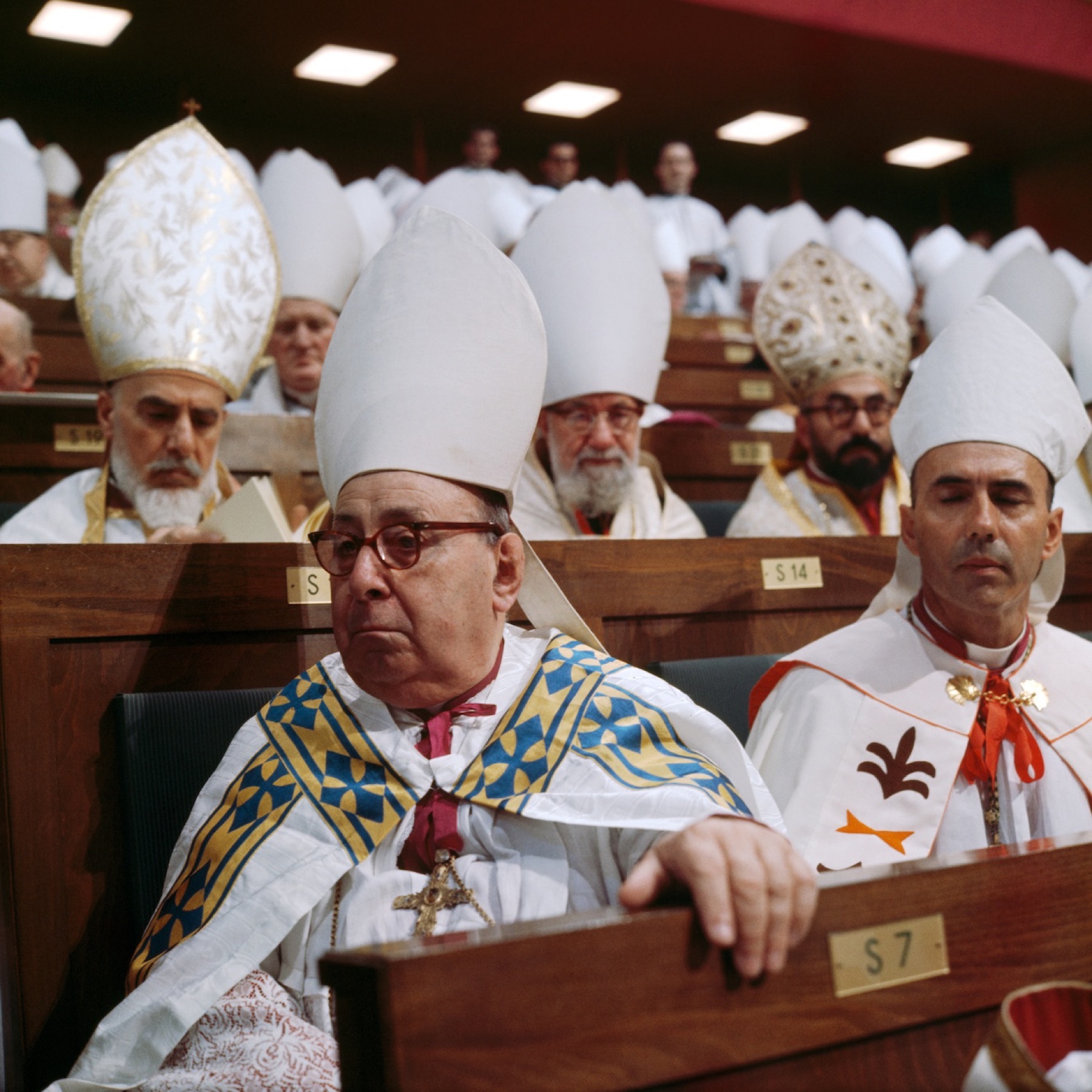
The Council Fathers assembled in the nave of St. Peter’s Basilica for the first session of the Second Vatican Council, October 1962. On the opening working day the Fathers voted to delay the election of the conciliar commissions. Photo: Lothar Wolleh, CC BY-SA 3.0, via Wikimedia Commons.
Event 25 of 57
The Second Vatican Council opened with great solemnity on 11 October 1962. Its first true working session — the first general congregation — was held two days later, on Saturday 13 October. The single item of business that morning was procedural but consequential: the Fathers were to elect the members of the ten conciliar commissions that would do the detailed work of drafting and revising the Council’s documents. What happened instead, within the session’s opening minutes, has been remembered ever since as the moment the assembly first asserted its own freedom of action.
The Vote That Was Supposed to Happen
Each Father had been given a booklet listing the names of those who had served on the preparatory commissions — the bodies, largely staffed and guided by the Roman Curia, that had drafted the schemata now placed before the Council. The arrangement invited a swift confirmation: bishops who knew few of their brethren from other nations could simply re-elect the experienced men already named, and the commissions would carry forward the same membership, and largely the same outlook, as the preparatory phase. Balloting was set to begin at once.
The difficulty was real and not merely tactical. More than two thousand bishops had arrived from every part of the world; most had never met one another. To be asked to choose, that very morning, some hundred and sixty commission members from among strangers was to be asked to vote almost blindly — or to defer, in practice, to the only list anyone had been given.
“It Is Truly Impossible to Vote Like This”
Cardinal Achille Liénart, the Bishop of Lille and one of the cardinals seated at the Council of Presidency, leaned toward the presiding dean, Cardinal Eugène Tisserant, and asked to speak. By his own later account he put it bluntly: in his recollection he whispered, “Eminence, it is truly impossible to vote like this.” Procedure did not provide for a discussion at that point, and he was not immediately granted the floor. Liénart nevertheless rose, took the microphone, and addressed the assembly.
Despite numerous efforts to become better acquainted with the bishops of other countries, we must admit that we, at least, have not been able to reach the degree of knowledge that would be necessary for us to designate the members of the commissions.
— Cardinal Achille Liénart, first general congregation, 13 October 1962 (trans. from the French)
His proposal was modest in form: postpone the election by a few days so that the bishops, meeting in their national and regional groups, could confer and propose candidates of their own. It was a request for time and information, not a denunciation of anyone. Cardinal Josef Frings, the Archbishop of Cologne and senior German cardinal, immediately rose to second it on behalf of the German-speaking and several other episcopates. The hall broke into sustained applause.
A Legitimate Motion, Not a Coup
It is important to describe what this was, and what it was not. Two cardinals — men of unquestioned standing, seated among the Council’s own presidency — made a reasonable parliamentary request that the electors be given time to know the candidates. The Council of Presidency, after a brief consultation, accepted it; the Secretary General, Archbishop Péricle Felici, announced that the election would be deferred. The first working session adjourned after only some fifteen minutes. No rule was broken and no authority was defied: the presiding body itself granted the delay. To call it a “seizure” of the Council overstates a motion that the chair lawfully allowed and the assembly overwhelmingly welcomed.
Honest histories differ on how much was spontaneous and how much prepared — Liénart appears to have acted on his own initiative that morning, while Frings, advised by his peritus Joseph Ratzinger, had been thinking along similar lines. Either way, asking for time to vote well is not a conspiracy. The Fathers had a genuine right to choose their own commissions, and they exercised it. Whatever one makes of the directions the Council later took, this particular act was an ordinary and defensible exercise of conciliar freedom.
What the Delay Made Possible
The few days’ postponement changed the composition of the working commissions. The European episcopates most identified with renewal coordinated their nominations and circulated a joint slate; when the Fathers finally voted on 16 October, a large share of those candidates were elected, and the commissions — including the all-important Doctrinal Commission — were no longer a simple continuation of the preparatory bodies. The men who would shape and reshape the Council’s texts were now chosen by the assembly rather than inherited from the Curia.
Across the spectrum — from Giuseppe Alberigo’s history to John W. O’Malley’s What Happened at Vatican II to Roberto de Mattei’s critical The Second Vatican Council: An Unwritten Story — this is treated as the hinge on which the first session turned. The disagreement is interpretive, not factual: was it the assembly recovering its rightful liberty, or the first move of a majority that would set aside the prepared schemata? The event itself is not in dispute. The meaning Catholics assign to it still is.
For the liturgy, the consequences were indirect but real. The reorganized commissions and the new confidence of the majority help explain why, in the weeks that followed, the prepared draft on the sacred liturgy — the most thoroughly developed text the Council had — would be taken up first and treated generously, while other curial schemata were sent back for rewriting. The road from 13 October 1962 runs, by stages, toward Sacrosanctum Concilium and the reforms that followed it.
None of this touches the legitimacy of the Council or of the Popes who guided it. A timeline honest about how the reform unfolded must be equally honest here: on its first working morning, the Second Vatican Council made a lawful, public, and widely approved decision to choose its own commissions. Whatever followed, that decision belonged to the Fathers themselves.
- It was A lawful parliamentary motion by two cardinals seated among the Council’s own presidency, asking that electors be given time to know the candidates.
- It was not A coup, a conspiracy, or a defiance of authority. The request was granted by the presidency.
- The difficulty was real Two thousand bishops from every part of the world, most of whom had never met, asked to fill some 160 seats that morning.
- The effect The delay let the European episcopates most identified with renewal coordinate and circulate a joint slate, changing the commissions’ composition.
- Indirect but real Reorganised commissions and a more confident majority shaped what followed.
- The liturgy first The prepared schema on the sacred liturgy was the most thoroughly ready text, and it was taken up first.
- The limit of the claim None of this touches the legitimacy of the Council or of the Popes who guided it.
Events That Led Here
Where It Led
- John W. O’Malley, What Happened at Vatican II (Harvard University Press, 2008)
- Giuseppe Alberigo (ed.), History of Vatican II, vol. II (1995–2006)
- Roberto de Mattei, The Second Vatican Council: An Unwritten Story (Loreto, 2012)
- Achille Liénart, recollection of 13 October 1962 (cited in conciliar histories and the Cardijn @ Vatican II archive)
- L’intervention du cardinal Liénart au concile Vatican II le 13 octobre 1962 (Presses universitaires du Septentrion, OpenEdition Books)
- Chronology of the Second Vatican Council; first general congregation, 13 October 1962