Vatican II Announced
Less than three months into his pontificate, Pope John XXIII surprised the Church with the call for an ecumenical council — and the liturgy would be the first thing it took up.
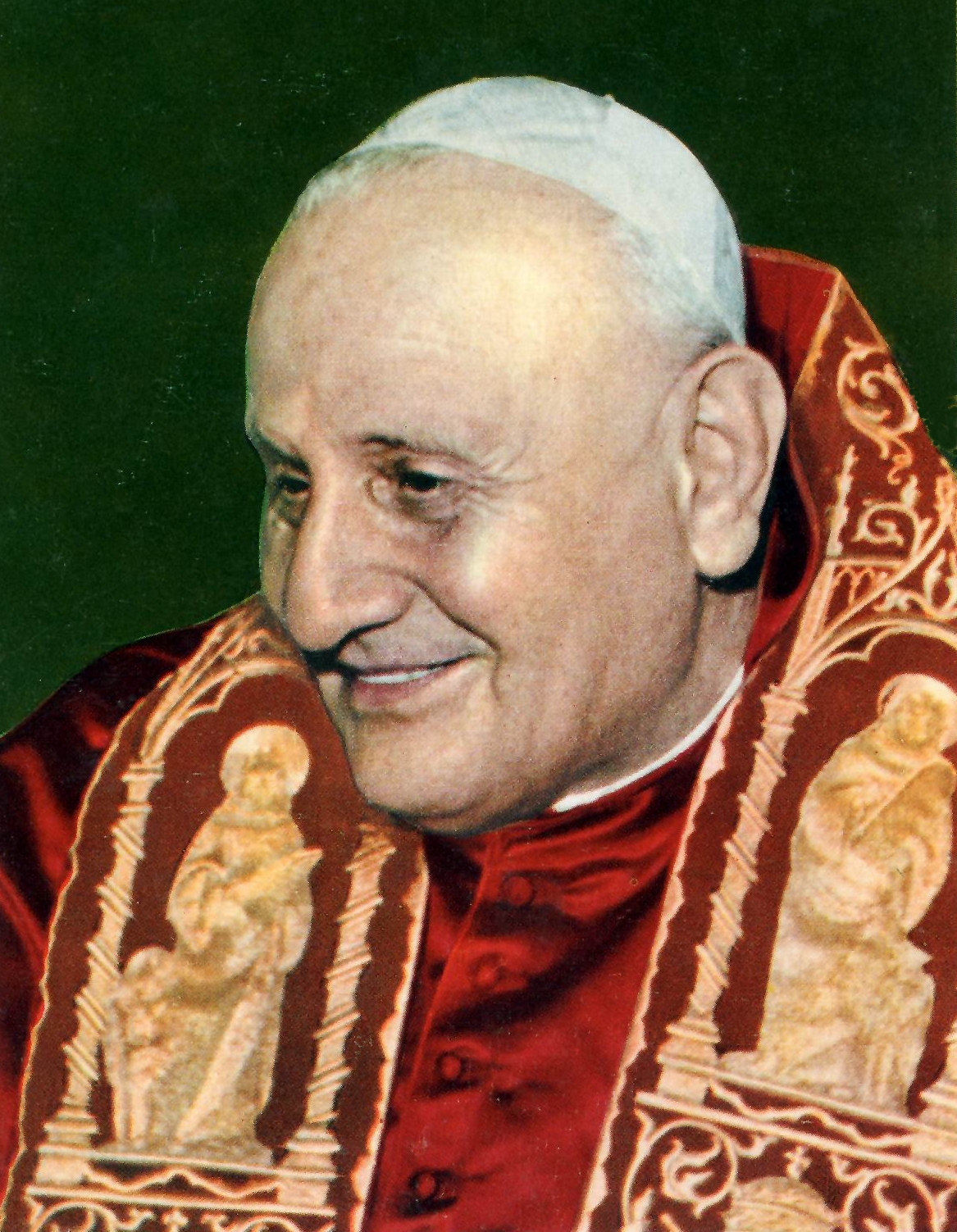
Pope John XXIII at the Basilica of St. Paul Outside the Walls, where on 25 January 1959 he announced an ecumenical council at the close of the Week of Prayer for Christian Unity. Photo: unknown author, public domain.
Event 22 of 57
On the afternoon of 25 January 1959 — the feast of the Conversion of St. Paul and the closing day of the Week of Prayer for Christian Unity — Pope John XXIII spoke to a small assembly of cardinals at the Basilica of St. Paul Outside the Walls. He had been pope for less than three months. Many had expected a brief, transitional reign from the genial seventy-seven-year-old elected in October. Instead, “trembling a little with emotion,” he told them he intended to summon an ecumenical council for the universal Church. It was the most consequential papal decision of the century for the liturgy, and almost no one in the room had seen it coming.
The Surprise at St. Paul’s
The setting was deliberate. To announce a council aimed in part at Christian unity, John XXIII chose the basilica raised over the tomb of the Apostle to the Gentiles, on the very day the Church closes its octave of prayer for the reunion of all Christians. The pope framed his plan not as one initiative but as a set of intertwined renewals for Rome and for the world.
We announce to you, indeed trembling a little with emotion, but at the same time with humble resolution of intention, the name and the proposal of a twofold celebration: a diocesan synod for the city, and an ecumenical council for the Universal Church.
— Pope John XXIII, allocution at St. Paul Outside the Walls, 25 January 1959 (trans.)
Alongside the synod and the council, he spoke of the “desired and awaited bringing up-to-date” of the Code of Canon Law. That phrase — aggiornamento, an “updating” or “bringing into the day” — would become the watchword of the whole enterprise. In the pope’s mind it meant presenting the unchanging faith with renewed vigor and clarity; it did not mean rupture. But it was a word capacious enough to be filled with many meanings, and not everyone who later invoked it shared his intentions.
A Saint’s Intent
It is essential to read John XXIII rightly. He was no liturgical radical. In February 1962, on the eve of the Council, he issued the Apostolic Constitution Veterum Sapientia — signed on the feast of the Chair of St. Peter, 22 February — a vigorous reaffirmation of Latin as the language of the Roman Church and a directive that it be safeguarded in seminary formation. The man who called the Council expected it to renew the Church’s life, not to dismantle her inherited worship. His later interventions show a pope who prized continuity even as he opened the door to reform.
Pope John XXIII was canonized a saint on 27 April 2014. A timeline that traces how reform later outran its mandate must never make him the villain of the story. His aim was pastoral renewal in continuity with tradition; the question Catholics rightly debate is not his holiness or his intent, but what others did with the council he convened.
Why the Liturgy Came First
When the Council opened in October 1962, the Fathers needed a subject to begin with — and the schema De Sacra Liturgia was ready. It was the most thoroughly prepared text on the table, the fruit of a half-century of scholarship from the Liturgical Movement: Solesmes and Maria Laach, Beauduin and Parsch, Pius XII’s Mediator Dei. Precisely because the liturgical question had been studied for so long, it seemed the safest and least contentious place to start.
1959 is the moment the Liturgical Movement turned from a scholarly and pastoral current into a conciliar mandate. For decades its proposals had circulated in monasteries, journals, and congresses. Now they would be debated by the world’s bishops and embedded in a binding constitution. The first document the Council would approve was on the liturgy.
The debate on the liturgy schema ran from 22 October to 13 November 1962. The text drew broad support; the sharpest disputes concerned the use of the vernacular and the role of national bishops’ conferences. The Movement’s reformers — many of them now periti (theological experts) and commission members — were well positioned to shape the outcome. What emerged, after years of revision, was Sacrosanctum Concilium, approved on 4 December 1963 by a vote of 2,147 to 4.
John XXIII meant by it the unchanging faith presented with fresh vigour. But a word that means “bringing up to date” carries no built-in limit, and within a decade it was doing work he never assigned it — underwriting changes he had explicitly guarded against, in a Church whose Latin he had defended in Veterum Sapientia months before the Council opened. The lesson is not that he chose the wrong word. It is that elastic words, once loosed in a council, are very hard to call back.
What 1959 Did and Did Not Settle
The announcement set processes in motion; it did not pre-decide their outcome. Sacrosanctum Concilium would call for Latin to be preserved, for Gregorian chant to retain pride of place, and for changes to be made only where the good of the Church genuinely required them. The wide gap between what the Council’s constitution actually said and what was later carried out belongs to a later chapter of this timeline — to the Consilium and the years after the Council closed.
For the story of the liturgy, then, this is the great hinge. Everything before 1959 was preparation; almost everything after it unfolds under the authority and momentum of a council. The decades of monographs, congresses, and pastoral experiments now had a stage equal to their ambitions, and reformers who had labored in relative obscurity suddenly found themselves drafting texts for the universal Church. Of all the subjects the Fathers might have addressed first, they began with the Mass.
- It was ready De Sacra Liturgia was the most thoroughly prepared schema on the table.
- Half a century of work Solesmes, Maria Laach, Beauduin, Parsch, and Pius XII’s Mediator Dei stood behind it.
- It looked safe Precisely because the question had been studied so long, it seemed the least contentious place to begin.
- The consequence The Movement’s reformers, now periti and commission members, were positioned to shape the first thing the Council did.
- He defended Latin Veterum Sapientia (1962) directed that Latin be safeguarded in seminary formation.
- He kept the old Holy Week At Santa Croce in Gerusalemme in 1959 he followed the pre-1955 practice.
- He is a canonized saint Canonized 27 April 2014.
- The honest question Not his holiness or his intent, but what others did with the council he convened.
Events That Led Here
Where It Led
- Pope John XXIII, Allocution at St. Paul Outside the Walls (25 January 1959)
- Pope John XXIII, Veterum Sapientia (Apostolic Constitution, 22 February 1962)
- Acta and history of the Second Vatican Council; Sacrosanctum Concilium (4 December 1963)
- Ralph M. Wiltgen, The Rhine Flows into the Tiber (1967)
- Canonization of John XXIII and John Paul II, vatican.va (27 April 2014)