The Protestant Observers
Non-Catholic observers were invited to follow the Consilium’s work on the reformed Mass — a fact that became, in the years after, the most abused claim in the whole story of the liturgy.
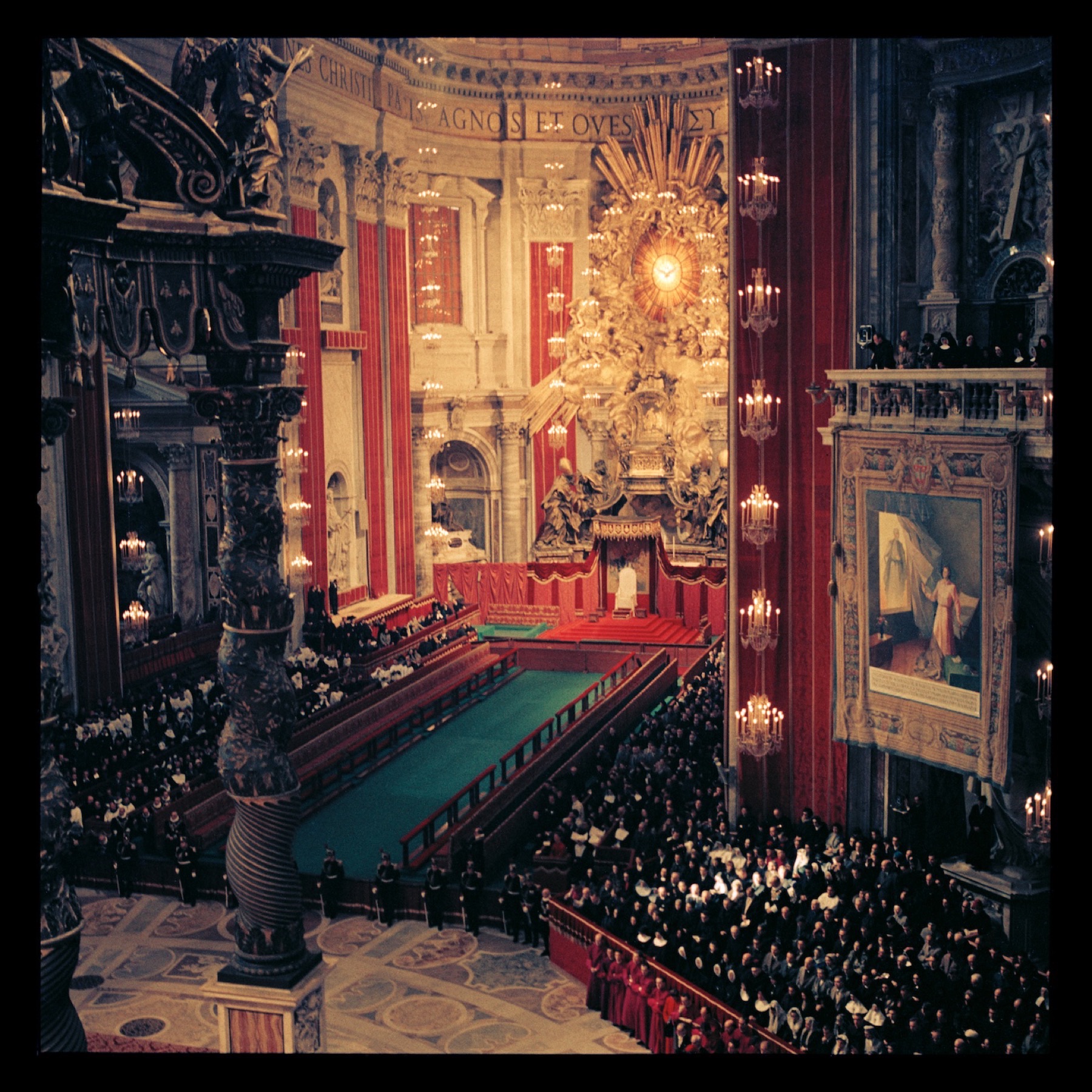
The Consilium ad exsequendam, which carried out the reform of the Roman liturgy after the Second Vatican Council. From 1965 onward, a small number of non-Catholic Christians were permitted to follow its work as observers. Photo: Lothar Wolleh, CC BY-SA 3.0, via Wikimedia Commons.
Event 30 of 57
No fact about the liturgical reform has been more distorted than this one. The bare truth is simple and verifiable: in the years after the Council, a handful of Protestant and non-Catholic Christians were invited to follow the work of the Consilium (the body charged with carrying out the reform of the Roman Mass) as observers. From that fact a legend grew: that “six Protestants wrote the Novus Ordo.” The legend is false. It is contradicted by the official record of the Holy See itself. And the saddest thing about it is that, in chasing a myth, its tellers have thrown away a real and defensible point.
What Actually Happened
The Consilium did its work in the open, in the spirit of the ecumenical age the Council had inaugurated. In 1965 members of certain Protestant communities asked to follow its work; the observers their communities named first sat in on its meetings in October 1966. In time, six theologians of various non-Catholic denominations were formally received as simple observers. The best known among them was the Reformed theologian Brother Max Thurian of the ecumenical community of Taizé.
Their role was exactly what the word says. Observers observe. They sat in; they could be consulted informally; they could not draft the texts, could not vote, and held no deliberative office whatsoever. The Consilium was a body of Catholic bishops and periti (expert advisors), answerable to the Pope, and it was these men — not the visitors — who composed the reformed rites and submitted them to Paul VI for approval.
The Protestant figures at the Consilium were OBSERVERS, not authors. They watched the reform; they did not write it. To say “six Protestants wrote the new Mass” is not a sharp polemical exaggeration, it is, on the official record of the Holy See, simply false. A faithful Catholic gains nothing by repeating it and loses the one real point worth making.
The Official Record Settles It
When the claim spread that Protestants had authored the new Missal, the Holy See did not ignore it. It answered the charge directly and in writing.
The Protestant observers did not take part in the composition of the texts of the new Missal.
— Vatican Press Office, reply of 25 February 1976 (Documents on the Liturgy 1963–1979, DOL 221)
That is decisive. It is not the opinion of a defender of the reform; it is the Church’s own statement of fact. The names are no secret: Bugnini prints the list as approved on 23 August 1966 (Canon Ronald Jasper, Massey Shepherd, A. Raymond George, Friedrich Wilhelm Künneth, replaced in 1968 by Eugene Brand, and Max Thurian). What the record denies is not that these men existed, but that they wrote anything.
“Six Protestants wrote the Novus Ordo” is a trap, and a tempting one, because it seems to win the argument in a single sentence. But it is false, it is refuted by the Holy See, and repeating it discredits the legitimate concerns of which it is a caricature. The valid worry is about influence on the reform’s TONE and ecumenical sensibility, never about authorship. Make the true claim, which is strong, not the false one, which collapses on contact with the record.
The Concern That Is Real
To correct the myth is not to pretend there was nothing here. There was. Ecumenical sensitivity was, by the reformers’ own admission, one current shaping the work, and the man who admitted it most plainly was the Consilium’s own secretary, Annibale Bugnini. Writing in L’Osservatore Romano in 1965 about the revision of certain Holy Week prayers, Bugnini explained the motive behind a painful change of wording.
It is the love of souls and the desire to help in any way the road to union of the separated brethren, by removing every stone that could even remotely constitute an obstacle or difficulty, that has driven the Church to make even these painful sacrifices.
— Annibale Bugnini, L’Osservatore Romano, 19 March 1965 (trans.)
Read carefully, that passage is the real and defensible point, and also a caution against overstatement. Bugnini was writing about a few Holy Week prayers, not announcing a program to strip the Mass of everything a Protestant might dislike. The version usually circulated (“We must strip from our Catholic prayers and from the Catholic liturgy everything which can be the shadow of a stumbling block for our separated brethren, that is, for the Protestants”) is a distortion: it turns a remark about a few prayers into a program. The honest summary is the precise one: a desire to remove what might needlessly offend separated Christians was an acknowledged motive in the reform; it was not a license to dismantle Catholic worship, and the reformers did not describe it as one.
Why the Critics Pressed the Point
The presence of the observers became a centerpiece of traditional criticism for a reason. In 1969, Cardinals Ottaviani and Bacci forwarded to Paul VI a critical study of the new Order of Mass (the document remembered as the Ottaviani Intervention), with a covering letter whose most famous sentence reads:
❝The Novus Ordo represents, both as a whole and in its details, a striking departure from the Catholic theology of the Mass as it was formulated in Session XXII of the Council of Trent.
— Cardinals A. Ottaviani and A. Bacci, letter to Paul VI accompanying the Short Critical Study, 25 September 1969
For these critics, the worry was never a question of validity: the new rite is valid and licit, and faithful Catholics do not deny it. The worry was that a reform conducted with one eye on Protestant sensibilities might soften, in tone and emphasis, the Mass’s clear expression of sacrifice and Real Presence. That is a question about prudence and effect that can be debated in communion. The fabricated charge of Protestant authorship is not a sharper form of that question; it is a different and false thing that drowns it out.
A faithful account refuses two errors. It will not pretend the observers were irrelevant or the ecumenical motive imaginary, Bugnini himself put it on the record. And it will not pretend the observers were authors, the Holy See has put THAT on the record too. The reformed Mass is valid, licit, and the Mass of the Church; one may still ask, charitably and in communion, whether the reform’s ecumenical sensibility cost something in the clarity of its sacrificial language. That is the real conversation. The myth only gets in its way.
So the observers were real, their presence was a fair subject of concern, and the concern belongs to the history honestly told. But they observed; they did not write. Between those two facts (a genuine ecumenical influence on the reform’s atmosphere, and the false claim that Protestants composed the Catholic Mass) lies the whole difference between a serious argument and a discrediting legend. The first is worth making. The second should be retired for good.
Six observers were present. The claim that they composed the new rite is not supported, and repeating it costs the argument – which does not need the help. Did the New Mass Empty the Pews? →
Events That Led Here
- Vatican Press Office, reply on the alleged Protestant influences on the new Order of Mass (25 February 1976), in Documents on the Liturgy 1963–1979 (Collegeville, 1982), DOL 221, p. 551
- Annibale Bugnini, The Reform of the Liturgy 1948–1975 (Liturgical Press, 1990), p. 200 (the observers as approved on 23 August 1966) and p. 239 (their first plenary meeting, October 1966)
- Annibale Bugnini, on the reform of the Holy Week prayers, L’Osservatore Romano (19 March 1965); cf. Bugnini, The Reform of the Liturgy 1948–1975 (Eng. trans. 1990)
- “Short Critical Study of the New Order of Mass” (the Ottaviani Intervention), with the covering letter of Cardinals Ottaviani and Bacci to Paul VI (25 September 1969)
- Dietrich von Hildebrand, The Devastated Vineyard (1973)
- Council of Trent, Session XXII (1562), on the Sacrifice of the Mass