Ecclesia Dei — John Paul II
Two days after the Écône consecrations tore at the Church, John Paul II answered the rupture not only with the law but with a father’s generosity — and from that mercy the first homes for the old rite in full communion were born.
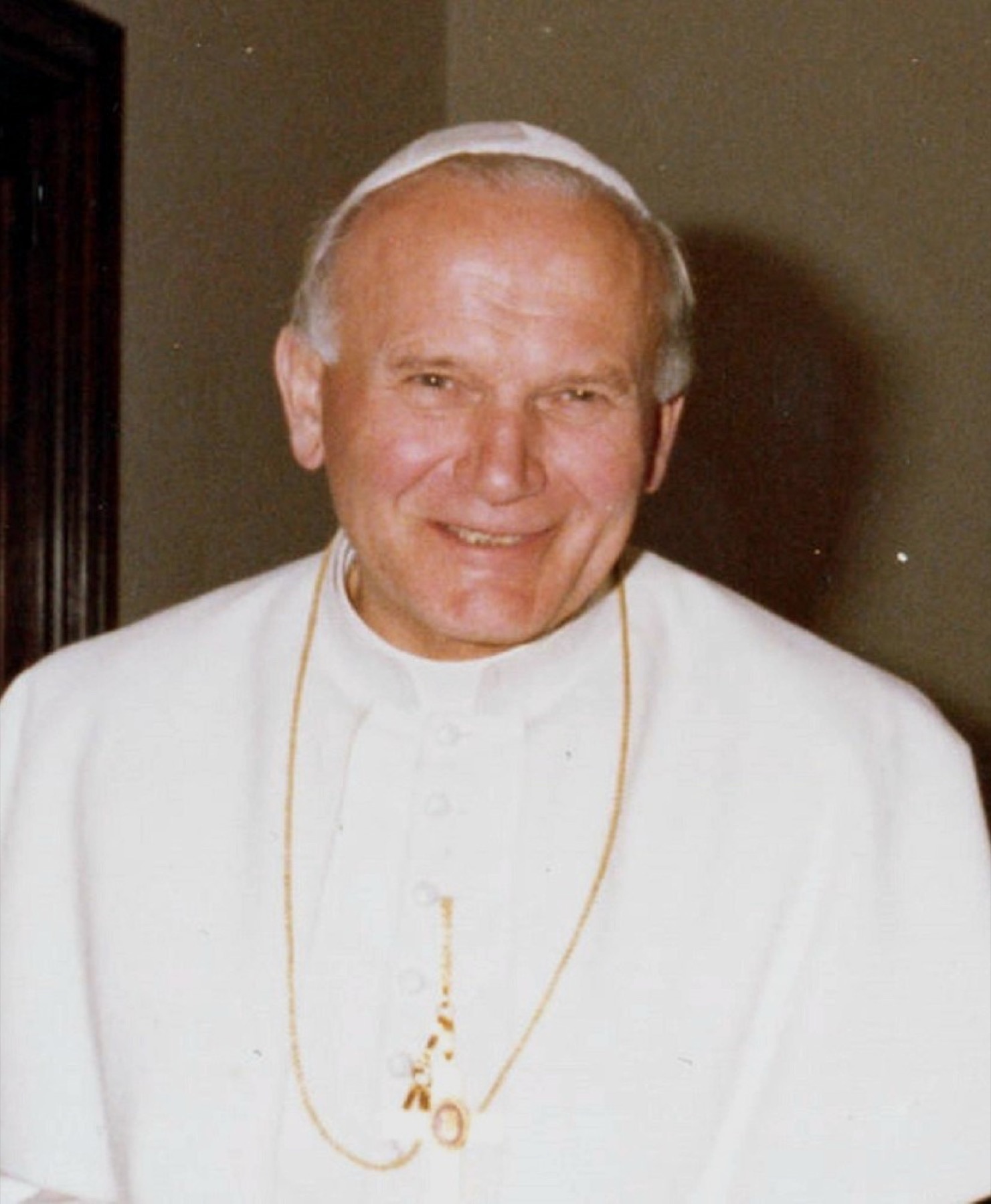
Pope John Paul II, who on 2 July 1988 issued the motu proprio Ecclesia Dei adflicta in response to Archbishop Marcel Lefebvre’s unlawful episcopal consecrations of 30 June 1988. The document declared the schismatic act yet made generous provision for the faithful attached to the traditional Latin liturgy. Photo: Gov.pl, CC BY 3.0 PL, via Wikimedia Commons.
Event 44 of 57
On 2 July 1988, two days after Archbishop Marcel Lefebvre had consecrated four bishops at Écône without papal mandate, Pope St. John Paul II issued a short, grave document that began with the Church’s sorrow: Ecclesia Dei adflicta, “With great affliction the Church has learned of the unlawful episcopal ordination conferred on 30 June last by Archbishop Marcel Lefebvre.” What followed could have been simply a sentence of judgment, and in part it was: the consecrations were named a schismatic act, and the canonical penalty of excommunication was declared incurred. But the motu proprio did not stop at the law. In the same breath it turned toward those Catholics who loved the old liturgy and wished to remain inside the Church, and it made room for them. Out of the rupture of Écône came the first structural home for the traditional rite in full communion with Rome. This is the merciful counter-move, the redemptive turn in the story.
The Law: A Schismatic Act
John Paul II did not soften what had happened. To consecrate bishops against the express prohibition of the Roman Pontiff was, he wrote, an act of disobedience that “implies in practice the rejection of the Roman primacy” and therefore “constitutes a schismatic act.” By the law of the Church (Canon 1382), Archbishop Lefebvre, the bishop-co-consecrator Antônio de Castro Mayer, and the four newly consecrated bishops incurred the penalty of excommunication latae sententiae, automatically, by the act itself. A Catholic in communion with Rome must say this plainly: the Pope was within his rights and his duty to uphold the order of the Church, and the schism was real. Nothing in the generosity that follows erases the gravity of what was done.
Such disobedience (which implies in practice the rejection of the Roman primacy) constitutes a schismatic act. In performing such an act, notwithstanding the formal canonical warning sent to them by the Cardinal Prefect of the Congregation for Bishops on 17 June last, Mons. Lefebvre and the priests Bernard Fellay, Bernard Tissier de Mallerais, Richard Williamson and Alfonso de Galarreta have incurred the grave penalty of excommunication envisaged by ecclesiastical law.
— John Paul II, Ecclesia Dei adflicta, 2 July 1988
The Mercy: Rightful Aspirations
Then the tone changes. Having upheld the law, John Paul II reached past the small band who had broken with Rome to the far larger number of faithful who shared their love of the ancient liturgy but not their disobedience. To them he addressed words that traditional Catholics would carry for a generation: he wished, he said, to guarantee “respect for their rightful aspirations.” The word matters. He did not speak of a tolerated preference to be endured; he spoke of aspirations that were rightful — a claim to be honored, not merely permitted.
To all those Catholic faithful who feel attached to some previous liturgical and disciplinary forms of the Latin tradition I wish to manifest my will to facilitate their ecclesial communion by means of the necessary measures to guarantee respect for their rightful aspirations.
— John Paul II, Ecclesia Dei adflicta, 2 July 1988
And he gave that will a concrete shape. Building on the limited indult Quattuor Abhinc Annos of 1984, he asked the whole Church for something warmer than grudging compliance:
❝Respect must everywhere be shown for the feelings of all those who are attached to the Latin liturgical tradition, by a wide and generous application of the directives already issued some time ago by the Apostolic See for the use of the Roman Missal according to the typical edition of 1962.
— John Paul II, Ecclesia Dei adflicta, 2 July 1988
“A wide and generous application.” That phrase became a watchword. It would be quoted in petitions and pastoral letters for the next two decades, and it pointed straight toward the day, in 2007, when Summorum Pontificum would declare the older Missal never abrogated.
The Commission: A Structure for Communion
Words needed an instrument, and John Paul II created one. The motu proprio established the Pontifical Commission Ecclesia Dei, whose task was to collaborate with the bishops and the offices of the Roman Curia “for the purpose of facilitating full ecclesial communion of priests, seminarians, religious communities or individuals” hitherto linked to the Fraternity of Saint Pius X who wished to remain united to the Successor of Peter. For the first time there was an office in Rome charged not with merely policing the old rite but with welcoming those attached to it home.
Notice what John Paul II did and did not do. He upheld the excommunications; the law was the law, and the schism was named for what it was. Yet in the very same document he opened wide the door of communion to everyone who would walk through it. This is the Catholic pattern at its best: justice and mercy held together, the gate of the fold guarded and also held open. To honor the traditional liturgy is never to despise this Pope, who gave it its first secure footing in Rome.
The Fruit: The Communities Born
The most beautiful consequence came almost at once. Among the priests of the Fraternity of Saint Pius X, a number had never wanted schism; they wanted the old Mass and Rome. The opening John Paul II provided gave them somewhere to go. On 18 July 1988, barely two weeks after the motu proprio, twelve priests and a band of seminarians, led by Fr. Josef Bisig and formerly of the SSPX, gathered at the Cistercian Abbey of Hauterive in Switzerland and founded the Priestly Fraternity of St. Peter (FSSP). They asked to live and serve in the Church under the authority of the Roman Pontiff. On 18 October 1988 the Holy See erected the Fraternity as a society of apostolic life of pontifical right, and that December its first priest was ordained in Rome.
The FSSP was the first of the “Ecclesia Dei communities” institutes that would celebrate the 1962 liturgy in undoubted communion with the Pope, soon joined by others devoted to the traditional rites. They were the living proof of the document’s promise: that one could love the old Mass with one’s whole heart and remain wholly inside the Church. The seed planted in the summer of 1988 would be watered, nineteen years later, by Summorum Pontificum, and the flourishing of the traditional liturgy in the early twenty-first century traces back, in no small part, to a father’s generosity offered in the very hour of a rupture.
Écône was a wound; Ecclesia Dei was the Church’s answer of grace. John Paul II refused to let the schism be the last word. By declaring the law and offering mercy in the same breath, he gave the traditional liturgy its first structural home in full communion, the Pontifical Commission and the FSSP, and showed that fidelity to the old rite and fidelity to the Pope are not rivals but companions. The communities that chose communion in 1988 are the truest heirs of the love that the schismatics betrayed.
When the history of the traditional movement is told honestly, 2 July 1988 is not remembered chiefly as a day of excommunications. It is remembered as the day Rome first said, in a binding act of the Pope, that the aspirations of those attached to the ancient liturgy were rightful, and then built a house in which they could live.
Events That Led Here
- John Paul II, Ecclesia Dei adflicta — apostolic letter given motu proprio, 2 July 1988 (vatican.va) — schismatic act, Canon 1382 excommunications, Pontifical Commission Ecclesia Dei, “rightful aspirations,” “wide and generous application”
- John Paul II, Dominicae Cenae (24 February 1980), n. 12, respect for those attached to the Latin liturgical tradition
- Congregation for Divine Worship, Quattuor Abhinc Annos (3 October 1984), the indult for the 1962 Missal referenced by Ecclesia Dei
- Priestly Fraternity of St. Peter (FSSP), founding at the Abbey of Hauterive, Switzerland, 18 July 1988, by twelve former-SSPX priests led by Fr. Josef Bisig; erected as a society of apostolic life of pontifical right 18 October 1988 (fssp.org; FSSP anniversary reflections)