Traditionis Custodes
For fourteen years the old Mass had a charter; in a single document, that charter was not amended but reversed.
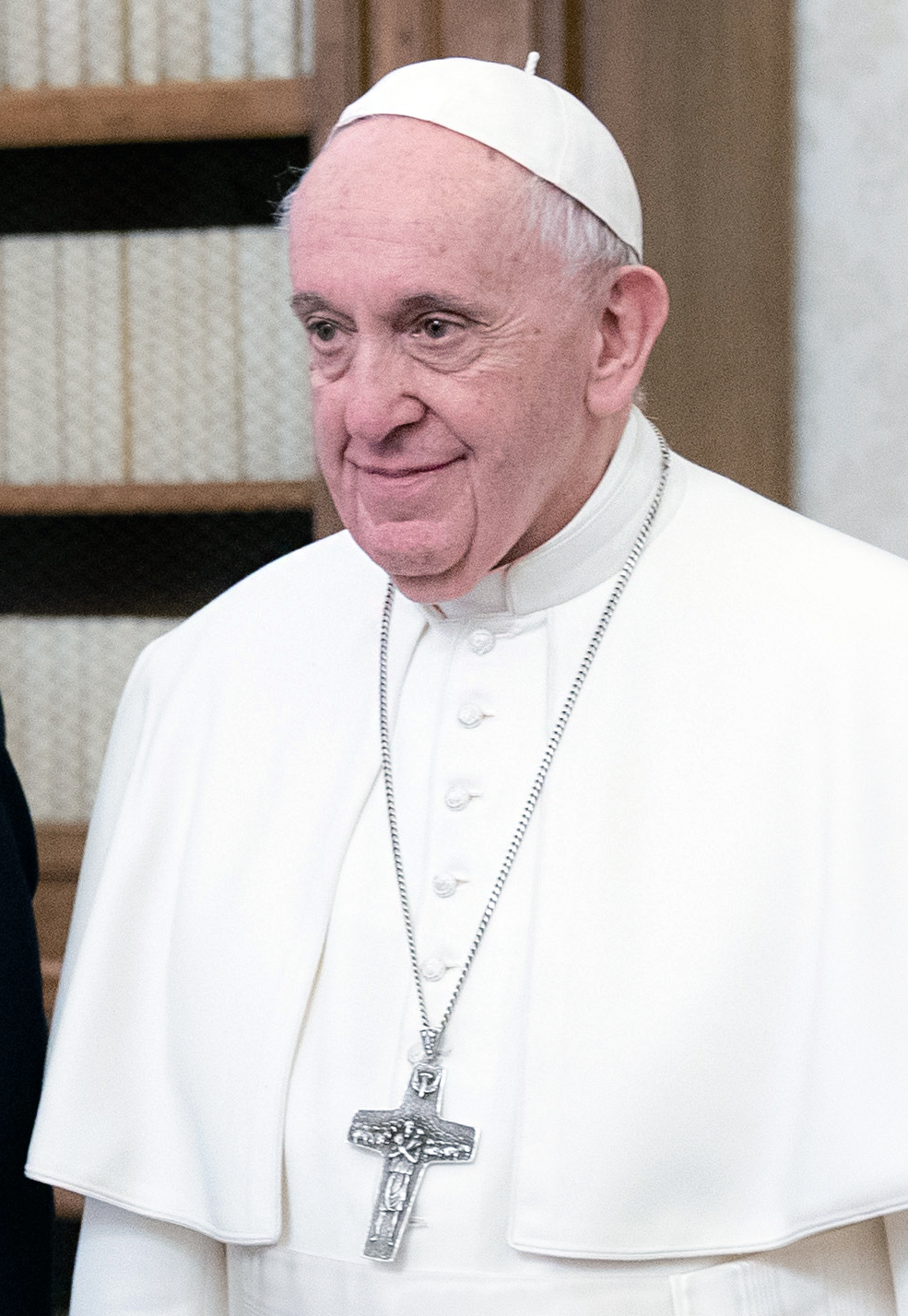
Pope Francis, who issued Traditionis Custodes — “Guardians of the Tradition” — motu proprio on 16 July 2021, the memorial of Our Lady of Mount Carmel. Photo: White House (D. Myles Cullen), public domain.
Event 52 of 57
On 16 July 2021, the memorial of Our Lady of Mount Carmel, Pope Francis issued the apostolic letter Traditionis Custodes, “Guardians of the Tradition”, and it took effect the day it was published. For fourteen years Summorum Pontificum had governed the traditional Mass, and under it the old rite had quietly flourished. Now that settlement was undone. Where Benedict XVI had spoken of two forms of one Roman Rite, both legitimate, Francis reversed the framing in his very first article. This was not a modification. It was a reversal, and it is the hinge on which the present moment turns.
This chapter must be handled with particular care. The temptation, for one who loves the old Mass, is to answer a hard act with a hard heart. But the duty of any Catholic is to remain in communion: to render the reigning pontiff his due respect and to state his reasons fairly, even while grieving honestly what was done and counting its cost. Both are required. Neither may be sacrificed to the other.
The Reversal in Article 1
Benedict had taught that the 1962 and post-conciliar books were two “forms”, ordinary and extraordinary, of the one Roman Rite, each a legitimate use of its lex orandi. Francis closed that door in a single sentence.
The liturgical books promulgated by Saint Paul VI and Saint John Paul II, in conformity with the decrees of Vatican Council II, are the unique expression of the lex orandi of the Roman Rite.
— Traditionis Custodes, Article 1, 16 July 2021
From that premise the restrictions followed in order. The diocesan bishop was made the sole regulator of the 1962 Missal, with “exclusive competence” to authorize it according to the guidelines of the Apostolic See (Art. 2). Celebrations were barred from parish churches; the erection of new personal parishes and the formation of new groups were forbidden (Art. 3). And priests ordained after the document’s publication faced a new gate (Art. 4): they “should submit a formal request to the diocesan Bishop who shall consult the Apostolic See before granting this authorization.” Point by point, the freedom Summorum Pontificum had granted was taken back.
That a pope may legislate for the Church’s liturgy is not in dispute, and it is not disputed here. Francis acted within his power; the see was not vacant and the office not in question. The question this chapter weighs is not whether he could act, but what the action cost, and whether it was prudent and charitable in its effect. The sedevacantist exit, declaring the pope no pope, is a false one, and this series rejects it from the first page.
The Pope’s Stated Reasons
Fairness requires that Francis’s reasons be stated as he gave them. In an accompanying letter to the bishops of the world, he wrote that he had instructed the Congregation for the Doctrine of the Faith to survey the world’s bishops on how Summorum Pontificum was working; the responses, he said, revealed “a situation that preoccupies and saddens me.” His central charge was that a generous concession had been abused.
An opportunity offered by St. John Paul II and, with even greater magnanimity, by Benedict XVI, intended to recover the unity of an ecclesial body with diverse liturgical sensibilities, was exploited to widen the gaps, reinforce the divergences, and encourage disagreements that injure the Church, block her path, and expose her to the peril of division.
— Letter to the Bishops accompanying Traditionis Custodes, 16 July 2021
His concern was unity. Francis judged that attachment to the old Mass had become, in some quarters, a banner for rejecting the Second Vatican Council and the reformed liturgy — and behind that, the authority of the Council and the Pope. “To doubt the Council,” he wrote, “is to doubt the intentions of those very Fathers who exercised their collegial power in a solemn manner cum Petro et sub Petro in an ecumenical council, and, in the final analysis, to doubt the Holy Spirit himself who guides the Church.” In defense of the Church’s unity, he reached his conclusion.
In defense of the unity of the Body of Christ, I am constrained to revoke the faculty granted by my Predecessors.
— Letter to the Bishops accompanying Traditionis Custodes, 16 July 2021
This much should be granted plainly: the abuse Francis named existed in places. There were corners of the traditional world where the old Mass had become a flag of rebellion, where the Council was treated as a heresy, the new Mass as invalid, and the reigning pope as an impostor. Against that distortion, a pope’s concern for unity is legitimate and even necessary. An honest traditionalist does not pretend the problem was invented.
The Cost
And yet the remedy fell hardest not on the disobedient few but on the faithful many. The communities most affected were overwhelmingly those in full, unquestioned communion with Rome: the families, the young priests, the converts, the Ecclesia Dei parishes that had accepted the Council, affirmed the validity of the new Mass, and prayed for the pope by name. They asked only to worship as their grandparents had. In effect they were made to bear the consequences of others’ faults, and the wound was real.
Nor did it stop with the motu proprio. A Responsa ad dubia from the Congregation for Divine Worship in December 2021 (under its Prefect, Archbishop Arthur Roche) tightened the screws further. A rescript of 20 February 2023 (published the next day) reserved to the Apostolic See itself the power to permit the use of parish churches, to erect personal parishes, and to authorize priests ordained after 16 July 2021, removing even those discretions from local bishops.
Across the United States the restrictions came down diocese by diocese. In Arlington and Washington in 2022, the traditional Mass was confined to a handful of approved sites. In Detroit, permission to use parish churches was allowed to expire on 1 July 2025. In Charlotte, after a public outcry forced a months-long delay, the old Mass was restricted from four parishes to a single chapel, effective 2 October 2025. These are documented diocesan actions; the precise figures are drawn from reporting and diocesan releases, and are best held as measured rather than exact.
Whatever one makes of the policy, its human texture is not in dispute: devout Catholics, guilty of nothing, found the Mass they loved pushed to the margins of the Church’s life (to a single chapel, an inconvenient hour, a borrowed space) by the very authority they were striving to obey. Communion does not require pretending that nothing was lost. The task under Traditionis Custodes was the hardest kind of fidelity: to suffer a wound from a father’s hand without ceasing to honor the father, and without ceasing to love the inheritance.
Where the Matter Stands
That was where the question rested when the pontificate ended. In April 2025 Pope Francis died, and the matter passed, unresolved, to his successor. Pope Leo XIV, elected on 8 May 2025, has not abrogated, revoked, or formally revised Traditionis Custodes as of mid-2026. What observers describe is continuity of the law with a more lenient application, the same statute on the books, applied with a readier hand. The reversal of 2021 remains the governing law of the old Mass, and the wound it opened is not yet healed.
Survey estimates and supply-side counts disagree by an order of magnitude. Counting parishes rather than self-reports puts the older rite at roughly one percent of American Mass-goers – growing fast, from a very small base. Did the New Mass Empty the Pews? →
Events That Led Here
- Pope Francis, Traditionis Custodes (motu proprio, 16 July 2021)
- Pope Francis, Letter to the Bishops of the whole world accompanying Traditionis Custodes (16 July 2021)
- Congregation for Divine Worship and the Discipline of the Sacraments, Responsa ad dubia on Traditionis Custodes (4 December 2021)
- Rescript ex audientia of the Holy Father on Traditionis Custodes (20 February 2023; published 21 February)
- Reporting on diocesan implementation: Arlington, Washington DC, Detroit, Charlotte (The Pillar, CNA/NCRegister, Catholic World Report, diocesan releases, 2022–2025)