Ottaviani’s Microphone Cut Off
On the day after his seventy-second birthday, the nearly blind head of the Holy Office rose to defend the ancient rite, ran past the clock, and had his microphone switched off — and some of the Fathers applauded.
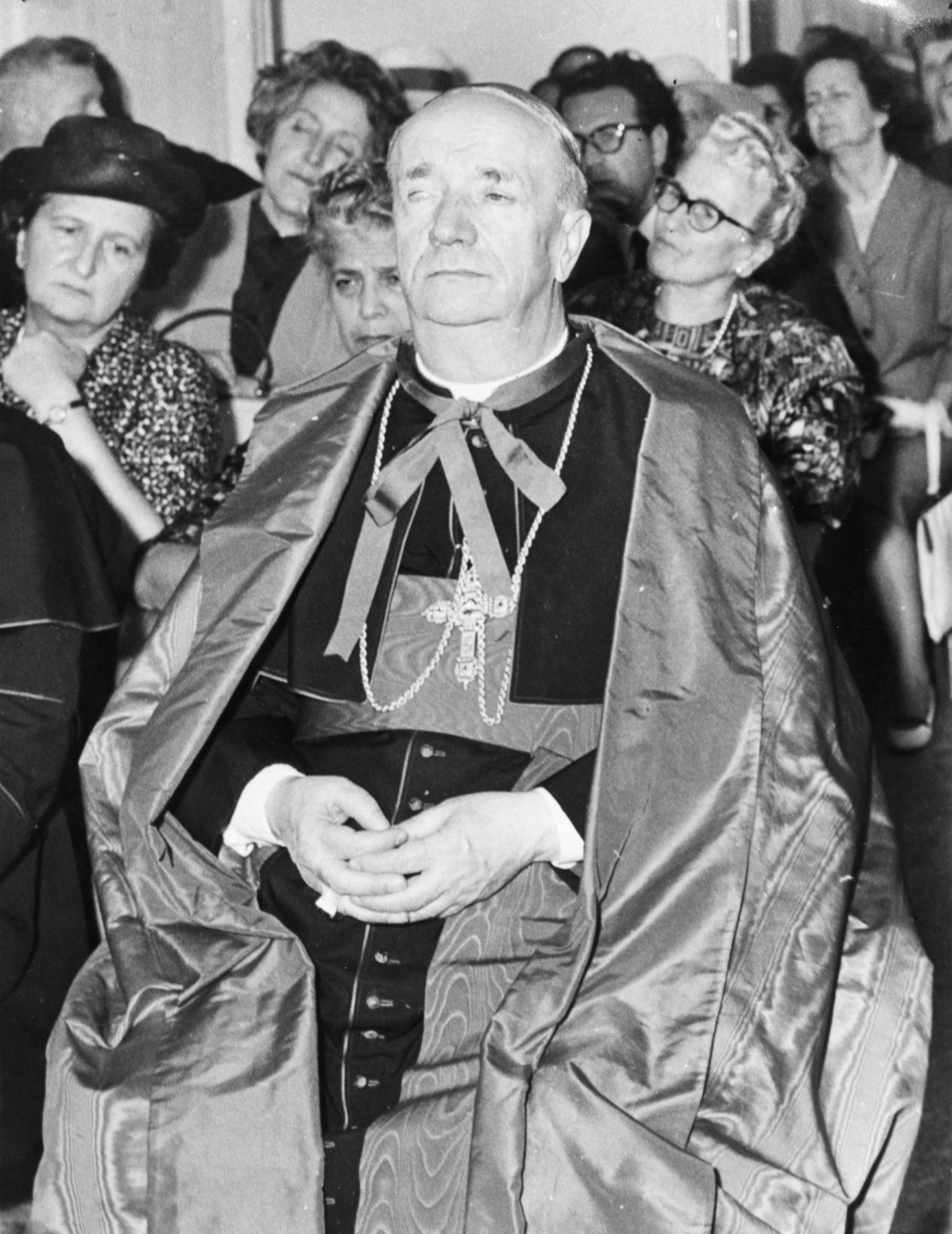
Cardinal Alfredo Ottaviani, Secretary of the Holy Office, photographed during the Second Vatican Council. On 30 October 1962, during the debate on the liturgy schema, his microphone was switched off when he overran the speaking time. Photo: Anefo / Nationaal Archief, public domain.
Event 26 of 57
On 30 October 1962, the day after his seventy-second birthday, Cardinal Alfredo Ottaviani, Secretary of the Holy Office and the most prominent voice of the Roman Curia, rose in the council hall to speak against the sweeping changes being proposed for the Mass. Nearly blind, he spoke without a text, from memory and conviction. He warned the Fathers against treating the venerable Roman liturgy as something to be remade at will. And then, having overrun the ten-minute limit that all speakers had been asked to observe, he had his microphone switched off in front of the assembled bishops of the world. A few, by several accounts, applauded. It is one of the most retold scenes of the Second Vatican Council, and one of the most embellished. Told accurately, it is poignant enough.
What Actually Happened
The setting was the first working business of the Council: the schema De Sacra Liturgia, the draft constitution on the liturgy, debated through the autumn of 1962. Ottaviani, head of the body then charged with guarding doctrine, took the floor to caution against changes he judged too drastic. Because his eyesight had nearly failed him, he spoke extemporaneously rather than from a prepared text, and he lost track of the time. All speakers had been asked to keep to roughly ten minutes.
According to Fr. Ralph Wiltgen’s contemporary chronicle The Rhine Flows into the Tiber, Cardinal Eugène Tisserant, dean of the council presidents, showed his watch to Cardinal Bernard Alfrink of Utrecht, who was presiding that morning. When Ottaviani reached fifteen minutes, Alfrink rang the warning bell. The cardinal, absorbed in his subject, did not stop: whether he failed to hear the bell or chose to ignore it is not certain. At a signal from Alfrink, a technician switched off the microphone. Ottaviani tapped the dead instrument to confirm it had been cut, and made his way back to his seat.
Are we seeking to stir up wonder, or perhaps scandal, among the Christian people, by introducing changes in so venerable a rite, that has been approved for so many centuries and is now so familiar? The rite of Holy Mass should not be treated as if it were a piece of cloth to be refashioned according to the whim of each generation.
— Cardinal Alfredo Ottaviani, address on the liturgy schema, 30 October 1962 (trans., as reported in Wiltgen, The Rhine Flows into the Tiber)
What he said is as important as what happened to him. His objection was not to reform as such but to the speed and scope of it, to handling the Mass “as if it were a piece of cloth.” That phrase has outlived the man.
It Was the Clock, Not Censorship
Here the legend must be separated from the fact, because the truth is more honest and finally more sympathetic. The microphone was cut for a procedural reason: Ottaviani had run roughly five minutes past a time limit that bound everyone equally. He was not silenced because of what he was saying. No ruling suppressed his content; the council presidents were enforcing the same rule against him that governed every other Father at the rostrum. To present the moment as the deliberate gagging of orthodoxy is to misread it, and to make the conservatives’ real grievance harder to take seriously.
Popular versions of this story drift. Some place it on the wrong date, some say Cardinal Liénart of Lille flipped the switch, some age Ottaviani to eighty, and some frame the cut-off as censorship of doctrine. The careful record, Wiltgen’s eyewitness chronicle, says: 30 October 1962, a technician acting on Cardinal Alfrink’s signal, a seventy-two-year-old cardinal, and a time-limit overrun. Defend the truth, not the embroidery.
The Applause — and What It Signified
The detail that has lodged in memory is not the bell but the reaction. As Ottaviani returned to his place, Wiltgen records that the Fathers clapped. Whether it was scattered or general, that applause is the reason this small parliamentary moment became an emblem. The man being applauded was no minor figure: he was the Church’s chief guardian of doctrine, an old Roman who had given his life to the Curia. To see the assembly relieved at his silencing, even over a clock, told everyone in the hall that the mood had turned.
By late October 1962 the curial old guard had already been outmaneuvered once, in the Liénart-Frings intervention that reopened the commission elections. The Ottaviani microphone scene crystallized the same shift in a single image: the Council’s center of gravity had moved away from the Roman Curia and toward the reform-minded majority. The clock was incidental; what the room revealed about itself was not.
It is worth weighing the human picture too. A nearly blind old cardinal, speaking from the heart in defense of the rite he had prayed all his life, taps a silent microphone and gropes his way back to his chair while younger men applaud. Whatever one makes of his theology of reform, the scene asks for charity, not triumph.
Ottaviani After the Microphone
Ottaviani did not vanish from the story. He remained Secretary of the Holy Office and a leading voice for continuity through the Council and after it. In 1969 his name would headline the famous critical study of the new Order of Mass that came to be called the Ottaviani Intervention — a measured doctrinal critique submitted to Pope St. Paul VI, not an act of rebellion. The arc from the silenced microphone of 1962 to that document is the arc of the conservative minority across the whole conciliar decade: outvoted, often outmaneuvered, but never disloyal.
This episode is a favorite of those who would weaponize it against the Council itself. Resist that. The legitimacy of the Second Vatican Council and the validity of the rites that followed are not in question here. What the scene records is a matter of prudence and tone, how a venerable churchman was treated, and how the room felt about the questions he raised. One can lament the discourtesy and still hold the Council in honor. Both are required of a Catholic in communion with Rome.
The microphone was switched back on for the next speaker, and the debate moved on. But the picture stayed: the old guardian of the rite, silenced by a clock, applauded as he sat down. It is remembered because everyone present understood, however dimly, that they had just watched an era change hands.
- Ralph M. Wiltgen, The Rhine Flows into the Tiber: A History of Vatican II (1967), primary chronicle of the 30 October 1962 incident
- Ralph McInerny, What Went Wrong with Vatican II (citing Wiltgen), EWTN Library
- Acta Synodalia Sacrosancti Concilii Oecumenici Vaticani II, debate on the schema De Sacra Liturgia, October–November 1962
- Alfredo Ottaviani, biographical record (b. 29 October 1890; Secretary of the Holy Office)