Rejection of the Curial Schemata
In the Council’s first session the Fathers set aside the preparatory draft on revelation — and Pope John XXIII, by his own authority, sent it back to be rewritten.
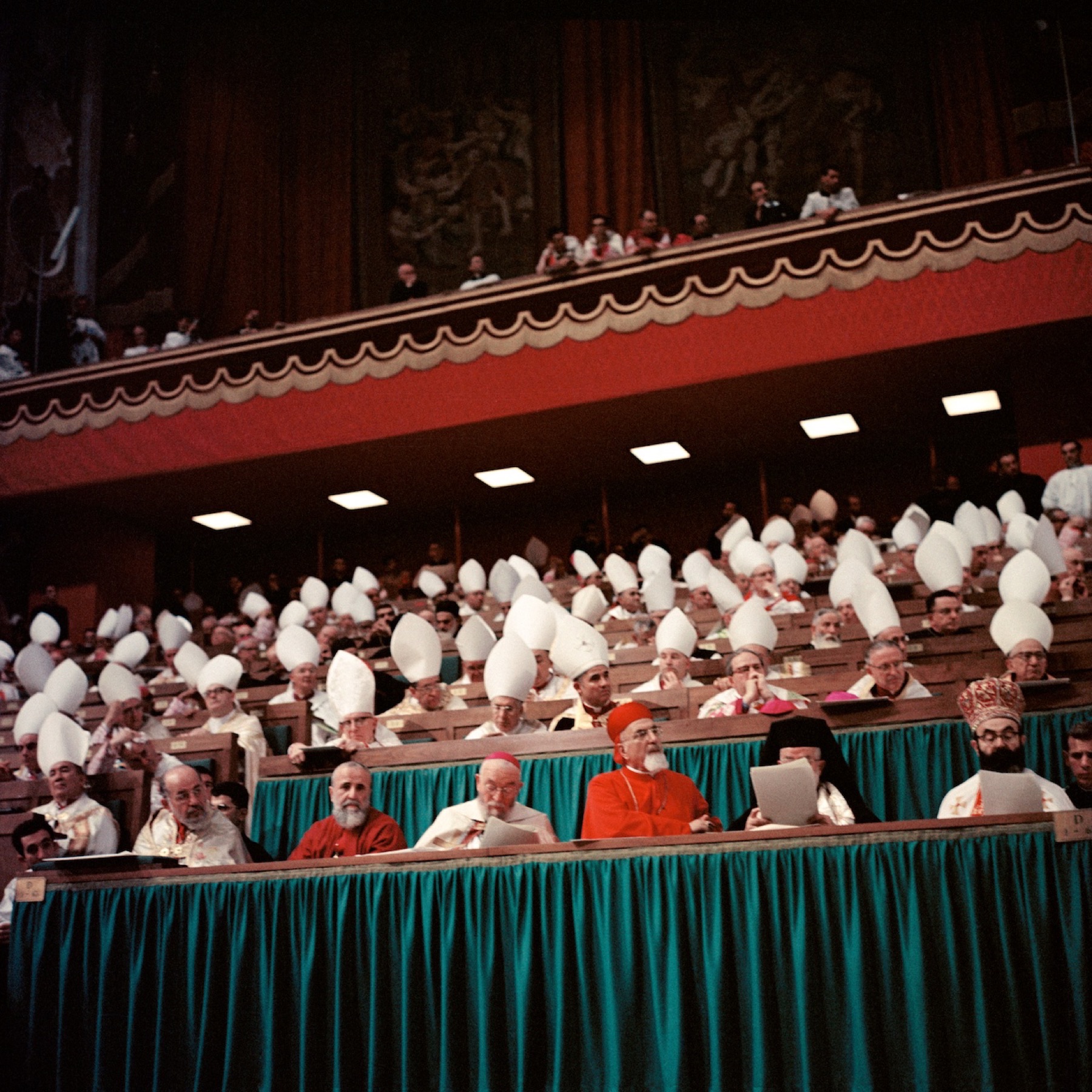
The Council Fathers in session in Saint Peter’s Basilica, 1962. In the first weeks they declined to take the preparatory schema on the sources of revelation as the basis for their work — and Pope John XXIII intervened to send it for redrafting. Photo: Lothar Wolleh, CC BY-SA 3.0, via Wikimedia Commons.
Event 27 of 57
When the Second Vatican Council opened in October 1962, more than seventy draft texts, the schemata, sat ready, the fruit of two years of preparatory work overseen largely by the Roman Curia. Within weeks the Fathers made clear they would not simply ratify what had been handed to them. The decisive test came over De fontibus revelationis, the schema on the sources of revelation. A majority voted to set it aside; the vote fell just short of the two-thirds the rules required to do so formally; and Pope John XXIII stepped in to break the impasse. The first session thereby established that the Council would be a working assembly, not a rubber stamp.
On 11 October 1962, John XXIII opened the Council before more than two thousand bishops gathered in Saint Peter’s. Awaiting them was a thick dossier of prepared texts. The most influential preparatory body had been the Theological Commission, presided over by Cardinal Alfredo Ottaviani, Secretary of the Holy Office, and these drafts bore the stamp of the neo-scholastic Roman theology of the day: precise, defensive, and framed largely to guard against modern errors. Many Fathers, especially from northern Europe, arrived convinced that the texts needed not polishing but substantial revision. The question was how an assembly of that size could possibly say so.
The answer came faster than anyone expected, and it came over the doctrine of revelation. The schema De fontibus revelationis (“On the Sources of Revelation”) opened by speaking of two sources, Scripture and Tradition, and took a sharply critical line toward modern biblical scholarship. To its drafters this was simply Catholic orthodoxy stated plainly. To a large bloc of bishops and their periti, it foreclosed questions the Council ought to leave open and struck the wrong note for an assembly meant to speak to the modern world.
The Debate on Revelation
Formal debate on the schema opened on 14 November 1962. What followed was the first open collision of the Council. Cardinal Ottaviani rose to defend the text; against it spoke a remarkable roster of cardinals: among them Liénart, Frings, König, Alfrink, Suënens, Léger, Ritter, and Cardinal Augustin Bea, the head of the new Secretariat for Promoting Christian Unity. The objection was not that the schema was heretical. It was that its tone and method were ill-suited to the Council’s purpose, and that on a contested theological point, the precise relationship of Scripture and Tradition, it tried to settle what the Fathers preferred to keep open.
Whether the discussion of the schema De fontibus revelationis should be interrupted.
— The substance of the procedural vote put to the Council Fathers, 20 November 1962
Because the rules did not provide a simple mechanism to throw out a draft, the presiding cardinals framed a procedural question: should discussion of the schema be interrupted? A placet (“it pleases”) meant: stop debating this text. The vote was taken on 20 November 1962.
The numbers tell the whole drama. 1,368 Fathers voted to set the schema aside; 822 voted to keep working from it. That is roughly sixty-one percent against the text — a clear majority, and yet, by the Council’s own procedure, not enough. A two-thirds vote was required to interrupt a schema, and the majority had fallen short of it. The result was paradoxical: most of the Council had rejected the draft, but the rules said the rejected draft must remain the basis of discussion.
The Pope’s Intervention
Into that deadlock stepped Pope John XXIII. On 21 November 1962, exercising his own authority over the Council’s order of business, he decided that the schema would be withdrawn from the floor and handed to a newly formed mixed commission, drawn from Cardinal Ottaviani’s Doctrinal Commission and Cardinal Bea’s Secretariat for Promoting Christian Unity together, to be rewritten. In effect the Pope read the will of the strong majority and gave it legal force the vote alone could not.
Whatever one makes of the outcome, the mechanics here were entirely in order. The voting procedure, including the two-thirds rule, was the Council’s own established norm, and it was followed. And the Pope’s intervention was not a circumvention of the Council but an act of the office that convoked it: an Ecumenical Council acts under and with the Roman Pontiff, who orders its work. John XXIII broke a genuine procedural impasse by ordinary papal authority. Nothing about the episode is irregular; it is simply the constitution of the Church functioning as designed.
The redrafting John XXIII ordered would take three years. The mixed commission’s work, carried through under his successor Paul VI, eventually became the Dogmatic Constitution Dei Verbum, promulgated in 1965, a text that speaks of revelation and of Scripture and Tradition in language notably different from the schema the Fathers had declined. The seed of that long development was the vote of 20 November and the papal decision of 21 November 1962.
How Far the Rejection Went
It became common to say that the Council “rejected the Curial schemata” wholesale, and that only the liturgy draft survived. The reality is more textured, and worth getting right. The preparatory schema on the sacred liturgy, De sacra liturgia, had in fact been received warmly (it carried the maturing work of the liturgical movement and drew broad support), and it went forward to become, in December 1963, the constitution Sacrosanctum Concilium. Several other preparatory texts, by contrast, were heavily revised or set aside in the sessions that followed. But the dramatic, defining moment was the one over De fontibus: there the Council showed, in a single recorded vote, that it intended to be the author of its own documents.
Two overstatements should be avoided. First, the November 1962 vote did not “abolish” the schemata or reject the doctrine of two sources of revelation: it was a procedural decision to stop debating one particular draft, and Dei Verbum would later affirm that Scripture and Tradition together transmit the one deposit of revelation. Second, it is too simple to say that “only Bugnini’s liturgy schema survived intact.” The liturgy draft did survive and prosper, but other preparatory texts were revised rather than discarded, and the liturgy text itself was further amended on the floor. The honest summary: the Fathers asserted their freedom, and the prepared draft on revelation was sent back to be rewritten with the Pope’s blessing.
What the first session settled was a matter of posture, not yet of content. The Council would deliberate in earnest, revise the work it had been given, and produce documents that bore its own mind. That this happened within the rules (by a counted vote and a papal decision, not by tumult) is exactly why it endures as a defining moment of Vatican II rather than a cautionary tale about one.
Events That Led Here
- John W. O’Malley, What Happened at Vatican II (2008)
- Giuseppe Alberigo & Joseph A. Komonchak (eds.), History of Vatican II, vol. II (1997)
- Roberto de Mattei, The Second Vatican Council: An Unwritten Story (2012)
- Karim Schelkens, Catholic Theology of Revelation on the Eve of Vatican II: A Redaction History of the Schema De fontibus revelationis (1960–1962) (Brill, 2010)
- Dei Verbum, Dogmatic Constitution on Divine Revelation (1965), vatican.va
- St Andrews Encyclopaedia of Theology, “History of the Second Vatican Council” (saet.ac.uk); Wikipedia, “Dei verbum” (dates/vote, attribution only)