Ratzinger: The Spirit of the Liturgy
In the year 2000 the Prefect of the Congregation for the Doctrine of the Faith gave the Church not another critique but a positive vision — a theology of worship turned wholly toward God, and a title borrowed, on purpose, from Romano Guardini.
Joseph Cardinal Ratzinger’s The Spirit of the Liturgy (Ignatius Press, 2000), translated by John Saward. Its title is a deliberate homage to Romano Guardini’s 1918 Vom Geist der Liturgie — the book that helped launch the Liturgical Movement eighty-two years before. Photo: Andrewgardner1, CC BY 4.0, via Wikimedia Commons.
Event 48 of 57
In the year 2000 the second most powerful churchman in Rome published a small book about how Catholics ought to worship, and gave it a borrowed name. Joseph Cardinal Ratzinger (Prefect of the Congregation for the Doctrine of the Faith, the future Pope Benedict XVI) called his book The Spirit of the Liturgy. The title was not an accident. It was the exact title Romano Guardini had given to the little volume that, in 1918, helped set the whole Liturgical Movement in motion. Ratzinger said so openly, in homage. After a century of reform and counter-reform, of congresses and commissions and controversy, the cardinal wanted to return to the beginning, to ask again, in Guardini’s own words, what the spirit of the liturgy actually is.
What made the book remarkable was not chiefly that it criticized the post-conciliar reform — Ratzinger had been doing that for years. What made it remarkable was that it stopped criticizing long enough to build. This was the positive vision: not a complaint about what had been lost, but a theology of worship oriented, from first page to last, toward God.
Cardinal Ratzinger had already written sharp prudential critiques of how the liturgical reform was carried out. The Spirit of the Liturgy is something different and rarer: a constructive theology of worship. Its governing claim is that the liturgy is not something the Church makes but something she receives; a given reality of adoration directed to God, not a community project the assembly designs for itself. That is the recovery of the sacred the whole book is after.
Why Borrow Guardini’s Title?
Ratzinger framed the gesture with a now-famous image. The liturgy of 1918, he wrote in his Preface, was like a fresco that the centuries had whitewashed over, preserved beneath the layers, but hidden. The Liturgical Movement, and then the Second Vatican Council, had stripped away the whitewash and brought the fresco back into the light. For a moment, he wrote, “its colors and figures fascinated us.” But a freshly uncovered fresco is fragile. The danger now was not a return of the old whitewash but a careless handling that could ruin what had just been recovered.
The fresco was laid bare by the Liturgical Movement and, in a definitive way, by the Second Vatican Council. For a moment its colors and figures fascinated us. But since then the fresco has been endangered by climatic conditions as well as by various restorations and reconstructions. In fact, it is threatened with destruction, if the necessary steps are not taken to stop these damaging influences. Of course, there must be no question of its being covered with whitewash again, but what is imperative is a new reverence in the way we treat it, a new understanding of its message and its reality, so that rediscovery does not become the first stage of irreparable loss.
— Joseph Ratzinger, The Spirit of the Liturgy (2000), Preface, pp. 7–8
By taking Guardini’s title, Ratzinger was claiming the Liturgical Movement’s best instincts for himself, and quietly redirecting them. Guardini and the early reformers had sought to draw the faithful out of private devotion and into the Church’s public prayer. Ratzinger agreed entirely. His worry was that, in some hands, “active participation” had curdled into mere busyness, a liturgy turned in on the congregation rather than out toward God. The cure was not to undo the Movement but to bring it full circle: to recover the one thing all its founders had taken for granted, that worship is, before anything else, adoration.
Turning Toward the Lord
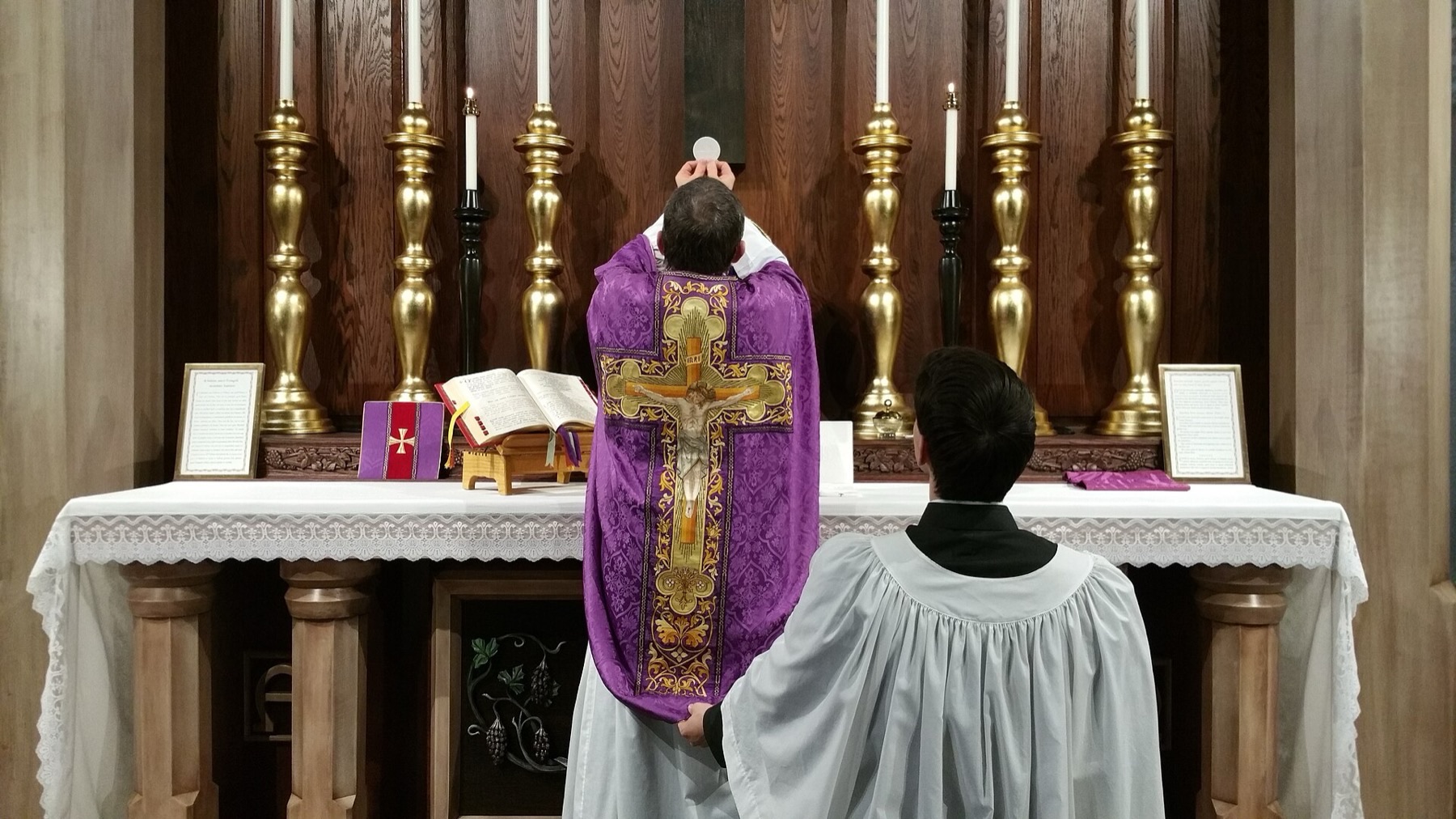
The book’s most discussed pages concern the direction of liturgical prayer. Ratzinger argued that the ancient and theologically richest posture is for priest and people to face the same way (ad orientem, “toward the East,” toward the Lord who comes), rather than for the priest to stand permanently facing the people across the altar. He was careful and historically honest about it: he did not call the new arrangement invalid, and he did not demand the wholesale tearing-out of altars. But he insisted that something real had been misunderstood.
The turning of the priest toward the people has turned the community into a self-enclosed circle. In its outward form, it no longer opens out on what lies ahead and above, but is locked into itself. The common turning toward the East was not a ‘celebration toward the wall’; it did not mean that the priest ‘had his back to the people’… They did not lock themselves into a circle, they did not gaze at one another, but as the pilgrim People of God they set off for the Oriens, for the Christ who comes to meet us.
— Joseph Ratzinger, The Spirit of the Liturgy (2000), Part II
His point was not nostalgia but theology. When priest and people face each other, he warned, the sanctuary risks becoming a stage and the priest its principal actor; an “unprecedented clericalization” in which the celebrant “becomes the real point of reference for the whole Liturgy.” When instead all face the Lord together, no one is the center; the whole assembly is a pilgrim people walking toward the One who comes. Where the altar cannot be reoriented, Ratzinger proposed a simple, eloquent remedy: place a cross at its center, so that priest and people alike look not at one another but at Christ crucified.
❝Moving the altar cross to the side to give an uninterrupted view of the priest is something I regard as one of the truly absurd phenomena of recent decades.
— Cardinal Joseph Ratzinger, The Spirit of the Liturgy (2000)
The Recovery of the Sacred
Direction was only the most visible part of a larger argument. Across the book Ratzinger pressed for the recovery of adoration in every dimension of worship: kneeling and silence as genuine forms of participation; reverence in the reception of Holy Communion; sacred music and sacred art that serve the mystery rather than the moment; a sense that the liturgy is cosmic and given, joining the worshipper to heaven, not invented anew each Sunday by a local committee. Liturgy, he kept insisting, is received before it is performed.
The Spirit of the Liturgy is not a tract against the new Mass. Ratzinger never denied the validity or the lawfulness of the reformed rite; he offered his book as a contribution to the Church’s ongoing work of receiving the Council well, not as a verdict against it. His critiques are of manner, emphasis, and effect — never of a Pope’s legitimacy or a rite’s validity. He even cautioned against making the sanctuary into a battlefield of styles. The aim throughout is a deeper reverence shared by all Catholics, whichever form of the Roman Rite they pray.
Bringing the Movement Full Circle
There is a quiet symmetry in the year 2000. The Liturgical Movement had begun, in part, with Guardini asking what the spirit of the liturgy is and recovering the Church’s public prayer from the fog of private devotion. Eighty-two years later, the man who would soon be Pope took up that exact question again, and answered it by insisting that the Movement’s deepest instinct had always been adoration of God, not the self-celebration of the assembly. He expressed the hope that his small book might help give rise to a new movement toward the liturgy, the way Guardini’s once had.
That hope did not stay on the page. As Benedict XVI, the author of The Spirit of the Liturgy would write his liturgical theology into the law and life of the Church: above all in Summorum Pontificum (2007), which declared that the older and newer forms of the Roman Rite are not two rival religions but one Church’s worship; as his accompanying Letter put it, the two forms “can be mutually enriching.” The book of 2000 is the mature seed of that pontificate, the moment the Liturgical Movement’s long argument came round, in continuity, to where it began: facing the Lord.
- Joseph Cardinal Ratzinger, The Spirit of the Liturgy, trans. John Saward (San Francisco: Ignatius Press, 2000), the book; title a deliberate homage to Guardini
- Ratzinger, The Spirit of the Liturgy, Preface, pp. 7–8: the “fresco” metaphor (preserved, whitewashed, restored, now endangered; “a new reverence… so that rediscovery does not become the first stage of irreparable loss”)
- Ratzinger, The Spirit of the Liturgy, Part II, “The Altar and the Direction of Liturgical Prayer” “self-enclosed circle,” the pilgrim People setting off “for the Oriens,” “Conversi ad Dominum,” “unprecedented clericalization,” the “truly absurd phenomena” altar-cross line (text reproduced at adoremus.org, “The Altar and the Direction of Liturgical Prayer,” May 2000)
- Ratzinger on Odo Casel: “perhaps the most fruitful theological idea of our century” / “not since the end of the patristic era” Joseph Ratzinger, Collected Works XI: Theology of the Liturgy (Ignatius, 2014), p. 153, “The Sacramental Foundation of Christian Existence”
- Romano Guardini, The Spirit of the Liturgy (Vom Geist der Liturgie, 1918), the title Ratzinger consciously echoed
- Benedict XVI, Summorum Pontificum and accompanying Letter to Bishops (7 July 2007); the two forms as one Roman Rite, which “can be mutually enriching” (Letter)