Communio Is Founded
Seven years after the progressive review Concilium set out to advance the “spirit” of Vatican II, the men who would one day give the Church the “hermeneutic of continuity” answered with a journal of their own.
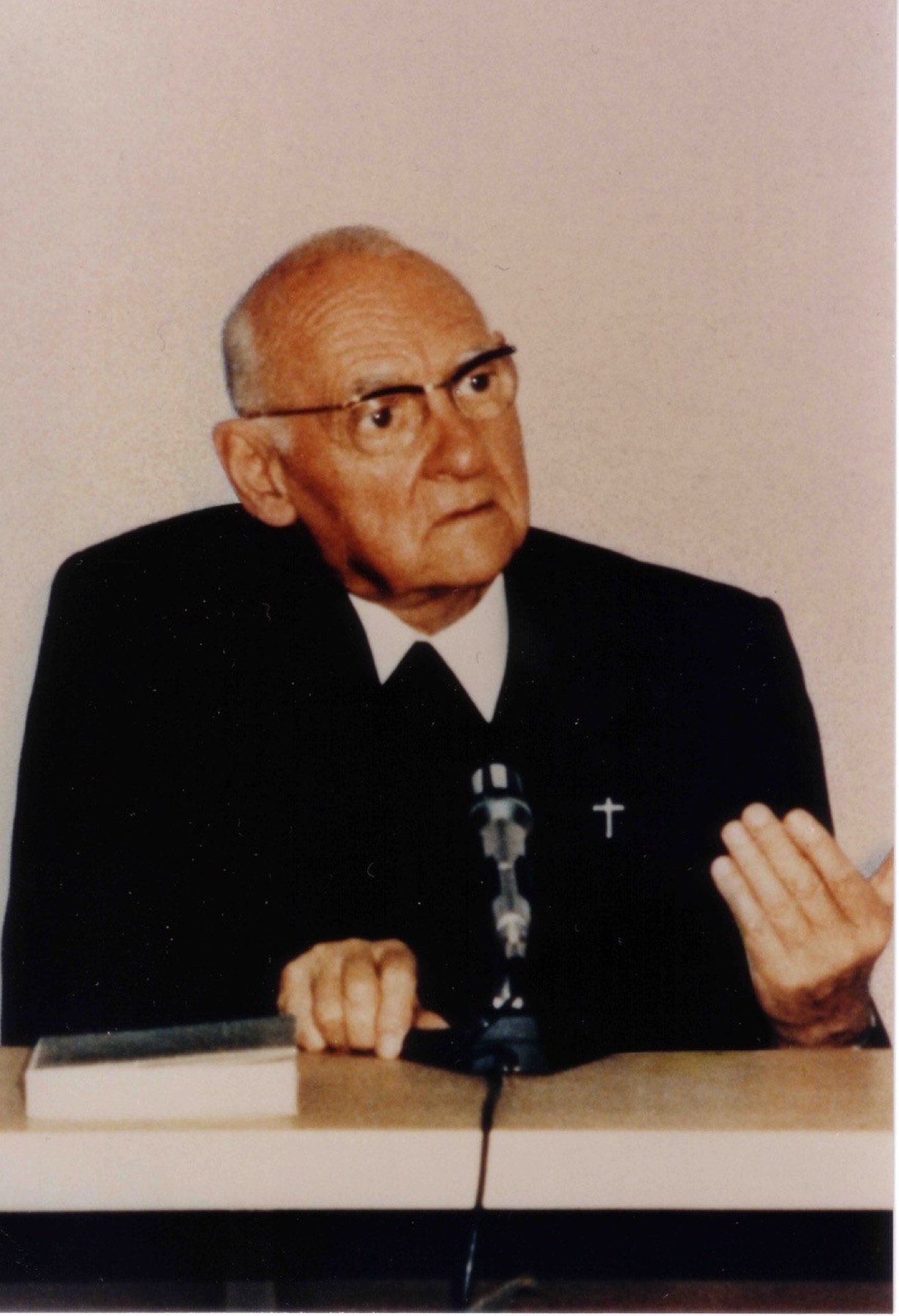
Launched in 1972 by Hans Urs von Balthasar, Joseph Ratzinger, and Henri de Lubac, the international review Communio set out to read the Second Vatican Council in continuity with the whole of Catholic Tradition. Photo: Hans Urs von Balthasar Stiftung, CC BY-SA 4.0, via Wikimedia Commons.
Event 40 of 57
In 1972 three of the most formidable theologians of the twentieth century launched an international Catholic review and called it Communio. Its founders were Hans Urs von Balthasar, Joseph Ratzinger, the future Pope Benedict XVI, and Henri de Lubac, and around them gathered a wider circle that included Louis Bouyer, the young Walter Kasper, and Jean-Luc Marion. They were not founding a journal of protest. They were founding a journal of renewal, but a renewal of a very particular kind: the renewal of theology, in their own words, “in continuity with the living Christian tradition.” To understand why that mattered, and why it belongs on a timeline of the liturgy, one has to see what Communio was answering.
An Answer to Concilium
Seven years earlier, in 1965, the same men had stood near the center of a different project. As the Council closed, a powerful coalition of its expert theologians had founded the review Concilium to carry forward what they called the “spirit of Vatican II.” De Lubac, von Balthasar, and Ratzinger had all been associated with its beginnings. None of them stayed. De Lubac withdrew within months, alarmed that an appeal to the Council’s “spirit” was being used to cut the Church loose from her own past; Ratzinger drew away as the turbulent late 1960s wore on.
Communio was their constructive reply. Where Concilium read the Council as a fresh start, Communio read it as a deepening — the same Church, the same faith, more fully understood. The first issue appeared at the beginning of 1972 in two languages, German and Italian; a North American and a French edition followed in 1974, and the review grew into a federation of journals now published in more than a dozen editions. From the outset its mission was stated in terms of fidelity, not rupture.
The split between Concilium (1965) and Communio (1972) is the clearest map of the deepest argument in the modern Church. It was never a fight over whether Vatican II was legitimate: both camps were founded by the Council’s own theologians, and both revered it. The argument was over how to read it: as a break with what came before, or as renewal within an unbroken tradition. Decades later, as Pope, the co-founder of Communio would give those two readings their lasting names, the “hermeneutic of discontinuity and rupture” and the “hermeneutic of reform” in continuity.
Balthasar’s Program
The German edition opened with a programmatic essay by von Balthasar simply titled “Communio: A Program.” In it he set the review against what he saw as a deadly polarization tearing at the post-conciliar Church, and refused both poles of it. The journal would not be a redoubt of reaction, nor a vehicle of revolution. It would be an attempt to recover the Church herself as a communio: a communion whose first source is not a party or a program but Christ.
Negatively: to resist at all costs the deadly polarization brought on by the fervor of traditionalists and modernists alike; positively: to perceive the Church as a central communio, a community originating from communion with Christ.
— Hans Urs von Balthasar, on the founding purpose of Communio (1972)
That double refusal is the key to the whole enterprise, and it is why the journal cannot be flattened into one “side” of the culture war. Communio did not exist to defeat Vatican II; it existed to receive it rightly. Its founders held that the Council’s reform was real and binding, and that the way to honor it was to read its texts in the light of the whole of Tradition rather than against that Tradition. This is the seed that would later flower, under Benedict XVI, into a pontificate built around exactly that principle.
It would be a serious error to cast Communio as an anti-conciliar faction. De Lubac was made a cardinal by John Paul II; Ratzinger became Pope; Kasper, too, was raised to the cardinalate, and would later sit on the opposite side of many debates from the Communio he helped begin. These were learned, believing Catholics arguing among themselves about how best to be faithful. The quarrel between Communio and Concilium was a family argument inside the Church, never a war between the Church and her enemies, and never a question of any Pope’s legitimacy or any rite’s validity.
Why a Theological Journal Belongs on a Liturgical Timeline
A history of the Mass might seem to have no room for a learned review. But the battle over interpreting the Council was, from the first, also a battle over how the Council’s liturgical reform should be received. To read Vatican II as continuity is to read its call for reform as organic development, pruning and renewal within a living rite. To read it as rupture is to license a far more sweeping recasting of Catholic worship. The same appeal to a forward-rushing “spirit” that animated the progressive reading animated the swiftest and most radical changes to the rite in the years after the Council.
Communio supplied the intellectual spine of the other reading. Its insistence that the Council be received in continuity with Tradition is the theological root of the later argument that the old and new forms of the Roman Rite are not two rival religions but one Church’s worship, an argument that would one day be written into law.
The Long Reach of 1972
The founding of Communio was a quiet event; a journal, not a decree, launched while the noisier dramas of the 1970s unfolded around it. Yet its long reach is hard to overstate. The men who organized around it would, in the decades to come, give the Church the language of the “hermeneutic of continuity,” a pontificate devoted to it, and the legal generosity of Summorum Pontificum. The continuity camp did not win every battle of the 1970s; the reform of the rite was already largely accomplished. But in Communio it found its intellectual home, and it is from that home that the strongest case for reading the whole story of this timeline as continuity, not conquest, still comes.
Events That Led Here
- Communio: International Catholic Review, “About” and “Our Founders” (communio-icr.com): founded 1972 by Hans Urs von Balthasar, Henri de Lubac, and Joseph Ratzinger; mission of renewal in continuity with the living Christian tradition
- Hans Urs von Balthasar, “Communio: A Program,” the programmatic essay common to the first (German and Italian) editions, 1972
- Communio, founding history, editions, and relationship to Concilium, en.wikipedia.org/wiki/Communio. German and Italian editions 1972; North American and French 1974; thirteen editions today
- On the wider founding circle (Bouyer, Kasper, Jean-Luc Marion) and the 1970–71 planning meetings (Rome / Paris): Communio “A Mission in Retrospect” and encyclopedia.com, “Communio: International Catholic Review”
- Benedict XVI, Address to the Roman Curia, 22 December 2005 (hermeneutic of reform in continuity vs. discontinuity and rupture)