The St. Gallen Group
For roughly a decade an informal circle of reform-minded European cardinals and bishops met quietly in a Swiss diocese to talk over the governance of the Church — a real, documented gathering that its own members would later, half in jest, call “the mafia.”
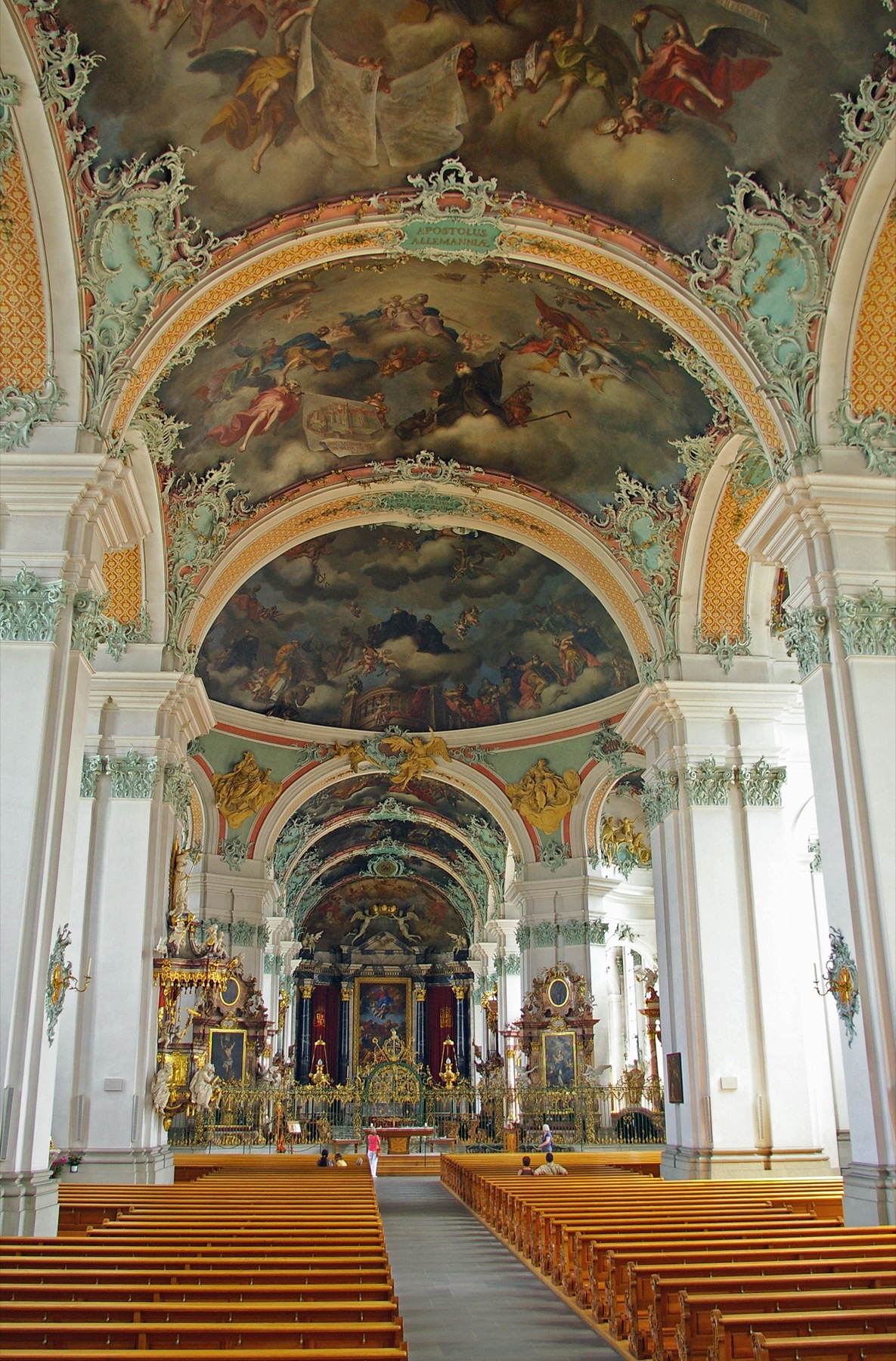
From the mid-1990s to about 2006, a small circle of mostly European prelates — among them Cardinals Carlo Maria Martini, Godfried Danneels, Walter Kasper, and Karl Lehmann — met for private, off-the-record conversations in the Swiss diocese of St. Gallen. Photo: 3s, CC BY-SA 3.0, via Wikimedia Commons.
Event 47 of 57
Between roughly 1996 and 2006, a small group of mostly European cardinals and bishops met once a year, usually in January, in the quiet Swiss diocese of St. Gallen. They came to talk (freely, privately, off the record) about the governance and future of the Catholic Church. Among them were some of the most prominent churchmen of the age: Cardinal Carlo Maria Martini, the celebrated Jesuit archbishop of Milan; Cardinal Godfried Danneels of Brussels; and the German cardinals Walter Kasper and Karl Lehmann. For nearly twenty years almost no one outside the circle knew the meetings had happened: until, in 2015, an authorized biography pulled back the curtain, and Danneels himself supplied the nickname that would stick.
A “Circle of Friends” in a Swiss Diocese
The gatherings grew out of European church structures, not a plot. They were initiated by Bishop Ivo Fürer of St. Gallen, formerly the secretary-general of the Council of the Bishops’ Conferences of Europe, in consultation with Cardinal Martini. Fürer described the participants simply as a Freundeskreis (a “circle of friends”) who came together each year to speak frankly about questions facing the Church. The roster grew over time: the founding members in 1996 included Martini, Kasper, and Lehmann; Danneels and others joined in 1999, and figures such as Cardinal Cormac Murphy-O’Connor of Westminster and Cardinal Achille Silvestrini were added in the early 2000s.
Their conversations ranged over the live ecclesial debates of the late John Paul II years: the balance between Roman centralism and the authority of local bishops, the role of bishops’ conferences, the manner of nominating bishops, the life of priests, and collegiality, the principle that the bishops govern the Church together with and under the Pope. On a number of these questions the participants found themselves uneasy with the direction set by Rome, and in particular by the doctrinal office then led by Cardinal Joseph Ratzinger.
Two things must be kept rigorously apart. Documented: a real, informal group of senior prelates met privately at St. Gallen for about a decade to discuss Church reform and governance, and one of its members publicly called it “the mafia” as a joke. Not documented — and actively disputed: the further claim that this group secretly “engineered” the 2013 election of Pope Francis. The group reportedly stopped meeting around 2006, seven years before that conclave; its leading figure, Cardinal Martini, had died in 2012; and the biographers who broke the story walked back any suggestion that it operated as an election lobby. A sober history holds the first firmly and treats the second as speculation.
“Actually, We Called Ourselves the Mafia”
The circle’s existence became public in September 2015, when church historians Karim Schelkens and Jürgen Mettepenningen published an authorized biography of Cardinal Danneels and devoted a full chapter to the St. Gallen meetings. At the book’s presentation, Danneels described the group with evident good humor. The official name “Group of St. Gallen,” he said, was a dignified one, deftig in his native Dutch, “but actually,” he added, “we said of ourselves and of that group: the mafia.”
The name ‘Group of St. Gallen’ is a dignified one. But in reality, of ourselves and of that group, we said: the mafia.
— Cardinal Godfried Danneels, paraphrasing the group’s in-joke at the presentation of his biography, September 2015 (trans. from the Dutch)
That single joking word (“mafia,” broadcast on Belgian television) launched a thousand headlines and an entire genre of writing about “the St. Gallen Mafia,” much of it casting the group as a shadowy cabal. The joke was real. The cabal is another matter.
The Contested Leap to 2013
Here the timeline demands care, because this is where documented fact gives way to inference. It is well established that at the 2005 conclave following John Paul II’s death, a bloc of reform-minded cardinals, several of them St. Gallen men did not want Cardinal Ratzinger elected and looked for an alternative. They did not prevail: the conclave turned quickly to Ratzinger, who became Benedict XVI. Pope Francis himself later spoke candidly about that conclave, saying in a 2024 interview that his own name had been “used” by others against Ratzinger, while insisting that Ratzinger “was my candidate” and the right man for the moment.
What the group did not do, by the weight of the evidence, is determine the conclave of 2013. The very biographers who broke the story moved quickly to correct an early news report that had described Bergoglio’s election as having been “prepared in St. Gallen.” They stressed that the group had not functioned as a lobbying bloc, that it had stopped convening after 2006, and that while the eventual election of a reform-minded pope “corresponded with the aims of St. Gallen,” a shared hope is not a conspiracy. Vatican observers have pressed the same points: the group had disbanded years earlier, Martini was dead, several members were elderly, and in the days before the 2013 conclave virtually no one expected a Bergoglio papacy at all.
It is tempting, on a timeline like this, to draw a straight line from a private reform circle to the election of a Pope, and a great deal of popular writing does exactly that. But the line does not hold. Treating the St. Gallen Group as the secret author of the 2013 conclave overstates the evidence, contradicts the biographers who first reported the group, and slides toward delegitimizing a validly elected Pope. The faithful Catholic position is the opposite: Pope Francis was canonically and validly elected by the College of Cardinals. One may discuss the ordinary, very human politics of a conclave (cardinals do have hopes and conversations) without indulging a conspiracy theory that impugns the legitimacy of the Petrine office.
Where It Belongs on This Timeline
Why does an informal discussion group earn a place in a history of the liturgy? Because the questions argued at St. Gallen were the same questions that ran beneath the liturgical battles of the era: how much authority belongs to Rome versus the local bishop, how to read the Second Vatican Council, and which churchmen would shape the Church’s direction in the generation after John Paul II. The St. Gallen circle sat squarely on one side of the great post-conciliar argument (the more decentralizing, reformist side) in tension with the “hermeneutic of continuity” that Cardinal Ratzinger embodied and would carry into his own pontificate.
Seen plainly, the St. Gallen Group is neither nothing nor everything. It was a real gathering of serious, believing cardinals and bishops who met to talk about a Church they disagreed about. The discipline this episode asks of us (separating what is documented from what is merely alleged) is exactly the discipline a trustworthy history requires.
The men of St. Gallen were not enemies of the Church; they were her cardinals and bishops, arguing in good faith about how to govern her well. One can hold a firm Traditional conviction (and judge that the reformist program they favored was, in places, imprudent) without ascribing bad faith to them or treating their meetings as sinister. And whatever one makes of the 1996–2006 conversations, they do not touch the validity of any Pope’s election or any rite of the Mass. On those points the Catholic answer is settled, and this timeline does not waver from it.
Events That Led Here
- Saint Gallen Group, en.wikipedia.org/wiki/Saint_Gallen_Group: dates (1996–2006), initiation by Bishop Ivo Fürer in consultation with Cardinal Martini, member roster by year, topics discussed (centralism, bishops’ conferences, collegiality, bishop nominations), and the Danneels “mafia” remark with the original Dutch
- Edward Pentin, “Cardinal Danneels’ Biographers Retract Comments on St. Gallen Group,” National Catholic Register / CNA, September 2015: Schelkens and Mettepenningen’s clarification that the group was not a lobby, no longer convened after 2006, and that the “election of Bergoglio corresponded with the aims of St. Gallen” though it was not engineered
- Philip F. Lawler, “A conspiracy to elect Pope Francis? Don’t believe it,” Catholic Culture (catholicculture.org), 2015, reasons the 2013 “engineered election” claim fails: group disbanded 2006, Martini dead by 2012, members elderly, Bergoglio unexpected before the conclave
- Karim Schelkens & Jürgen Mettepenningen, biography of Cardinal Godfried Danneels (2015), authorized biography whose chapter on the St. Gallen meetings made the group public
- “Pope Francis: I was ‘used’ against Ratzinger in 2005 conclave, but he was ‘my candidate,’” Catholic World Report (catholicworldreport.com), April 2024, Francis’s own account of the 2005 conclave
- Holy See Press Office statement (2015): cardinals expressly denied campaigning for Bergoglio’s election, calling such accounts “surprising and disappointing”