The Election of Pope Francis
On a rainy Roman evening in March 2013, the cardinals went “almost to the ends of the earth” and returned with the first Jesuit pope, the first from the Americas — Jorge Mario Bergoglio of Buenos Aires, who took the name Francis.
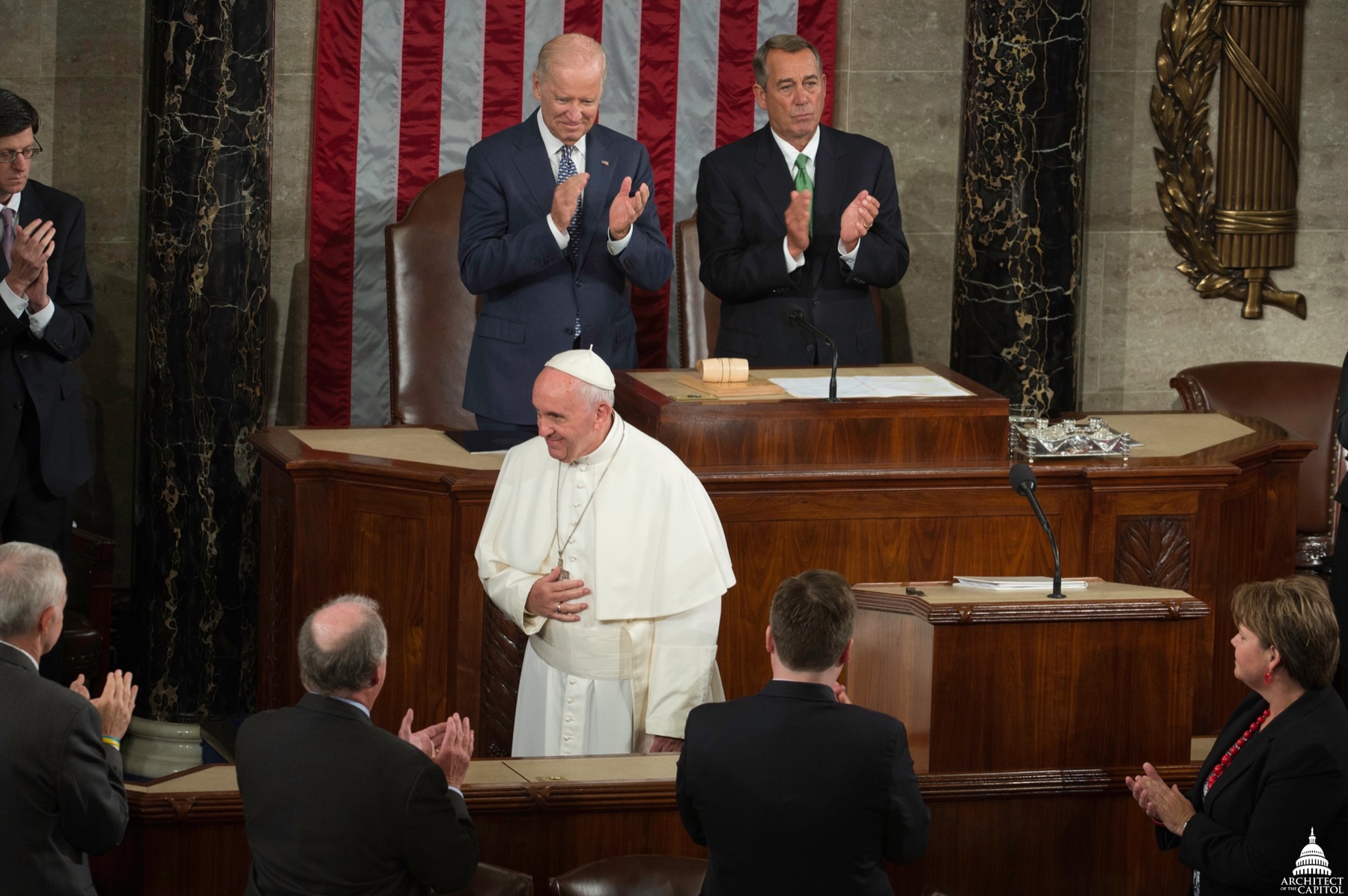
Pope Francis — Cardinal Jorge Mario Bergoglio of Buenos Aires, elected 13 March 2013, the first Jesuit and the first pope from the Americas. Photo: Architect of the Capitol, public domain.
Event 51 of 57
On the evening of 13 March 2013, at six minutes past seven, white smoke poured from the chimney above the Sistine Chapel and the bells of St. Peter’s began to ring. The cardinals had a pope. When the senior cardinal-deacon stepped onto the loggia to pronounce the ancient formula, the name he gave was one few in the square had expected: Georgium Marium, Cardinal Bergoglio, Archbishop of Buenos Aires, who had chosen to be called Francis. It was a name no pope had ever borne. He was the first Jesuit ever elected to the See of Peter, and the first pope drawn from the Americas. A new pontificate had begun, and with it a new chapter in the story this timeline has traced; one whose consequences for the traditional Mass no one in the rain-soaked piazza could yet foresee.
After an Unprecedented Resignation
The conclave of 2013 met under circumstances without modern precedent. On 11 February 2013, Pope Benedict XVI had stunned the Church by announcing, in Latin, that he would resign the papacy — the first pope to do so freely in nearly six centuries. His resignation took effect on 28 February, and for the first time in living memory the cardinals gathered to elect a successor while the man they were replacing still lived, in prayerful retirement within the Vatican walls. One hundred fifteen cardinal electors entered the Sistine Chapel on 12 March. The following afternoon, on the fifth ballot, they elected the seventy-six-year-old Argentine.
“From the Ends of the Earth”
Bergoglio’s first act before the world was disarmingly simple. Appearing on the balcony in a plain white cassock, without the red mozzetta his predecessors had worn, he greeted the enormous crowd not with a blessing but with an ordinary evening salutation, Buonasera. Then he spoke of how far the cardinals had reached to find a bishop for Rome.
Brothers and sisters, good evening. You know that the task of the conclave was to give Rome a bishop. It seems my brother cardinals went almost to the ends of the earth to find one.
— trans. as published, The Catholic Sun / Catholic News Service (2013)
Before imparting his own blessing, he bowed his head and asked the hundreds of thousands below to pray for him in silence, a gesture that became, in an instant, the emblem of the new pontificate. He asked, too, for prayers for his predecessor, whom he called the bishop emeritus of Rome.
Why “Francis”
Three days later, addressing the journalists who had descended on Rome by the thousand, the new pope explained the name he had chosen, a name laden with meaning and never before taken by a pope. As the votes mounted in his favor during the conclave, he recalled, the Brazilian cardinal Cláudio Hummes had embraced him and whispered words he would not forget.
❝Don’t forget the poor.
— Cardinal Cláudio Hummes to Bergoglio during the conclave, as recounted by Pope Francis, 16 March 2013
That whisper, he said, turned his thoughts at once to St. Francis of Assisi: “the man of poverty, the man of peace, the man who loves and protects creation.” “How I would like a Church that is poor and that is for the poor,” he told the assembled press. The choice signaled, from the first hours, a pontificate whose accent would fall on simplicity, mercy, and the peripheries.
Let one thing be stated plainly, for it is the foundation of everything that follows. The election of Jorge Mario Bergoglio was valid, and Pope Francis was a true and legitimate Successor of St. Peter. Whatever the strains his pontificate would later bring to those attached to the traditional Mass (and they were real) nothing in that future touches the legitimacy of his office. To honor the papacy is to honor the man who holds it. This site is, and remains, in full communion with Rome; the chair of Peter is not vacant, and was not.
A Different Liturgical Sensibility
For those who had welcomed Benedict XVI’s liturgical vision, the election was watched with a particular and respectful attentiveness. Benedict had been, before all else, a liturgical pope: the theologian of the “reform of the reform,” the author of Summorum Pontificum, which in 2007 had freed the traditional Mass and called it a treasure of the whole Church. Francis was a man of a different formation and a different emphasis. A Jesuit and a pastor, his concerns ran toward mission, the poor, and the outward life of the Church more than toward the fine grain of the sacred liturgy, and his own celebrations were marked by a studied plainness.
It would be unjust to read the whole of his pontificate backward into its first evening; on 13 March 2013 the new pope had said nothing of the older rite, and much remained unwritten. But honesty requires noting the shift in sensibility that the election represented. The liturgical project that had defined the previous reign now passed to a successor who did not share its central preoccupation. What that would mean for the peace Benedict had tried to establish (a peace between the two forms of the Roman Rite) would unfold only over the years that followed.
For the traditional movement, the election of Pope Francis would prove a hinge in the story. The settlement of Summorum Pontificum (two coexisting forms of the one Roman Rite) was not the new pope’s own vision, and in 2021 he would reverse much of it with Traditionis Custodes. That this timeline names the period opening in 2013 “the Present Crisis” is a judgment about the strain that followed, not about the Pope’s legitimacy or good faith. The criticism proper to these pages is of the prudence and effects of later decisions, never of the office, never of the man’s standing as the true Vicar of Christ.
And so the conclave of 2013 closed one era and opened another. The pope of the “reform of the reform” had stepped aside; a pope of mission and mercy had taken his place. The faithful of every sensibility owed him, from that first evening, their prayers, their obedience in what is owed, and their love; even those who would come to grieve the decisions of the years ahead. The story of the traditional Mass under Pope Francis was not yet written. But its first page had been turned, in the rain, beneath a chimney of white smoke.
Events That Led Here
Where It Led
- “Text of Pope Francis’s remarks from the balcony after his election,” The Catholic Sun / Catholic News Service, 13 March 2013 (verbatim first words)
- “Transcript: Pope Francis’ First Speech As Pontiff,” NPR, 13 March 2013
- “Pope Francis explains why he chose St. Francis of Assisi’s name,” The Catholic Telegraph / CNA, 16 March 2013 (Hummes “Don’t forget the poor”; “a Church that is poor and for the poor”)
- “2013 papal conclave,” Wikipedia, 115 electors, conclave opened 12 March, elected on the fifth ballot 13 March, white smoke 19:06 CET, Benedict’s resignation effective 28 February 2013, Bergoglio aged 76
- “Pope Francis,” Wikipedia, first Jesuit and first Latin-American pope; the “ends of the earth” greeting; the bishop-emeritus reference
- Benedict XVI, Declaratio of resignation, 11 February 2013 (vatican.va), the resignation that occasioned the conclave