The Ottaviani Intervention
Two cardinals and a study of theologians warn the Pope — in obedience, not in revolt — that the new rite has drifted from Trent.
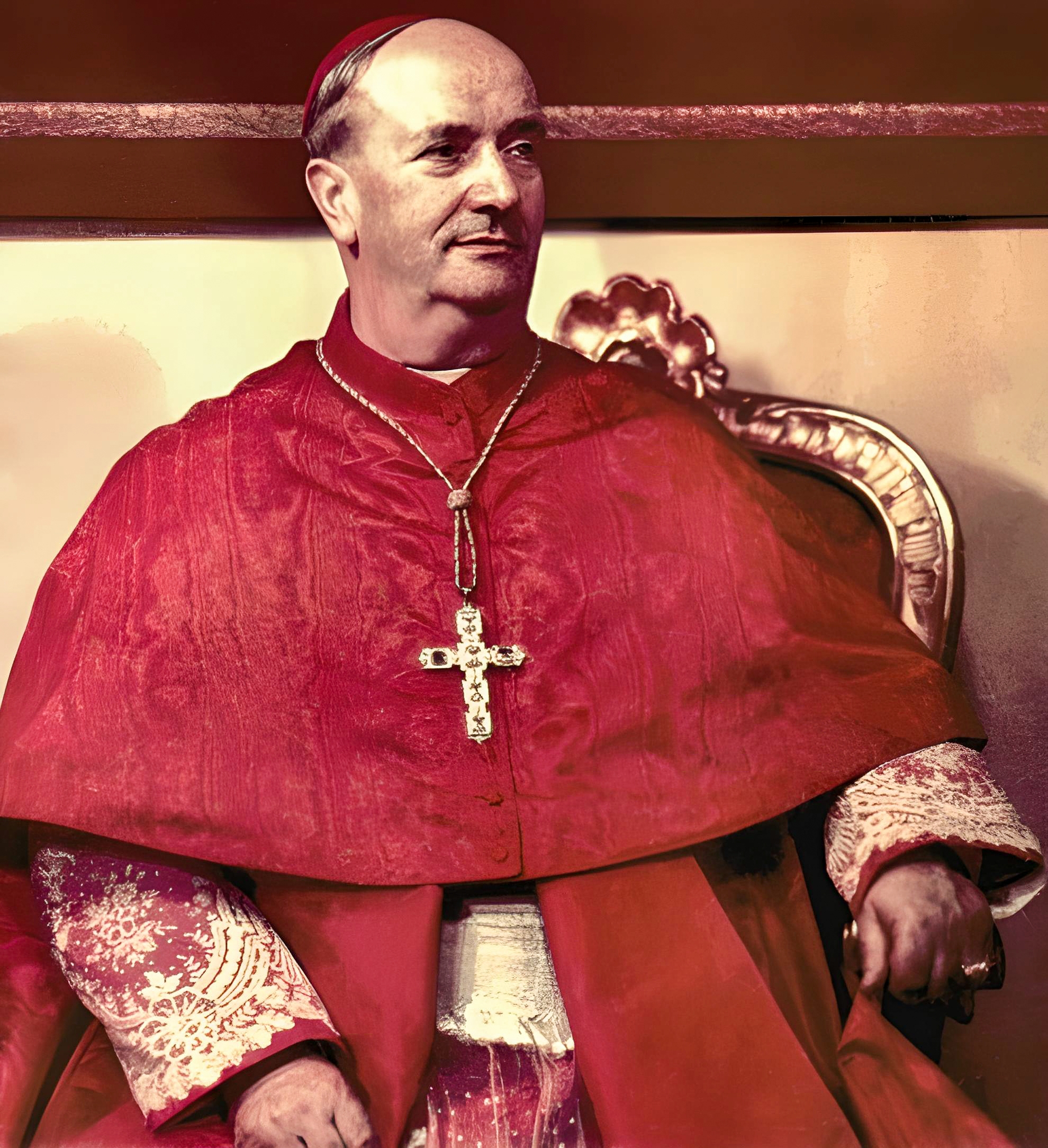
Alfredo Cardinal Ottaviani, former Secretary of the Holy Office, whose cover letter to Paul VI lent his name to the 1969 critique of the new Order of Mass. Photo: True Restoration, CC BY 2.0, via Wikimedia Commons.
Event 35 of 57
On 25 September 1969, two cardinals of the Roman Church transmitted to Paul VI a theological study warning that the new Order of Mass departed strikingly from the Mass as defined at Trent. It was a critique submitted in obedience to the Pope — never a schism, never a denial of the rite’s validity.
On the eve of the most consequential liturgical change in four centuries, a cover letter reached Pope Paul VI, dated 25 September 1969 and signed by two cardinals: Alfredo Ottaviani, the aged and nearly blind former Secretary of the Holy Office, and Antonio Bacci, a renowned Latinist of the Roman Curia. The letter forwarded a longer document, the Short Critical Study of the New Order of Mass, drafted by a group of Roman theologians. The new Novus Ordo Missae had been promulgated that April; it would take force in a matter of weeks. These men were not trying to stop a train from outside the station. They were inside the Church’s own house, appealing to its head, asking him to look again before the doors closed.
What gives the so-called Ottaviani Intervention its enduring weight is precisely who was speaking and how. Not schismatics. Not cranks. Two cardinals, one of them the man who for years had guarded Catholic doctrine itself, and a study of credentialed theologians, addressing the Pope in writing, with deference, and submitting their concerns to his judgment. This was loyal opposition in the strict sense: a warning offered within the bonds of obedience, not a banner of revolt.
The Charge: A “Striking Departure”
The heart of the document is a single sentence from the cover letter, the line that has framed every liturgical controversy since. The two cardinals told the Pope that the new rite, taken as a whole, no longer gave full and faithful voice to the Catholic doctrine of the Mass as the Council of Trent had defined it against the errors of the sixteenth century.
The Novus Ordo Missae, considering the new elements widely susceptible to widely different interpretations which are implied or taken for granted, represents, both as a whole and in its details, a striking departure from the Catholic theology of the Mass as it was formulated in Session XXII of the Council of Trent.
— Cardinals Alfredo Ottaviani & Antonio Bacci, letter to Pope Paul VI, 25 September 1969 (English translation)
The reference to Session XXII is exact and deliberate. There, in 1562, the Council of Trent had defined the Mass as a true and proper sacrifice, offered for the living and the dead, in which Christ, the same victim of Calvary, is offered in an unbloody manner. The critics’ fear was not that the new rite denied this (the doctrine was untouched in the Church’s teaching), but that the reformed prayers gave it fainter and less explicit expression, so that the Mass could too easily be received as a fellowship meal rather than a sacrifice for sin.
What the Study Pointed To
The longer Short Critical Study singled out concrete losses, all of them matters of plain fact rather than interpretation. The old Offertory (with its explicitly sacrificial prayers, the priest offering “this immaculate host… for my innumerable sins”) had been replaced by a newly composed “Preparation of the Gifts” modeled on a Jewish table blessing. The signs of the cross and genuflections over the offerings were sharply reduced; the penitential and sacrificial emphasis that had marked the rite was, the critics argued, thinned out.
Their sharpest objection fell on the definition of the Mass in the first edition of the new General Instruction. Article 7 had described the Mass primarily as “the Lord’s Supper, or Mass,” a “sacred assembly or gathering together of the people of God… under the presidency of the priest.” To the critics this read like a definition by assembly rather than sacrifice, a phrasing, they feared, a Protestant could sign without flinching. Here the Intervention struck a nerve, and what Rome did next is still argued over. In November 1969 the Congregation for Divine Worship declared that the criticisms of the Instruction’s doctrine were without any foundation. Yet in the 1970 typical edition it rewrote article 7 in full, “so that those truths might appear more clearly”: the sacrifice, the ministerial priesthood and the Real Presence. It also added a doctrinal preamble. Critics read the rewrite as a concession; the Congregation called it a clarification (Notitiae 5 (1969) 417; 6 (1970) 178).
Obedience, Not Schism
It is essential to say what the Intervention was not. It did not declare the new Mass invalid; the Short Critical Study argued that the rite was dangerous and impoverished, not that it was no Mass. It did not break communion. It did not deny the Pope’s authority to reform the liturgy. It was an appeal addressed to the Pope, asking him to use that very authority to reconsider. The validity and liceity of the reformed rite is the floor on which this whole story stands, a true and licit Mass of the Catholic Church, in which the same Lord is truly offered and truly received.
The Ottaviani Intervention was loyal opposition, not schism. The cardinals submitted their concerns to the Pope’s judgment; they never set up an altar against him, never denied the new rite’s validity, and never questioned papal authority. To enlist this document for sedevacantism or for a rejection of the reformed Mass as “no Mass” is to betray what its signers actually did.
What followed is itself instructive. Paul VI answered in his general audiences of 19 and 26 November 1969, and the 1970 edition of the General Instruction rewrote the article the critics had attacked. A letter of 17 February 1970, published over Ottaviani’s name, is reported to have welcomed the doctrinal clarifications of those November audiences; it predates the revised Instruction, and scholars still debate how far the nearly blind cardinal shaped its wording. What is not in doubt is that he died in 1979 in communion with Rome, a cardinal of the Church to the end.
The Consilium’s architects had real reasons: a simpler, more intelligible rite, closer as they understood it to ancient models. Defenders note that the doctrine of the Mass was never altered in the Church’s teaching, that the 1970 revisions met the gravest objection head-on, and that no Pope or council ever endorsed the Short Critical Study‘s conclusions. The honest critic argues prudence and effects (what the prayers express), not legitimacy.
Why It Still Matters
The Intervention’s lasting power is that the traditional case no longer rested only on the testimony of its partisans. Within weeks of the new rite, the alarm had been sounded by men at the summit of the Roman Church. Their warning did not halt the reform; the Novus Ordo took force on schedule and became the ordinary form of the Latin Church. But the questions they raised (about what the lex orandi teaches, about loss and continuity, about how a sacred inheritance is to be handed on) would not go away.
Those questions ran straight to Joseph Ratzinger, who as Pope Benedict XVI would labor to reconcile the old rite and the new, and to Summorum Pontificum in 2007, and onward to the disputes of our own day. The Ottaviani Intervention stands at the head of that line: the first great in-house objection, made in obedience, by men who loved the Mass enough to plead for it — and loved the Church enough to leave the decision to her head.
Ottaviani and Bacci charged that the new rite departed strikingly from the theology of Trent. They did not charge that it was invalid, and the distinction still decides most arguments about the reform. Did the New Mass Empty the Pews? →
- Cardinals Ottaviani & Bacci, Letter to Paul VI (1969)
- Short Critical Study of the New Order of Mass (1969)
- Council of Trent, Session XXII (1562)
- Institutio Generalis Missalis Romani, Art. 7 (1969 1st ed.; rev. 1970)
- Pope Paul VI, General Audience (26 November 1969)
- Joseph Ratzinger, Preface to Klaus Gamber, The Reform of the Roman Liturgy (1992)