The Assisi Congress
The liturgical movement gathered at its zenith under papal patronage — and the pope who blessed it also drew the lines it must not cross.
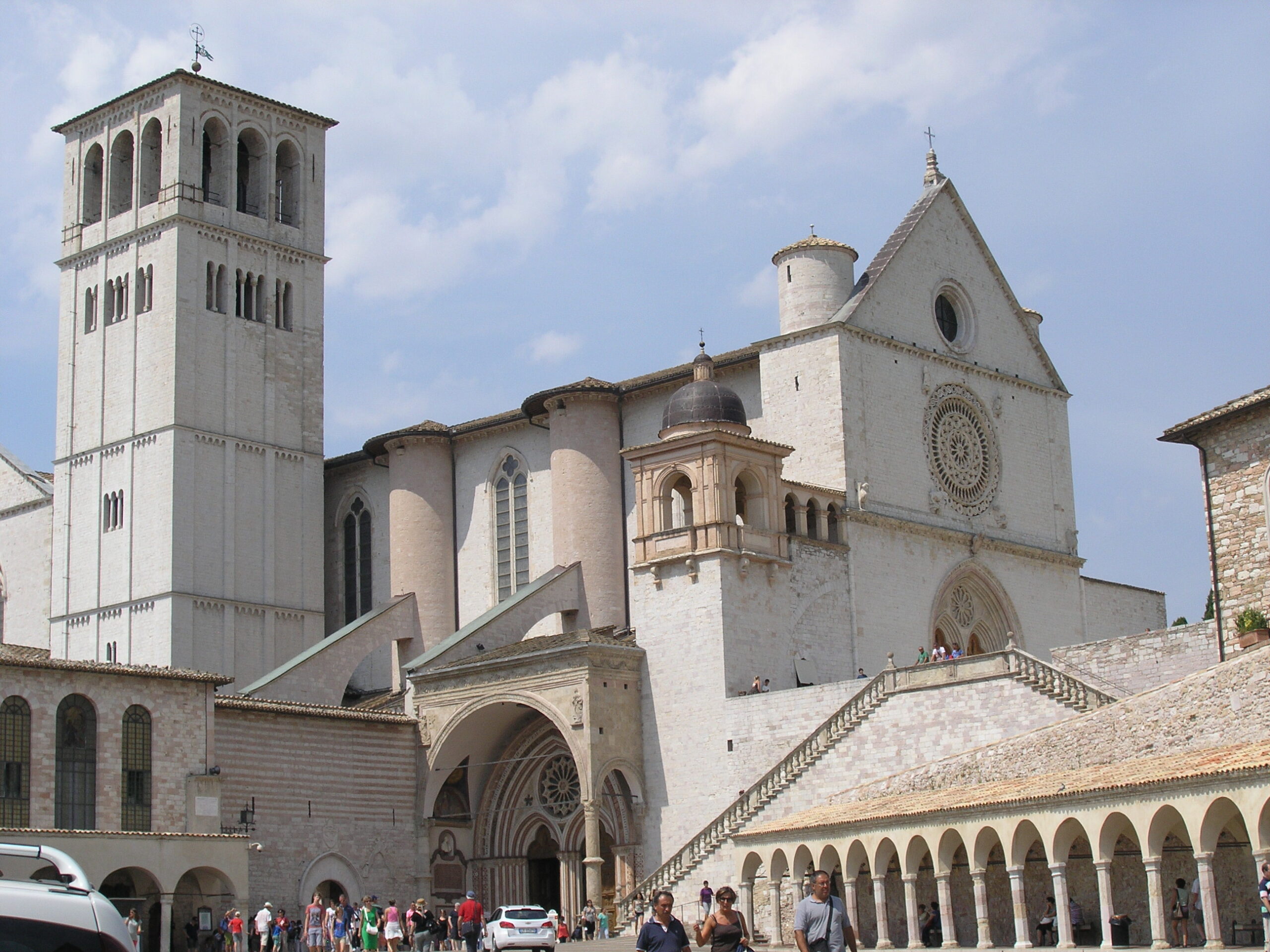
The Basilica of Santa Maria degli Angeli at Assisi, where in September 1956 the First International Congress of Pastoral Liturgy gathered six cardinals, scores of bishops, and some 1,400 clergy and laity — the largest assembly the liturgical movement had yet seen — before processing to Rome for an audience with Pope Pius XII. Photo: Florian Decker, CC BY-SA 3.0, via Wikimedia Commons.
Event 20 of 57
From 18 to 22 September 1956, the liturgical movement reached the summit of its public, Rome-sanctioned phase. The First International Congress of Pastoral Liturgy convened at Assisi — in the shadow of St. Francis, beneath the dome of Santa Maria degli Angeli, and it was no fringe gathering of enthusiasts. Six cardinals, some eighty archbishops and bishops, and roughly 1,400 priests and laity came from across the Catholic world. It was presided over by Gaetano Cardinal Cicognani, Prefect of the Sacred Congregation of Rites, the very dicastery that governed the Church’s worship. The men who had spent half a century arguing for liturgical renewal now found themselves not merely tolerated but hosted under the highest auspices. On 22 September the Congress moved to Rome, and Pope Pius XII himself received the participants and addressed them. The movement had arrived.
Assisi 1956 was the largest gathering the liturgical movement had ever held, and it came with explicit papal patronage. Yet the same pope who called the movement a work of the Holy Spirit used the occasion to fix its boundaries. The encouragement and the limits were issued in a single breath. To remember only one half of Pius XII’s address, as both later enthusiasts and later critics have been tempted to do, is to misread the moment entirely.
The Movement at Its Zenith
The years immediately before Assisi had given the reformers real momentum. Pius XII had issued Mediator Dei in 1947, the first papal encyclical wholly devoted to the liturgy, which both blessed the movement’s aims and warned against its excesses. In 1955 he had promulgated Musicae Sacrae Disciplina on sacred music, and, most consequentially, a sweeping reform of the rites of Holy Week, the first major surgery on the Roman Missal in centuries. To the men assembling at Assisi, the lesson seemed plain: the liturgy could be reformed, and Rome itself would do the reforming.
The Congress proceedings, later published as The Assisi Papers, read like a roster of the movement’s leadership: Josef Jungmann, the great historian of the Roman Mass; the biblical scholar Augustine Cardinal Bea; pastoral theorists from the four great centers of liturgical effort, the German, the French, the Italian, and the Swiss. The mood was one of confidence and, as one contemporary report had it, of reformers congratulating themselves. Among the figures rising into prominence in the machinery of reform was a Vincentian priest, Father Annibale Bugnini, whose star was ascending through precisely the commissions and congresses that Assisi crowned. Within a few years he would become the central architect of the post-conciliar liturgical reform; at Assisi the trajectory was already visible.
Pius XII Blesses the Movement
When the participants reached Rome, the pope did not stint his praise. He opened, in French, by recalling that he had been asked to close their Congress, and he measured the movement’s progress against where it had stood thirty years before, finding the advance, in both extent and depth, undeniable. Then came the sentence the reformers would treasure: the liturgical movement, he said, had shown itself to be a sign of God’s providential designs for the present age, a passing of the Holy Spirit through His Church.
Le mouvement liturgique est apparu ainsi comme un signe des dispositions providentielles de Dieu sur le temps présent, comme un passage du Saint-Esprit dans son Église. — “The liturgical movement has thus appeared as a sign of the providential dispositions of God for the present time, as a passing of the Holy Spirit in His Church.”
— Pope Pius XII, Address to the International Congress of Pastoral Liturgy (22 September 1956; trans.)
It is hard to overstate what those words meant to the men of the movement. The Vicar of Christ had publicly identified their cause with the action of the Holy Spirit. Half a century of patient labor (Beauduin’s parish program, the monastic centers of Maria Laach and Klosterneuburg, the dialogue Mass, the scholarship that had recovered the chant) was, in the pope’s own telling, a grace given to the Church for this hour. The Congress closed in something like triumph.
And Pius XII Draws the Limits
But the same address, read whole, is not a blank check. Having praised the movement, Pius XII immediately set its boundaries, and he set them in language no reformer could honestly ignore. The liturgy, he taught, contains elements that are immutable, a sacred content that transcends time, alongside elements that are variable and transitory. The distinction matters: not everything in the rite is open to revision, and the work of reform must know the difference.
On trouve dans la liturgie des éléments immuables, un contenu sacré qui transcende le temps, mais aussi des éléments variables, transitoires. — “In the liturgy there are immutable elements, a sacred content which transcends time, but also variable, transitory elements.”
— Pope Pius XII, Address at Assisi (22 September 1956; trans.)
He went further. Authority over the rites, he reminded them, is not the movement’s to claim: it belongs to the Popes to recognize the rites in force, to introduce new ones, and to regulate the order of worship. He warned against a creeping diminishment of reverence: against detaching the faithful’s attention from the principal action of the Mass, and against the tendency to esteem Christ’s presence in the tabernacle less, as though the sacrifice of the altar were enough and the Lord who accomplished it could recede from the center. And on the most contested question of all, he gave no inch: the Church, he said, has grave reasons for maintaining firmly in the Latin rite the unconditioned obligation of the celebrating priest to use the Latin language.
l’Église a de graves motifs de maintenir fermement dans le rite latin l’obligation inconditionnée pour le prêtre célébrant de se servir de la langue latine. — “the Church has grave reasons for maintaining firmly in the Latin rite the unconditioned obligation upon the celebrating priest to use the Latin language.”
— Pope Pius XII, Address at Assisi (22 September 1956; trans.)
Whatever some at Assisi hoped to hear about a vernacular Mass, the pope did not grant it. He acknowledged the developments already conceded (limited vernacular in some rites, popular chant, new church architecture), but he reaffirmed Latin for the priest at the altar without qualification, and he reasserted that the regulation of worship is the prerogative of the Apostolic See, not of congresses or commissions.
It is a disservice to this pope to quote only his praise or only his cautions. He genuinely blessed the liturgical movement and credited it to the Holy Spirit — that is real and must be honored. And he genuinely fixed its limits: immutable elements that may not be touched, the priest’s Latin, the centrality of the Real Presence, and the rule that reform belongs to the Holy See alone. The encouragement and the guardrails are both his, spoken in the same address. The Traditional Latin Mass, prayed devoutly and in Latin, sits comfortably within everything Pius XII affirmed at Assisi.
The Distance Between 1956 and What Followed
Here is the quiet drama of Assisi. Within a dozen years, much of what Pius XII had ruled off-limits would be revisited: the Latin of the priest at the altar, the boundary of the immutable, the very scope of reform. Father Bugnini, prominent at Assisi, would chair the commission that drafted Sacrosanctum Concilium and then lead the Consilium that produced the Mass of 1969. None of this denies the validity or the liceity of the reformed rite, nor impugns the authority of the Council or of any pope, that floor is firm. But it does pose a historical question that this timeline cannot avoid: the movement that Pius XII blessed in 1956 he also fenced. The fences did not all hold.
To observe that Pius XII set limits at Assisi which were later passed is not to accuse anyone of bad faith, and emphatically not to deny the validity of the Novus Ordo. It is to take a pope at his word. He praised the movement and he restrained it. A faithful reading of the liturgical reform must reckon with both halves of what he said: the blessing he gave, and the boundaries he drew, in the same breath, on the same September day.
❝…a sign of the providential dispositions of God for the present time, as a passing of the Holy Spirit in His Church.
— Pope Pius XII at Assisi, 22 September 1956
Assisi 1956 was the movement’s brightest public moment under the patronage of Rome. Pius XII would die two years later. The Council that would carry the reform forward lay six years ahead. For one September week the liturgical movement stood in the sun of papal favor: encouraged, and cautioned, by the pope who knew both how much good it had done and how easily its instinct could be stretched past what he was willing to grant.
- Pope Pius XII, Vous Nous avez demandé. Address to the participants in the International Congress of Pastoral Liturgy (Rome, 22 September 1956), French text at vatican.va
- The Assisi Papers: Proceedings of the First International Congress of Pastoral Liturgy, Assisi–Rome, September 18–22, 1956 (Liturgical Press, 1957)
- Pope Pius XII, Mediator Dei (encyclical on the sacred liturgy, 1947)
- Pope Pius XII, Musicae Sacrae Disciplina (encyclical on sacred music, 1955)
- Annibale Bugnini, The Reform of the Liturgy 1948–1975 (Eng. trans. 1990)