The Restored Order of Holy Week
Pius XII rewrote the holiest days in the calendar — and Paul VI would later call it the first stage of the reform that ended in the Novus Ordo.
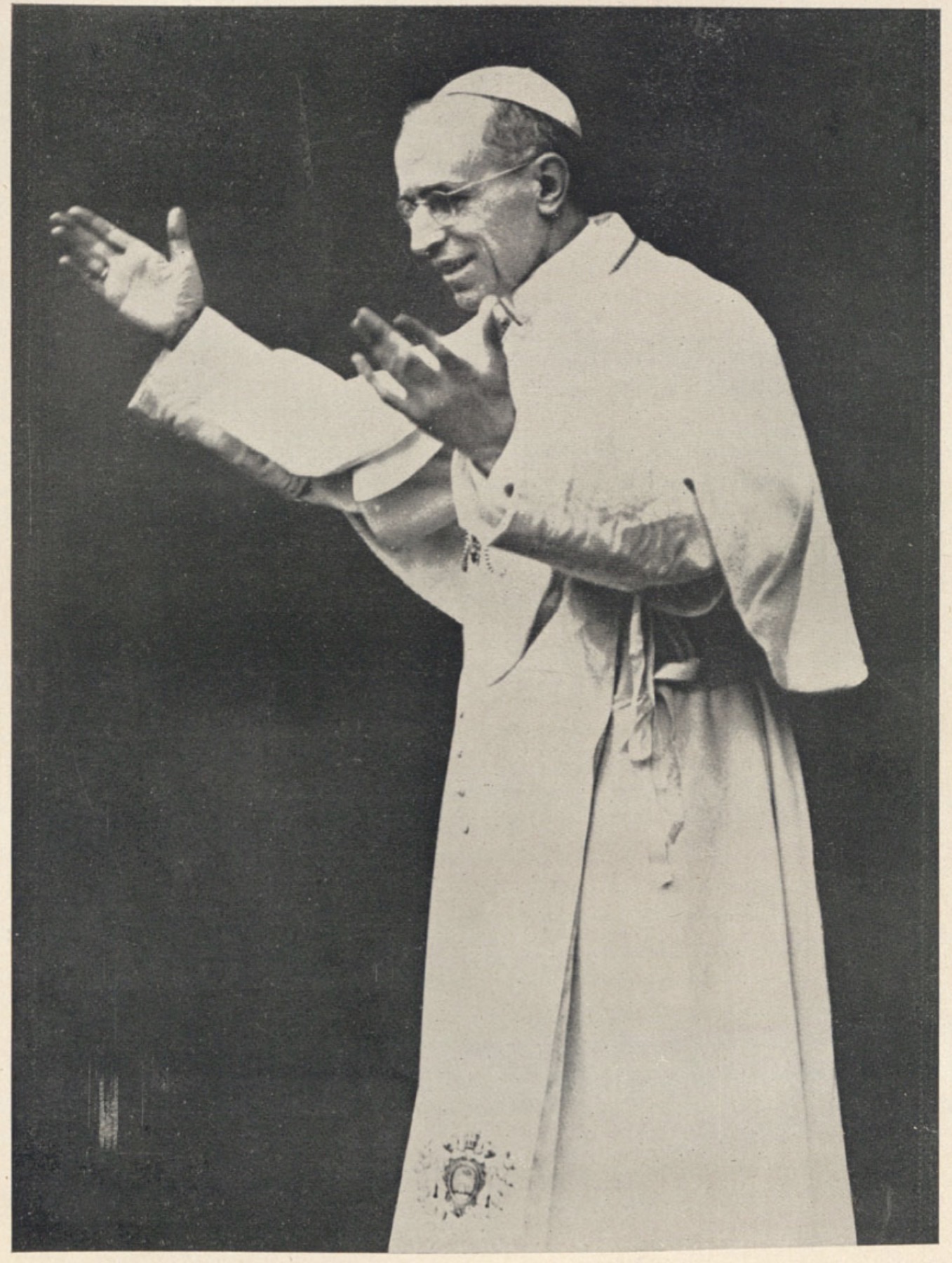
Pope Pius XII, who approved the restored Order of Holy Week on the recommendation of the Sacred Congregation of Rites in July 1955. Photo: public domain, via Wikimedia Commons.
Event 19 of 57
On 16 November 1955 the Sacred Congregation of Rites issued a general decree with a magnificent opening phrase: Maxima redemptionis nostrae mysteria, “the greatest mysteries of our Redemption.” It ran to a few pages. It was signed by Cardinal Gaetano Cicognani as Prefect and Archbishop Alfonso Carinci as Secretary, and it carried the express mandate of Pope Pius XII. From Palm Sunday, 25 March 1956, every priest of the Roman Rite was bound to celebrate Holy Week according to a new set of books. It was the first rewriting of the Missal’s rites on this scale since its promulgation in 1570. Clement VIII (1604), Urban VIII (1634) and Pius X had all revised the book, but none had reached so deeply into the rites of Holy Week.
Almost nobody at a traditional Latin Mass today has ever seen the Holy Week this decree replaced. That is the fact around which everything else in this article turns. The 1962 Missal (the book Benedict XVI designated in Summorum Pontificum, the book used in virtually every diocesan and institute apostolate in the world) contains Pius XII’s reformed Holy Week, not the older one. When a Catholic today attends a Latin Triduum, he is attending the reform, not the thing the reform replaced.
Nobody disputes that Pius XII had the authority to do this, or that the restored rites are valid and were licit. The dispute is narrower and more interesting: whether a small commission of experts, working in secret and under pressure, made good judgments about the Church’s oldest and most carefully guarded ceremonies, and whether the criteria they used in 1955 are the same criteria that produced 1969.
The Case for the Reform
The decree deserves to be read before it is criticised, because its stated reasons are strong and largely true. The rites of the Triduum, it observed, were originally celebrated “on the same days of the week and at the same hours of the day at which the sacred mysteries took place” the Supper on Thursday evening, the Passion on Friday afternoon, the vigil through Saturday night. By the end of the Middle Ages all of them had crept back into the morning, so that the Easter Vigil, “having been torn from its own place in the night hours, lost its innate clarity and the sense of its words and symbols.” A vigil sung at eight o’clock on Saturday morning, announcing a night that had not fallen, is a real incoherence, and the reformers were right to say so.
The second reason was pastoral and it was grave. In 1642 Urban VIII, in the Apostolic Constitution Universa per orbem, had been forced by changed social conditions to strike the Sacred Triduum from the list of holy days of obligation. Three centuries later the consequence was plain: the holiest ceremonies of the year were being sung on weekday mornings while the faithful were at work, at school, and at market. The decree’s own description of this is unsparing, and it is the single best argument the reform ever had.
Common and almost universal experience teaches that these liturgical services of the sacred triduum are often performed by the clergy with the body of the church nearly deserted.
— Sacred Congregation of Rites, Maxima redemptionis nostrae mysteria, 16 November 1955
So the decree moved the Mass of the Lord’s Supper to the evening (between five and eight o’clock), the Good Friday liturgy to about three in the afternoon, and the Easter Vigil to a time that would let its Mass begin around midnight. It extended the Lenten fast to midnight on Holy Saturday instead of releasing it at noon. And it restored Holy Communion for the faithful on Good Friday (“as was the custom for many centuries,” in the words of the accompanying Instruction) after some seven hundred years in which only the priest communicated. Bishops had petitioned for these things. The cardinals of the Congregation, meeting in extraordinary session at the Vatican on 19 July 1955, recommended the restored Order by unanimous vote. Pius XII approved it. On the clock alone, the reform has an excellent case.
A traditional Catholic who cannot say plainly that the Triduum belongs in the evening, that Good Friday Communion for the faithful was a genuine restoration, or that empty churches were a real emergency, is not arguing — he is posturing. The pre-1955 books are not defended by pretending the 1950s had no problems.
What Actually Changed
The trouble is that the reform did not stop at the clock. Under cover of a timetable, the ceremonies themselves were rewritten, and rewritten by the same commission, established in May 1948 under Cardinal Clemente Micara (from 1953, Cardinal Cicognani), whose members included Alfonso Carinci, Josef Löw, Anselmo Albareda, Augustin Bea, and, as its secretary, a young Vincentian named Annibale Bugnini.
On Palm Sunday the ancient blessing of palms (a complete “dry Mass” with its own lesson, gradual, gospel, Preface and Sanctus) was abolished and replaced with a short new rite performed at a table, the priest facing the people with his back to the altar. The Preface that proclaimed Christ’s dominion over “the kings and powers of this world” was suppressed as prolix. The folded chasubles and broad stole, among the oldest surviving vestments in the Roman Rite, were abolished. The rite in which the processional cross struck the closed doors of the church was deleted. And the first thirty-five verses of St. Matthew’s Passion, with the institution of the Eucharist, were cut, and its last six as well.
On Holy Thursday the Mandatum, the washing of feet, was moved from after Mass into the middle of Mass, inverting the order St. John gives (“the supper being ended”), and bringing laymen into the sanctuary during the sacred action. The Confiteor before the people’s Communion was dropped. The altar was stripped even of its cross.
On Good Friday the immemorial name “Mass of the Presanctified” was retired in favour of “Solemn Liturgical Action.” The celebrant was stripped of the chasuble for the first part of the rite and left in a stole, marking off a “liturgy of the word” from what followed. The Orate fratres and the other prayers naming the sacrifice were removed from the Communion rite. The commingling of a particle of the Host with the wine was abolished. The Blessed Sacrament, carried out in solemn procession the night before, was now fetched back by a deacon while the celebrant sat.
On Holy Saturday the changes were heaviest. The twelve prophecies of the Easter Vigil were cut to four. The tricereo, the triple reed whose three candles were lit one by one at the threefold Lumen Christi, was abolished, and with it the symbolism of the Resurrection kindled by the Trinity; the paschal candlesticks of Christendom, some of them ancient, became ornaments. The Exsultet was left singing of actions (the fixing of the incense grains, the lighting of the candle, the illumination of the church) that had all been performed half an hour earlier in the porch. The Litany of the Saints was cut in half, with the blessing of the font inserted into the gap. The baptismal font was replaced by a basin in the middle of the sanctuary. The “Renewal of Baptismal Promises”, composed for the experimental Vigil of 1951, became part of the rite, and with its introductory admonition it could now be said anywhere in an approved vernacular version. The prayers at the foot of the altar were suppressed from the Mass. And in the same decree, almost as an afterthought, the entire baptismal vigil of Pentecost was abolished, leaving its Mass praying over catechumens who no longer existed.
The Architects’ Own Words
What makes 1955 impossible to dismiss as traditionalist grievance is that its authors described it in exactly the terms their critics use. Fr. Carlo Braga (Bugnini’s closest collaborator, his “right arm” in Carusi’s phrase, and long the editor of Ephemerides Liturgicae) looked back on the reform of Holy Saturday and called it the head of the battering-ram that pierced the fortress of a static liturgy. He was not complaining. He was boasting.
❝The head of the battering-ram which pierced the fortress of our hitherto static liturgy.
— Fr. Carlo Braga, C.M., on the 1955 reform of Holy Saturday, Ecclesia Orans 23 (2006), tr. S. Carusi
Fr. Ferdinando Antonelli, O.F.M., a member of the same commission and a future cardinal, told the Assisi Congress in 1956 that it had been said, “and with reason,” that the reform of Holy Week constituted “the most important act in the history of the liturgy from St. Pius V to our day” (The Assisi Papers, 1957, p. 150). Braga, writing fifty years later, explained why it had been possible at all, and his explanation is a small masterpiece of the mentality at work: what could not be done under Pius V or Urban VIII “because of tradition, because of insufficient spiritual and theological formation, and because of a lack of acquaintance with the liturgical sources, was possible at the time of Pius XII.” Tradition, in that sentence, is not the foundation of reform. It is the obstacle to it.
The method matched the mentality. The commission worked in secret; when the experimental Easter Vigil was published on 1 March 1951, Bugnini himself records that it “caught even the officials of the Congregation of Rites by surprise” (The Reform of the Liturgy, p. 9). And Bugnini is also the source for how its results reached an ailing Pope: not through the Cardinal Prefect who presided over the commission, but through Msgr. Giovanni Battista Montini, the future Paul VI, and Fr. Bea, the Pope’s confessor.
The commission enjoyed the full confidence of the Pope, who was kept abreast of its work by Monsignor Montini and even more, on a weekly basis, by Father Bea, confessor of Pius XII. Thanks to them, the commission was able to achieve important results even during periods when the Pope’s illness kept everyone else from approaching him.
— Annibale Bugnini, C.M., The Reform of the Liturgy 1948–1975 (Liturgical Press, 1990), p. 9
This is a description of an ordinary, if unusual, channel of communication during a Pope’s illness, given by the man who used it. It is not evidence of deception, and honest critics do not treat it as such. Dr. Peter Kwasniewski, no friend of the reform, warns explicitly against exaggerating Bugnini’s role in the Pacellian years, noting that the reforms were carried by a number of like-minded men and that the young Bugnini was then “more of a fanboy and water-carrier for them than a sinister schemer.” The case against 1955 does not need a villain. It has minutes.
The Dissent That Was Not Heard
There was opposition, and it was competent. Msgr. Léon Gromier had been a papal master of ceremonies and a consultor to the Congregation of Rites, and he had written the standard commentary on the Caeremoniale Episcoporum. In July 1960, in a conference in Paris, he took the restored Holy Week apart point by point, with the exasperation of a man who knew the rubrics better than their reformers. Of the new Renewal of Baptismal Promises he said it was “a massive para-liturgy, a purely pastoral creation and un-liturgical, an occasion to insert the vernacular into the liturgy,” and added, drily, that on the same logic “they could go on to renew marriage vows for people at a wedding.” Of the basin in the sanctuary and the carrying of the water back to an abandoned font, he wrote that it was “an insult to history, to discipline, to the liturgy and common sense” a procession accompanied by “the song of a thirsty deer, which has already drunk, and which is going towards a dry font.”
Requests to keep the old rites began arriving almost at once and multiplied; they were refused, though the traditional Holy Week was in fact retained in the Holy Land until the year 2000. Gromier was heard politely and ignored. In the climate of the 1950s, a liturgist who dissented from the liturgical movement was simply out of step.
Why This Is the Hinge of the Whole Timeline
There is one quotation that settles the question of what 1955 was, and it comes from the highest possible authority on the matter: the Pope who promulgated the new Mass. In the Apostolic Constitution by which he issued the Missal of 1969, Paul VI reached back fourteen years to name where the work had begun.
The beginning of this renewal was the work of Our predecessor, this same Pius XII, in the restoration of the Paschal Vigil and of the Holy Week Rite, which formed the first stage of updating the Roman Missal for the present-day mentality.
— Pope Paul VI, Apostolic Constitution Missale Romanum, 3 April 1969
“The first stage.” Not a precedent claimed after the fact by hostile critics, but the reformer’s own account of his own lineage. This is why the timeline places 1955 where it does. The common story (that the liturgy was serene until the Council, when a committee broke it) does not survive contact with the documents. The commission, the method, the criteria, several of the personnel, and the papal warrant were all in place in 1948, running by 1951, and universal by 1956. Dr. Kwasniewski compresses the whole arc into a line: “Pius X reordered part of the Roman rite’s prayer; Pius XII refashioned the heart of the Roman rite’s year; Paul VI replaced the entire Roman rite with a modern rite.”
The Strange Afterlife of 1955
Then comes the twist that almost nobody expects. Many of the 1955 novelties did not survive the reform they had begun. When Paul VI’s Missal appeared in 1969, it quietly reversed them, and in several places it reverted to the practice of the books Pius XII had replaced. The Good Friday celebrant wears the chasuble again for the whole rite. Palm Sunday is celebrated in a single colour. The concluding prayer invented for the 1955 procession was deleted. The Agnus Dei on Holy Thursday got its dona nobis pacem back. The paschal candle was restored to a candelabrum magnum instead of a bracket in the middle of the sanctuary. The Easter Vigil went from four prophecies to seven, three of them, the sacrifice of Isaac among them, recovered from the pre-1955 Missal.
The consequence is genuinely odd, and it is the strongest single argument for the recovery movement: on a series of specific points, the Holy Week bound into the 1962 books is more novel than the Holy Week of the Novus Ordo. Gregory DiPippo, who has catalogued the changes more thoroughly than anyone writing in English, sorts them into three categories, outright novelties without precedent; partial restorations grafted on in ways foreign to the tradition; and authentic restorations of things that had genuinely been lost. His verdict on the third category is one sentence long.
❝The third category consists of authentic restorations of this very kind, the return to traditional customs which through whatever accidents of history, fell out of use, and were brought back by the reform of 1955. This category is empty.
— Gregory DiPippo, New Liturgical Movement, March 2023
The Recovery
For half a century the older Holy Week survived only in memory, in a handful of chapels, and in the Holy Land. That has changed. In 2018 the Pontifical Commission Ecclesia Dei granted the Priestly Fraternity of St. Peter, the Institute of Christ the King and a few other societies permission to use the pre-1955 books for Holy Week, on an experimental and time-limited basis, with the pastoral compromise that they use Benedict XVI’s 2008 form of the Good Friday prayer for the Jews. By 2021 no renewal was issued, not, as far as anyone could tell, because it had been refused, but because Rome had stopped micromanaging the question, while pre-1955 ceremonies were being sung by bishops and cardinals a few streets from the Vatican.
Since then the recovery has become a small movement with its own scholarship and its own infrastructure: Dr. Kwasniewski’s The Once and Future Roman Rite (2022), which argues the case at book length; the resource project Restore the ’54, which exists “to promote the integrity of the Classical Roman Rite, the Usus Antiquior” and puts the old ordos, chants and ceremonial guides into any pastor’s hands; the parallel Pre-1955 Holy Week Resources; and, at the popular level, the Mass of the Ages films, which carried the story of how the modern rite was made to an audience of millions. Under Pope Leo XIV, elected in May 2025, Traditionis Custodes stands; as of September 2026 he has issued no act changing it.
The argument here is not that Pius XII sinned, nor that his rites are invalid, nor that Catholics attending the 1962 Triduum are doing something wrong. It is that a reform whose universal life lasted fourteen years, many of whose innovations its own successors discarded, has no obvious claim to bind the Church’s memory forever, and that what it displaced was old enough, and good enough, to be worth having back. Fr. Carusi, the reform’s most detailed critic, states the boundary himself: nothing here suggests “that these rites lack the requisite orthodoxy.”
The men who made the reform of 1955 believed they were serving the faithful, and in the matter of the clock they were. But they also believed, and wrote down, that the accumulated tradition of the Roman Rite was chiefly an obstacle to be got past, and that a commission of scholars in one decade could improve on what fifteen centuries of Christian prayer had produced. That conviction did not stop at Holy Week. It had another fourteen years to run.
The book traditionalists defend is itself a reformed book. Any case resting on unbroken tradition has to say why the line falls at 1962 rather than 1954 – and the honest answer is available, but it has to be given. Did the New Mass Empty the Pews? →
- Palm Sunday The blessing of palms as a “dry Mass” with its own Preface and Sanctus; the folded chasubles and broad stole; the cross striking the church doors; the first thirty-five verses of St. Matthew’s Passion, and its last six.
- Holy Thursday The Mandatum after Mass, in the Gospel’s own order; the Confiteor before Communion; the cross left on the stripped altar.
- Good Friday The name “Mass of the Presanctified”; the chasuble for the whole rite; the prayers naming the sacrifice; the commingling; the incensing of the Host.
- Holy Saturday Eight of the twelve prophecies; the triple reed and the threefold Lumen Christi; the Exsultet sung with the actions it describes; the unbroken Litany; the baptismal font; the prayers at the foot of the altar.
- Pentecost The entire baptismal vigil, abolished in the same decree.
- The hours The Supper in the evening, the Passion in the afternoon, the Vigil at night, an authentic and ancient custom, and a real correction.
- Good Friday Communion Restored to the faithful after some seven centuries in which only the celebrant communicated.
- The fast Extended from noon to midnight on Holy Saturday, matching the day’s restored character as one of mourning.
- Attendance The decree’s central pastoral aim (ceremonies the faithful could actually attend) was met, and no honest critic denies it.
- Sacred Congregation of Rites, general decree Maxima redemptionis nostrae mysteria, 16 November 1955, AAS 47 (1955) 838–847, with the accompanying Instruction
- Sacred Congregation of Rites, decree Dominicae Resurrectionis vigiliam, 9 February 1951 — AAS 43 (1951) 128ff.
- Pope Urban VIII, Apostolic Constitution Universa per orbem, 24 September 1642
- Pope Paul VI, Apostolic Constitution Missale Romanum, 3 April 1969 (vatican.va)
- Annibale Bugnini, C.M., The Reform of the Liturgy 1948–1975 (Collegeville: Liturgical Press, 1990; Italian original, Rome, 1983)
- Carlo Braga, C.M., “Maxima Redemptionis Nostrae Mysteria: 50 anni dopo (1955–2005),” Ecclesia Orans 23 (2006)
- Ferdinando Antonelli, O.F.M., “La riforma liturgica della Settimana Santa,” in La Restaurazione liturgica nell’opera di Pio XII (Assisi–Rome congress, 1956; Genoa, 1957)
- Nicola Giampietro, Il Card. Ferdinando Antonelli e gli sviluppi della riforma liturgica dal 1948 al 1970, and “A cinquant’anni dalla riforma liturgica della Settimana Santa,” Ephemerides Liturgicae 120 (2006)
- Léon Gromier, “Semaine Sainte Restaurée,” conference, Paris, July 1960; published Opus Dei 2 (1962) 76–90
- Stefano Carusi, “The Reform of Holy Week in the Years 1951–1956,” Disputationes Theologicae; English translation, Rorate Caeli, 2010
- Gregory DiPippo, “Compendium of the 1955 Holy Week Revisions of Pius XII,” New Liturgical Movement, Parts 1–9 (2009) and Conclusion (2023)
- Alcuin Reid, “Holy Week Reforms Revisited,” in Liturgy in the Twenty-First Century (London/New York: Bloomsbury, 2016), 234–59
- Peter Kwasniewski, The Once and Future Roman Rite (TAN Books, 2022); and “Ending Seventy Years of Liturgical Exile,” New Liturgical Movement, April 2021