Chartres: 19,000 Pilgrims
Each Pentecost a river of mostly young Catholics walks the hundred kilometers from Paris to Chartres for the traditional Latin Mass — and at the very moment Rome tightens its rules, the numbers keep breaking records, a living sign that the old rite is drawing the young.
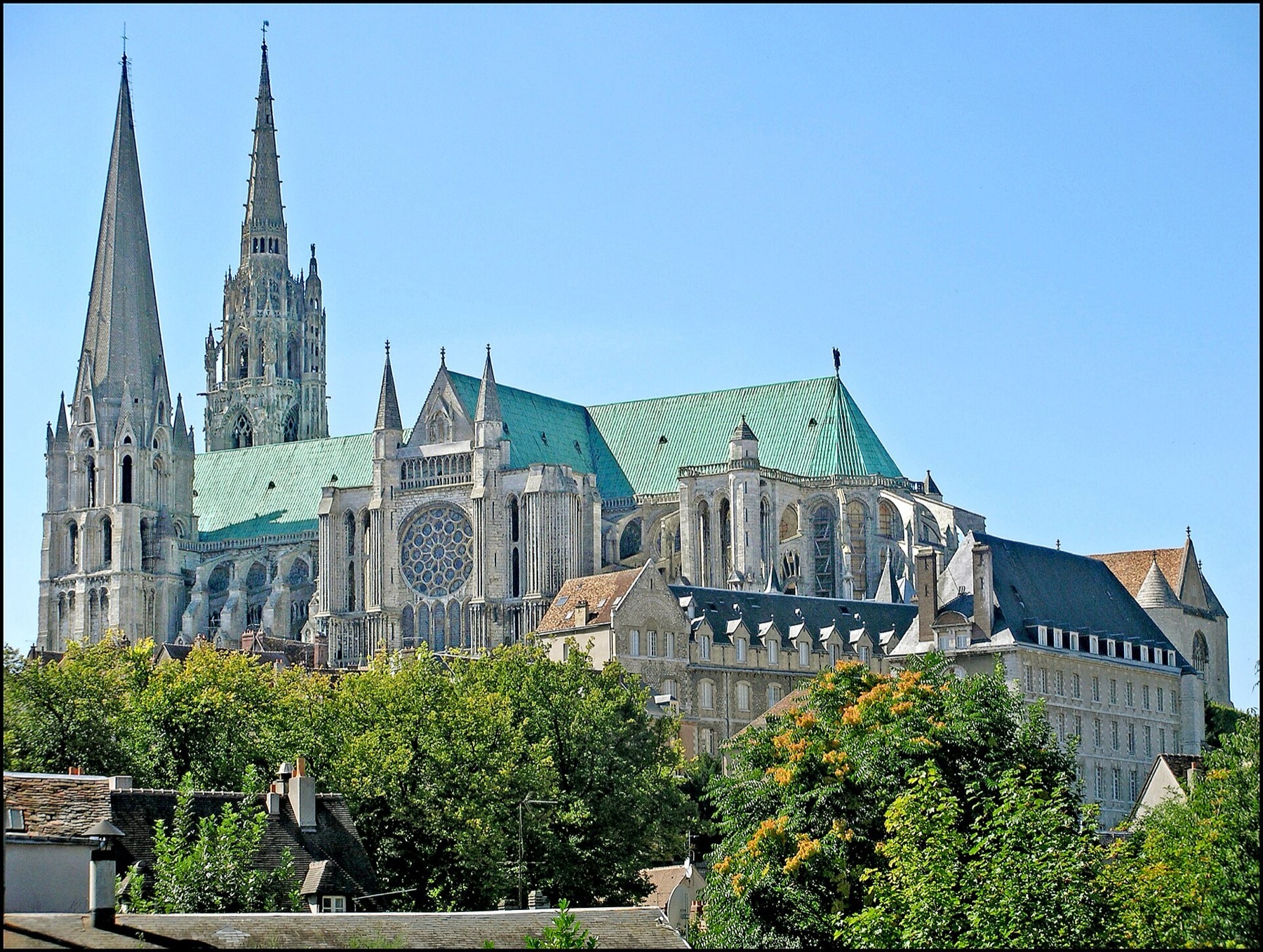
Banners and chapters of the annual Pèlerinage de Chrétienté stream across the fields of the Beauce toward the spires of Chartres cathedral. Organized by Notre-Dame de Chrétienté and centered on the traditional Latin Mass, the three-day Pentecost walk from Paris drew record numbers — roughly 18,000 in 2024 and more than 19,000 registered in 2025 — with an average age around twenty. Photo: MathKnight and Honge, CC BY-SA 3.0, via Wikimedia Commons.
Event 55 of 57
Every year, on the Saturday before Pentecost, a great procession sets out at dawn from the heart of Paris and walks south. For three days, in heat and rain, columns of pilgrims grouped into “chapters” (each with its own banner, songs, and chaplain) cover roughly a hundred kilometers of road and field until, on the far horizon, the twin spires of Chartres cathedral rise out of the wheat. This is the Pèlerinage de Chrétienté, the Paris-to-Chartres pilgrimage, organized since 1991 by the association Notre-Dame de Chrétienté and built entirely around the traditional Latin Mass. And in the 2020s it has become the most striking paradox in the whole story of the liturgical struggle: at the very hour Rome moved to restrict the old rite, the old rite drew the young in record-breaking numbers.
A Rising Tide of the Young
The growth has been steep and steady. Where earlier years counted in the thousands, the pilgrimage of 2023 gathered some sixteen thousand walkers. In 2024 it swelled to roughly eighteen thousand: registration filled so quickly that organizers had to cap it and turn latecomers away. In 2025 more than nineteen thousand registered, the rolls closing within days, with a reported waiting list of some two thousand more who could not be accommodated. Most remarkable of all is the age of the crowd. Reporters who have walked the route describe a sea of students and young families; organizers and Catholic press place the average age at around twenty. This is not a museum-piece kept alive by nostalgia. It is a youth movement on foot.
Numbers can mislead, and these come from the organizers and the Catholic and French press rather than from any independent census; they should be read as reported figures, not audited ones. But the trend is unmistakable and widely confirmed: a pilgrimage devoted to the older form of the Mass is among the fastest-growing acts of public Catholic piety in secular, dechristianized France. The contrast with the surrounding culture, and with the official anxieties about the traditional rite, could hardly be sharper.
Here is the heart of the matter. Traditionis Custodes (2021) restricted the traditional Latin Mass on the stated worry that attachment to it threatened the unity of the Church and fed a spirit of rejection. Yet the Chartres pilgrimage shows tens of thousands of mostly young Catholics embracing that very rite — not in a bunker, not in schism, but joyfully, publicly, on the open road, singing and praying their way to a cathedral. Whatever one concludes about the prudence of the restrictions, the bare fact remains: the form Rome has moved to limit is the one visibly drawing the next generation.
Under the Vatican’s Eye
That paradox did not go unnoticed in Rome. In December 2024 the French daily La Croix reported that the pilgrimage had come under review by the Dicastery for Divine Worship and the Discipline of the Sacraments, led by Cardinal Arthur Roche. The concern, as relayed in the reporting, was that the celebrations along the route did not fully conform to the norms in force for the older rite under Traditionis Custodes, and there was discussion of whether certain Masses, including in cathedrals, might be limited. The principle the dicastery underscored was a jurisdictional one: an association may organize a pilgrimage, but authority over the liturgy belongs to the bishops of the dioceses the route crosses, and ultimately to the Holy See.
If anyone is to decide anything, it is the pope.
— quoted by the National Catholic Register, on the 2025 pilgrimage
The local bishop’s response was a study in communion under strain. Bishop Philippe Christory of Chartres did not forbid the pilgrimage or shut his cathedral against it. He asked the organizers to make room for the celebration of Mass in the current rite within his diocese as well, authorized the older form for confessions, and, far from distancing himself, confirmed that he would preside and preach at the closing solemn Mass, which in 2025 fell within the celebrations of the cathedral’s millennium jubilee. It was an arrangement that honored both the law of the Church and the devotion of the pilgrims: the bishop present, the Mass celebrated, the young welcomed.
It would be a grave misreading to cast Chartres as a march against the Pope. The organizers and chaplains are emphatic on this point, and so are the pilgrims’ own banners and prayers: they walk for something, not against someone. They pray for the Holy Father by name. The pilgrimage is an act of love for the liturgy and for the Church, offered in communion, penance, conversion, the rosary, the Mass. As the prior of one walking fraternity put it, “The real question is not how many of us are walking the road to Chartres, but how many of us will be truly converted at the end.” That is the spirit of the thing: not defiance, but discipleship.
The New Liturgical Movement, On the Road
When Pope Benedict XVI freed the older Mass with Summorum Pontificum in 2007, he wrote of his hope that the two forms of the Roman Rite might enrich one another, and he spoke often of a needed renewal he and others called a “new liturgical movement” a recovery of reverence, beauty, and the sense of the sacred. Chartres is that hope made visible. The crowds walking the Beauce are not theorists; they are the movement’s living evidence. Many in those columns were not yet born when the reforms were enacted; for them the traditional Mass is not a memory to defend but a discovery to make.
What Chartres witnesses, finally, is hope. It is easy, reading a timeline of suppressions and indults and motu proprios, to feel that the story of the traditional Mass is a long retreat. The pilgrims who reach the cathedral each Pentecost (footsore, sunburned, singing the Salve Regina beneath the great windows) tell a different story. The rite that some feared was a relic is, in their hands, a seed. And the question they leave with the whole Church is the gentle, searching one their own chaplains keep asking: not how many walked, but how many were converted, and what the Church will do with so many young hearts who have fallen in love with her oldest prayer.
Events That Led Here
Where It Led
- “Record 19,000 young Catholics to walk Paris-Chartres pilgrimage amid Vatican scrutiny,” Catholic World Report / CNA (5 June 2025): 19,000+ registered (filled in five days), ~18,000 in 2024, 16,000 in 2023, average age 20; Dicastery for Divine Worship review under Cardinal Roche; La Croix Dec. 2024 report; Bishop Christory’s arrangements and millennium-jubilee closing Mass; Philippe Darantière quote
- “The Chartres Pilgrimage Continues to Grow Amid Liturgical Tensions,” National Catholic Register (2025), growth figures, average age ~20, “if anyone is to decide anything, it is the pope” (Bishop Christory), request to allow current-rite Mass in the diocese
- “Record Attendance at the Chartres Pilgrimage: What’s Next?,” The European Conservative (2024): ~18,000 pilgrims, ~100 km over three days, registration fully booked and capped, “ever younger” crowds, Br. Augustin-Marie conversion quote
- “Attack on Chartres: Full Text of the Letter of Bishops of France … on Traditional Pilgrimages” and related coverage, Rorate Caeli (2024–2025), on the dicastery’s jurisdictional norms (organizers have no authority over the liturgy; permission belongs to the diocesan bishops)
- Notre-Dame de Chrétienté, “The Pilgrimage” (nd-chretiente.com), route from Notre-Dame de Paris to Notre-Dame de Chartres, ~100 km, three days over Pentecost weekend, chapter structure