The Trattoria Canon: Eucharistic Prayer II
A consultor of the Consilium left a candid account of how the Church’s second Eucharistic Prayer was finished — over an evening, against a next-morning deadline, at a bistro in Trastevere.
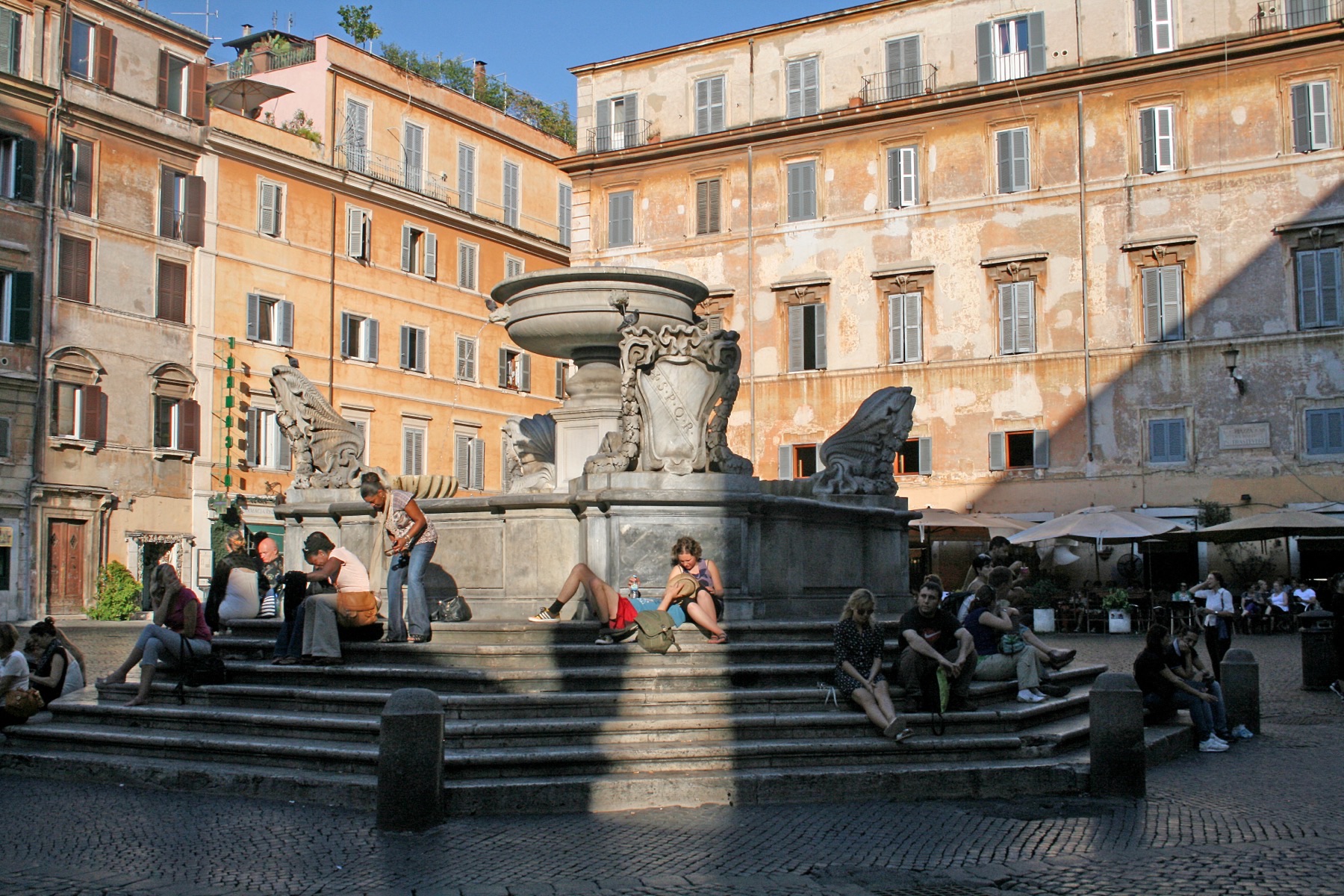
A trattoria terrace in the Trastevere quarter of Rome. Here, by his own account, Louis Bouyer and the Benedictine liturgist Bernard Botte worked to finish the text of a new Eucharistic Prayer against a deadline that fell the very next morning. Photo: Jean-Pol GRANDMONT, CC BY 4.0, via Wikimedia Commons.
Event 34 of 57
For fifteen centuries the Roman Rite had prayed a single great Eucharistic Prayer at the heart of the Mass, the venerable Roman Canon, the Canon Missae, prayed in substantially the same words from the early Middle Ages to the threshold of the Second Vatican Council. The Consilium charged with carrying out the Council’s reform did not abolish it. But it set three new Eucharistic Prayers alongside it, and one of them, Eucharistic Prayer II, would in time become, by wide report, the most frequently heard of them all. The story of how that prayer was finished is not a slander invented by the rite’s opponents. It was recorded, candidly and ruefully, by one of the men who wrote it.
What Eucharistic Prayer II Actually Is
First, a correction that must be made carefully, because the point is abused in both directions. Eucharistic Prayer II is not simply “the anaphora of Hippolytus” lifted out of antiquity and dropped into the modern Missal. It was inspired by and adapted from an ancient Eucharistic prayer found in the Apostolic Tradition, a church order long attributed to Hippolytus of Rome around the year 215. But the attribution itself is now doubted by scholars, and so is the text’s Roman origin; and the prayer the Consilium produced is a genuinely new composition, substantially reordered and rewritten, that took the ancient anaphora as its point of departure, not a verbatim reproduction of it.
The accurate statement is the modest one. Critics sometimes say the reformers simply “revived a third-century prayer”; defenders sometimes say the same in praise. Both overstate it. Eucharistic Prayer II is a new composition that reached back to the so-called Hippolytan anaphora for its shape and some of its language — and the antiquity it reached for is itself contested. The reform reconstructed; it did not merely restore.
The reformers added a Sanctus the ancient text did not have, supplied an intercession, and reworked the structure to suit the post-conciliar Order of Mass. To call the result “the prayer of Hippolytus” flatters the antiquarian claim while obscuring the editorial hand. What was placed in the Missal was new work, built on an old and contested foundation.
The Evening in Trastevere
And the new prayer’s making was as hurried as it was learned. The source for that is not rumor; it is the published memoir of Louis Bouyer, the Oratorian theologian who served as a consultor to the Consilium and helped draft the text. Bouyer was no traditionalist firebrand. He was a distinguished member of the legitimate Liturgical Movement who had hoped for genuine renewal, and his disillusionment is among the most credible testimonies we possess, precisely because of where he sat. In his Memoirs, written before his death in 2004 and published in 2014, he describes being charged, together with the Benedictine liturgist Dom Bernard Botte, with patching the text into final shape under brutal time pressure, with everything due the following morning.
Dom Botte and I were charged with patching up the text so as to introduce these elements, which are certainly very ancient … in time for the very next morning! … I can never reread this weird composition without recalling the terrace of the bistro in the Trastevere where we had to work carefully at our allotted drudgery, so as to be in a position to present ourselves, with it in our hands, at the Bronze Gate at the time fixed by our bosses.
— Louis Bouyer, The Memoirs of Louis Bouyer (French ed., Mémoires, Cerf, 2014), on the finishing of Eucharistic Prayer II, tr. John Hunwicke
Read it carefully, because it is easy to inflate. Bouyer and Botte were correcting and finishing an existing draft (“patching up the text,” introducing elements he calls “certainly very ancient”), not inventing a Eucharistic Prayer from nothing in a single sitting. The bistro terrace in Trastevere is real; the next-morning deadline is real; the rue and the haste are real, in a participant’s own hand. What is not in Bouyer’s account is the popular legend.
You will hear that Eucharistic Prayer II was “written on a napkin in a single hour.” That garbled claim is a later exaggeration, and it should be dropped. The verified record is more sober and, frankly, sobering enough: Bouyer says he and Botte finished and corrected the prayer over an evening at a Trastevere trattoria against a deadline the next morning, and that, by his telling, some “archaeologising” members had wanted Hippolytus’s prayer adopted just as it was, without even the Sanctus or the intercessions. Do not trade the documented account for the myth; the documented account is the stronger indictment of the method.
Why the Haste Troubles Critics
The trattoria evening is so often retold not because Catholics enjoy embarrassing the Missal, but because it is a small, vivid window onto the whole enterprise. A rite of immense antiquity was being substantially rebuilt in less than ten years, study group by study group, each expert reworking its assigned portion. Bouyer’s memory captures what that felt like from the inside: serious scholars, real learning, genuine reach toward the early Church, and yet a finished Eucharistic Prayer carried to the Bronze Gate still warm from a restaurant table, against the clock, “at the time fixed by our bosses.”
The legitimate worry is not that a hurried prayer must be a bad prayer. It is that the gravest words the Church ever speaks (the words of the Eucharistic action itself) were composed and finalized under a pressure no fifteen-century inheritance had ever known. Organic growth gives a rite the test of generations; manufacture by deadline does not. That is the danger Pius XII had named in Mediator Dei and that Sacrosanctum Concilium had tried to forbid: that changes should grow organically from forms already existing, and only where the genuine good of the Church required them.
A Valid Prayer of the Church
None of this touches validity, and it must not be made to. Eucharistic Prayer II is a true and valid Eucharistic Prayer of the Catholic Church, lawfully promulgated, containing the words of institution and a true sacrifice. To pray it is to offer the Mass; the consecration it effects is the Body and Blood of the Lord. A Catholic in communion with Rome owes that affirmation without hedging, and this timeline makes it plainly.
The Church may take a prayer made in haste and make of it a vessel of the Holy Mysteries; grace is not hostage to the circumstances of an editorial deadline. The faithful Catholic can therefore hold two truths at once: that Eucharistic Prayer II is a valid and licit prayer of the Church, to be reverenced wherever it is offered, and that the manner of its making, recorded by one of its own authors, is a fair object of sober criticism. To criticize the prudence and method of a reform is not to deny the validity of its fruit.
So the story is neither the triumphant “return to the third century” some defenders claim, nor the cartoon “napkin in an hour” some critics repeat. It is something more honest and more unsettling: a genuinely new prayer, built on a contested antiquity, finished by learned men over an evening in Trastevere with the dawn deadline pressing, and now, on most days in most parishes of the Roman Rite, by wide report, the prayer the Church most often prays.
Events That Led Here
- Louis Bouyer, Mémoires (Éditions du Cerf, 2014), the Eucharistic Prayer II passage as translated by Fr John Hunwicke (reproduced at wdtprs.com, April 2015); English edition, The Memoirs of Louis Bouyer (Angelico Press, 2015)
- Domus Dei, The Consilium and the New Mass
- Apostolic Tradition (attributed to Hippolytus of Rome, c. 215), attribution and Roman origin disputed in modern scholarship
- Pius XII, Mediator Dei (Encyclical, 1947); Sacrosanctum Concilium (Second Vatican Council, 1963)
- Bernard Botte, From Silence to Participation: An Insider’s View of Liturgical Renewal (1988)